A responsibility center is a part, segment, or subunit of an organization whose manager
is accountable for a specified set of activities.
Negotiated transfer prices are often employed when market prices are stable.
Period costs are included in the cost of goods sold.
ABC systems provide greater insight than traditional systems into the management of
indirect costs.
Budgetary slack results because management sets challenging but achievable levels of
expected performance.
Post-investment audits prevent managers from overstating the expected cash inflows
from projects and accepting projects they should reject.
When administered wisely, budgets promote communication and coordination among
the various subunits of the organization.
Once a cost pool has been established, it should NOT need to be revisited or revised.
A non-value-added cost is a cost that, if eliminated, would reduce the actual or
perceived value or utility (usefulness) customers experience from using the product or
service.
Most ethical issues related to budgetary decisions are clear cut because at no point
should pressure for performance influence budgetary decisions.
Supervision costs can have both value-added and non-value-added components.
As per IMA statement of ethical professional practice, integrity refers to disclosing all
relevant information that could reasonably be expected to influence an intended user’s
understanding of the reports, analyses, or recommendations is a responsibility.
The dependent variable is a cost to be predicted and managed, whereas an independent
variable or cost driver is the factor used to predict the dependent variable.
Tax deductions for depreciation result in tax savings that partially offset the cost of
acquiring the capital asset.
Companies that adopt the EVA concept define investment as total assets employed
minus current liabilities.
Management accountants might provide information on decisions on whether to buy a
product from outside or manufacture it in-house.
When actual production is below practical capacity, there will be unused-capacity cost
only in the manufacturing function while unused capacity is not a factor in
nonmanufacturing links of the value chair such as in the marketing function.
The market-share variance is the difference in actual contribution margin for actual
market size in units caused solely by actual market share being different from budgeted
market share.
Product-cost cross-subsidization is very common when costs are uniformly spread
across various products.
A learning curve is a function that measures how labor-hours per unit decrease, as units
of production decrease.
Companies that have low manufacturing lead time usually find that a version of
backflush costing will report cost numbers totally different to what a sequential costing
approach would report.
To smooth fluctuating levels of output, separate indirect-cost rates should be calculated
for each month.
Cost-based transfer prices are helpful when markets are not perfectly competitive.
In linear programming, a constraint is a mathematical inequality or equality that must
be satisfied by the
variables in a mathematical model.
In a revenue center, a manager is responsible for investments, revenues, and costs.
For management accounting, internal measurement and reporting are based on
cost-benefit analysis.
Spoilage is typically assumed to occur at the stage of completion where inspection takes
place.
Bid prices and costs that are relevant for regular orders are the same costs that are
relevant for one-time-only special orders.
A firm using a backflush costing system will always use actual costs rather than
standard costs.
Long-run pricing is an operational decision and not a strategic decision as perceived by
many.
Absorption costing is also referred to as super-variable costing.
The management accounting system is an informal management control system which
provide information about the firm’s costs, revenues, and income.
Revenues that remain the same for two alternatives being examined are relevant
revenues.
Possible operational causes of an unfavorable direct materials efficiency variance
include poor design of products or processes.
Since costs that are inventoried are not expensed until the units associated with them
are sold, a manager can produce more units than are expected to be sold in a period
without reducing a firm’s net income.
Rework is finished production that is NOT in accordance with customer desires. The
product is redone and sold as finished goods.
Value engineering seeks to reduce value-added costs as well as nonvalue-added costs.
Answer the following question using the information below:
Jason Novelty Company produces a specialty item. Management has provided the
following information:
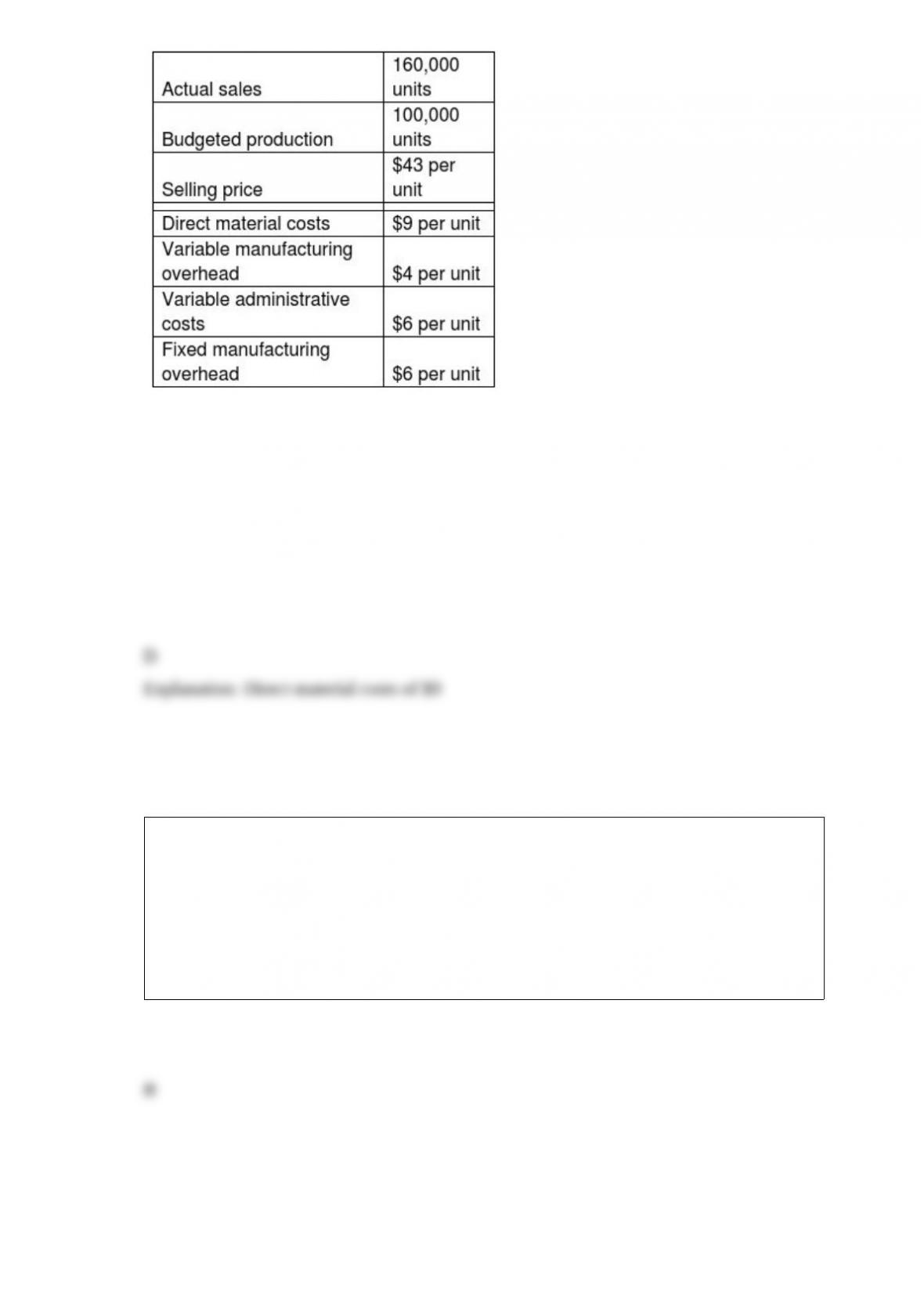
What is the cost per unit if throughput costing is used?
A) $25
B) $13
C) $19
D) $9
Financial accounting ________.
A) focuses on the future and includes activities such as preparing next year’s operating
budget
B) must comply with GAAP (generally accepted accounting principles)
C) is the process of measuring, analyzing, and reporting financial and nonfinancial
information related to the costs of acquiring or using resources in an organization
D) is prepared for the use of department heads and other employees

An incremental cost is
A) an additional total cost for an activity
B) a cost that has already been incurred
C) the difference in total costs between two alternatives
D) always related to fixed costs
Post-investment audits ________.
A) result in managers to overstate the expected cash inflows from projects and accept
projects they should reject
B) provide management with feedback about the performance of a project
C) include obtaining appropriation requests so that the funding will be authorized to
purchase the equipment
D) are usually not feasible in a large project because the cost accounting system does
not collect actual costs at the same level of detail as the initial plans had
The capital budgeting method that calculates the discount rate at which the present
value of expected cash inflows from a project equals the present value of expected cash
outflows is the ________.
A) net present value method
B) accrual accounting rate-of-return method
C) payback method
D) internal rate of return method
Which of the following costs is inventoried when using variable costing?
A) rent on factory building
B) electricity consumed in manufacturing process
C) sales commission paid on each sale
D) advertising costs incurred for the product
Lewis S. Gray Inc. manufactures a part for use in its production of art deco furniture.
When 10,000 items are produced, the costs per unit are:
Direct materials $ 15
Direct manufacturing labor 60
Variable manufacturing overhead 25
Fixed manufacturing overhead 32
Total $132
Colonial Accents Company has offered to sell to Lewis S. Gray 10,000 units of the part
for $125 per unit. The plant facilities could be used to manufacture another part at a
savings of $180,000 if Lewis S. Gray accepts the supplier’s offer. In addition, $30 per
unit of fixed manufacturing overhead on the original part would be eliminated.
Required:
a. What is the relevant per unit cost for the original part?
b. Which alternative is best for Lewis S. Gray Company? By how much?
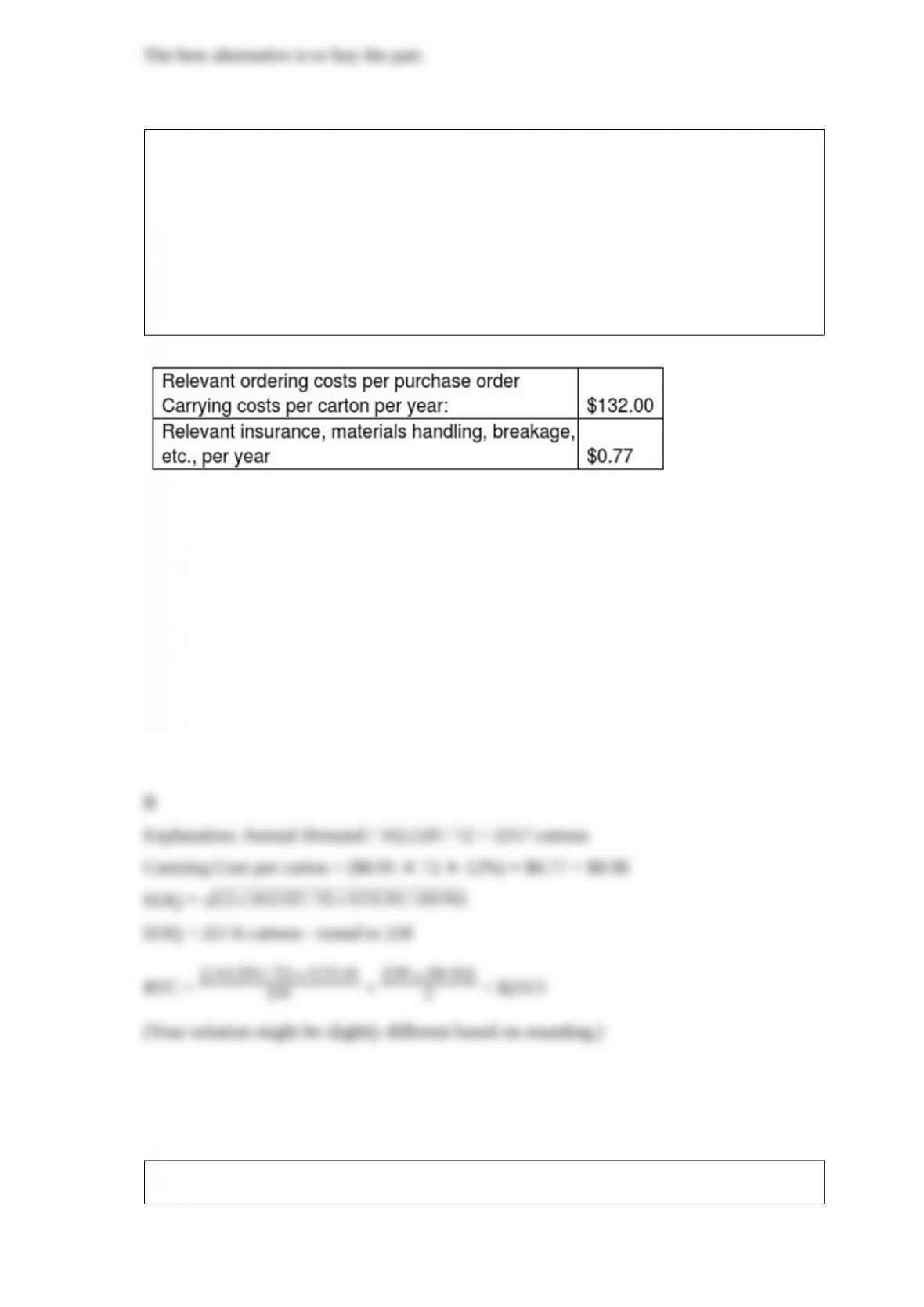
Short Grass Incorporated is a distributor of golf balls. Martin’s Golf Supplies is a local
retail outlet which sells golf balls. Martin’s purchases the golf balls from Short Grass
Incorporated at $0.95 per ball; the golf balls are shipped in cartons of 72. Short Grass
Incorporated pays all incoming freight, and Martin’s Golf Supplies does not inspect the
balls due to Short Grass’ reputation for high quality. Annual demand is 162,520 golf
balls at a rate of 3591 balls per week. Martin’s Golf Supplies earns 12% on its cash
investments. The purchase-order lead time is one week. The following cost data are
available:
Purchasing at the EOQ recommended level, what are the relevant total costs? (Round costs
to the nearest cent and quantities to the nearest whole number. Your answer might be
slightly different from the best answer due to rounding.)
A) $1584
B) $2313
C) $1157
D) $3168
Assume the following cost information for Fernandez Company:
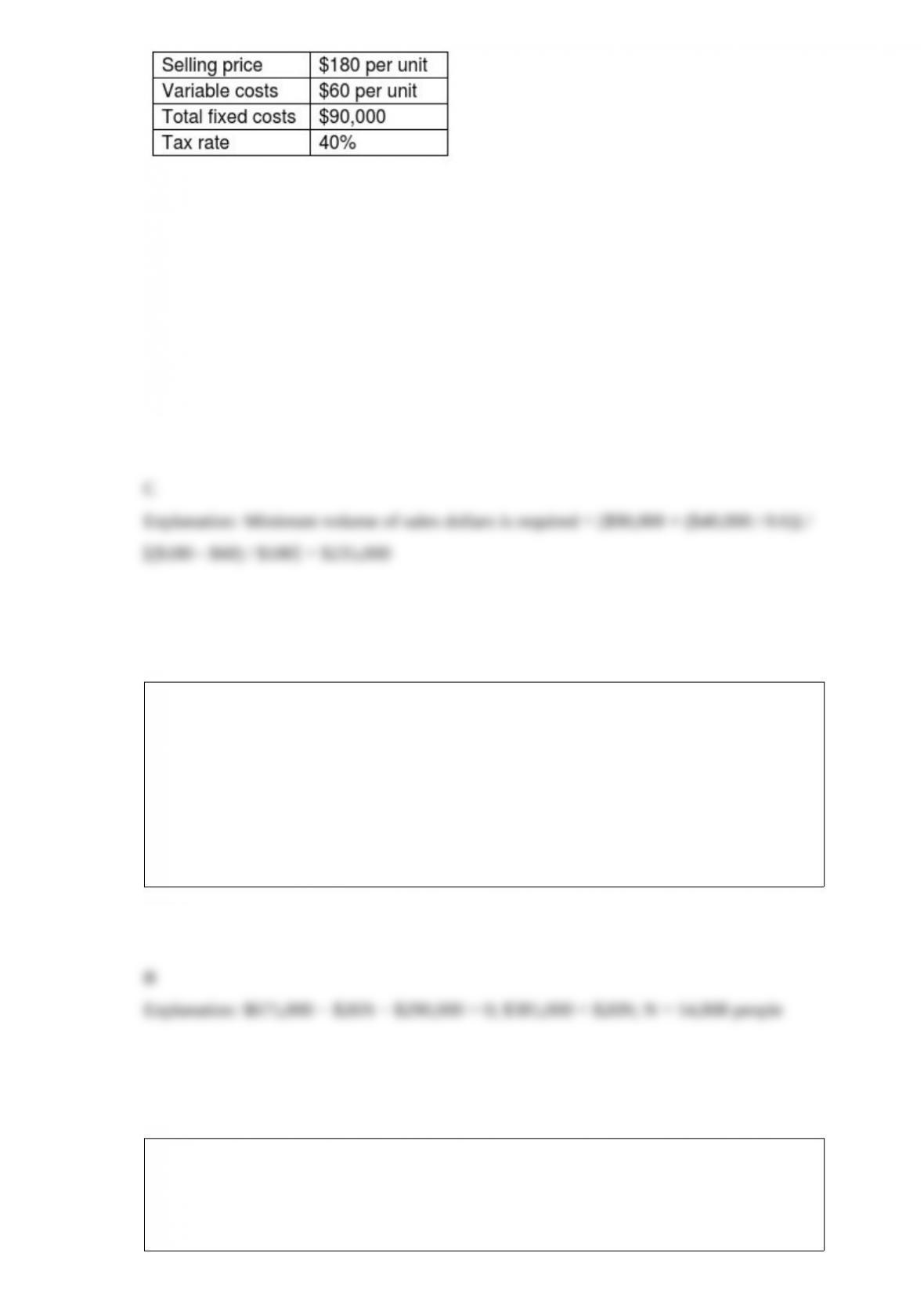
What minimum volume of sales dollars is required to earn an after-tax net income of
$40,000? (Do not round interim calculations and round the final answer to the nearest
dollar.)
A) $135,000
B) $100,000
C) $235,000
D) $225,000
Helping Hands is a nonprofit organization that supplies electric fans during summer for
individuals in need. Fixed costs are $290,000. The fans cost $26 each. The organization
has a budgeted appropriation of $675,000. How many people can receive a fan during
summer?
A) 11,154 people
B) 14,808 people
C) 25,962 people
D) 37,116 people
Which of the following is not one of the methods used to to allocate the revenues of a
bundled product?
A) direct revenue method
B) stand-alone selling prices method
C) Stand-alone physical units method
D) incremental revenue method
Facility-sustaining costs are the costs of activities ________.
A) undertaken to support individual products or services regardless of the number of
units or batches in which the units are produced
B) related to a group of units of a product or services, rather than each individual unit of
product or service
C) that managers cannot trace to individual products or services but that support the
organization as a whole
D) performed on each individual unit of a product or service such as the cost of energy,
machine depreciation, and repair
The cost system of Charlton Frabricators indicates that a product cost $30 to make in
house. Of that $30 cost, $7 consists of plant costs that have already been paid for. A
supplier proposes to make the same product for $26 but Charlton’s plant will have idle
time and because of budgetary constraints, will not be retooled to take advantage of that
idle time. Should the product be outsourced to the supplier?
A) No because the relevant cost for making the product is only $23 .
B) Yes because the Supplier can produce the product for $4.00 less per unit than
Charlton can.
C) Yes because the Supplier can produce the product for $11.00 less per unit than
Charlton can.
D) No because the plant can be utilized for other purposes and either save the company
even more money or produce additional revenue.

Which of the following costs is a relevant inventory stockout cost?
A) The costs of obsolescence and costs of insurance that change with the quantity of
inventory held.
B) The return forgone by investing capital in inventory rather than elsewhere.
C) The lost contribution margin on sales forgone as a result of customer dissatisfaction
due to unavailability of goods.
D) The costs of storage space owned that cannot be used for other profitable purposes
when inventories decrease.
Which of the following steps can a management take to reduce the undesirable effects
of absorption costing?
A) It can evaluate managers on quarterly basis rather than the usual yearly period
thereby mitigating the undesirable effects of absorption costing.
B) It can delegate powers to managers to decide which orders they want to accept so
that any order which will lead to inventory build-up can be rejected.
C) It can empower managers to decide the timings of maintenance of plants thereby
ensuring that the production is not affected.
D) It can encourage using nonfinancial measures such as units in ending inventory
compared to units in sales.
How does the sales value at split-off method allocate joint costs?
A) allocates joint costs to joint products on the basis of the relative total sales value at
the split-off point
B) allocates joint costs to joint products on the basis of a comparable physical measure
at the split-off point
C) allocates joint costs to joint products on the basis of relative NRV
D) allocates joint costs to joint products in a way that each product has an identical
gross-margin percentage

The breakeven point revenues is calculated by dividing ________.
A) fixed costs by total revenues
B) fixed costs by contribution margin percentage
C) total revenues by fixed costs
D) contribution margin percentage by fixed costs
Which of the following best describes a rolling budget?
A) It is a budget that continually outlines the amount required to roll over debt in a
future period.
B) It is created continually by adding a month, quarter, or year to the period just ended
C) It is a budget that outlines budgeted expenses while utilizing a moving average
D) It is a budget that is submitted to a bank at the beginning of every month as per a
loan covenant.
When deciding whether to discontinue a segment of a business, relevant costs include
________.
A) auditing expenses for the whole company
B) fees paid to a management consultant to study the feasibility of the business segment
C) annual insurance costs of the company
D) future administrative costs that can be eliminated
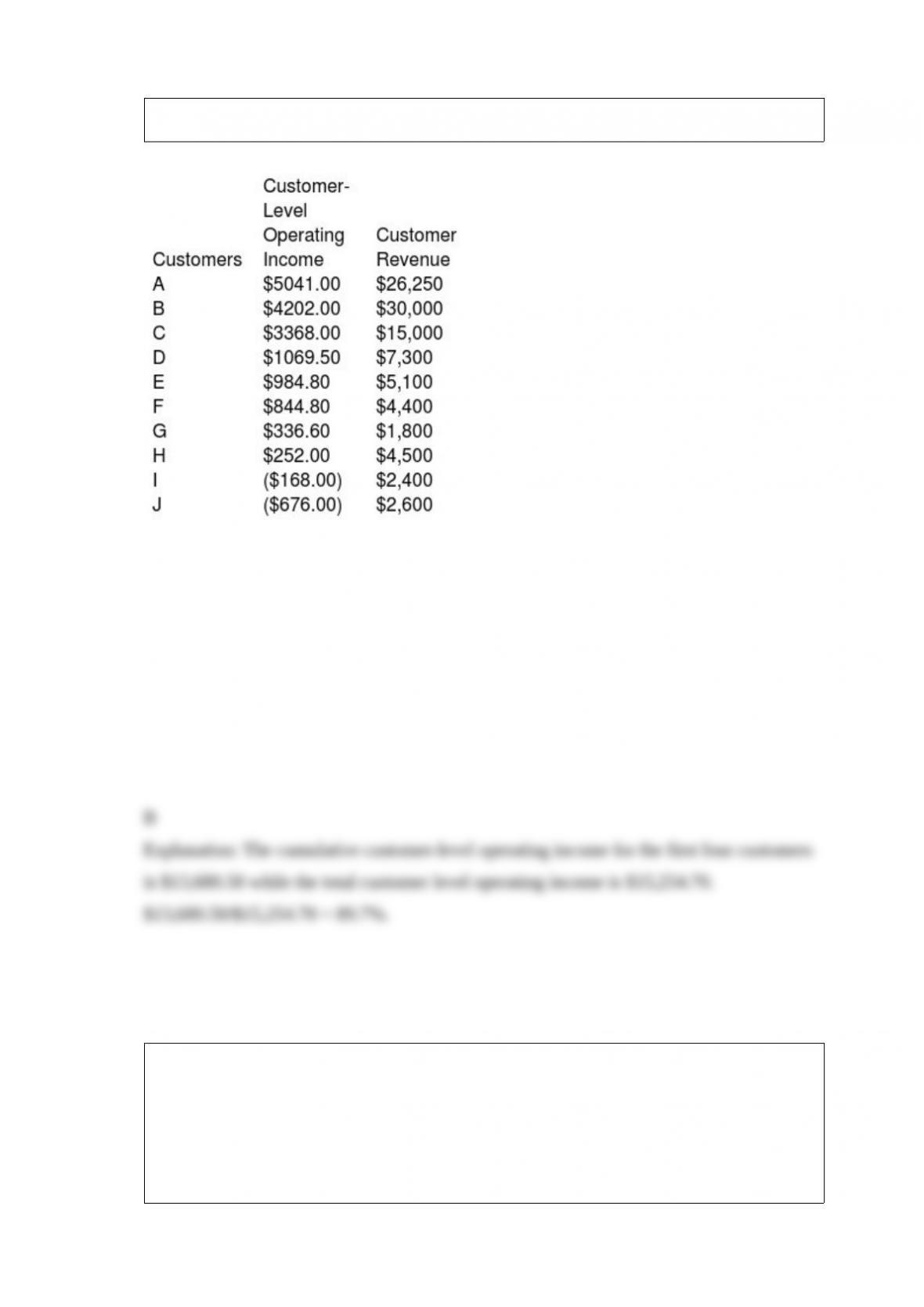
A financial analyst for Simon Manufacturing prepared the following report:
What is the cumulative customer-level operating income as a percentage of customer level
operating income for the top 4 most profitable (operating income) customers?
A) 17.4%
B) 89.7%
C) 85.0%
D) 79.1%
Managers and accountants collect most of the cost information that goes into their
systems through ________.
A) an information data bank
B) computer programs
C) source documents
D) time surveys
Axelia Corporation has two divisions, Refining and Extraction. The company’s primary
product is Luboil Oil. Each division’s costs are provided below:
Extraction: Variable costs per barrel of oil $10
Fixed costs per barrel of oil $8
Refining: Variable costs per barrel of oil $26
Fixed costs per barrel of oil $38
The Refining Division has been operating at a capacity of 40,300 barrels a day and
usually purchases 25,400 barrels of oil from the Extraction Division and 15,100 barrels
from other suppliers at $64 per barrel.
What is the transfer price per barrel from the Extraction Division to the Refining
Division, assuming the method used to place a value on each barrel of oil is 120% of
full costs?
A) $18.00
B) $21.60
C) $56.00
D) $100.80
Block Island TV currently sells large televisions for $380. It has costs of $320. A
competitor is bringing a new large television to market that will sell for $360.
Management believes it must lower the price to $360 to compete in the market for large
televisions. Marketing believes that the new price will cause sales to increase by 10%,
even with a new competitor in the market. Block Island TV sales are currently 150,000
televisions per year.
What is the change in operating income if marketing is correct and only the sales price
is changed?
A) $6,600,000
B) $3,000,000
C) $(6,600,000)
D) ($2,400,000)

Which if the following is a negative consequence of recording byproducts in the
accounting records when the sale occurs?
A) the revenue from the byproducts is usually fairly large and the accounting records
will be distorted
B) earnings cannot be timed under this method
C) managers can be tempted to stockpile byproducts
D) it involves complex calculations compared to the production method
Managers use a customer-profitability analysis report to ensure that ________.
A) unpaid invoices are categorized according to age by due date
B) costs related to customers are segmented into different cost pools on the basis of
different types of cost drivers or cost-allocation bases
C) customers making large contributions to the operating income of a company receive
a high level of attention from the company
D) cost allocation of indirect cost is in place
Inventoriable costs are expensed on the income statement ________.
A) when direct materials for the product are purchased
B) when the direct materials are used in production.
C) when the products are sold
D) when the goods move from work-in process to finished goods account
All else being equal, an increase in advertising expenditures will ________.
A) reduce operating income
B) reduce contribution margin
C) increase variable costs
D) increase selling price
Kinnane’s Fine Furniture manufactures two models, Standard and Premium. Weekly
demand is estimated to be 100 units of the Standard Model and 70 units of the Premium
Model. The following per unit data apply:
Standard Premium
Contribution margin per unit $21 $20
Number of machine-hours required 3 4
If there are 720 machine-hours available per week, how many rockers of each model
should Kinnane produce to maximize profits?
A) 100 units of Standard and 48 units of Premium
B) 71 units of Standard and 70 units of Premium
C) 100 units of Standard and 70 units of Premium
D) 82 units of Standard and 62 units of Premium
Estate Corp., has the following information:
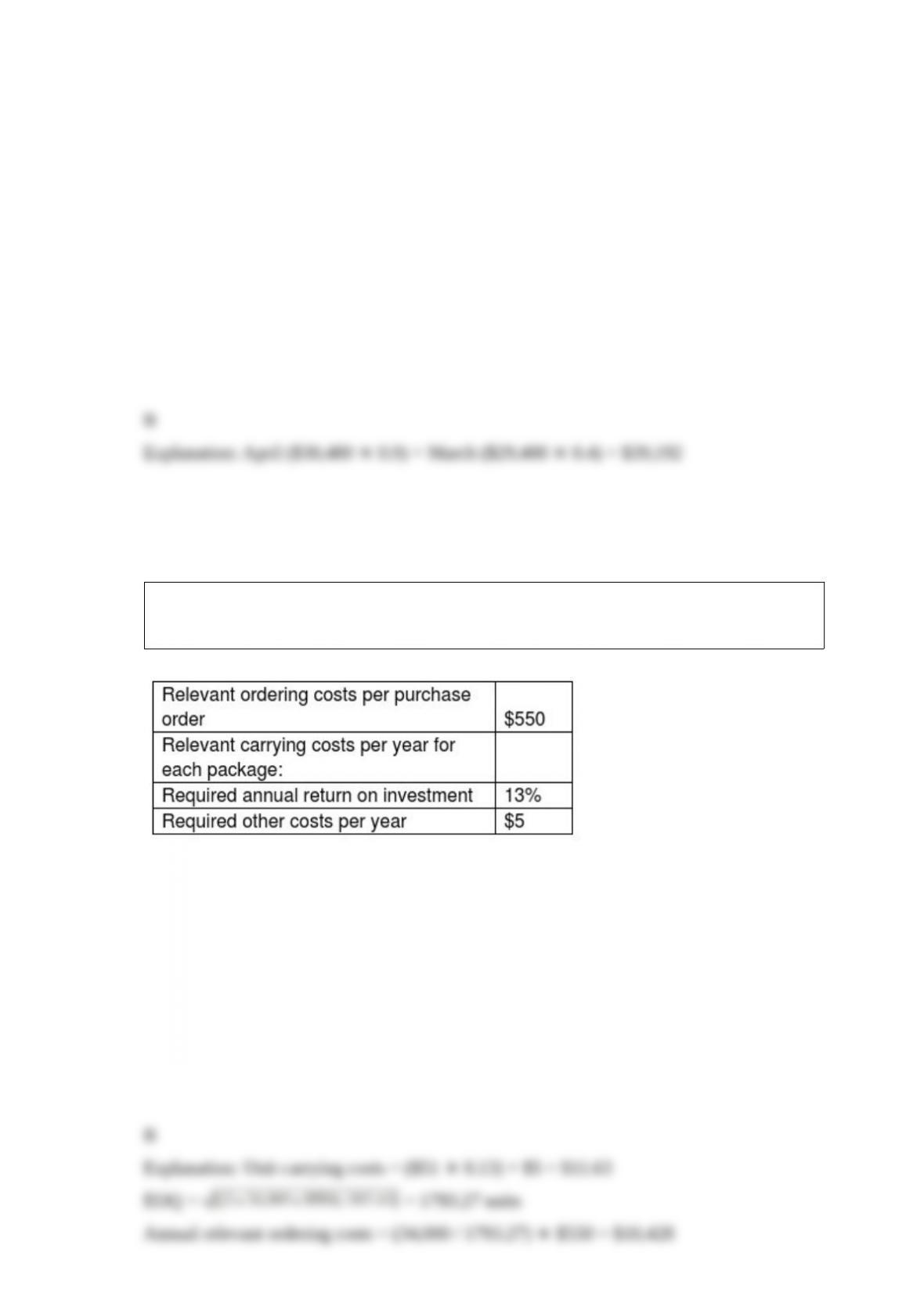
Purchases are paid for in the following manner:
10% of the purchase amount in the month of purchase
50% of the purchase amount in the month after purchase
40% of the purchase amount in the second month after purchase
What is the expected balance in Accounts Payable as of April 30?
A) $38,220
B) $39,192
C) $29,400
D) $18,288
The Allianz Company produces a specialty wood furniture product, and has the
following information available concerning its inventory items:
Annual demand is 34,000 packages per year. The purchase price per package is $51.
What is the annual relevant ordering costs?
A) $6837
B) $10,428
C) $7873
D) $11,300