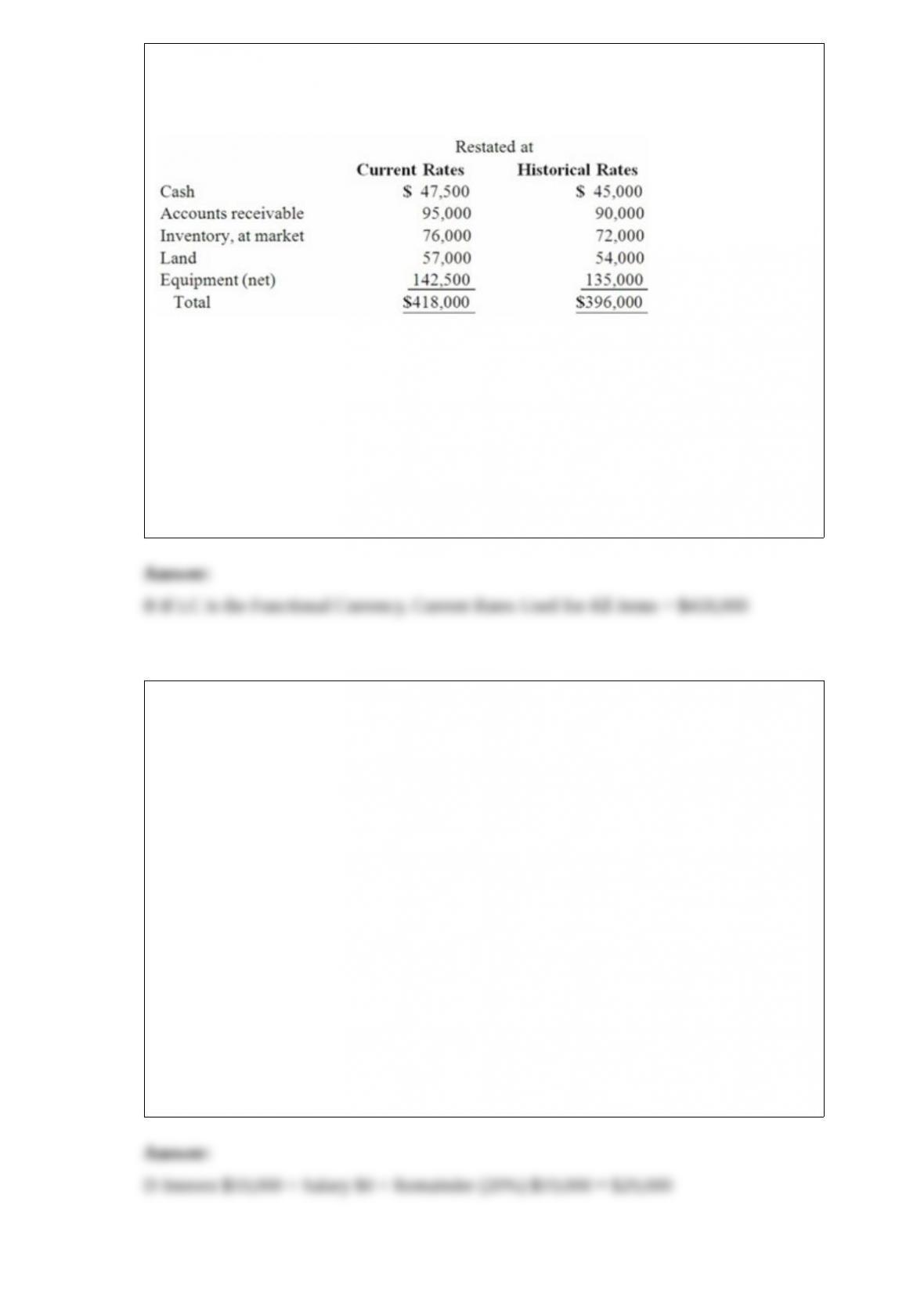
1) Certain balance sheet accounts of a foreign subsidiary of Parker Company at
December 31, 2013, have been restated into U.S. dollars as follows:
Assuming the functional currency of the subsidiary is the local currency, what total
should be included in Parker’s consolidated balance sheet at December 31, 2013, for the
above items?
A.$407,500
B.$418,000
C.$396,000
D.$403,500
E.$398,500
2) Cleary, Wasser, and Nolan formed a partnership on January 1, 2012, with
investments of $100,000, $150,000, and $200,000, respectively. For division of income,
they agreed to (1) interest of 10% of the beginning capital balance each year, (2) annual
compensation of $10,000 to Wasser, and (3) sharing the remainder of the income or loss
in a ratio of 20% for Cleary, and 40% each for Wasser and Nolan. Net income was
$150,000 in 2012 and $180,000 in 2013. Each partner withdrew $1,000 for personal use
every month during 2012 and 2013.
What was Cleary’s total share of net income for 2012?
A.$63,000.
B.$53,000.
C.$58,000.
D.$29,000.
E.$51,000.
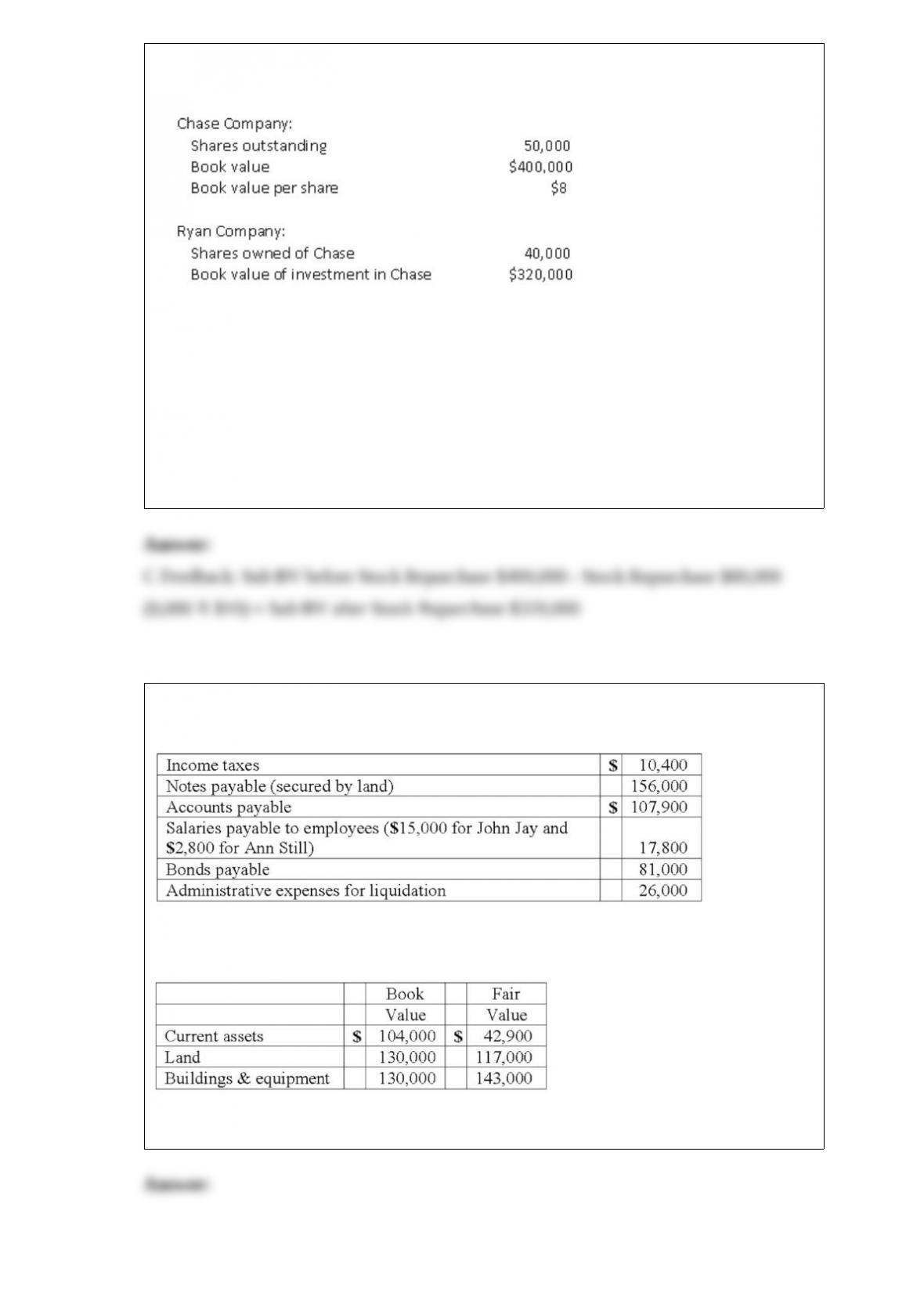
3) Ryan Company owns 80% of Chase Company. The original balances presented for
Ryan and Chase as of January 1, 2013 are as follows:
Assume Chase reacquired
8,000 shares of its common stock from outsiders at $10 per share.
What should the adjusted book value of Chase be after the treasury shares were
purchased?
A) $400,000.
B) $480,000.
C) $320,000.
D) $336,000.
E) $464,000.
4) A company that was to be liquidated had the following liabilities:
The company had the following assets:
Total unsecured non-priority liabilities are calculated to be what amount?
5) Clemente Co. owned all of the voting common stock of Snider Co. On January 2,
2012, Clemente sold equipment to Snider for $125,000. The equipment had cost
Clemente $140,000. At the time of the sale, the balance in accumulated depreciation
was $40,000. The equipment had a remaining useful life of five years and a $0 salvage
value. Straight-line depreciation is used by both Clemente and Snider.
At what amount should the equipment (net of depreciation) be included in the
consolidated balance sheet dated December 31, 2012?
A) $105,000.
B) $100,000.
C) $ 95,000.
D) $ 80,000.
E) $ 85,000.
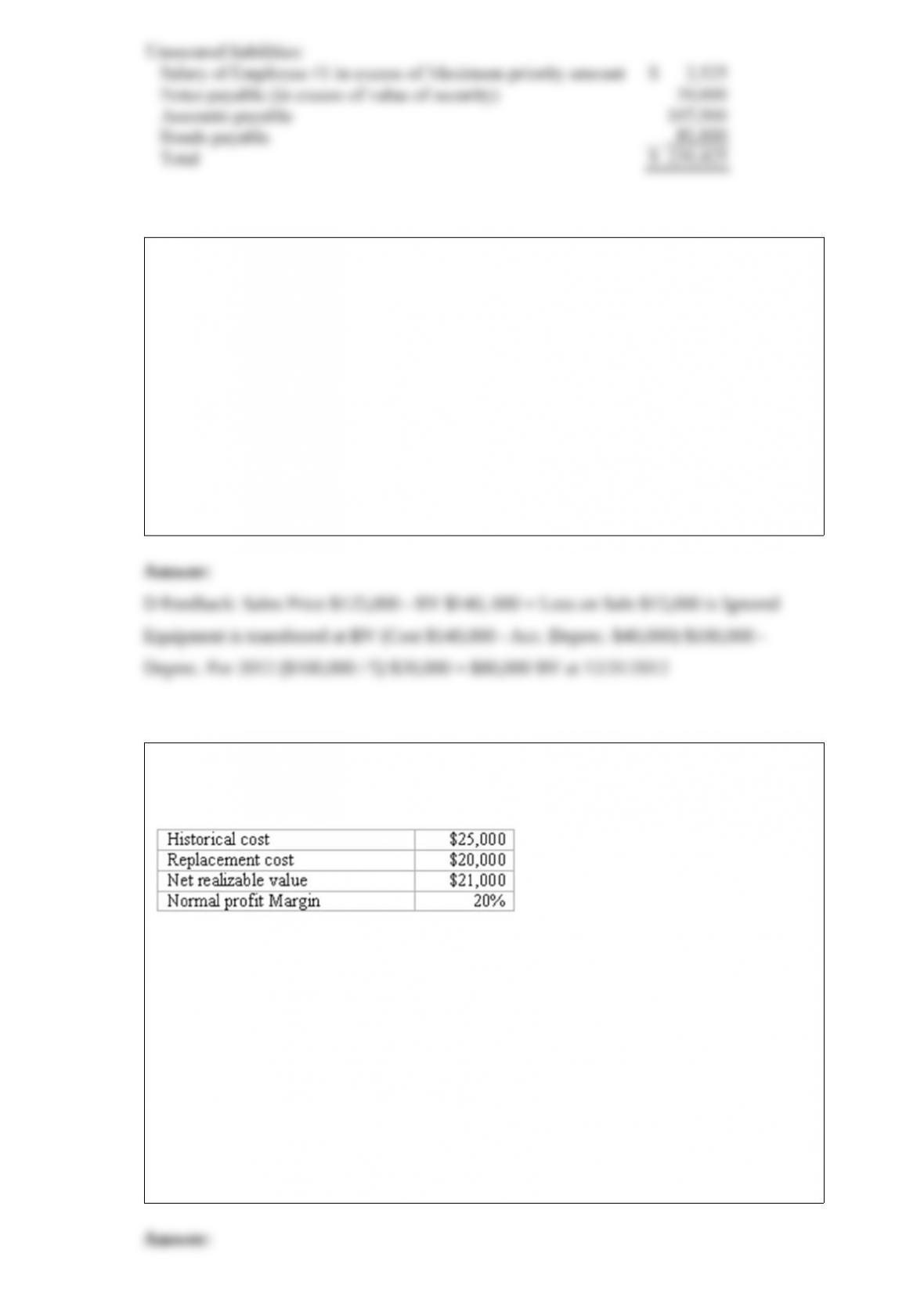
6) The following information pertains to inventory held by a company at December 31,
2013.
What is the amount of inventory loss shown on the income statement under U.S.
GAAP?
A.$1,000.
B.$2,000.
C.$4,000.
D.$5,000.
E.$8,200.
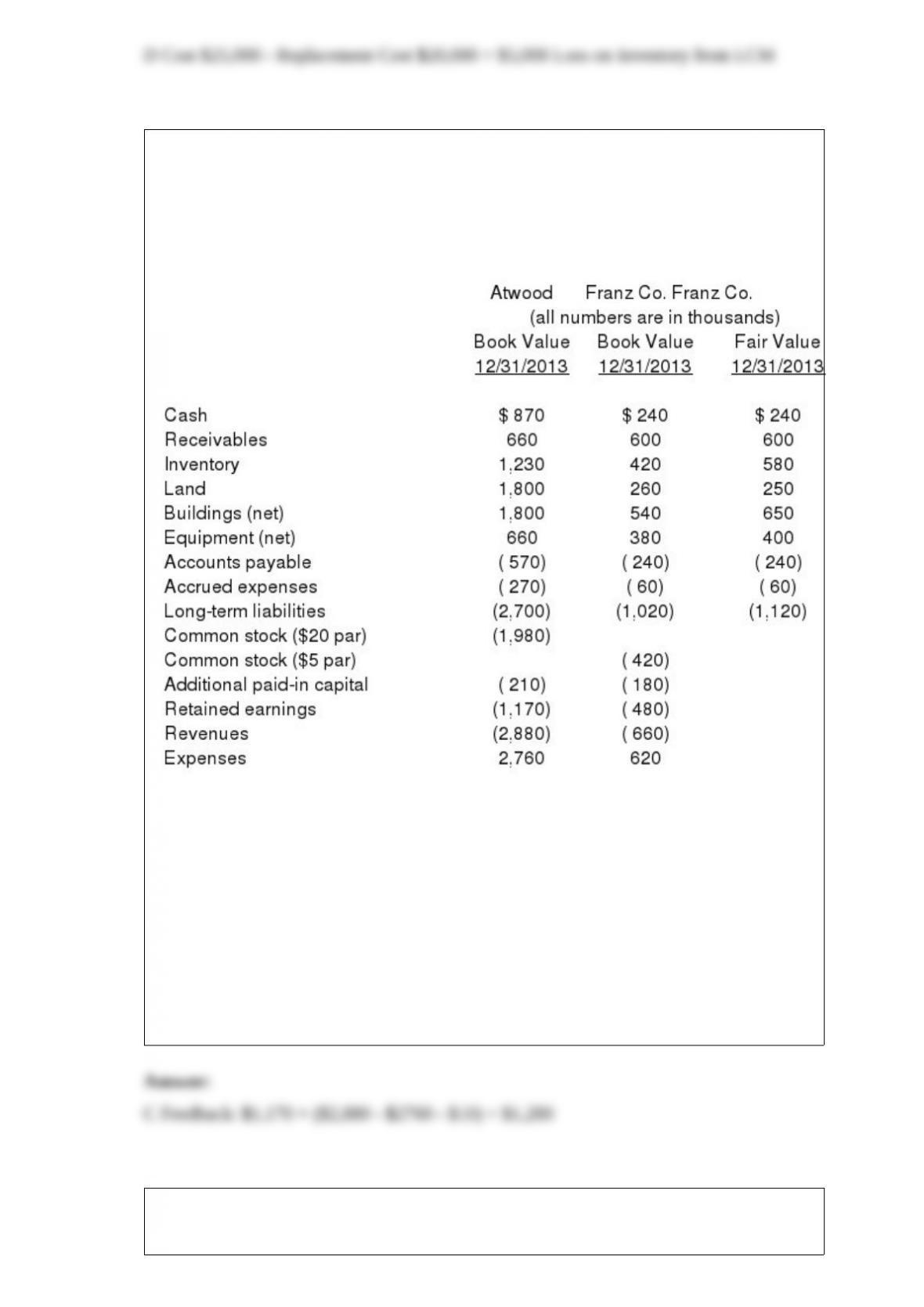
7) The financial balances for the Atwood Company and the Franz Company as of
December 31, 2013, are presented below. Also included are the fair values for Franz
Company’s net assets.
Note: Parenthesis indicate a credit balance
Assume an acquisition business combination took place at December 31, 2013. Atwood
issued 50 shares of its common stock with a fair value of $35 per share for all of the
outstanding common shares of Franz. Stock issuance costs of $15 (in thousands) and
direct costs of $10 (in thousands) were paid.
Compute consolidated retained earnings at the date of the acquisition.
A) $1,160.
B) $1,170.
C) $1,280.
D) $1,290.
E) $1,640.
8) Gargiulo Company, a 90% owned subsidiary of Posito Corporation, sells inventory to
Posito at a 25% profit on selling price. The following data are available pertaining to
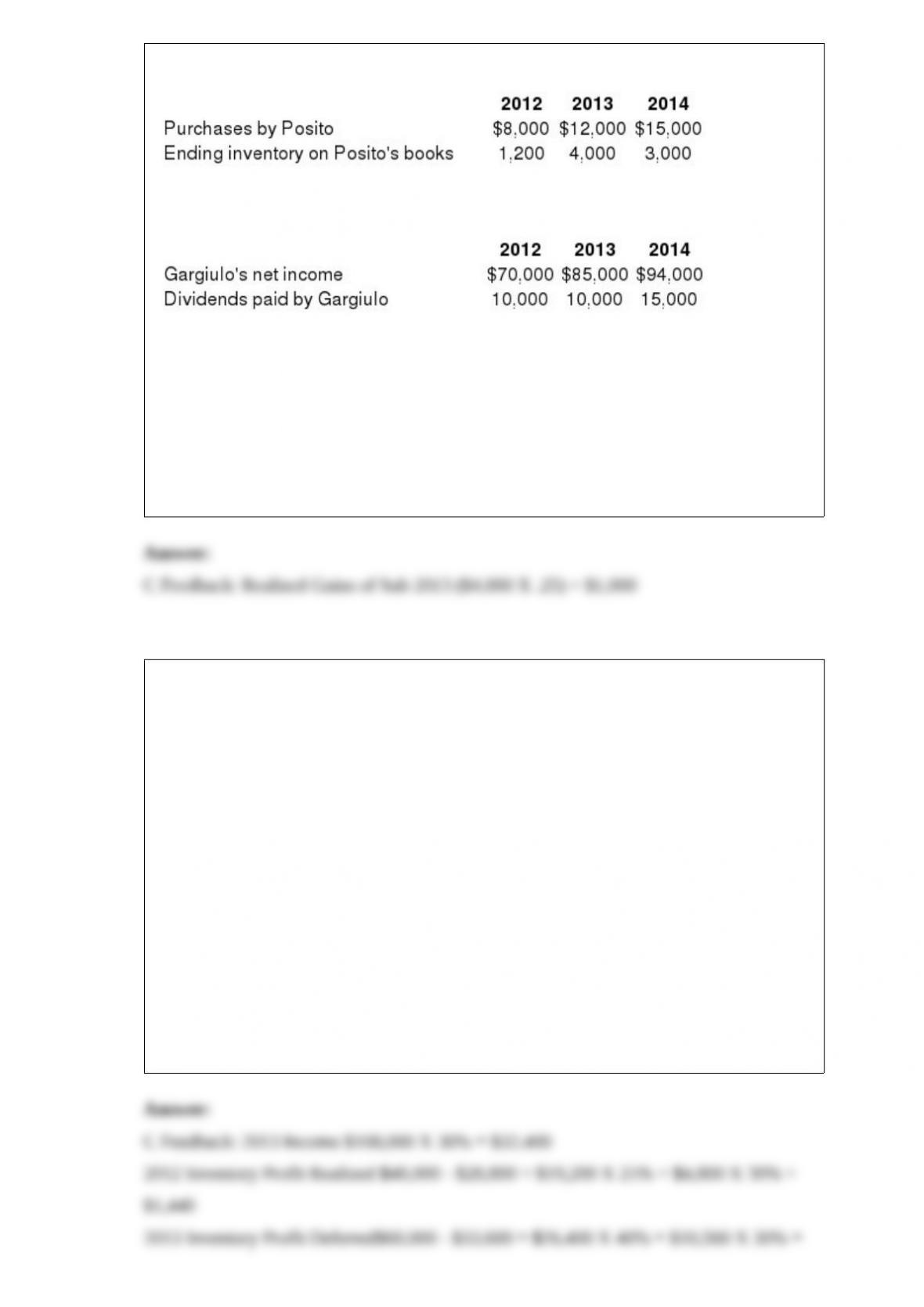
intra-entity purchases. Gargiulo was acquired on January 1, 2012.
Assume the equity method is used. The following data are available pertaining to
Gargiulo’s income and dividends.
For consolidation purposes, what amount would be debited to January 1 retained
earnings for the 2014 consolidation worksheet entry with regard to the unrealized gross
profit of the 2013 intra-entity transfer of merchandise?
A) $3,000.
B) $2,400.
C) $1,000.
D) $ 800.
E) $ 900.
9) Atlarge Inc. owns 30% of the outstanding voting common stock of Ticker Co. and
has the ability to significantly influence the investee’s operations and decision making.
On January 1, 2013, the balance in the Investment in Ticker Co. account was $402,000.
Amortization associated with the purchase of this investment is $8,000 per year. During
2013, Ticker earned income of $108,000 and paid cash dividends of $36,000.
Previously in 2012, Ticker had sold inventory costing $28,800 to Atlarge for $48,000.
All but 25% of this merchandise was consumed by Atlarge during 2012. The remainder
was used during the first few weeks of 2013. Additional sales were made to Atlarge in
2013; inventory costing $33,600 was transferred at a price of $60,000. Of this total,
40% was not consumed until 2014.
What amount of equity income would Atlarge have recognized in 2013 from its
ownership interest in Ticker?
A) $19,792.
B) $27,640.
C) $22,672.
D) $24,400.
E) $21,748.
10) Strickland Company sells inventory to its parent, Carter Company, at a profit during
2012. One-third of the inventory is sold by Carter in 2012.
In the consolidation worksheet for 2012, which of the following choices would be a
credit entry to eliminate unrealized intra-entity gross profit with regard to the 2012
intra-entity sales?
A) Retained earnings.
B) Cost of goods sold.
C) Inventory.
D) Investment in Strickland Company.
E) Sales.
11) On January 4, 2013, Mason Co. purchased 40,000 shares (40%) of the common
stock of Hefly Corp., paying $560,000. At that time, the book value and fair value of
Hefly’s net assets was $1,400,000. The investment gave Mason the ability to exercise
significant influence over the operations of Hefly. During 2013, Hefly reported income
of $150,000 and paid dividends of $40,000. On January 2, 2014, Mason sold 10,000
shares for $150,000.
What was the balance in the investment account before the shares were sold?
A) $520,000.
B) $544,000.
C) $560,000.
D) $604,000.
E) $620,000.
12) Pell Company acquires 80% of Demers Company for $500,000 on January 1, 2014.
Demers reported common stock of $300,000 and retained earnings of $210,000 on that
date. Equipment was undervalued by $30,000 and buildings were undervalued by
$40,000, each having a 10-year remaining life. Any excess consideration transferred
over fair value was attributed to goodwill with an indefinite life. Based on an annual
review, goodwill has not been impaired.
Demers earns income and pays dividends as follows:
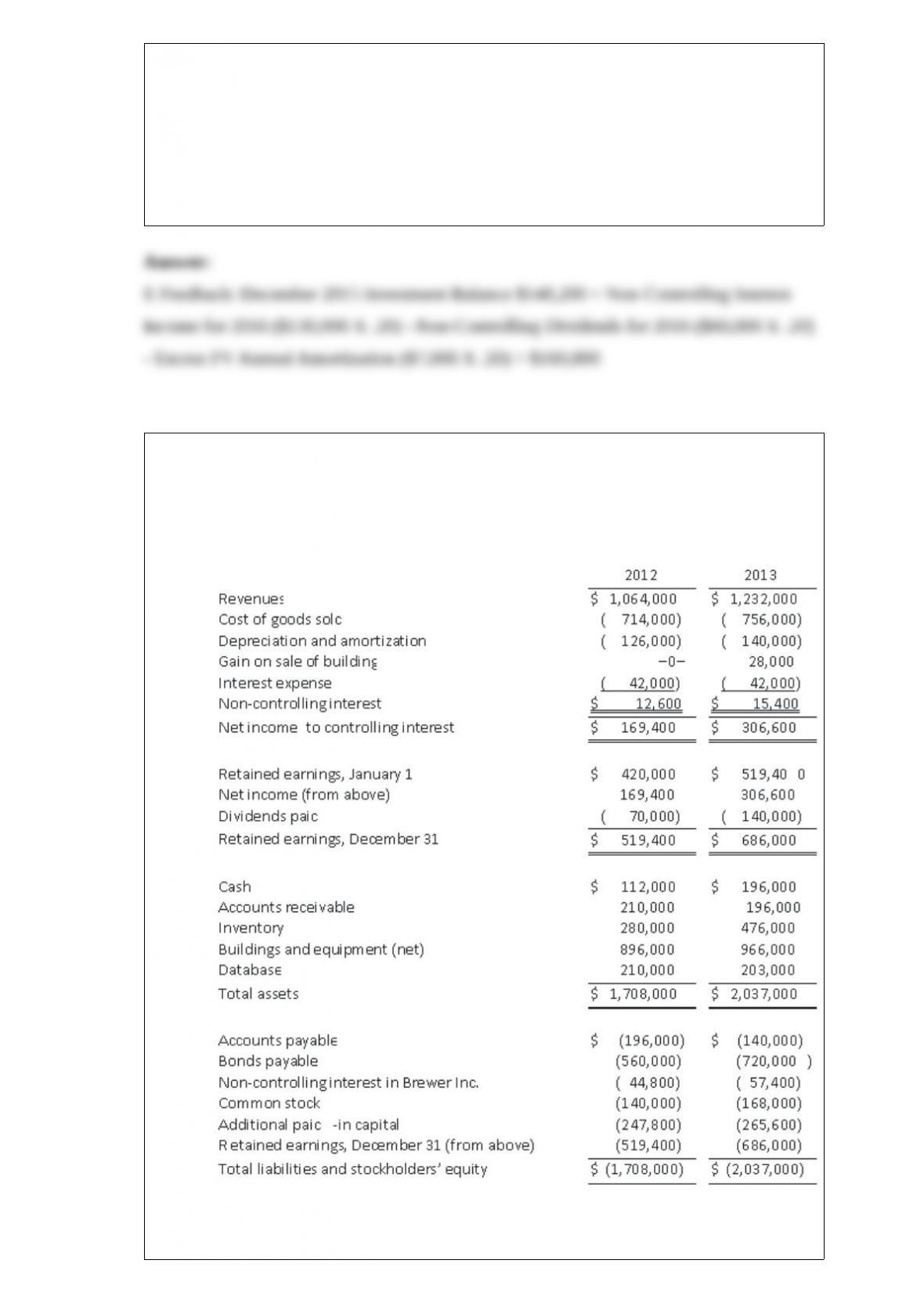
Assume the INITIAL VALUE is applied.
Compute the non-controlling interest in Demers at December 31, 2016.
A) $107,800.
B) $140,000.
C) $ 80,000.
D) $ 50,000.
E) $160,800.
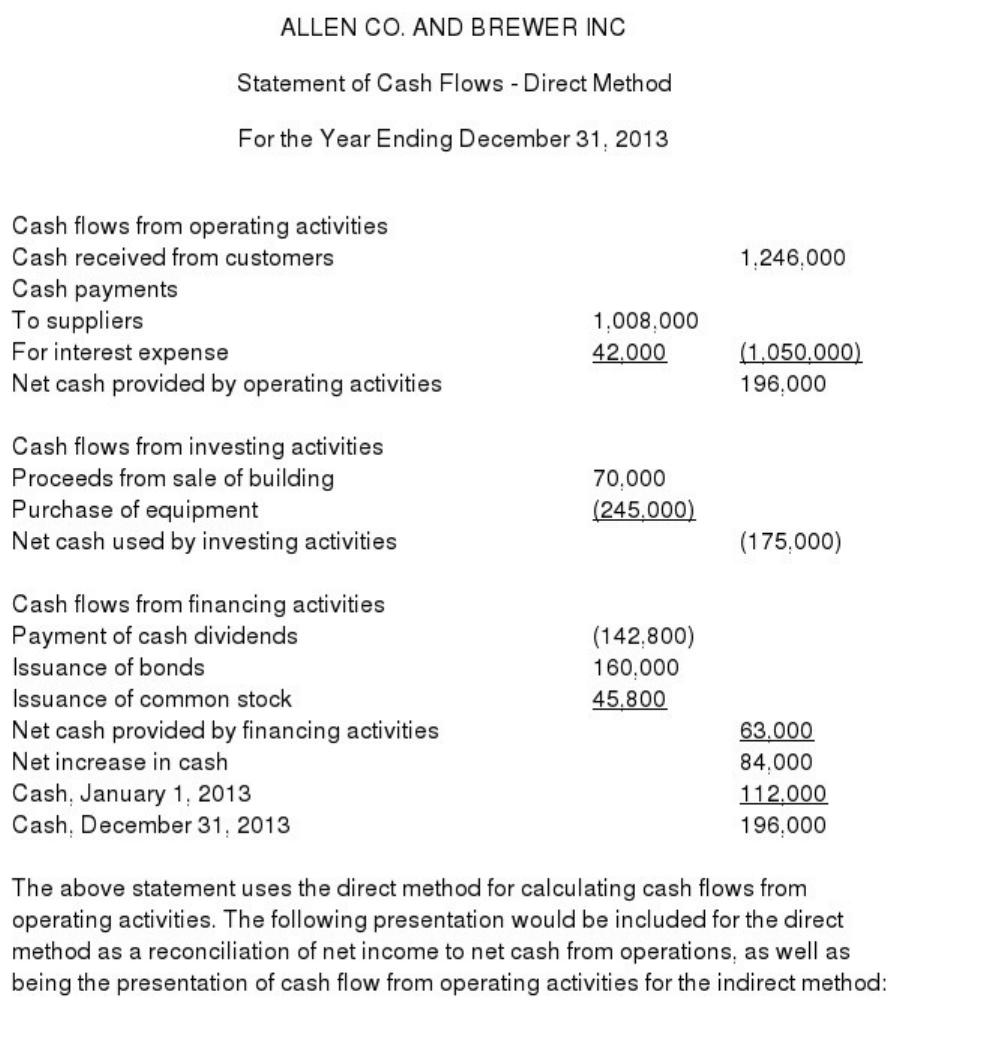
13) Allen Co. held 80% of the common stock of Brewer Inc. and 40% of this
subsidiary’s convertible bonds. The following consolidated financial statements were
for 2012 and 2013.

Additional Information: Required:
Prepare a consolidated statement of cash flows for this business combination for the
year ending December 31, 2013. Either the direct method or the indirect method may be
used.
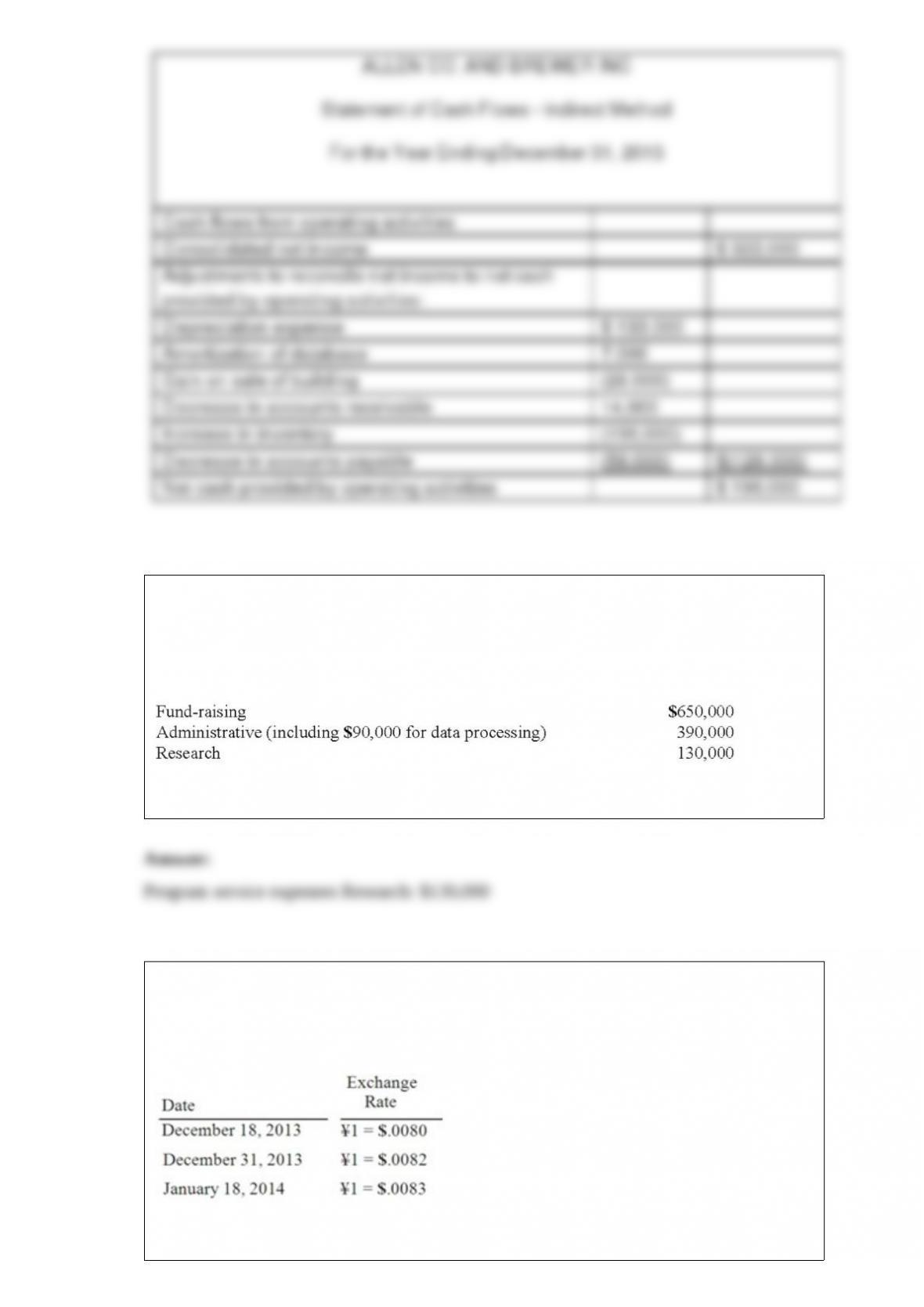
14) Dura Foundation, a voluntary health and welfare organization dedicated to finding
medical cures and supported by contributions from the general public, included the
following costs in its Statement of Functional Expenses for the year ended December
31, 2013:
What should Dura Foundation report as program service expenses?
15) Gaw Produce Company purchased inventory from a Japanese company on
December 18, 2013. Payment of 4,000,000 yen (x) was due on January 18, 2014.
Exchange rates between the dollar and the yen were as follows:
Required:
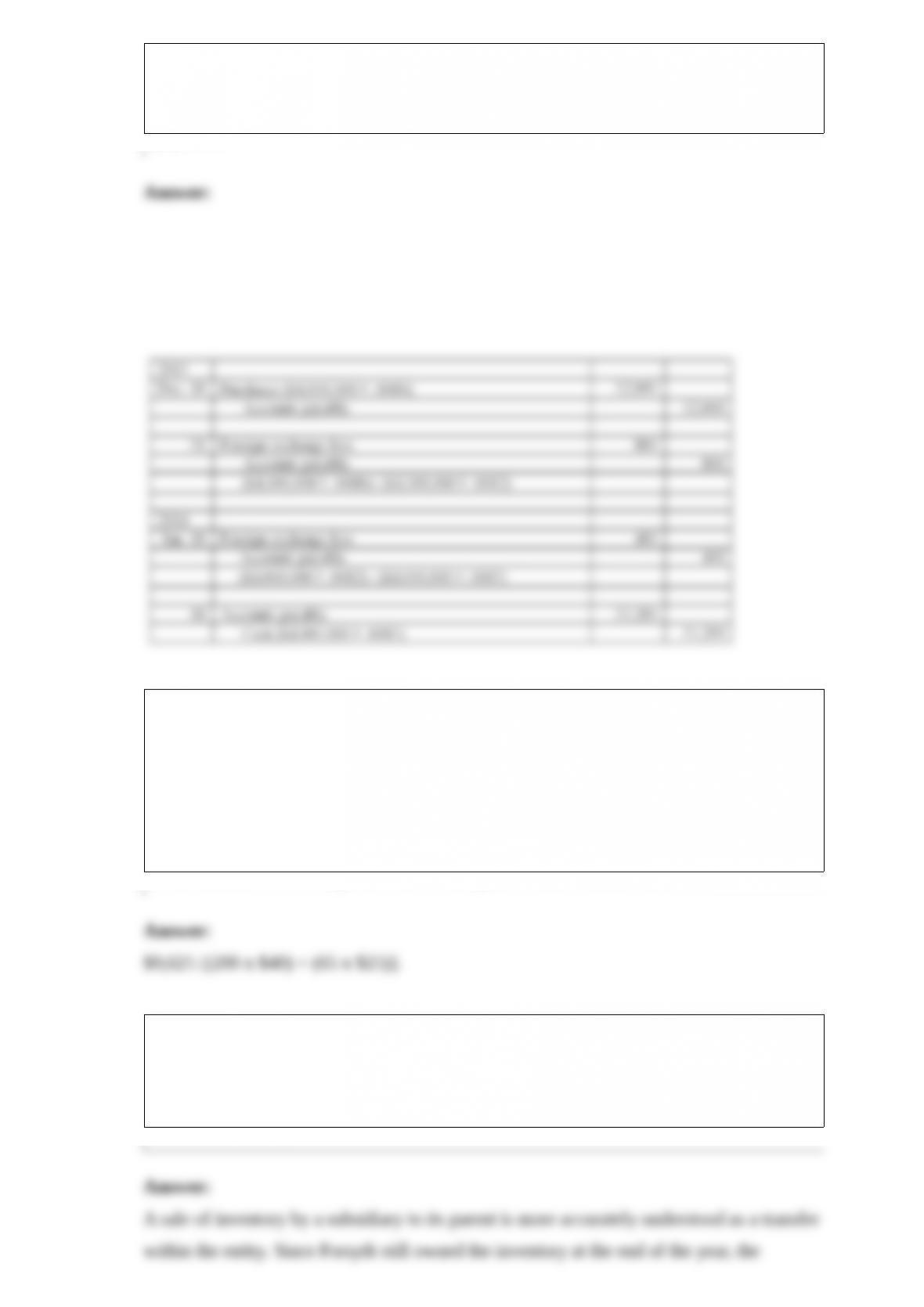
Prepare all journal entries for Gaw Produce Co. in connection with the purchase and
payment.
16) Gregor Inc. uses the LIFO cost-flow assumption to value inventory. Inventory for
Gregor on January 1, 2013 was 100 units at a LIFO cost of $25 per unit. During the first
quarter of 2013, 200 units were purchased costing an average of $40 per unit, and sales
of 265 units at a retail price of $50 per unit were made.
Assuming Gregor does not expect to replace the units of beginning inventory sold, what
is the amount of cost of goods sold for the quarter ended March 31, 2013?
17) During 2013, Edwards Co. sold inventory to its parent company, Forsyth Corp.
Forsyth still owned the entire inventory purchased at the end of 2013. Why must the
gross profit on the sale be deferred when consolidated financial statements are prepared
at the end of 2013?