
1) the coefficient of determination is a number between:
a.0 and 1
b.-1 and 1
c.-2 and 2
d.the coefficient of determination can be any number
2) which of the following is not a way for a management accountant to resolve an
ethical conflict?
a.bring the matter to the attention of the company’s auditor
b.consult an attorney concerning the ethical conflict
c.initiate a confidential discussion with an ima ethics counselor
d.discuss the issue with the management accountant’s immediate supervisor except
when the supervisor is involved
3) the management accountant who planned to improve an organization’s operations by
developing models of consumer behavior would be using which of the following
contemporary management techniques:
a.target costing
b.benchmarking
c.business intelligence
d.lean accounting
e.focus on the customer
4) which of the following is not an advantage of using a “highly achievable target”
when constructing budgets?
a.increasing managers’ commitment to achieving budget targets
b.increasing the risk that managers will engage in “earnings management” behavior
c.improving predictability of earnings or operating results
d.decreasing the cost of achieving organizational control
e.enhancing the usefulness of a budget as a planning and coordinating tool
5) staley co. manufactures computer monitors. the following is a summary of its basic
cost and revenue data:
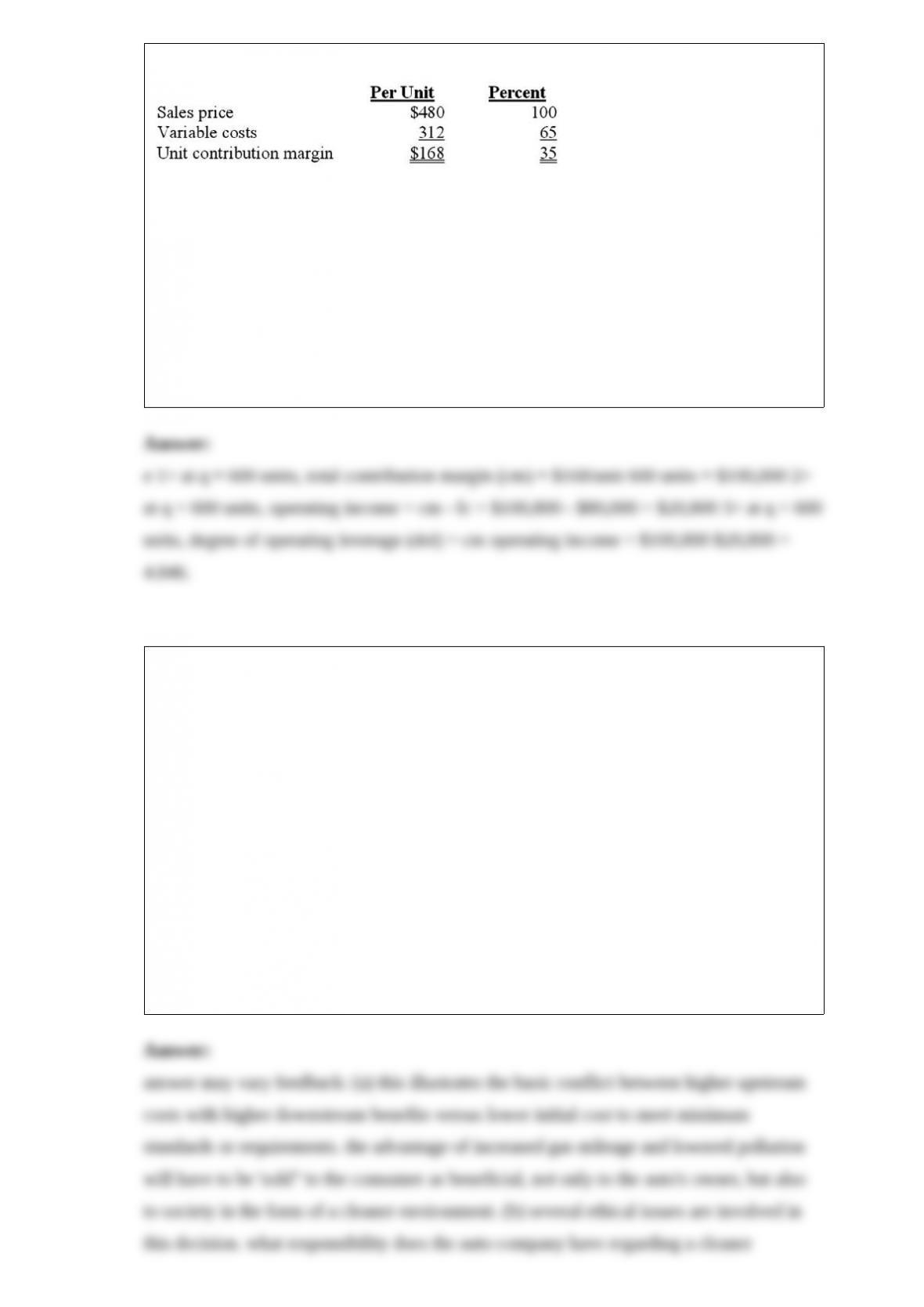
assume that staley co. is currently selling 600 computer monitors per month and
monthly fixed costs are $80,000.
what is staley co.’s degree of operating leverage (dol) at this sales volume? (round your
answer to three decimal places.)
a.5.118
b.4.405
c.5.630
d.5.000
e.4.846
6) auto engines have become more complex over the past twenty years, partly as a
result of environmental concerns about exhaust contaminants. engineers have
developed two basic approaches to solving the contaminant problem. the first
emphasized the catalytic converter, a modification of the auto exhaust system designed
to break down pollutants. the second emphasized redesign of the auto engine’s
combustion process, which adds more than twice the cost of the catalytic converter
alone. however, redesigning the combustion process usually results in improved full
efficiency.
required:
(a) comment on the strategic advantage of redesigning the combustion process versus
simply adding a catalytic converter.
(b) what are the ethical questions, if any, that should be addressed in the above
decision?
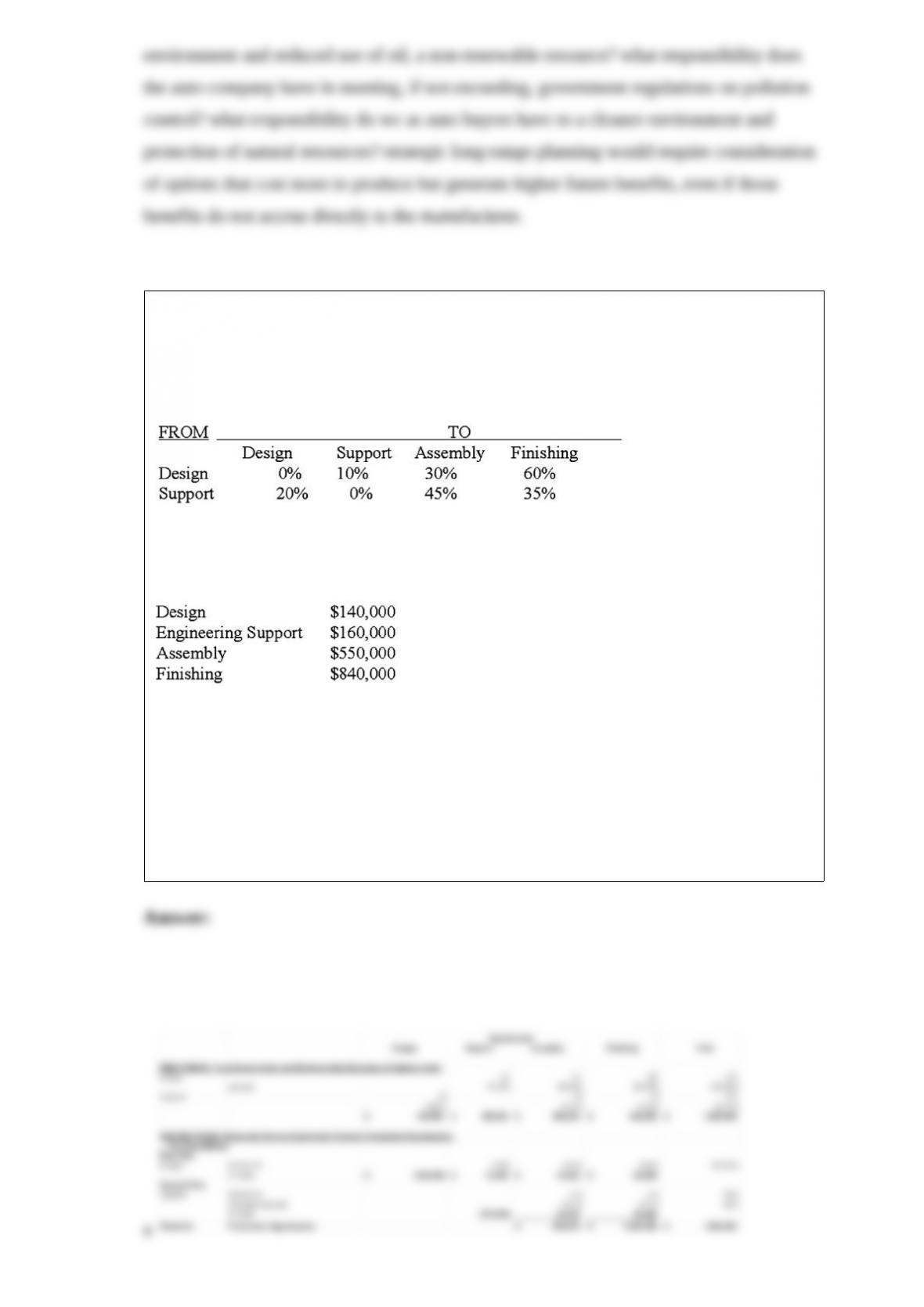
7) barstow manufacturing company has two service departments product design and
engineering support, and two production departments assembly and finishing. the
distribution of each service department’s efforts to the other departments is shown
below:
the direct operating costs of the departments (including both variable and fixed costs)
were as follows:
the total cost accumulated in the finishing department using the step method is
(calculate all ratios and percentages to 4 decimal places, for example 33.3333%, and
round all dollar amounts to the nearest whole dollar):
a.$1,000,125
b.$1,890,000
c.$689,875
d.$642,000
e.$923,000
8) important concepts in resource consumption accounting include all of the following
except:
a.variable costing
b.resource interrelationships
c.activity interrelationships
d.detail level cost information
e.treatment of idle capacity
9) the sum of units transferred out and ending inventory units, assuming no spoilage,
determines the:
a.units completed during the period
b.units spoiled
c.units transferred in during the period
d.units accounted for
e.units started during the period
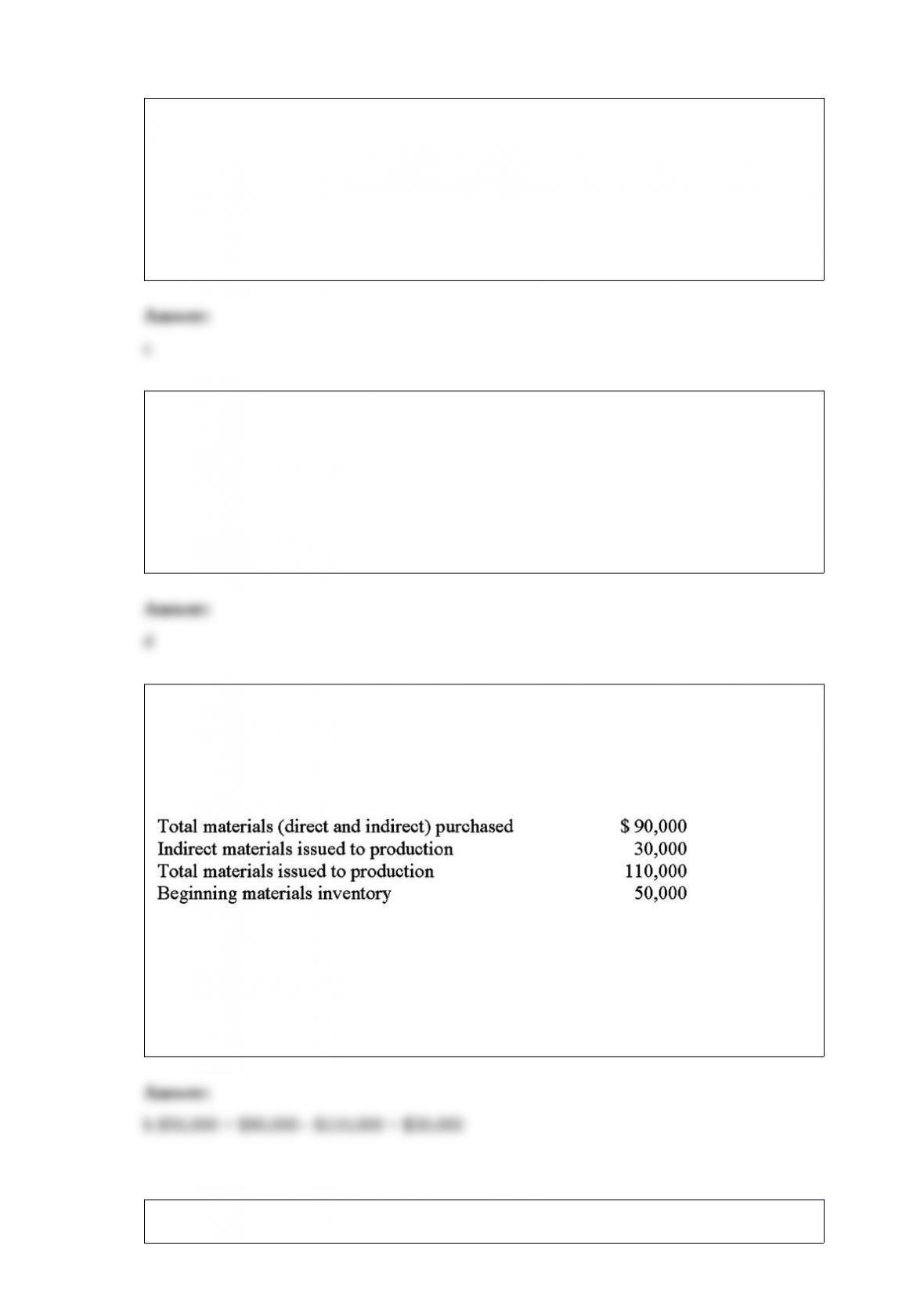
10) abc company uses a materials inventory account to record both direct and indirect
materials. abc charges direct materials to wip, while indirect materials are charged to
the factory overhead account. during the month of april, the company has the following
cost information:
the ending materials inventory cost is:
a.$110,000
b.$30,000
c.$90,000
d.$80,000
e.$50,000
11) relevant costs in a make-vs.-buy decision of a part include:
a.corporate headquarter costs that will be allocated differently depending on the
decision option chosen
b.setup overhead costs for the manufacture of the product using the outsourced part
c.currently used manufacturing capacity that has alternative uses if the part is
outsourced
d.factory-related insurance cost
e.corporate (i.e., headquarter) salaries
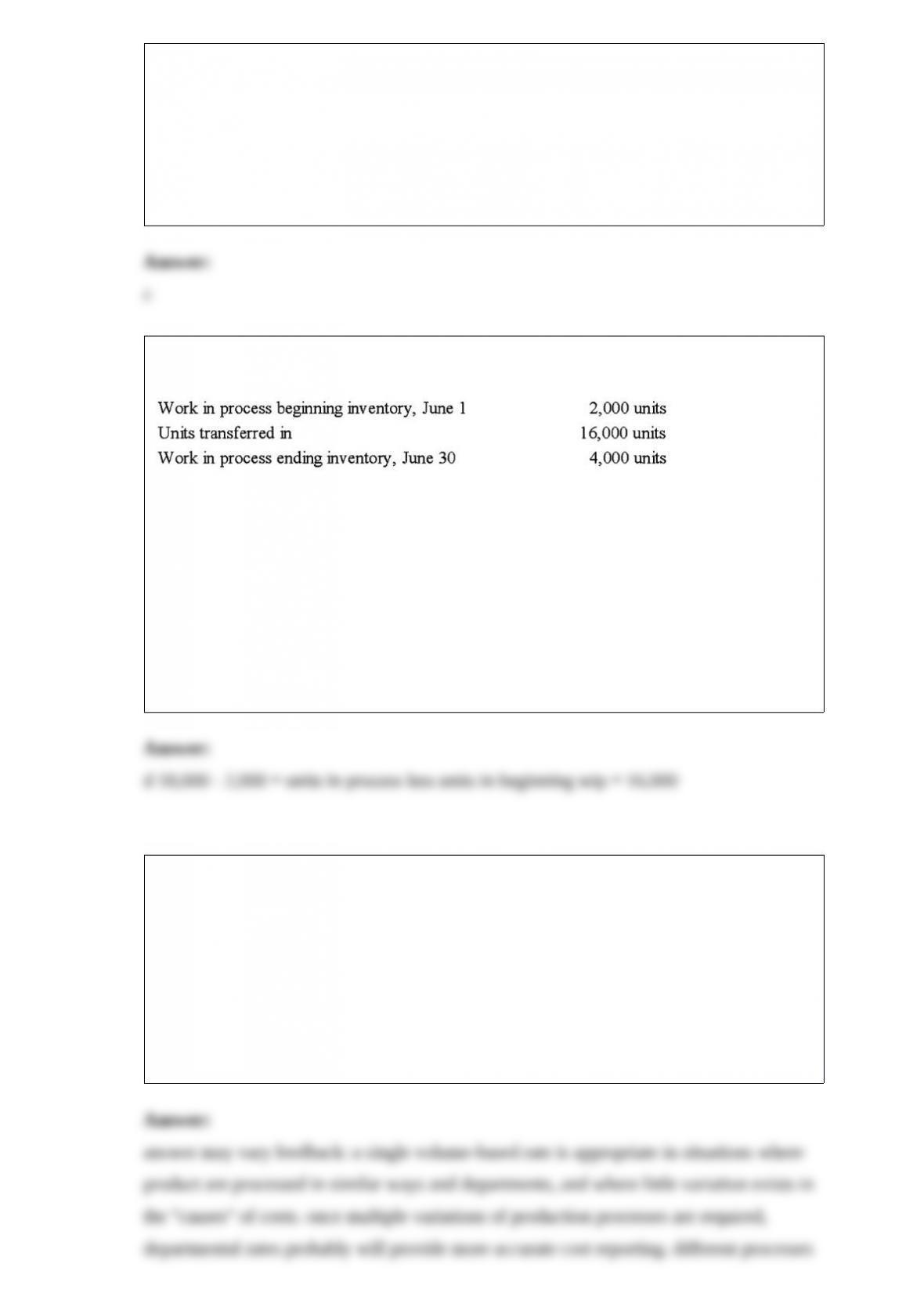
12) stoltenberg co. had the following information for the month of june:
beginning work-in-process inventory is 30 percent complete as to conversion. ending
work-in-process inventory is 50 percent complete as to conversion. materials are added
at the end of the process.
the equivalent units for transferred-in costs under the fifo method are calculated to be:
a.12,000
b.10,000
c.14,000
d.16,000
e.18,000
13) certo health products was formed two years ago to produce and distribute a
newly-patented protein supplement. two variations of the original supplement have
since been developed and introduced for general sale. the three products are processed
in essentially the same way, but ann marshall, the owner of certo, anticipates that a
half-dozen new products will be developed for sale in the next two years. these products
will not be variations of the patented supplement, and will require a different production
process other than the one currently used. ann has asked you to review the current use
of a single volume-based rate and explain the arguments for using departmental rates
with activity-based drivers.
14) helen auger has seen the centicle group, a not-for-profit, in-home health care
organization, grow during the past ten years to a $500 million revenue, multi-state
organization. helen was promoted to her controller position six months ago, after
serving capably in several financial accounting positions at the centicle group.
at a budget review committee meeting last friday, several committee members
expressed frustration with the pace of the budget development. they described the
newly introduced “bottom up” system of participative budgeting as “unwieldy,”
‘slow-paced,” and “repetitive.” helen’s objective in introducing the participative
approach was to involve to a much greater extent lower level supervisors and
employees. helen is meeting with the budget review committee again tomorrow when
she plans to explain the advantages of “bottom up” versus “top down” approaches to the
budgeting process.
required: helen has asked you to help her prepare for tomorrow’s meeting by preparing
the following:
1> a 40 -50 word description of participative budgeting, including some basic
advantages of this approach to budgeting.
2> a brief, one-paragraph explanation of the concept of “budget ownership,” one of the
values that participative (“bottom up”) budgeting is said to have.

15) two students in a cost accounting class were arguing about the need to gather good
unit cost information for manufacturing. one student, travis, maintained that a firm
producing and selling large quantities of relatively few products would have no need for
an abc system, since an abc system is usually more expensive to implement than a
volume-based system. alicia countered that even firms with high-volume homogeneous
products could benefit from a cost management technique like activity-based costing
(abc).
required: choose sides in this discussion and present justifications for your choice.
16) levis strauss and co, maker of levi’s familiar 501 and 505 brands of jeans, also make
a new brand that was introduced for discount retailers such as walmart. levi’s strategy
with the new jeans was to sell a competitively priced pair. the jeans will be about
one-half the price of the familiar 501 and 505 jeans. to get costs down levi’s will:
use cheaper fabrics and materials.
shun costly mass-market advertising.
strictly limit the number of fits, styles, and colors.
required:
1> assess the new strategy at levi. what do you think are the potential benefits and
risks?
2> how will the firm’s value chain and balanced scorecard change as a result of the new
strategy?
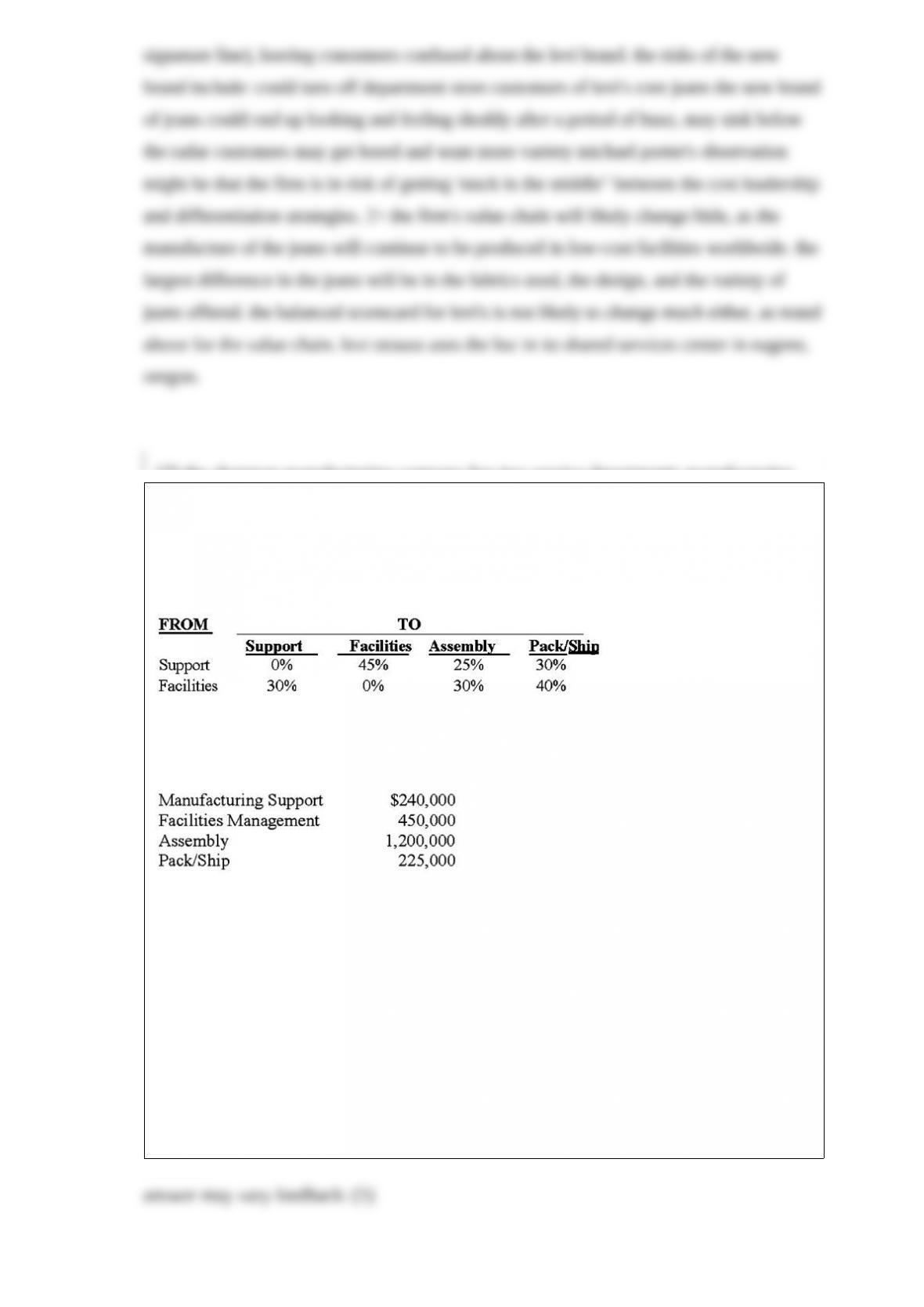
17) the chapman manufacturing company has two service departments manufacturing
support and facilities management, and two production departments assembly and
packing/shipping. the distribution of each service department’s efforts to the other
departments is shown below:
the direct operating costs of the departments (including both variable and fixed costs)
were as follows:
required:
(calculate all ratios and percentages to 2 decimal places, for example 33.33%, and
round all dollar amounts to the nearest whole dollar):
(1) allocate the service department costs to the production departments using the direct
method.
(2) allocate the service department costs to the production departments using the step
method with the support department going first.
(3) allocate the service department costs to the production departments using the
reciprocal method.

18) feel the difference, inc. manufactures bath and beauty products such as soaps, skin
creams, lotions, and other products primarily for people with dry and sensitive skin. it
has just introduced a new line of product that removes the spotting and wrinkling in
skin associated with aging. it sells these products in pharmacies and department stores
at prices slightly higher than those of other brands because of feel the difference’s
excellent reputation for quality and effectiveness.
feel the difference currently has very low utilization of plant capacity. two years ago, in
anticipation of rapid growth, the company opened a new large manufacturing plant,
which has yet to be utilized more than 50 percent. partly for this reason, feel the
difference has sought new partners and was able, with the help of financial analysts, to
locate suitable business partners. the first potential partner identified in this search was
a large supermarket chain, all-mart, which is interested in the partnership because it
wants feel the difference to manufacture an age cream to sell in its stores. the product
would be essentially the same as the feel the difference product but would be packaged
in the all-mart brand name. the agreement would pay feel the difference $2.00 per unit
and would allow all-mart a limited right to advertise the product as manufactured for
all-mart by feel the difference. feel the difference’s cfo has made some calculations and
has determined that the direct materials, direct labor and other variable costs needed for
the all-mart order would be about $1.00 per unit as compared to the full cost of $2.50
(materials, labor, and overhead) for the equivalent feel the difference product.
required:
should feel the difference accept the proposal from all-mart? why or why not? (include
strategic considerations)
19) patterson equipment inc. produced a pilot run of 20 units of a recently developed
motor used in the finished products. the pilot run required an average of 12 direct labor
hours per motor. patterson has an eighty percent learning curve on the direct labor hours
needed to produce new motors.
required:
calculate the average direct labor hours per unit for the first 640 motors (including the
pilot run) produced.