1) which of the following statements about budgeting is not true?
a.budgeting is designed to be an aid to planning and control
b.budgets create standards for performance evaluation
c.budgets help coordinate the activities of the entire organization
d.budgeting forces managers to think ahead and formalize long-range objectives
e.budgeting eliminates the need for day-to-day monitoring of operations
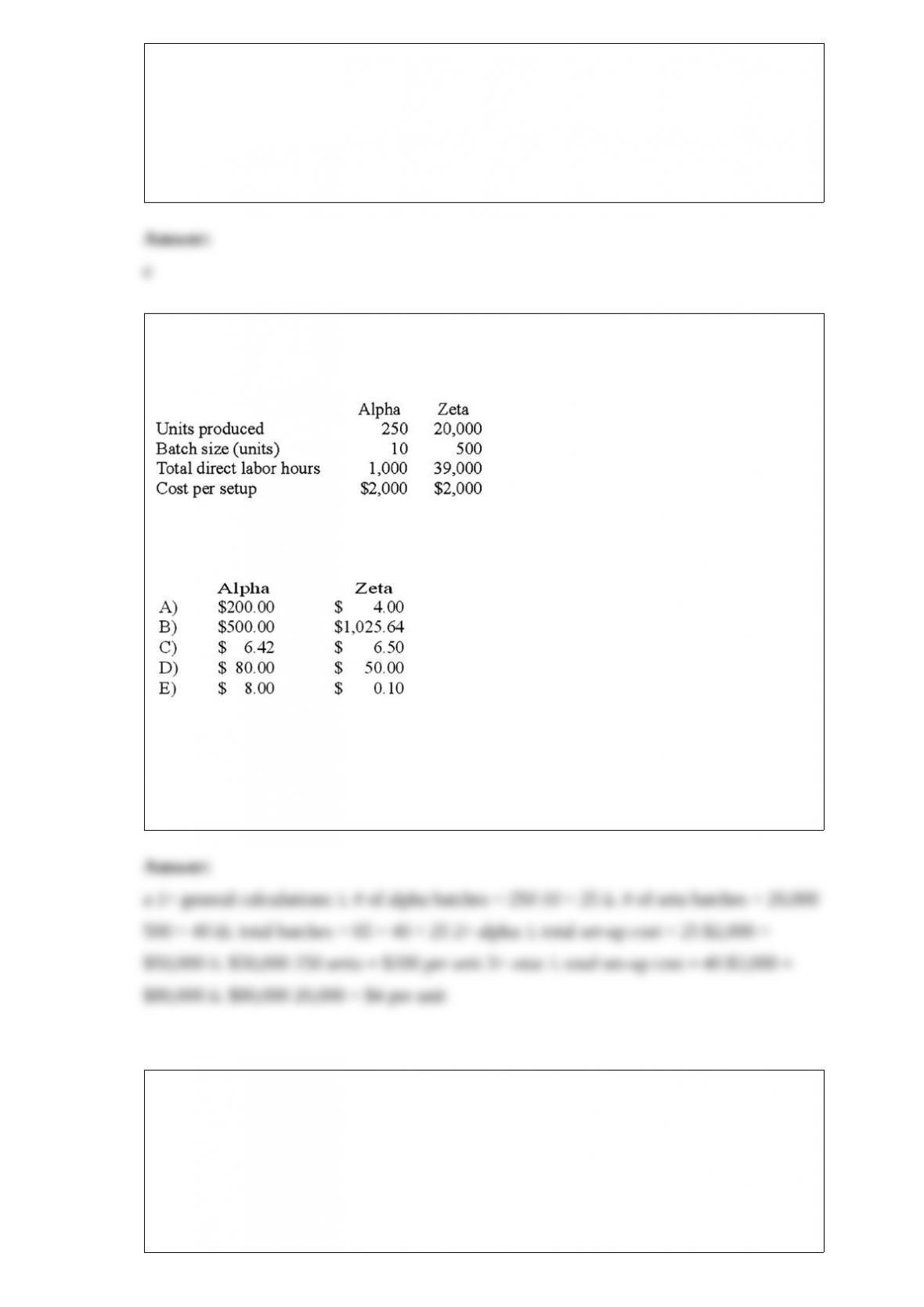
2) pasternik company produces and sells two products, alpha and zeta. the following
information is available relating to its setup activities:
use of activity-based costing would allocate the following amounts of setup cost to each
unit (rounded to the nearest cent):
a.option a
b.option b
c.option c
d.option d
e.option e
3) which of the following professional certificates is considered to be the most relevant
for dealing with cost management issues?
a.the cpa, which is monitored differently for each state in the u.s
b.the cma, which is administered through the institute of management accountants
c.the cfa, since its program focuses on the broadest range of topics and responsibilities
for financial analysis
d.the cpa, cma, and cfa are viewed as equally relevant, since all three require an exam,
as well as specific background and experience requirements
4) unless properly controlled, a “bottom-up” budgeting process can lead to:
a.excessively tight (i.e., difficult-to-achieve) budgets
b.easy budget targets
c.excessive downward communication
d.reduced incentives for participation
e.reduced levels of “budgetary slack”
5) all of the following statements regarding activity-based costing systems are true
except they:
a.can provide more accurate product costs
b.identify more costs as indirect costs than do traditional volume-based systems
c.are likely to be more time-consuming than volume-based systems
d.are used in both manufacturing and non-manufacturing companies
e.are likely to have more overhead rates than volume-based systems
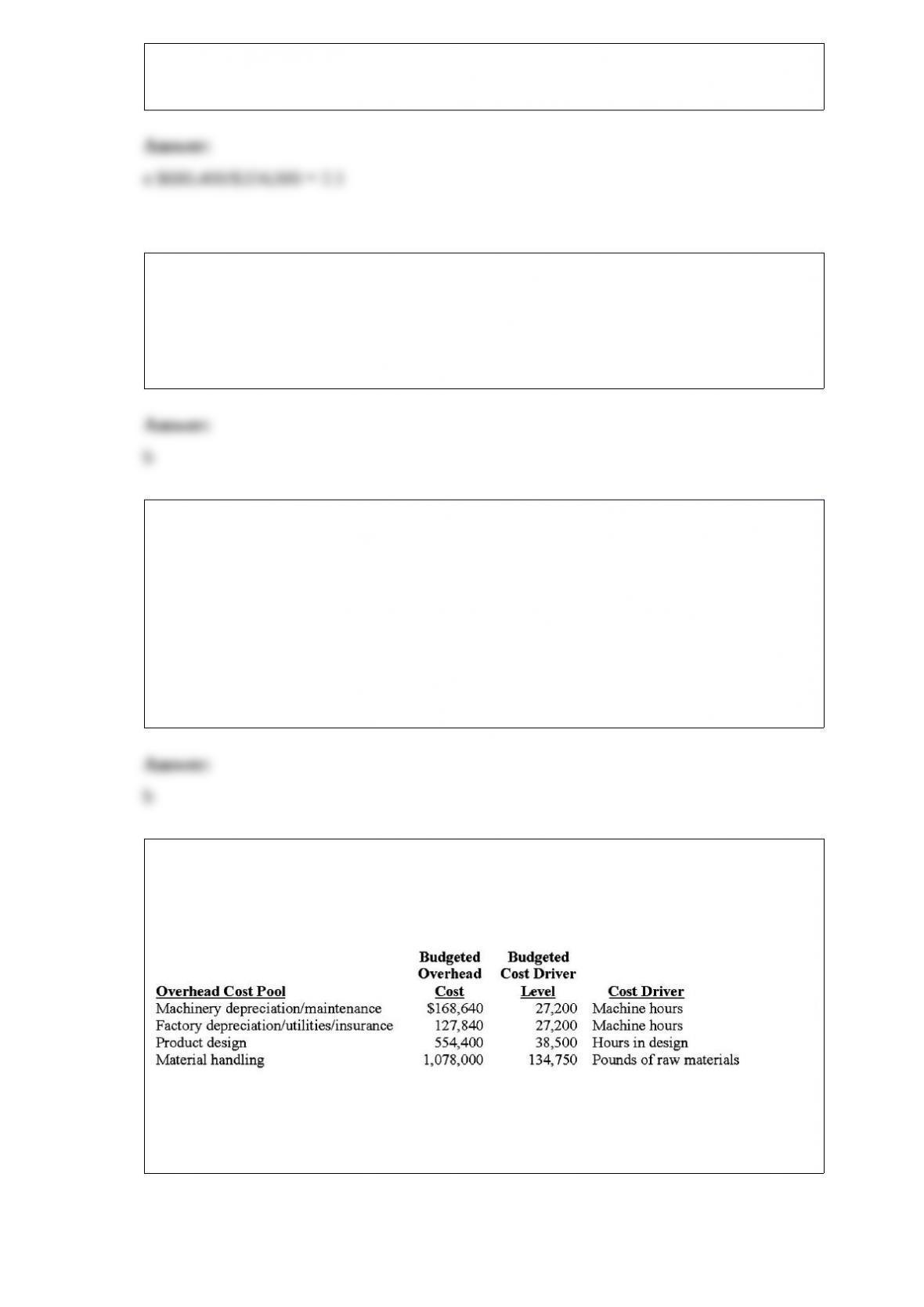
6) maple mount fishery is a canning company in astoria. the company uses a normal
costing system in which factory overhead is applied on the basis of direct labor costs.
budgeted factory overhead for the year was $680,400, and management budgeted
$324,000 of direct labor costs. during the year, the company incurred the following
actual costs.
the january 1 balances of inventory accounts are shown below.
the december 31 balances of these inventory accounts were ten percent lower.
the predetermined factory overhead rate is:
a.212% of direct labor costs
b.215% of direct labor costs
c.222% of direct labor costs
d.203% of direct labor costs
e.210% of direct labor costs
7) which of the following is not a product cost?
a.direct materials costs
b.selling costs
c.direct labor costs
d.factory overhead costs
8) based on analyzing the relationship of total factory overhead (y) to direct labor hours
(x). the following relationship was found:
y = $1,000 + $2x
the variable y in the equation is an estimate of:
a.total variable costs
b.total factory overhead
c.total fixed costs
d.total direct labor hours
9) shaver co. manufactures a variety of electric razors for men and women. the
company’s plant is partially automated. listed below is cost driver information used in
the product-costing system:
in addition, shaver expects to spend $514,368 for 8,037 direct labor-hours. two current
product orders had the following requirements:
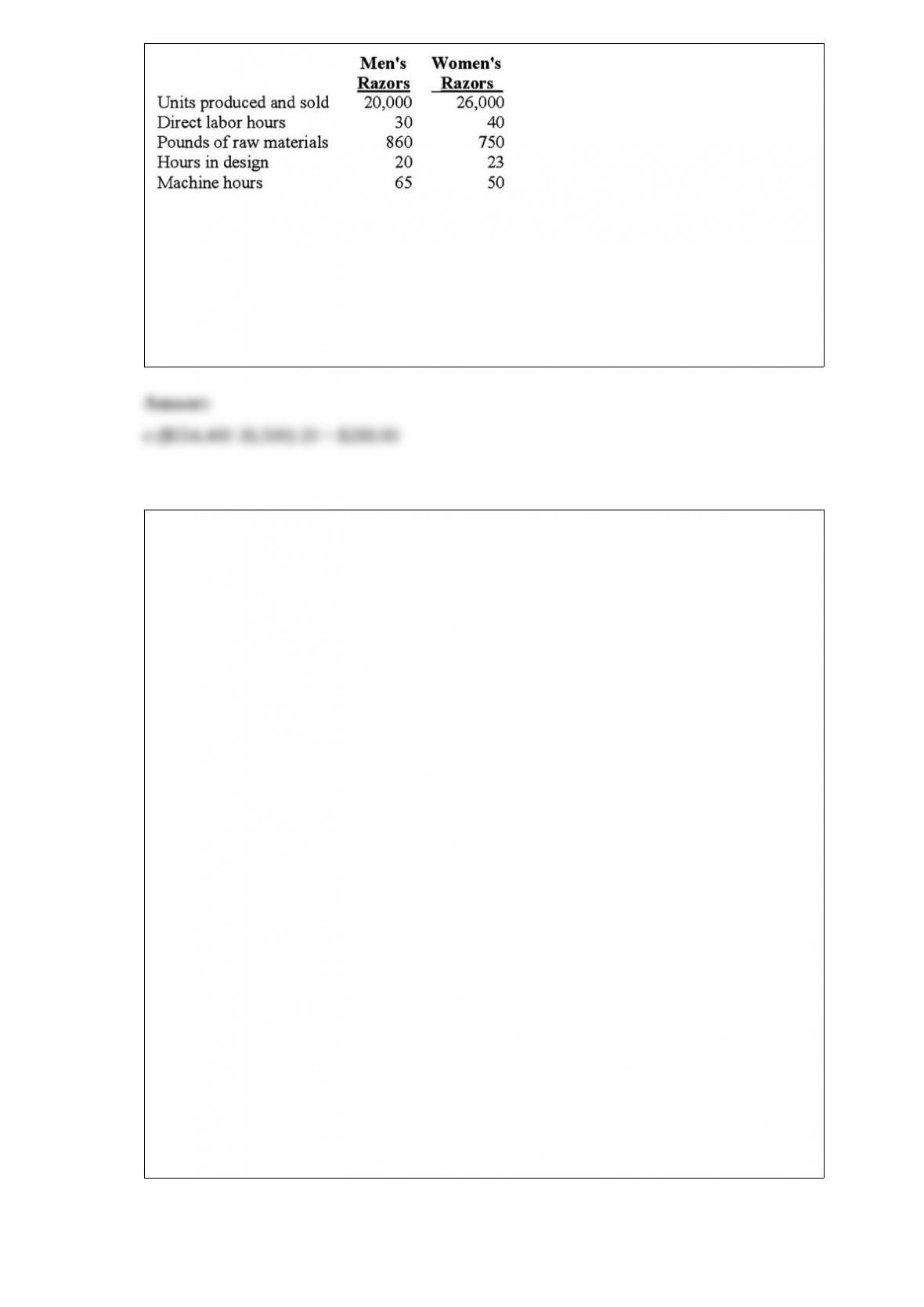
using abc, how much product-level overhead is assigned to the current order for men’s
razors?
a.$218.00
b.$250.70
c.$331.20
d.$284.00
e.$288.00
10) whittenberg distributors, a major retailing and mail-order operation, has been in
business for the past 10 years. during that time, its mail-order operations have grown
from a sideline to represent more than 80 percent of the company’s annual sales. of
course, the company has suffered growing pains. at times, overloaded or faulty
computer programs resulted in lost sales. and scheduling temporary workers to augment
the permanent staff during peak periods has always been a problem.
peter bloom, manager of mail-order operations, has developed procedures for handling
most problems. however, he is still trying to improve the scheduling of temporary
workers to take customer telephone orders. under the current system, peter keeps a
permanent staff of 60 employees who handle the base telephone workload and
supplements this staff with temporary workers as needed. the temporary workers are
hired on a daily basis; he determines the number needed for the next day the afternoon
before based on his estimate of the upcoming telephone volume.
peter has decided to try regression analysis to improve the hiring of temporary workers.
by summarizing the daily labor-hours into weekly totals for the past year, he determined
the number of workers used each week. in addition, he listed the number of orders
processed each week. after entering the data into a spreadsheet, peter ran two
regressions. regression 1 related the total number of workers (permanent staff plus
temporary workers) to the number of orders received. regression 2 related only
temporary workers to the number of orders received. the output of these analyses
follows:
regression model: w = a + bt
where:
w = workers; t = telephone orders
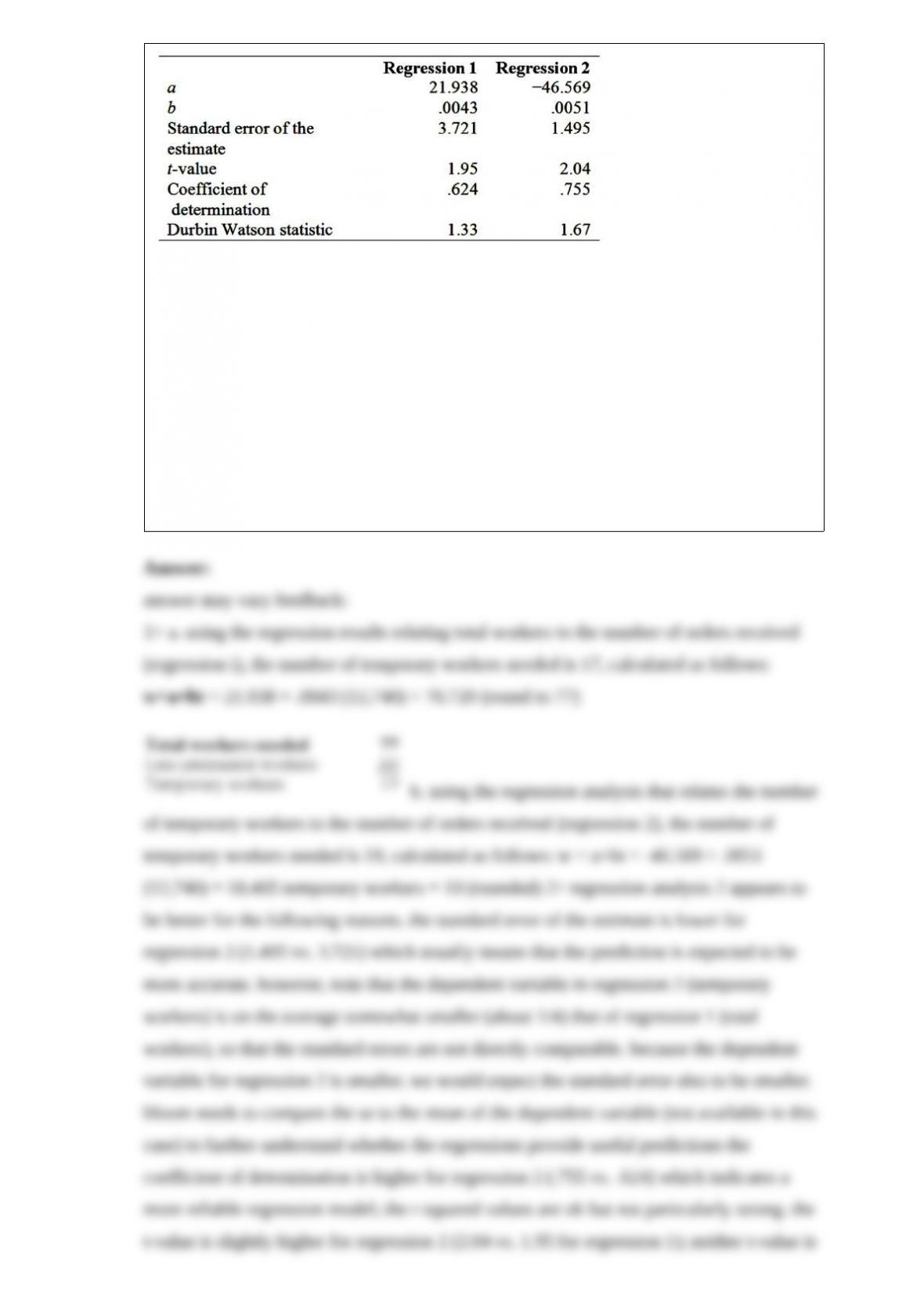
required:
1> peter bloom estimates that whittenberg distributors will receive 12,740 orders during
the second week of december.
a. predict the number of temporary workers needed for this week using regression 1 .
round your answer to the nearest whole number.
b. using regression 2, predict the number of temporary workers needed during this
week. round your answer to the nearest whole number.
2> which of the two regression analyses appears to be better? explain your answer.
3> describe at least three ways that peter bloom could improve his analysis to make
better predictions than either of these regression results provides. (cma adapted)
11) selection and employment of the correct estimation method is:
a.easy once the data is gathered
b.relatively easy because only two effective methods exist
c.dependent on the precision/cost tradeoff for the estimation objectives
d.primarily subjective in nature
e.difficult because so many effective methods are available
12) in an organization that makes furniture, which of the following is a high
value-added activity?
a.using direct materials in production
b.inspecting production
c.storing finished goods inventory
d.moving work-in-process inventory between work stations
e.reworking the product to repair defects
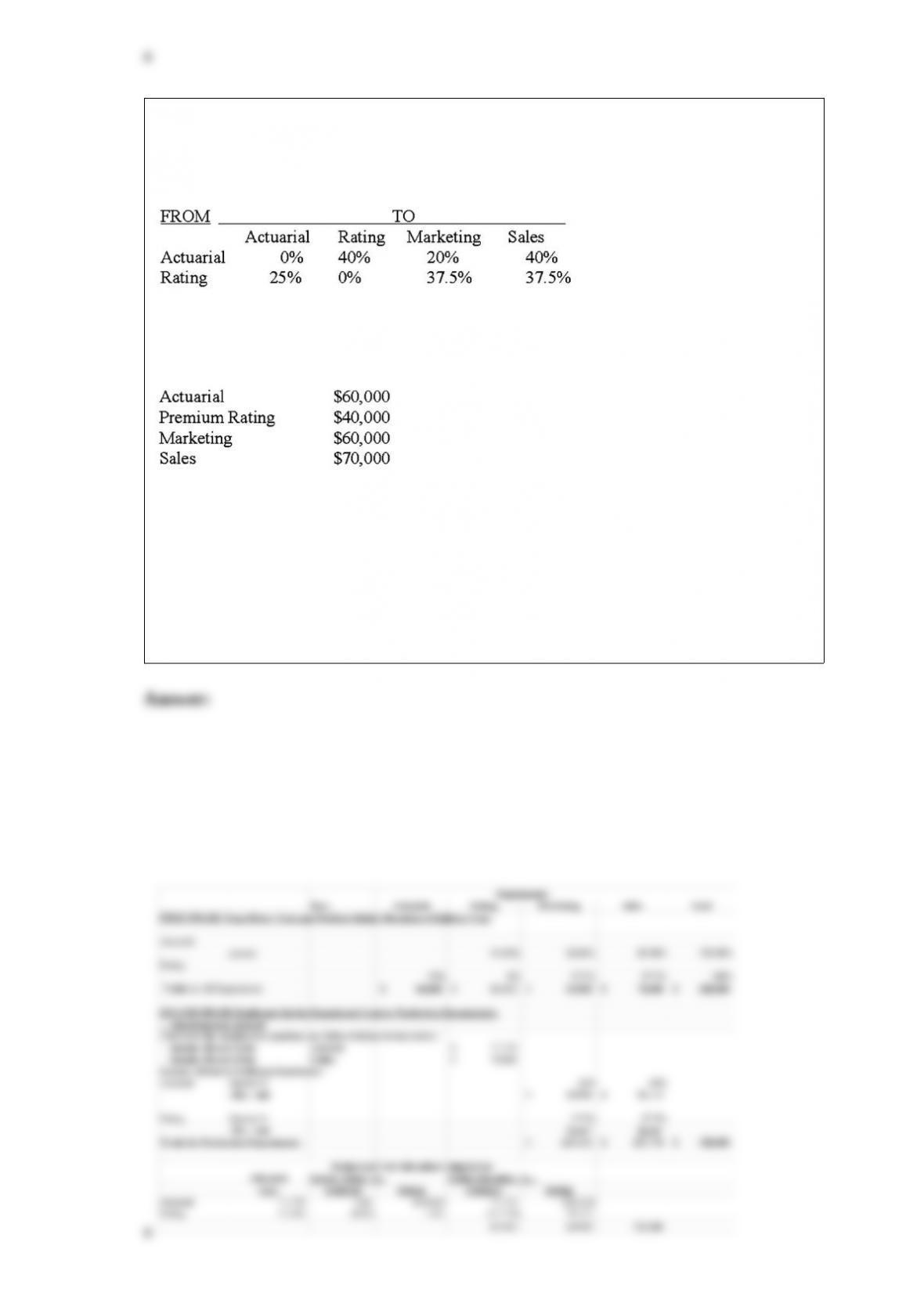
13) the long term care plus company has two service departments actuarial and
premium rating, and two production departments marketing and sales. the distribution
of each service department’s efforts to the other departments is shown below:
the direct operating costs of the departments (including both variable and fixed costs)
were as follows:
the total cost accumulated in the marketing department using the reciprocal method is
(calculate all ratios and percentages to 4 decimal places, for example 33.3333%, and
round all dollar amounts to the nearest whole dollar):
a.$102,222
b.$122,402
c.$127,778
d.$142,471
e.$150,050
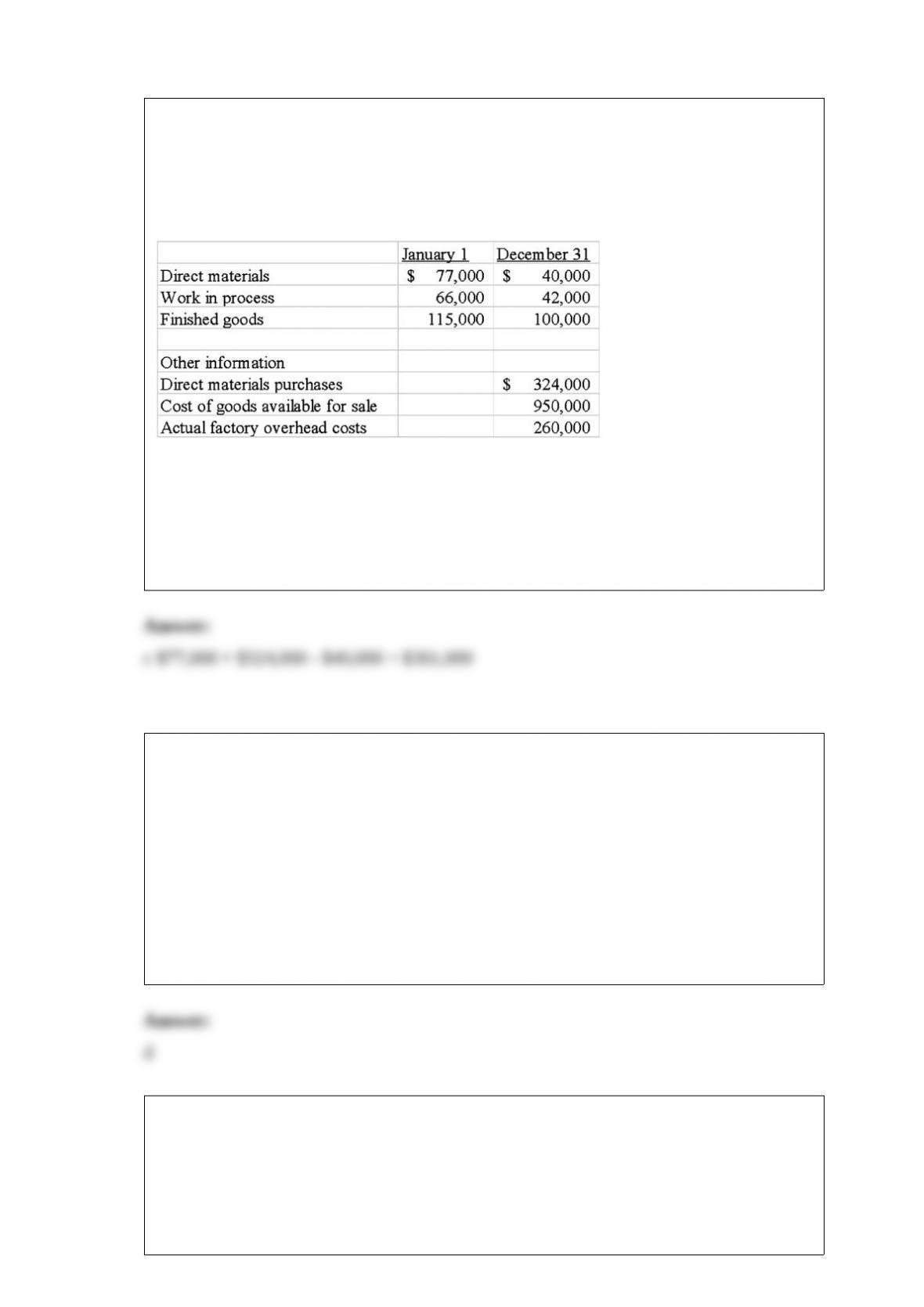
14) randall company manufactures products to customer specifications. a job costing
system is used to accumulate production costs. factory overhead cost was applied at
125% of direct labor cost. selected data concerning the past year’s operation of the
company are presented below.
the cost of direct materials used for production is:
a.$351,000
b.$297,000
c.$361,000
d.$306,000
e.$324,000
15) gralyn corp. compares two products’ margin of safety ratios (mos%). product a has
a ratio of 0.13 and product b has a ratio of 0.31 . based on this information, what should
the managers at gralyn corp. do and why?
a.they should choose product a because it will cost less than half as much to produce
b.they should choose product a because it is less risky and might require less
management attention than product b
c.they should choose product b because it will produce more than double the profit of
product a
d.they should choose product b because it is less risky and might require less
management attention than product a
16) depending on the nature of rework being done on a particular unit, the cost can be
charged to one of three specific accounts. which of the following is correct?
a.abnormal rework is charged to a loss from abnormal rework account
b.abnormal rework is charged to the work-in-process inventory account
c.normal rework for a particular job is charged to that specific job’s finished goods
inventory account

d.normal rework common to all jobs is charged to the work-in-process inventory
account
e.normal rework common to all jobs is charged to a loss from normal rework account