1) Too high a price may ________.
A) deter a customer from purchasing a product
B) increase demand for the product
C) indicate supply is too plentiful
D) decrease a competitor’s market share
2) Which of the following is an example of price discrimination?
A) Larry’s offers a 30% discount to buyers making repeat purchases within 30 days.
B) Enrique Corp sells different kind of goods at different prices.
C) Chang sells his wares at different prices based on the market conditions.
D) Nathan sells his ice-creams for a discount during winter season.
3) The revenues budget identifies ________.
A) expected cash flows for each product
B) actual sales from last year for each product
C) the expected level of sales for the company
D) the variance of sales from actual for each product
4) Which of the following formulas determine cost of goods sold in a merchandising
entity?
A) Beginning inventory + Purchases + Ending inventory = Cost of goods sold
B) Beginning inventory + Purchases – Ending inventory = Costs of goods sold
C) Beginning inventory – Purchases + Ending inventory = Cost of goods sold
D) Beginning inventory – Ending inventory – Purchases = Cost of goods sold
5) For a manufacturing-sector company, the cost of factory depreciation is classified as
a ________.
A) direct material cost
B) direct manufacturing labor cost
C) manufacturing overhead cost
D) period cost
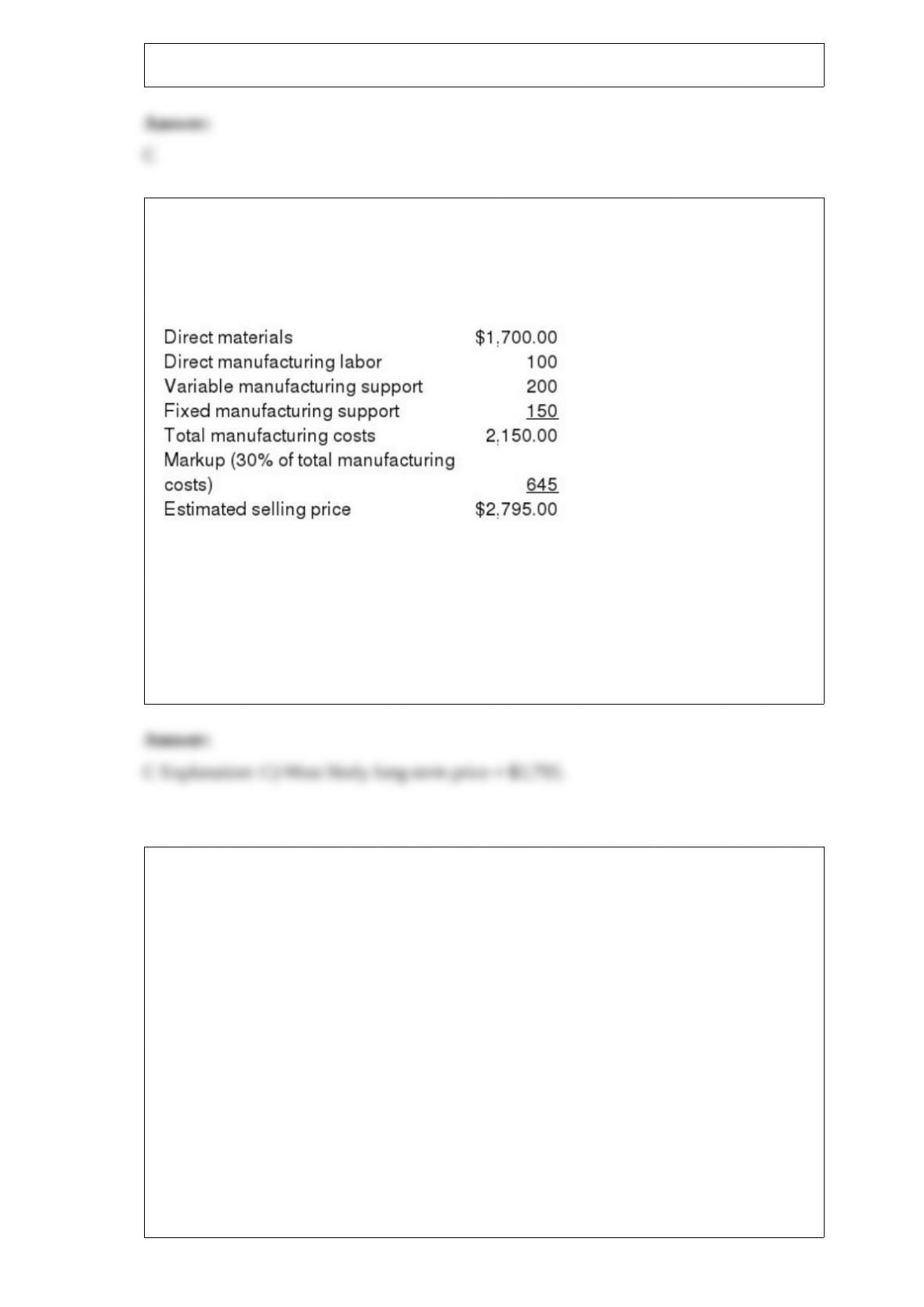
6) Golden Generator Supply is approached by Mr. Stephen, a new customer, to fulfill a
large one-time-only special order for a product similar to one offered to regular
customers. Golden Generator Supply has excess capacity. The following per unit data
apply for sales to regular customers:
If Mr. Stephen wanted a long-term commitment, and not a one-time-only special order,
for supplying this product, calculate the most likely price to be quoted assuming the
markup remains same?
A) $2,000
B) $2,150
C) $2,795
D) $2,800
7) Abby Company has just implemented a new cost accounting system that provides
two variances for fixed manufacturing overhead. While the company’s managers are
familiar with the concept of spending variances, they are unclear as to how to interpret
the production-volume overhead variances. Currently, the company has a production
capacity of 54,000 units a month, although it generally produces only 46,000 units.
However, in any given month the actual production is probably something other than
46,000.
Required:
a.Does the production-volume overhead variance measure the difference between the
54,000 and 46,000, or the difference between the 46,000 and the actual monthly
production? Explain.
b.What advice can you provide the managers that will help them interpret the
production-volume overhead variances?
8) Sales of Blair Inc. have been on a steady decline for the last 12 months. A market
research study conducted revealed that the product of Blair Inc. can be sold only for
$400 as opposed to the current market price charged of $500 per unit. Blair Inc. has
decided to revise its sales price to $400. The annual sales target volume of the product
after price revision is 200 units. Blair Inc. wants to earn 18% on its sales amount.
What is the target operating income?
A) $16,992
B) $14,400
C) $11,808
D) $3,240
9) ________ occurs when a decision’s benefits for one subunit is more than offset by
the costs to the organization as a whole.
A) Suboptimal decision making
B) Independent decision making
C) Congruent decision making
D) Departmental decision making
10) The budgeting process is most strongly influenced by ________.
A) the capital budget
B) the budgeted statement of cash flows
C) the sales forecast
D) the production budget
11) Using residual income as a measure of performance rather than return on
investment promotes goal congruence because residual income ________.
A) places importance on the reduction of underperforming assets
B) calculates a percentage return rather than an absolute return
C) concentrates on maximizing an absolute amount of dollars
D) concentrates on maximizing the return on sales
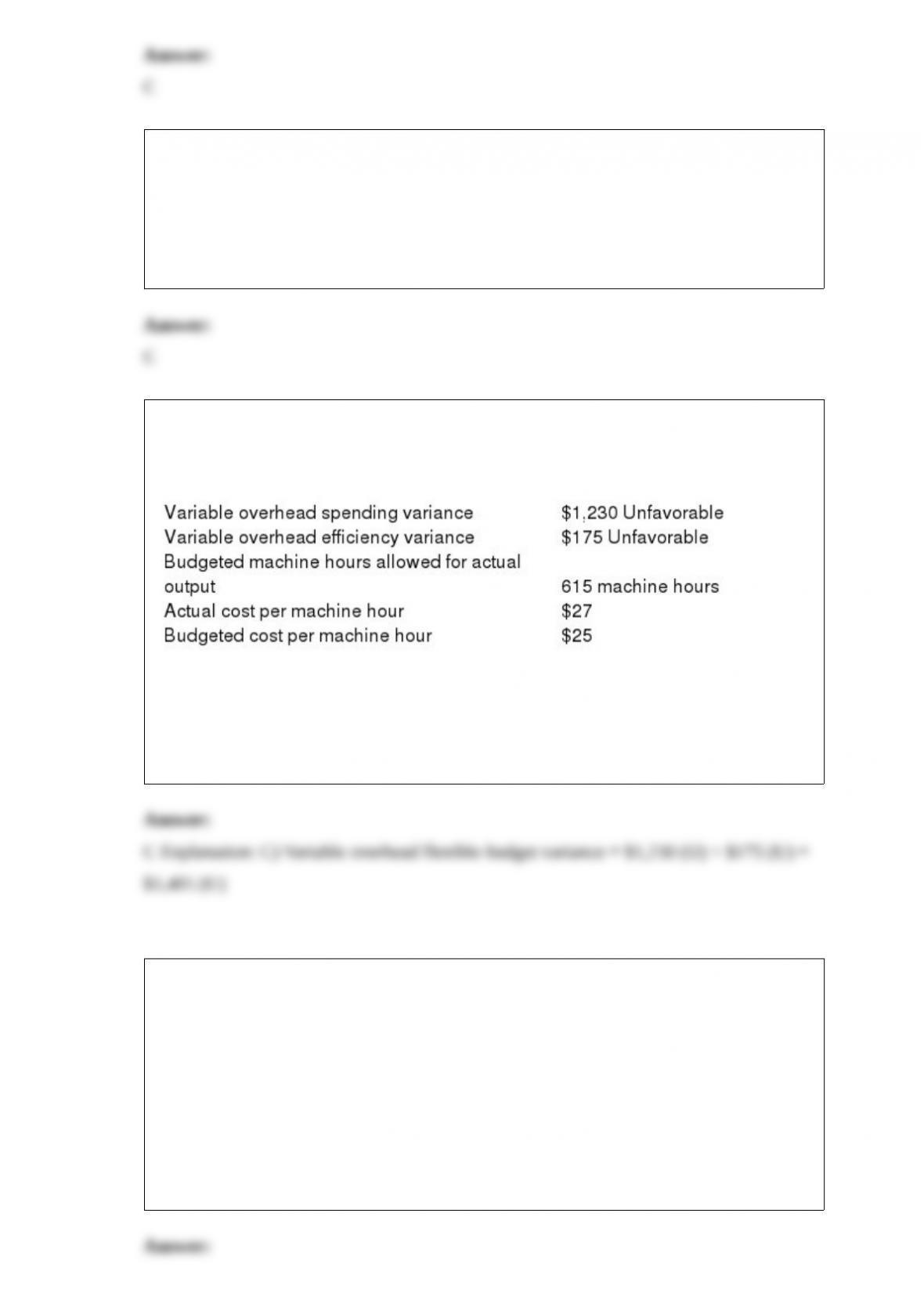
12) Ecocomfort Corporation manufactured 1,000 coolers during October. The following
variable overhead data relates to October:
Calculate the variable overhead flexible-budget variance.
A) $1,055 unfavorable
B) $1,055 favorable
C) $1,405 unfavorable
D) $1,405 favorable
13) The tool crib at a large manufacturing company is responsible for providing tools to
the factory workers on demand. The tool crib has a variable demand. Historically, its
demand has ranged from 300 to 500 small tools per day with an average of 400. Diane,
the tool crib attendant, works eight hours a day, five days a week. Each order is for one
small tool and each small tool takes Diane 1 minute to retrieve from the bins.
What is the average waiting time, in minutes?
A) 1.0
B) 1.5
C) 2.5
D) 3.5
14) In joint costing, which of the following is a market-based approach to allocating
costs?
A) sales units
B) units of production
C) physical measures
D) net realizable value