
Which of the following statements is true of sell-or-process-further decisions in joint
costing?
A) Joint costs incurred before the split-off point are relevant in deciding whether to
process the product further.
B) All separable costs in joint-cost allocations are incremental costs.
C) Separable costs incurred before the split-off point are irrelevant in deciding whether
to process the product further.
D) Costs that differ between the alternatives of selling products or processing further
are relevant.
Captain Carl’s Seascapes produces sea pictures for sale through catalogs. The company
has two workstations, photo production and framing. The photo production station is
limited by the speed of operating the photo development machine. Framing is limited
by the speed of the employees. Framing normally waits for work from photo
production. Each department works an eight-hour day. If Captain Carl’s Seascapes adds
an earlier half shift so that photo production begins work four hours earlier than
framing each day, the two departments generally finish their work at about the same
time. Not only does this eliminate the bottleneck, but it also increases finished units
produced each day by 200 units. All units produced can be sold. The cost of operating
the photo production department four more hours each day is $1310. The contribution
margin of the finished products is $20 each.
What is the change in the daily contribution margin if the change is made?
A) $250
B) $2690
C) $4000
D) $200
Globe Inc. is a distributor of DVDs. DVD Mart is a local retail outlet which sells blank
and recorded DVDs. DVD Mart purchases DVDs from Globe at $29.00 per DVD;
DVDs are shipped in packages of 65. Globe pays all incoming freight, and DVD Mart
does not inspect the DVDs due to Globe’s reputation for high quality. Annual demand is
321,000 DVDs at a rate of 6800 DVDs per week. DVD Mart earns 15% on its cash
investments. The purchase-order lead time is one week. The following cost data are
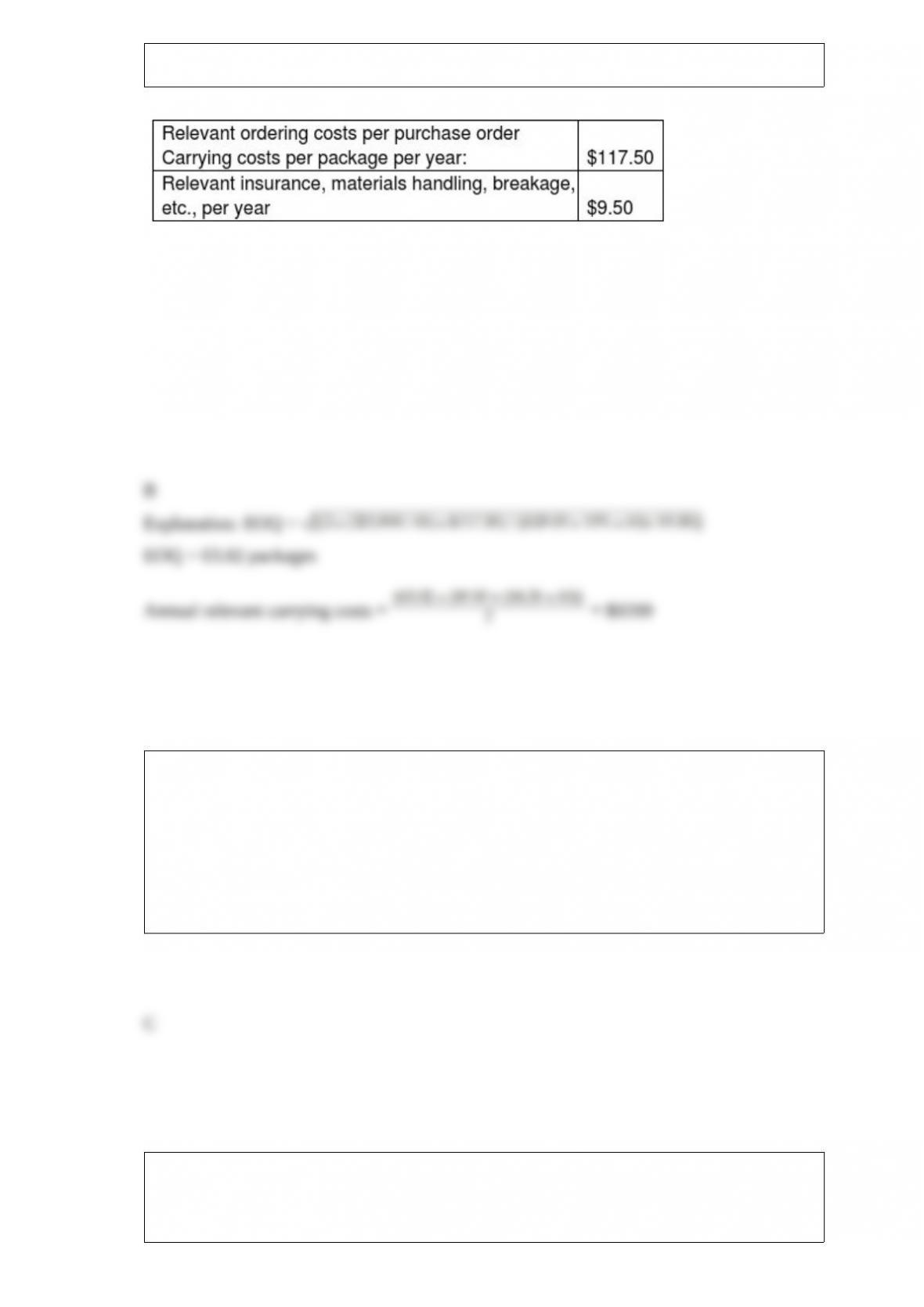
available:
What are the annual relevant carrying costs?
A) $9362
B) $9209
C) $849
D) $6511
When analyzing the change in operating income, the strategy component of
productivity ________.
A) calculations are similar to the sales-volume variance calculations
B) compares the change in output price with the changes in input prices
C) will report a large positive amount when a company has successfully pursued the
cost leadership strategy
D) isolates the change attributed solely to an increase in the quantity of units sold
To minimize the chances of violating pricing laws, a company should ________.
A) keep detailed records of variable costs for all value-chain business functions
B) use a variable cost-plus markup method of pricing
C) underprice products on a consistent basis, rather than sporadically
D) use dumping only when a product is at the end of its life cycle
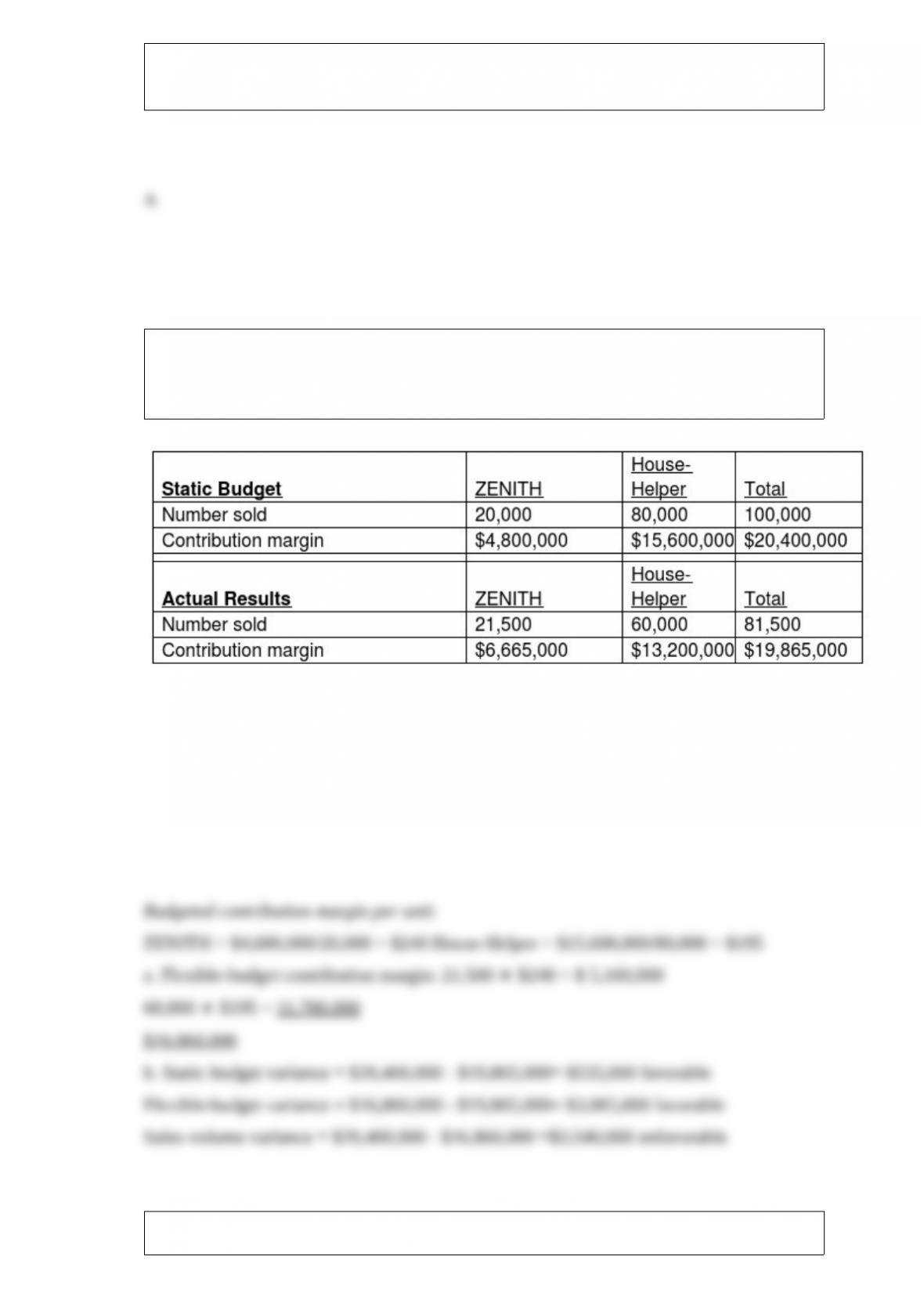
The Octova Corporation manufactures two types of vacuum cleaners: the ZENITH for
commercial building use and the House-Helper for residences. Budgeted and actual
operating data for the year 2017 are as follows:
Required:
a. Calculate the contribution margin for the flexible budget.
b. Determine the total static-budget variance, the total flexible-budget variance, and the
total sales-volume variance in terms of the contribution margin.
During 2018, Get There Corporation incurred manufacturing expenses of $200,000 to
produce 40,000 finished units. It was determined that 35,000 units were sold by the end
of November while 5,000 units remained in ending inventory. The storage cost for
December is $0.5 per unit.
Required:
a. What is the cost of producing one unit?
b. What is the amount that will be reported on the income statement for cost of goods
sold?
c. What is the cost incurred for storing the inventory?
________ is the continuing reduction in the demand for a company’s products that
occurs when competitor prices are not met.
A) Downward demand spiral
B) Competitor pricing pressure
C) Continuous step down demand
D) Super-demand cutback
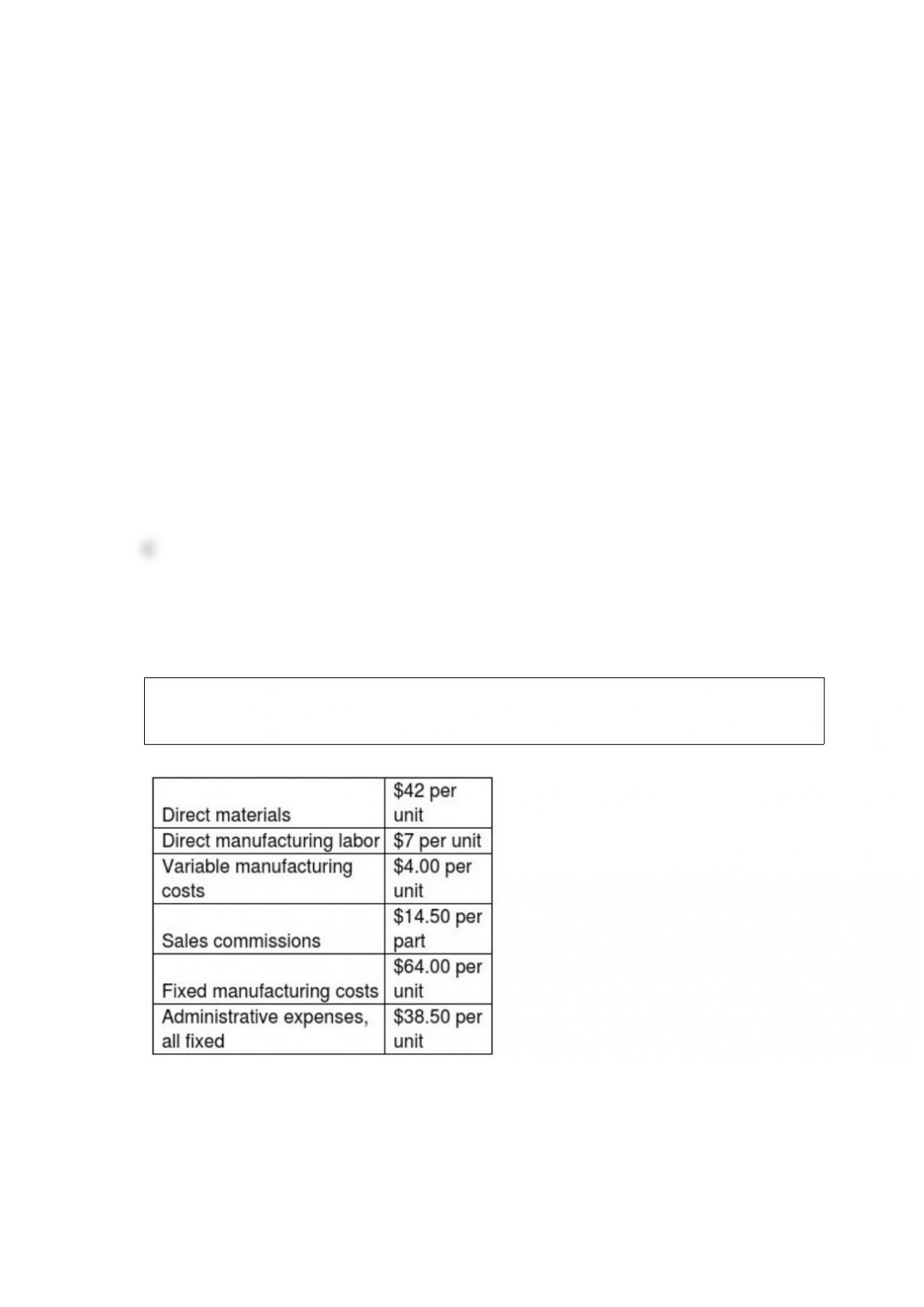
Canton Corp. manufactures two sizes of ceramic paperweights, regular and jumbo. The
following information applies to their expectations for the planning period:
Production Estimates
Production units:
Regular = 12,000,000 units
Jumbo = 24,000,000 units
Machine-hours = 400,000 mh
Labor-hours = 800,000 dlh
Expected direct costs amounts to $927,000 for the period. Support cost requirements of
both products are substantially different from one another. Zitriks uses an ABC costing
system.
Which of the following is true of Canton’s overhead costing?
A) Multiple cost pools are appropriate for Canton’s because of high direct costs.
B) Single cost pool is appropriate for Canton’s because of high direct costs.
C) Multiple cost pools are appropriate for Canton’s because of diverse support costs.
D) Single cost pool is appropriate for Canton’s because of diverse support costs.
Time Again LLC produces and sells a mantel clock for $100 per unit. In 2017, 41,000
clocks were produced and 37,000 were sold. Other information for the year includes:
What is the inventoriable cost per unit using absorption costing?
A) $49.00
B) $53.00
C) $117.00
D) $106.00
The major objectives of a budgeting process should include all of the following
EXCEPT:
A) providing coordination among the subunits
B) providing communication among the subunits
C) providing unyielding commitment to targets as a means to achieve a target profit
D) providing a framework for judging performance and facilitating learning
When using the five-step decision process, which one of the following steps should be
done first?
A) obtain information
B) choose an alternative
C) evaluation and feedback
D) implementing the decision
Time and Again Company makes clocks. The fixed overhead costs for 2017 total
$900,000. The company uses direct labor-hours for fixed overhead allocation and
anticipates 200,000 hours during the year for 330,000 units. An equal number of units
are budgeted for each month.
During June, 32,000 clocks were produced and $72,000 was spent on fixed overhead.
Required:
a. Determine the fixed overhead rate for 2017 based on units of input.
b. Determine the fixed overhead static-budget variance for June.
c. Determine the production-volume overhead variance for June.
In planning and control of capacity costs, managers must consider possible capacity
measures. Which of the following measures the available supply of capacity in a
factory?
A) Theoretical capacity
B) Practical capacity
C) Normal capacity
D) Master-budget capacity
Forge Company wants to purchase a new cutting machine for its sewing plant. The
investment is expected to generate annual cash inflows of $140,000. The required rate
of return is 10% and the current machine is expected to last for seven years. Of the
following choices, which is the dollar amount the company would be willing to spend
for the machine, assuming its life is also seven years? Income taxes are not considered.
A) $1,328,180
B) $882,000
C) $702,660
D) $681,520
Division A sells ground veal internally to Division B, which in turn, produces veal
burgers that sell for $19 per pound. Division A incurs costs of $1.25 per pound while
Division B incurs additional costs of $6.50 per pound.
Which of the following formulas correctly reflects the company’s operating income per
pound?
A) $19 – ($1.25 + $6.50) = $11.25
B) $19 – ($3.25 + $6.50) = $9.25
C) $19 – ($1.25 + $9.75) = $8.00
D) $19 – ($0.75 + $3.25 + $3.25) = $5.50
Striker 44 Corporation produces a part that is used in the manufacture of one of its
products. The costs associated with the production of 12,000 units of this part are as
follows:
Direct materials $86,000
Direct labor 130,000
Variable factory overhead 57,000
Fixed factory overhead 135,000
Total costs $408,000
Of the fixed factory overhead costs, $58,000 is avoidable.
Assuming no other use of their facilities, the highest price that McMurphy should be
willing to pay for 12,000 units of the part is ________.
A) $408,000
B) $273,000
C) $331,000
D) $351,000
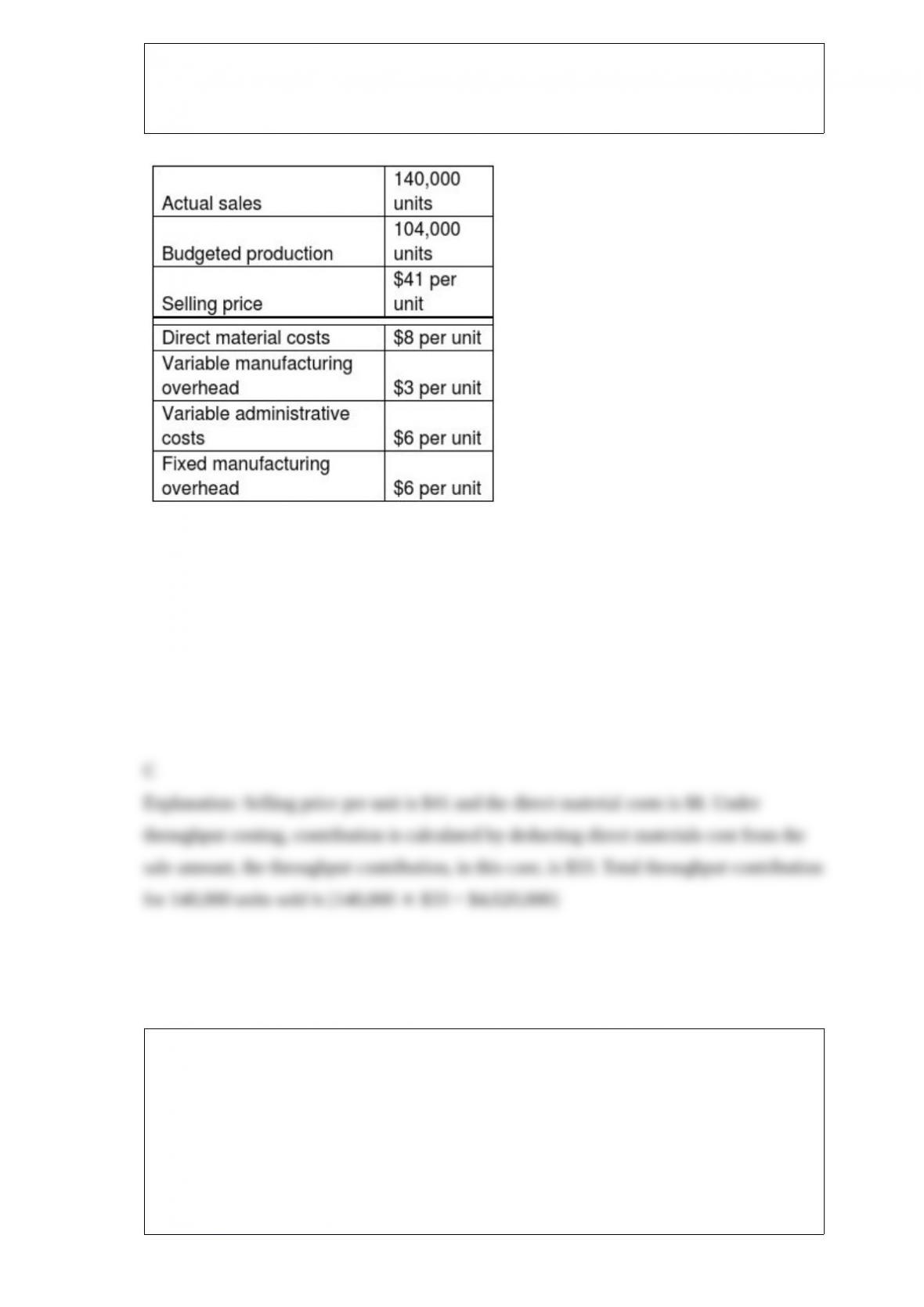
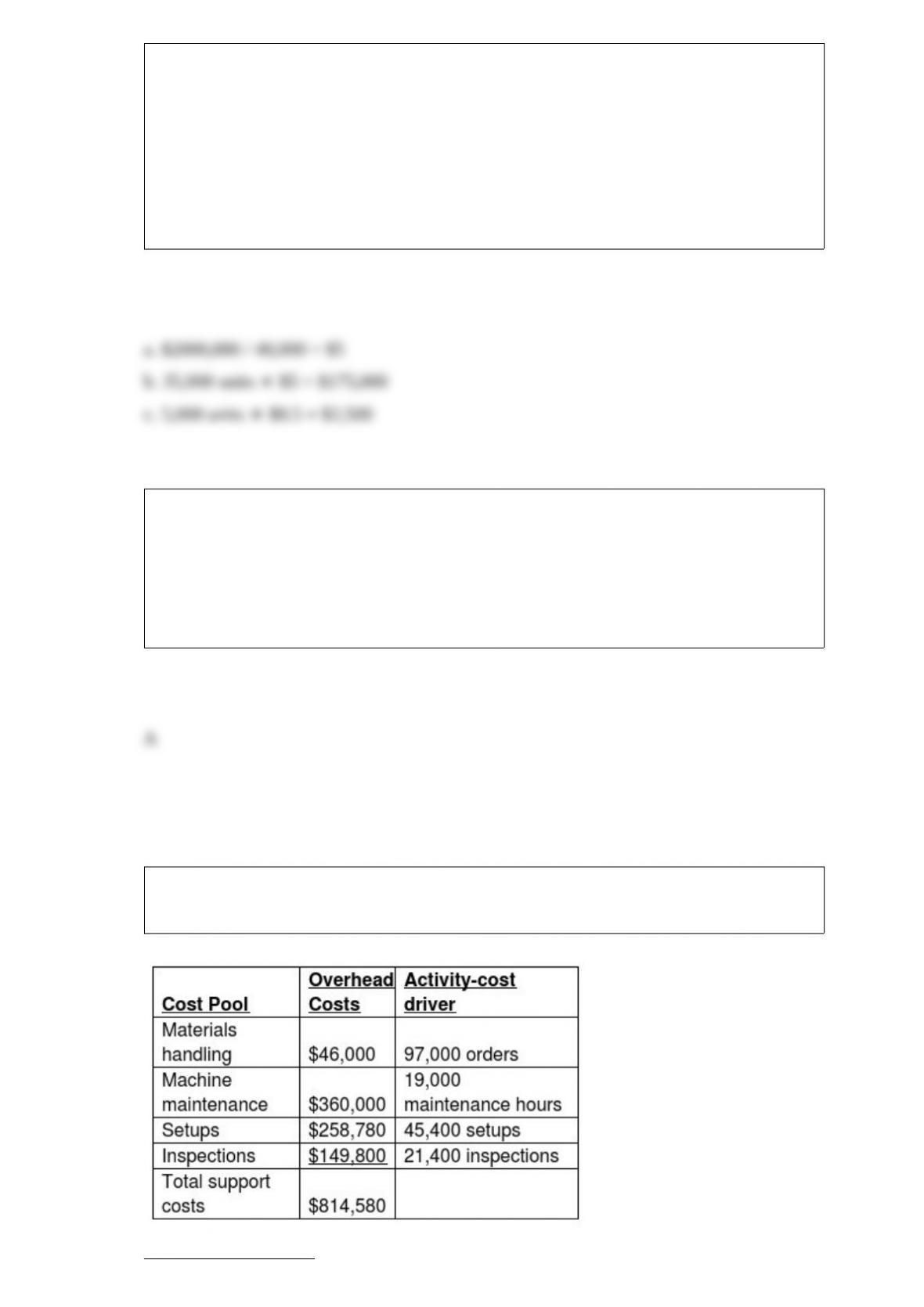
Answer the following question using the information below:
Jason Novelty Company produces a specialty item. Management has provided the
following information:
What is the total throughput contribution?
A) $3,432,000
B) $3,360,000
C) $4,620,000
D) $2,520,000
Which of the following statements is true of benchmarking?
A) It is a systematic approach of optimizing business processes.
B) It fails to help to improve organizational performance as benchmarking data does not
provide insight into why costs or revenues differ across companies.
C) It is difficult to ensure that the benchmark numbers are comparable due to the
existence of differences across companies.
D) It considers four major business aspects such as financial, customer, internal
business processes, and learning and growth.
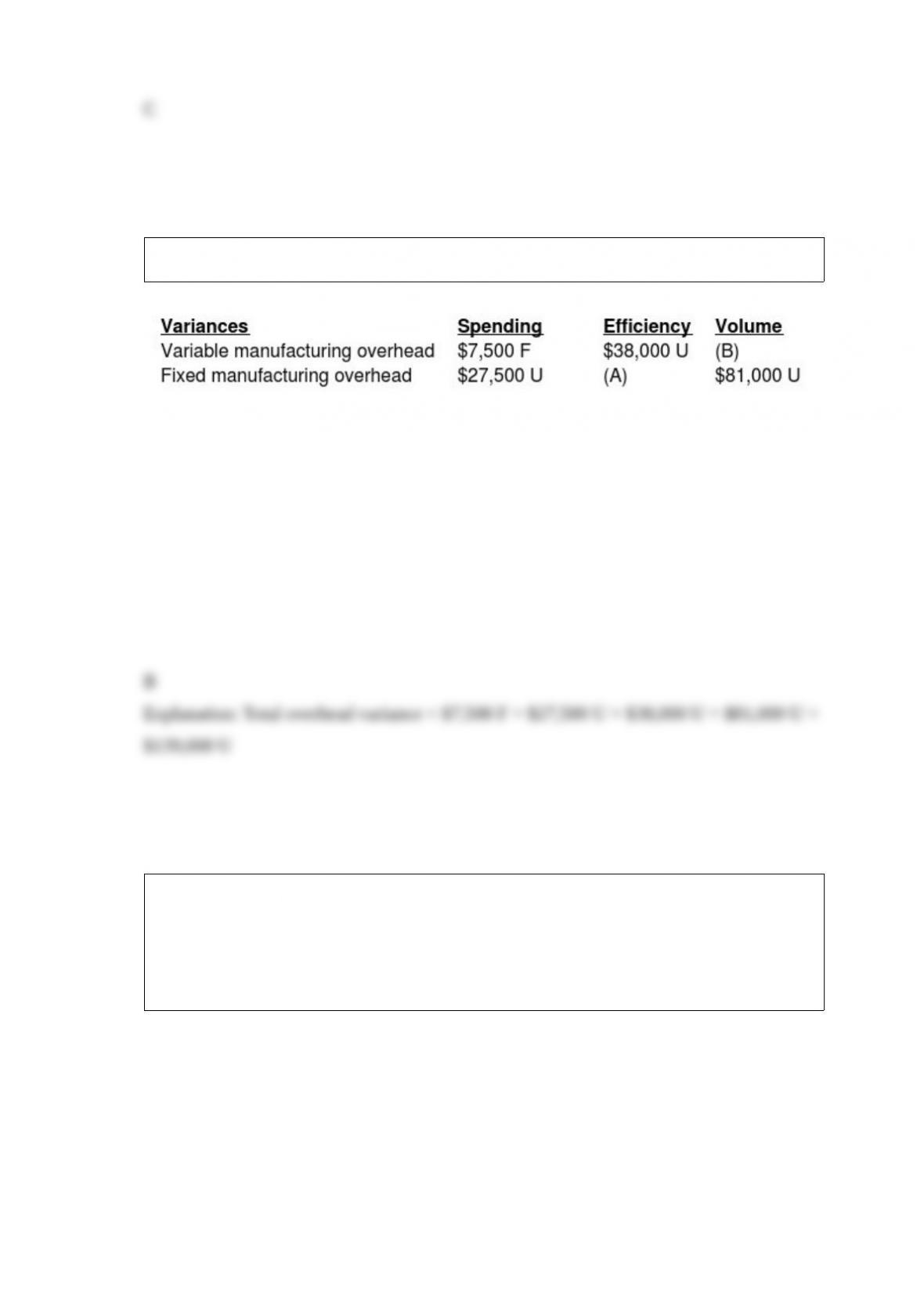
The total overhead variance should be ________.
A) $154,000 F
B) $139,000 U
C) $154,000 U
D) $139,000 F
Bismite Corporation purchases trees from Cheney lumber and processes them up to the
split-off point where two products (paper and pencil casings) emerge from the process.
The products are then sold to an independent company that markets and distributes
them to retail outlets. The following information was collected for the month of
October:
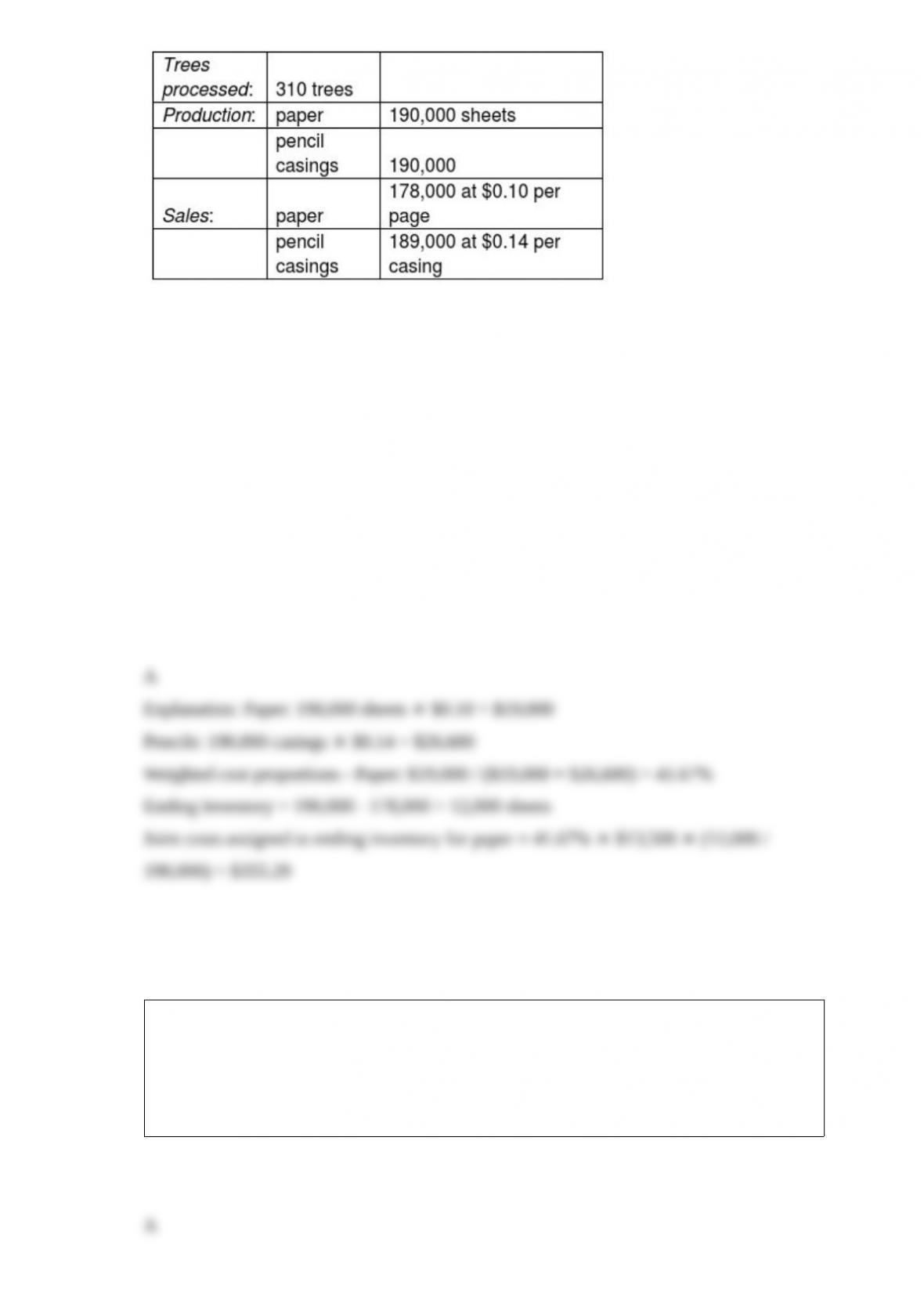
The cost of purchasing 310 trees and processing them up to the split-off point to yield
190,000 sheets of paper and 190,000 pencil casings is $13,500.
Bismite’s accounting department reported no beginning inventory.
If the sales value at split-off method is used, what are the approximate joint costs assigned
to ending inventory for paper? (Round intermediary percentages to the nearest hundredth.)
A) $355.29
B) $29.61
C) $497.34
D) $379.24
Under GAAP, only ________ can be assigned to inventories in the financial statements.
A) manufacturing costs
B) period costs
C) cost of goods sold
D) historical costs
The use of activity-based budgeting is growing because of ________.
A) the increased use of activity-based costing
B) the increased use of kaizen costing
C) increases in work-in-process inventory
D) increases in direct materials inventory
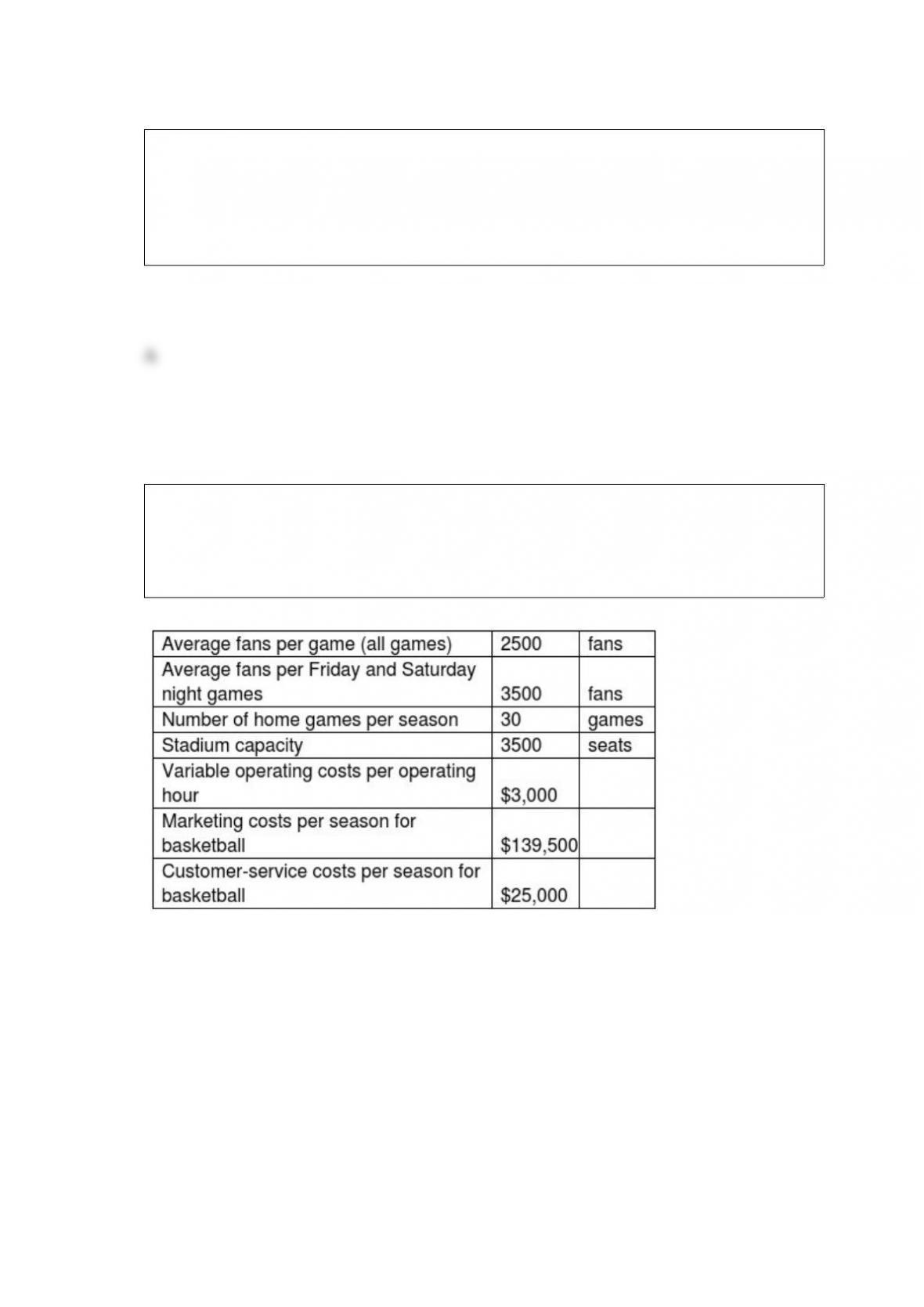
The Maize Eagles are evaluating ticket prices for its basketball games. Studies show
that Friday and Saturday night games average more than twice the number of fans
compared to other days. The following information pertains to the stadium’s normal
operations per season:
The stadium is open for 4 operating hours on each day a game is played. All employees
work by the hour except for the administrators. A maximum of one game is played per day
and each fan has only one ticket per game.
The stadium authority wants to charge more for games on Friday and Saturday. What is the
minimum price that should be charged for peak attendance nights?
A) $4.99
B) $4.80
C) $6.99
D) $209.80
The Zeron Corporation wants to purchase a new machine for its factory operations at a
cost of $380,000. The investment is expected to generate $225,000 in annual cash flows
for a period of four years. The required rate of return is 10%. The old machine can be
sold for $30,000. The machine is expected to have zero value at the end of the four-year
period. What is the net present value of the investment? Would the company want to
purchase the new machine? Income taxes are not considered.
A) $363,025; yes
B) $22,500; no
C) $350,000; yes
D) $375,650; no
Crandle Manufacturers Inc. is approached by a potential new customer to fulfill a
one-time-only special order for a product similar to one offered to domestic customers.
The company has excess capacity. The following per unit data apply for sales to regular
customers:
Variable costs:
Direct materials $170
Direct labor 90
Manufacturing support 135
Marketing costs 85
Fixed costs:
Manufacturing support 145
Marketing costs 75
Total costs 700
Markup (40%) 280
Targeted selling price $980
What is the contribution margin per unit?
A) $220
B) $280
C) $500
D) $700
When companies do not want to use market prices or find it too costly, they typically
use ________ prices, even though suboptimal decisions may occur.
A) average-cost
B) full-cost
C) long-run cost
D) short-run average cost
Which of the following is true of a budget?
A) Budgets are used to express only the operational plans and not the strategic plans of
a company.
B) Budgets do not account for nonfinancial aspects of the upcoming period.
C) Budgets are most useful when they are planned independent of the company’s
strategic plans.
D) Budgets help managers to revise their plans and strategies.
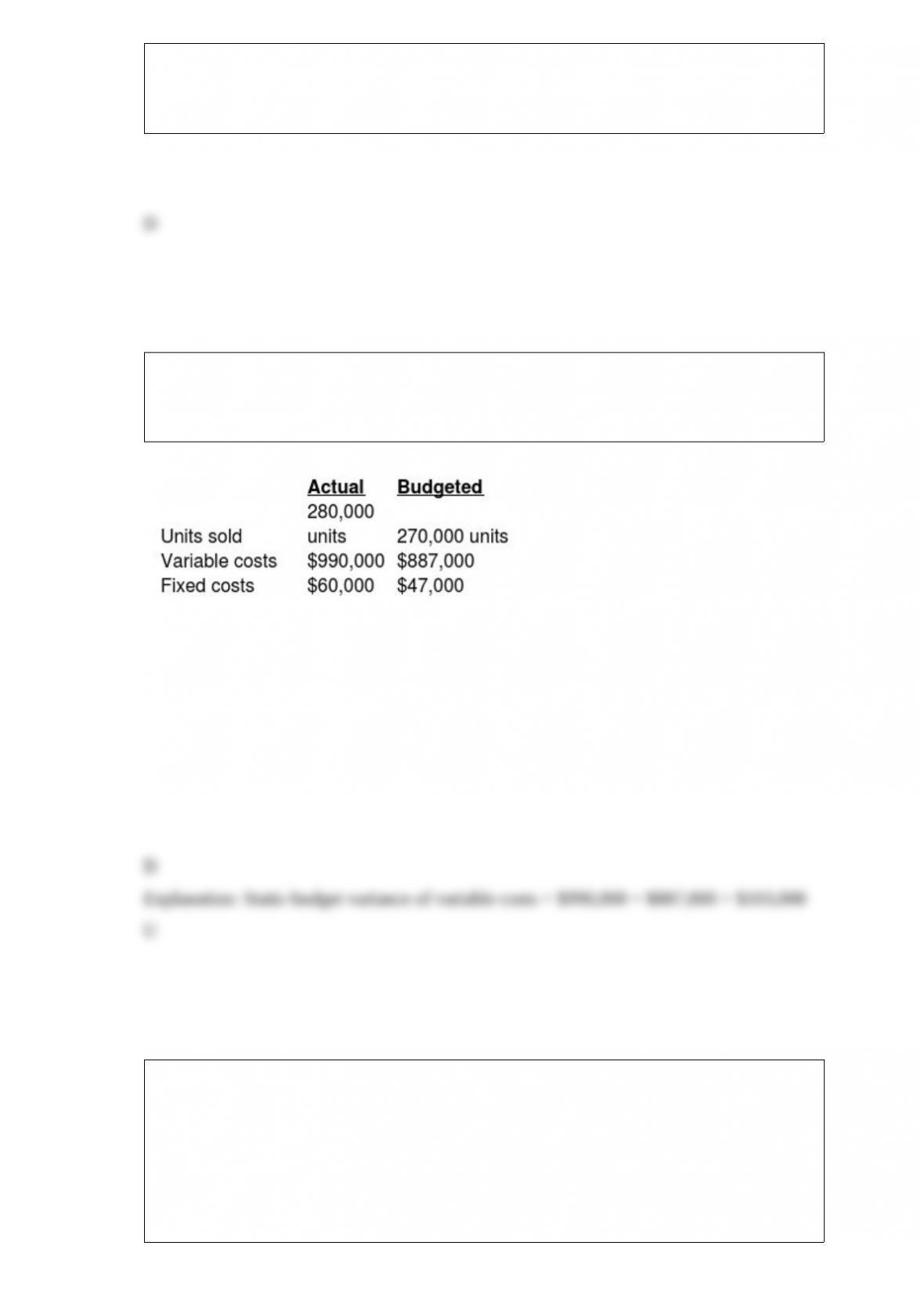
Daniels Corporation used the following data to evaluate their current operating system.
The company sells items for $19 each and had used a budgeted selling price of $20 per
unit.
What is the static-budget variance of variable costs?
A) $116,000 favorable
B) $116,000 unfavorable
C) $103,000 favorable
D) $103,000 unfavorable
Stephanie’s Bridal Shoppe sells wedding dresses. The average selling price of each
dress is $1,200, variable costs are $700, and fixed costs are $100,000. How many
dresses must the Bridal Shoppe sell to yield after-tax net income of $20,000, assuming
the tax rate is 40%?
A) 267 dresses
B) 240 dresses
C) 200 dresses
D) 400 dresses
Which of the following is a stage of the capital budgeting process that indicates
potential capital investments that agree with an organization’s strategy?
A) identify projects stage
B) make predictions stage
C) obtain information stage
D) implement the decision, evaluate performance, and learn stage
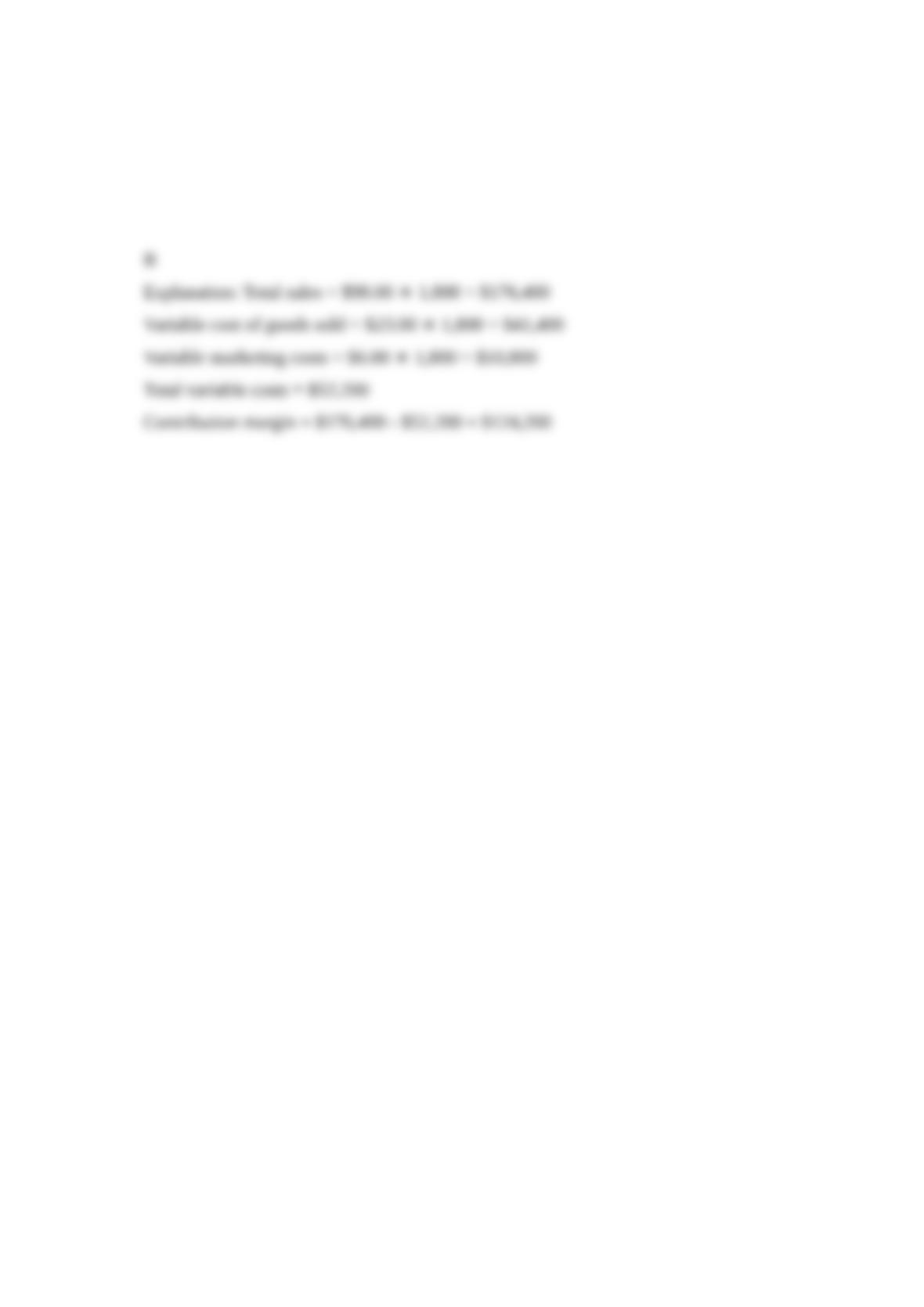
Swan Textiles Inc. produces and sells a decorative pillow for $98.00 per unit. In the first
month of operation, 2,300 units were produced and 1,800 units were sold. Actual fixed
costs are the same as the amount budgeted for the month. Other information for the
month includes:
What is the contribution margin using variable costing?
A) $135,000
B) $124,200
C) $165,600
D) $123,500