
Responsibility for ethical financial reporting rests solely with the accountant.
A bond sells at the face value when the face interest rate of the bond is identical to the
market interest rate for similar bonds on the date of the issue.
The salary allocation to partners also appears as Salaries Expense on the partnership
income statement.
Companies file their quarterly reports with the SEC on Form 8-Q.
In a common-size income statement, net sales is represented by 100 percent.

When bonds are converted to stock, no gain or loss is recognized.
Vertical analysis is the same as trend analysis.
Both the employee and the employer must bear the tax burden for unemployment
benefits.
The salary, interest, and stated ratio method of allocation can still be applied when a net
loss has occurred.

A capital lease represents both an asset and a liability.
Only the chief financial officer and the company’s CPAs must certify that, to their
knowledge, the statements are accurate and complete.
On a statement of cash flows prepared using the direct method, if certain expenses do
not require a current outlay of cash, those expenses must be subtracted from operating
expense to arrive at cash payments for operating expenses.
Assets purchased under a deferred payment plan should be recorded at the present value
of the installment payments.
In periods of rising prices, the LIFO method will result in a larger gross margin than the
FIFO method.

Sales returns and allowances are deducted from gross sales on the income statement.
Under securitization, a company sells individual receivables with recourse at a large
discount.
Regulatory agencies are considered information users with an indirect financial interest.
During the closing process, revenues are transferred to the debit side of the Income
Summary account.

Accounting for capital leases can be thought of as similar to accounting for mortgage
payments.
Owner’s equity equals assets minus liabilities.
When a petty cash fund is established, the entry contains a credit to Cash.
All the interest income on U.S. Treasury bills is recorded at maturity.
When the cost of inventory is written down due to a market decline, a loss must be
recorded.

Natural resources are classified as intangible assets on the balance sheet.
One way a company can manage its expenditures is to rely on its creditors to give it
time to pay for purchases.
Proper control procedures can guarantee the prevention of theft.
As the interest coverage ratio declines, the risk for creditors also declines.

On a statement of cash flows prepared using the direct method, if Income Taxes
Payable decreased during the accounting period, cash payments for taxes will be less
than the expense shown on the income statement.
Reversing entries can be made for accruals, but not for deferrals.
The average-cost method under a periodic inventory system relies on a simple average
calculation as total cost of goods available for sale divided by the total units availabler
for sale.
Entering into a lease is an example of off-balance-sheet financing.
Deferred income taxes are a type of long-term liability that result from using different
accounting methods to calculate income taxes on the income statement and income tax

liability on the income tax return.
The convention of consistency pertains to the use of the same accounting principles by
firms in the same industry.
In a small business, active involvement by the owner can be a practical substitute for
the separation of some duties.
Effective internal control requires a department to purchase supplies on its own.
Market interest rate is another term for effective interest rate.
Use the following information to obtain the ratios requested below. Where necessary,
carry answers to one decimal place.
Dividends per share: $1.14
Market price per share: $54
Net income: $118,000
Stockholders’ equity, beginning of year: $500,000
Stockholders’ equity, end of year: $530,000
Earnings per share: $1.75
a. Dividends yield = _____________%
b. Return on equity = _____________%
c. Price/earnings (P/E) ratio = __________ times
How would the collection of an account receivable affect the current ratio and the quick
ratio, respectively?
A. No effect on current ratio; increase in quick ratio
B. Increase in current ratio; increase in quick ratio
C. No effect on current ratio; no effect on quick ratio
D. Decrease in current ratio; decrease in quick ratio
Which of the following statements best describes predictive value?
A. Helps capital providers make decisions about future actions.
B. Provides all information necessary for a reliable decision.
C. Enables users to identify similarities and differences.
D. Enables users to comprehend the meaning of the information.
The cost of tearing down a building on land just purchased should be
A. debited to the Land account.
B. debited to the Land Improvements account.
C. debited to the Buildings account.
D. expensed immediately.
A partner invests into a partnership a building with a $50,000 carrying value and
$40,000 fair market value. The related mortgage payable of $25,000 is assumed by the
partnership. The entry to record the investment in partnership is:
Which of the following accounts most likely would be found on both a trial balance and
an adjusted trial balance?
A. Utilities Expense
B. Insurance Expense
C. Supplies Expense
D. Depreciation Expense–Equipment

The statement of cash flows would disclose the withdrawal of cash by the owner
A. in the financing activities section.
B. in the investing activities section.
C. in the operating activities section.
D. nowhere on the statement.
A contingent liability is best described as a(n)
A. current liability.
B. probable liability.
C. potential liability.
D. estimated liability.
A partner has a capital balance of $40,000 for five months, $50,000 for six months, and
$60,000 for one month. The average capital balance is
A. $49,168
B. $50,000
C. $48,500
D. $46,667
Which of the following items would be considered a revenue expenditure?
A. Plant assets
B. Routine maintenance
C. Addition
D. Betterment
An example of vertictal analysis is
A. common-size statements.

B. trend analysis.
C. ratio analysis.
D. profitability analysis.
A specialized piece of equipment closely associated with a mine is most likely to be
depreciated over a shorter than normal useful life because the
A. equipment will be fully utilized.
B. income tax laws require that a shorter life be used.
C. equipment contains certain defects.
D. mine is expected to be fully depleted in the shorter length of time.
Which of the following describes a joint venture?
A. Entities with limited lives that a company creates to achieve a specific objective.
B. An association of two or more entities for the purpose of achieving a specific goal.
C. Corporations that U.S. tax laws treat as partnerships, and they do not pay income
taxes.
D. A special type of partnership that confines the limited partner’s potential loss to the
amount of his or her investment.
The higher the interest rate assumed, the
A. higher the present value of an ordinary annuity.
B. more one must deposit today to accumulate to a desired sum.
C. lower the future value of a sum invested in the bank today.
D. lower the present value of a sum due in the future.
A company recorded office supplies in an asset account when the supplies were
purchased. Failure to take inventory and make an adjusting entry will result in an

A. understatement of liabilities.
B. understatement of owner’s equity.
C. understatement of assets.
D. overstatement of owner’s equity.
If net sales total $50,000, beginning accounts receivable was $10,000, and ending
accounts receivable is 16,000, what is the receivables turnover?
A. 1.9 times
B. 3.1 times
C. 3.8 times
D. 5 times
Which of the following documents would be sent to the treasurer?
A. Purchase order
B. Invoice
C. Check authorization
D. Bank statement
The future value of an ordinary annuity table would not include the factor
A. 0.909.
B. 2.010.
C. 20.300.
D. 1.000.
Pelican Company issued $200,000 of 20-year, 6 percent bonds at 98 on one of its
semiannual interest dates. The straight-line method of amortization is to be used. After
seven years, what is the carrying value of the bonds?

A. $196,700
B. $197,400
C. $198,600
D. $199,300
Which pair of accounts follows the rules of debit and credit in the same manner?
A. Service Revenue and Equipment
B. Land and Withdrawals
C. Notes Payable and Buildings
D. Wages Expense and Service Revenue
In a common-size balance sheet for a retail store, the 100 percent amount is for
A. total liabilities.
B. total property, plant, and equipment.
C. total assets.
D. total current assets.
Russell Corporation issued $224,000 of 12 percent bonds (at face value) one month
after the last semi-annual interest date. Which of the following is the entry to record the
issuance?
A. Cash 226,240
Bonds Payable 224,000
Bond Interest Expense 2,240
B. Cash 226,240
Bonds Payable 226,240
C. Cash 212,800
Bond Interest
Expense 11,200
Bonds Payable 224,000
D. Cash 235,200

Which of the following most likely is an estimated liability?
A. Liability for vacation pay
B. Payroll liabilities
C. Unearned revenues
D. Current portion of long-term debt
In the United States, insider trading is considered
A. unethical, but not illegal.
B. neither unethical nor illegal.
C. both unethical and illegal.
D. illegal, but not unethical.
Use this balance sheet and income statement to answer the following question. Use
ending balances whenever average balances are required for computing ratios.
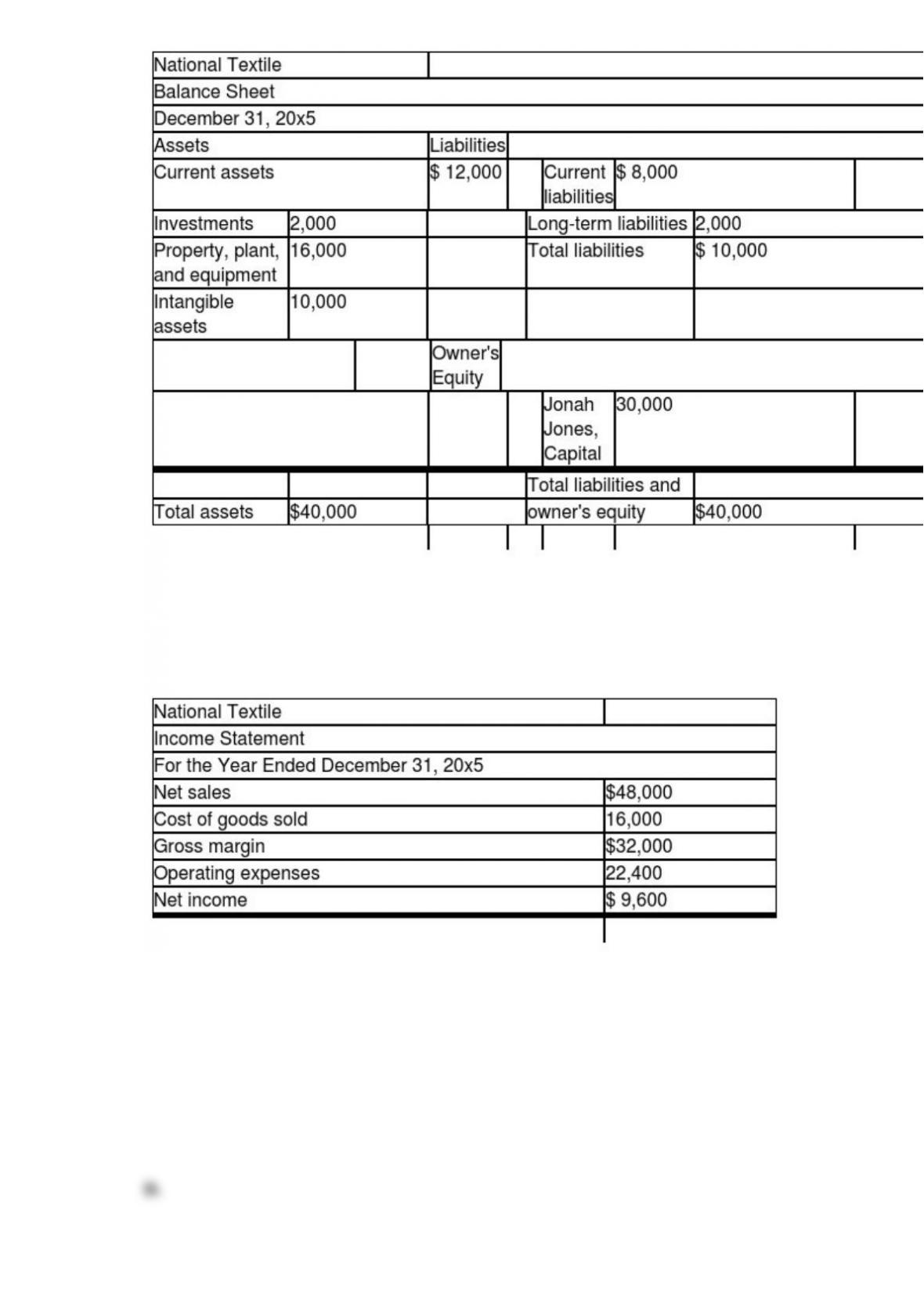
The return on equity for National Textile is
A. 40 percent.
B. 67 percent.
C. 47 percent.
D. 32 percent.
Using the following transactions, calculate (A) the ending balance of Cash, (B) the
ending balance of Accounts Receivable, (C) total liabilities, and (D) Owner’s Equity at
the end of the period. For parts a, b, and d, indicate whether each balance is debit or
credit.
a. Opened business by investing $50,000 in cash.
b. Billed customers for services rendered, $10,000.
c. Paid for six months’ subscription in advance, $2,500.
d. Received advertising bill, to be paid next week, $500.
e. Withdrawals of $4,000 were made by the owner.
f. Received $7,500 from customers billed in b.
g. Paid half of advertising bill.
h. Received $1,000 in advance of performing a service.
Public companies are required to
A. have an independent audit of financial statements.
B. have an audit of the internal control systems.
C. fully document and certify the company’s system of internal controls.
D. do all of these.
Which of the following is not a characteristic of all long-term assets?
A. Possess physical substance
B. Not for resale
C. Used in operations of business
D. Useful life of more than a year
Term bonds are bonds that
A. are also called serial bonds.
B. may be called in and redeemed by the issuing corporation prior to their scheduled
maturity date.
C. are secured by specific assets of the issuing corporation.
D. mature in one lump sum at a single maturity date.
Brendan Company sold merchandise worth $1,600 on credit, terms n/15 and on the next
day the customer returned merchandise worth $100, which cost $60 for Brendan
Company. What is the required journal entry to record the merchandise returns under
the perpetual inventory system?
A. Accounts Receivables 100
Sales Returns and Allowances 100
Cost of Goods Sold 60
Merchandise Inventory 36
B. Sales Returns and Allowances 100
Accounts Receivables 100
Merchandise Inventory 60
Cost of Goods Sold 60
C. Accounts Receivables 100
Merchandise Inventory 100
Cost of Goods Sold 60
Sales 60
D. Merchandise Inventory 100
Describe at least three reasons why a corporation would want to buy back its own stock.
What purpose is served by a factoring arrangement? What does it mean to factor
accounts receivable with recourse?
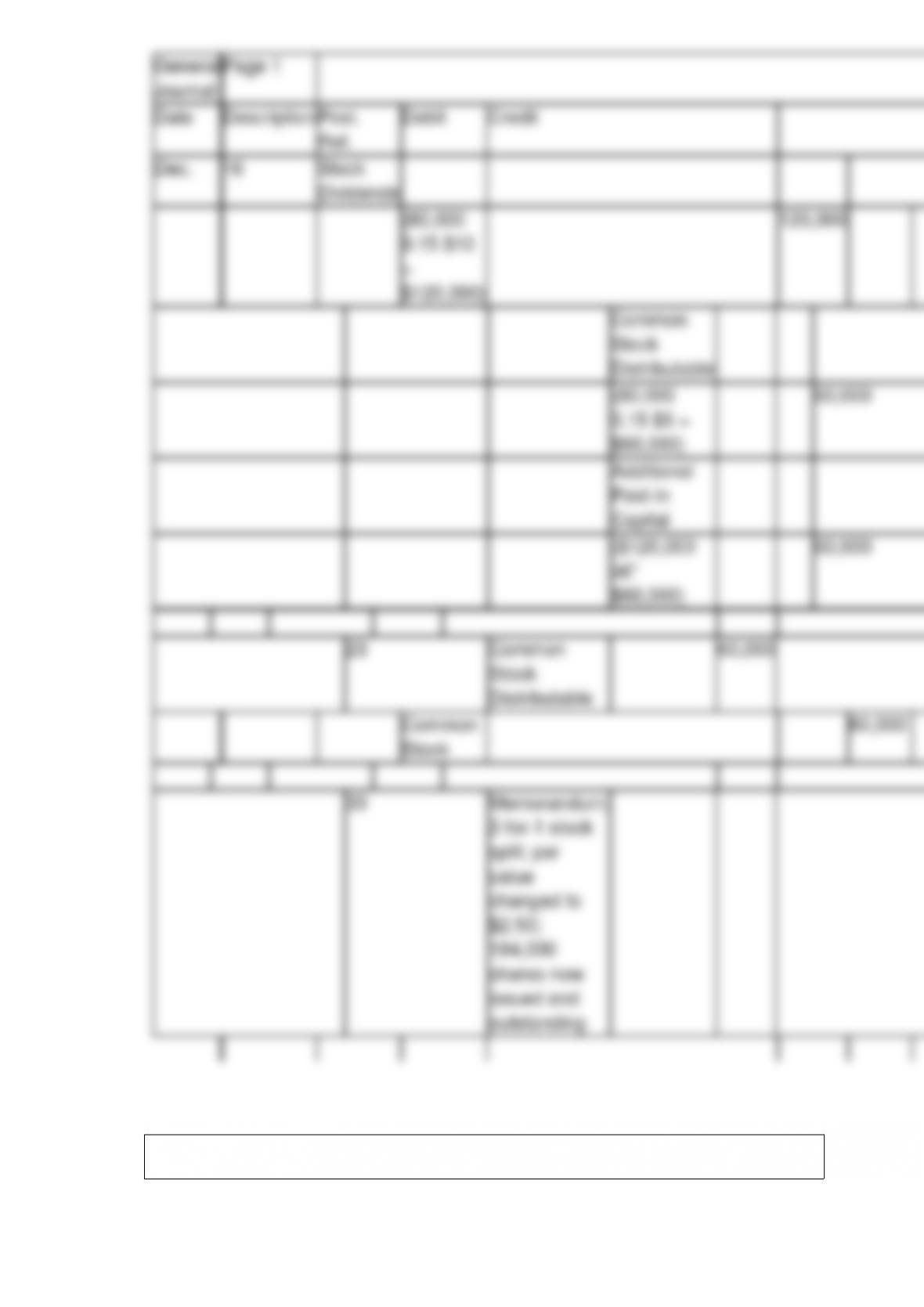
Stetson Corporation has 80,000 shares of $5 par value common stock outstanding.
Prepare entries in journal form without explanations for the following transactions.
(Market value of the stock was $10.00 on December 16 and $12.00 on December 23.)
35 times {$45,000 .
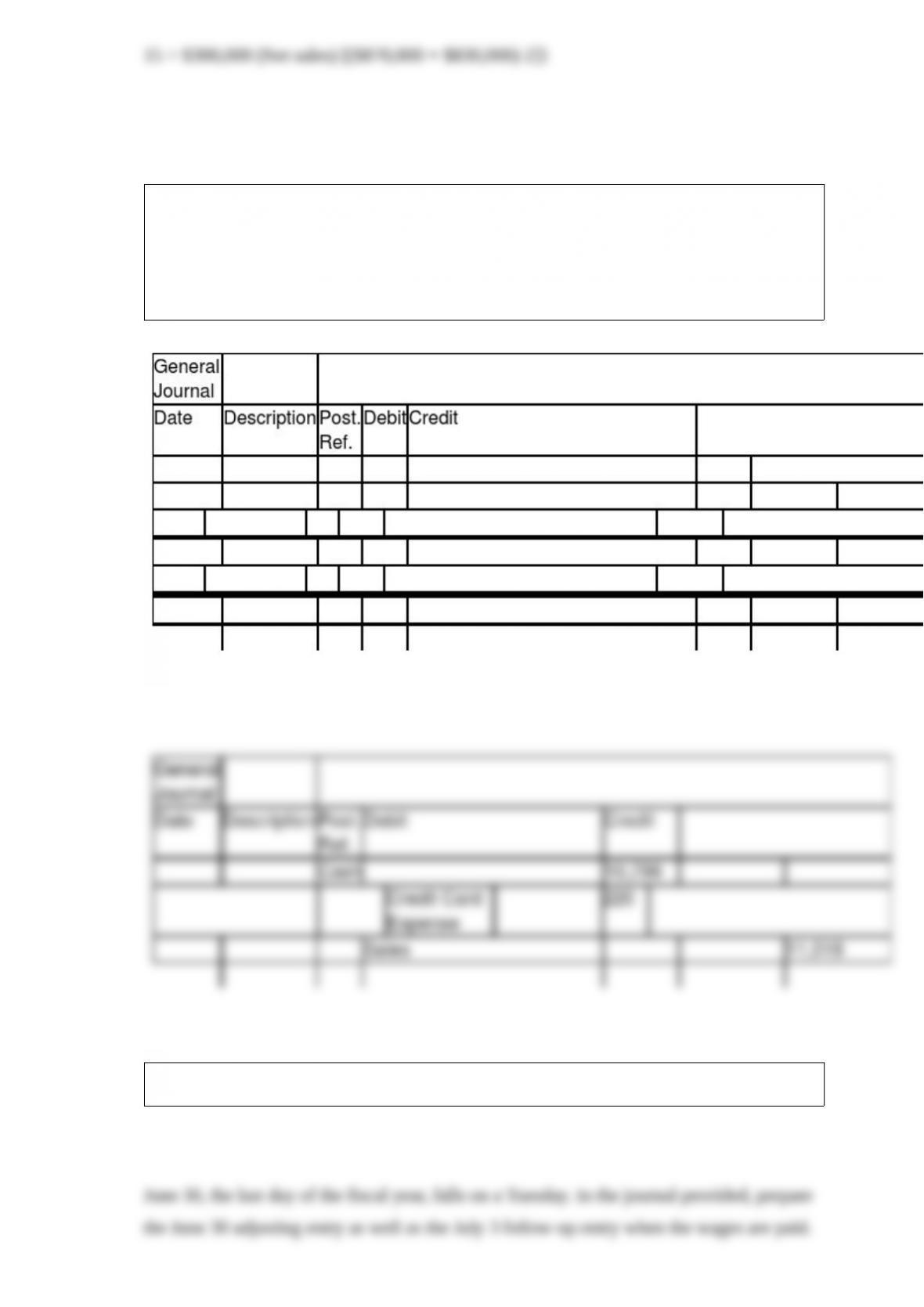
Assume that the $11,018 sales made by Advantage Medical Company for the month
ended December 31, 20×5, were made to customers using credit cards. Prepare one
entry in journal form to record these sales assuming that all of the credit card companies
charge Advantage Medical a 2 percent discount fee. (Omit date.) Round to the nearest
whole dollar.
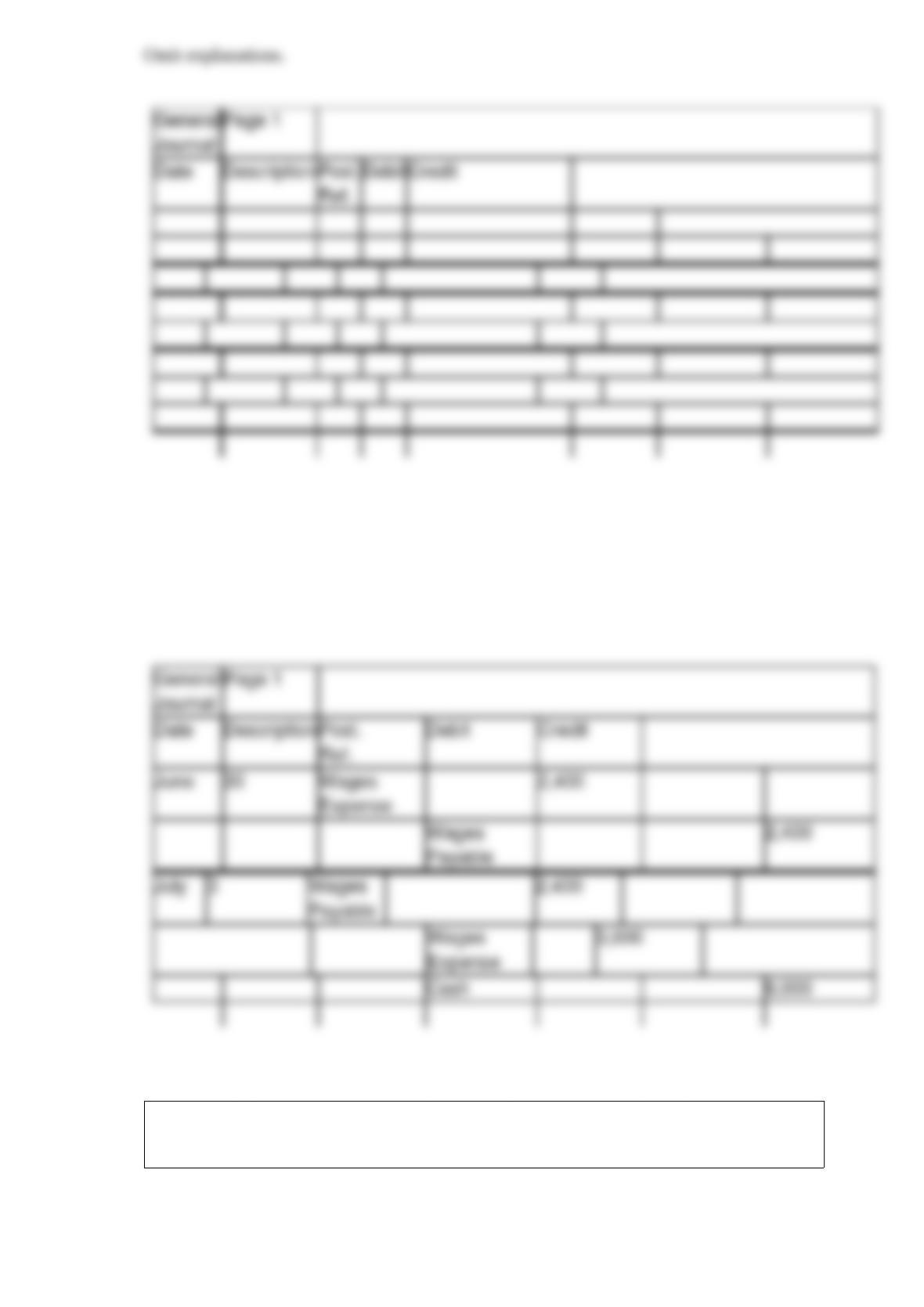
Erwin Press pays wages of $6,000 every Friday for a five-day workweek.
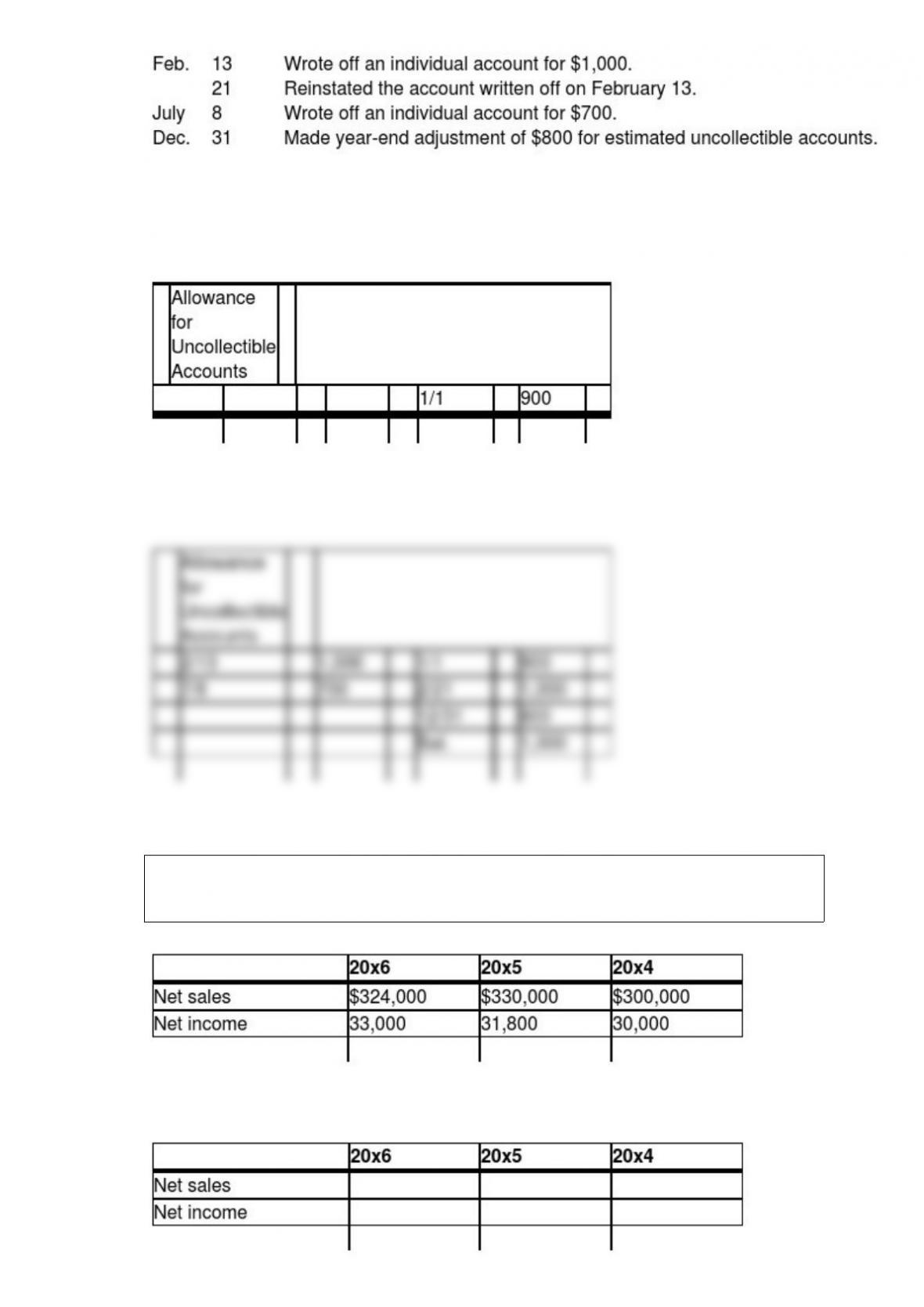
Using the following transactions for 2014, show how the T account below would appear
after all appropriate postings have been made. Assume an opening balance of $900.
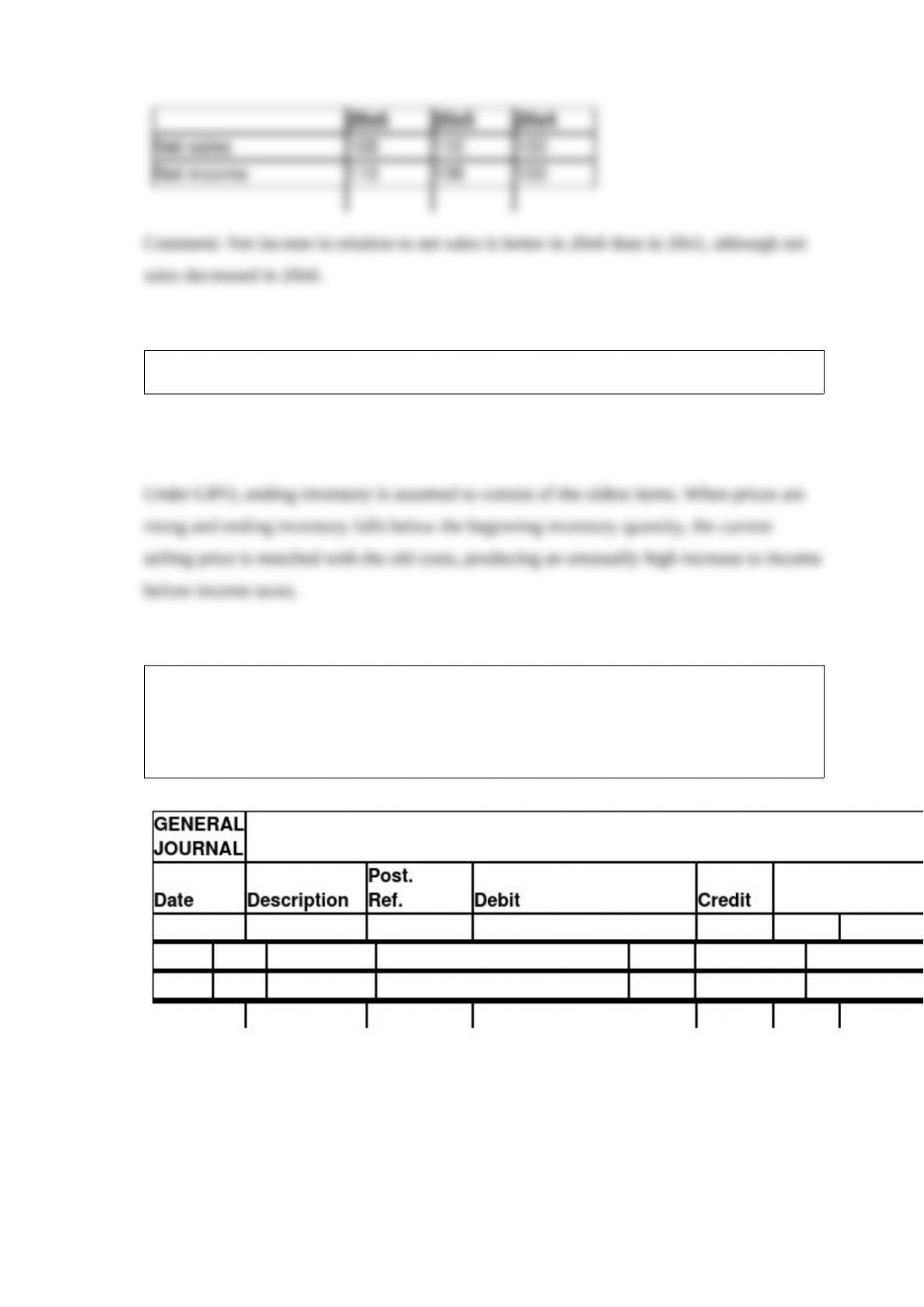
Prepare a trend analysis of the following data, using 20×4 as the base year. Place your
answers in the chart provided. Comment on the trend.
What is a LIFO liquidation, and what is its effect on income before income taxes?
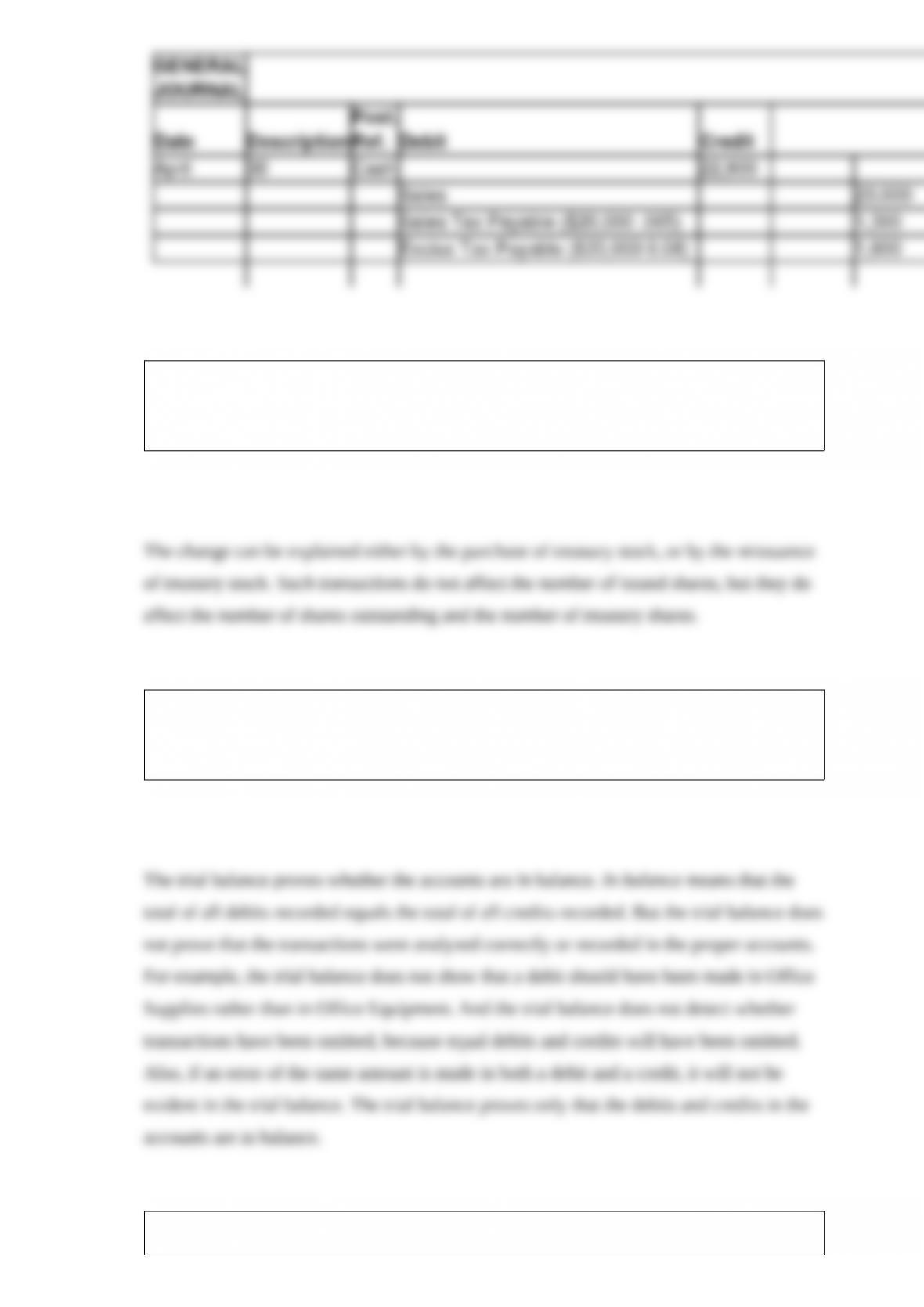
Collin’s Auto Parts had cash sales of $20,000 for the month of September. Sales are
subject to a 6.5 percent sales tax and an 8 percent excise tax. In the journal provided,
prepare a compound entry without explanations to record Collin’s sales and related sales
and excise taxes for the month.
If there is no change in the number of shares authorized and issued from one year to the
next, but there is a change in the number of shares outstanding on those same dates,
how would you explain that change?
A trial balance proves that the accounts are in balance. Does a balanced trial balance
also prove that all the transactions are correctly analyzed and recorded? Why or why
not?
What two broad purposes do closing entries serve?
If a debit to Supplies were posted as a credit, and a credit of the same amount to Cash
were posted as a debit, what would be the effect, if any, on the two accounts and on the
trial balance column totals?
Contrast the circumstances where horizontal analysis would be an effective analysis
tool with those where common-sized analysis would be more useful.