
Which one of the following duties should not be assigned the purchases department?
A) finding the lowest cost vendor
B) reviewing vendors’ catalog descriptions and prices for standardized items
C) designing the purchase order form
D) authorizing the acquisition of goods
When an auditor is trying to determine how changes can affect consistency and and/or
comparability, he should keep in mind that
A) changes that affect comparability but not consistency require an explanatory
paragraph.
B) items that materially affect the comparability of financial statements requires a
disclaimer of opinion.
C) changes that affect consistency require an explanatory paragraph if they are material.
D) changes that involve either comparability or consistency only need to be mentioned
in the footnotes.
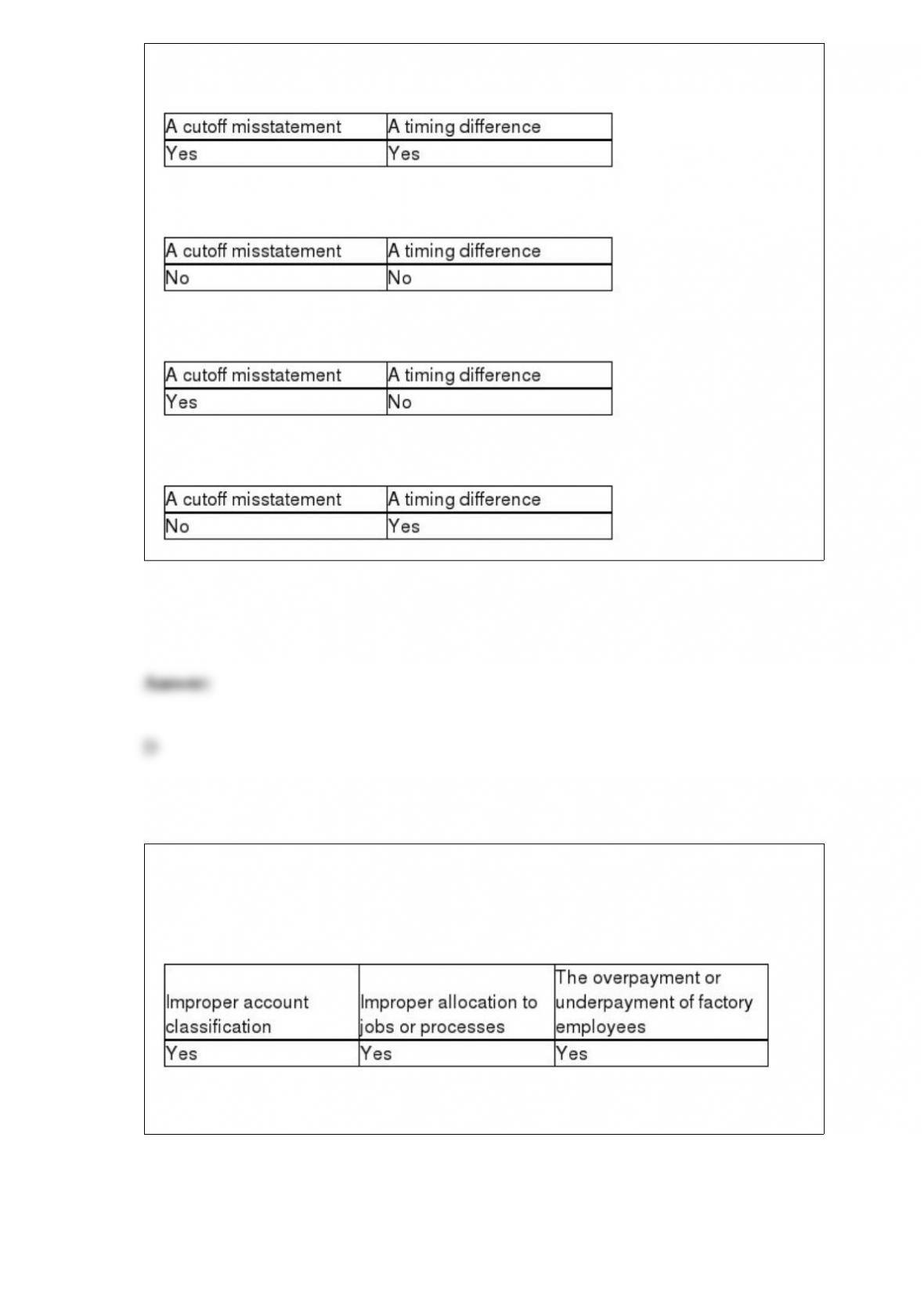
A customer mails and records a check to a client for payment of an unpaid account on
December 30. The client receives and records the amount on January 2. The records of
the two organizations will be different on December 31. This represents
A)
B)
C)
D)
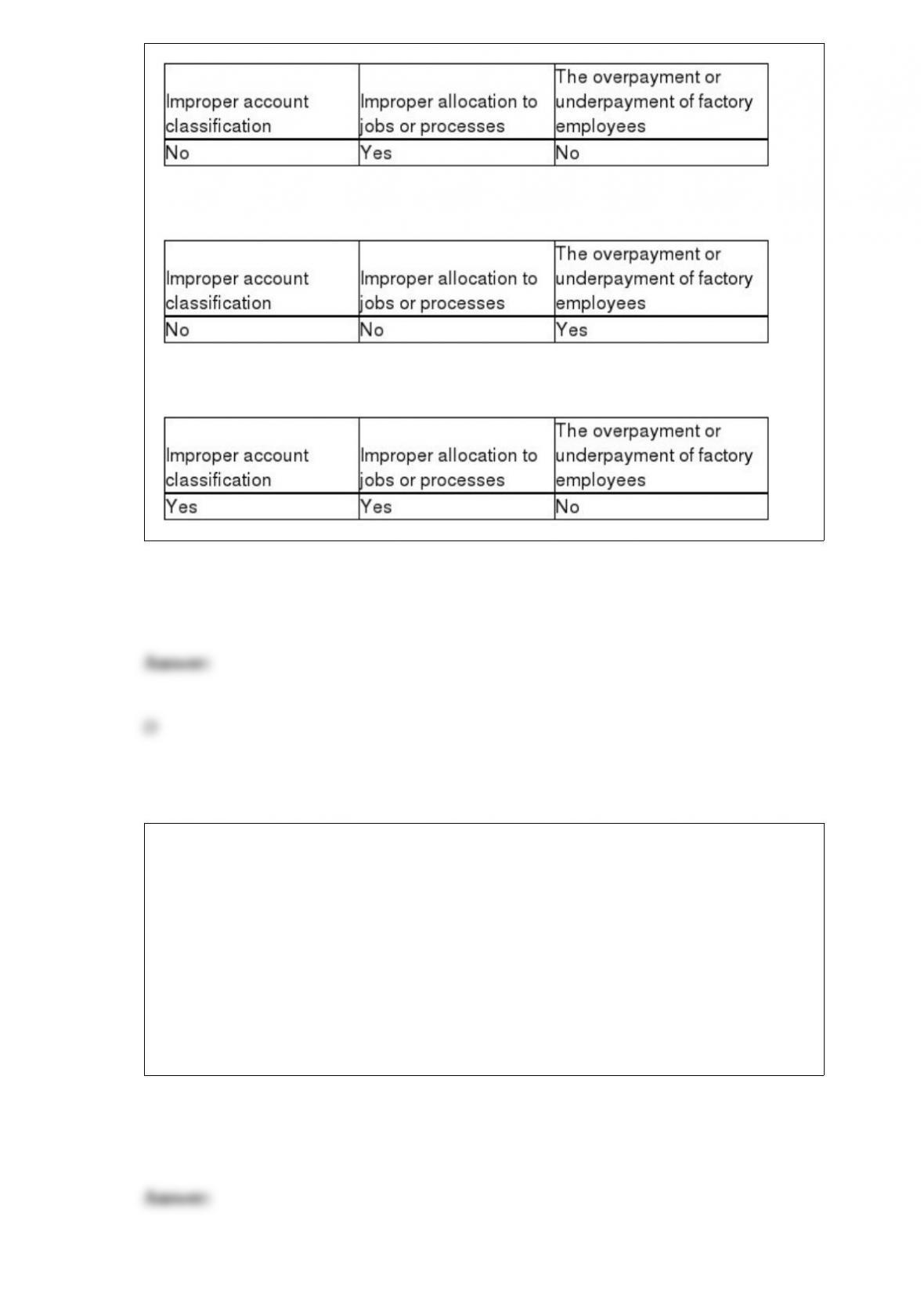
What potential problems may arise when an auditor considers the relationship between
payroll and inventory valuation?
A)
B)
C)
D)
There is a(n) ________ relationship between acceptable risk of overreliance and
planned sample size.
A) direct
B) inverse
C) proportional
D) exponential

The auditor is testing for the balance-related audit objective of detail tie-in when they
A) prove the schedule of investment activity as to additions and subtractions.
B) perform a physical inspection of the security.
C) verify the quoted market prices.
D) test management’s assumptions related to valuation.
Which of the following statements related to application controls is correct?
A) Application controls relate to various aspects of the IT function including software
acquisition and the processing of transactions.
B) Application controls relate to various aspects of the IT function including physical
security and the processing of transactions in various cycles.
C) Application controls relate to all aspects of the IT function.
D) Application controls relate to the processing of individual transactions.

When auditors verify accrued property taxes, two audit objectives are especially
significant. These are
A) completeness and accuracy.
B) completeness and net realizable value.
C) detail tie-in and completeness.
D) accuracy and classification.
When analyzing the various types of audit reports,
A) the unmodified opinion with an emphasis-of-matter paragraph is the most common
type of report.
B) companies will generally make the appropriate changes to their accounting records
to avoid a qualification by the auditor.
C) management is more concerned about a qualified report than a disclaimer report.
D) an adverse report is issued when the auditor is unable to form an opinion on the
financial statements.
The auditor needs to be aware that most users of financial statements rely most heavily
on the ________ for making decisions.

A) balance sheet
B) income statement
C) statement of cash flows
D) statement of stockholders’ equity
The King Surety Company wrote a general fidelity bond covering thefts of assets by the
employees of Wilson, Inc. Thereafter, Cooney, an employee of Wilson, embezzled
$17,200 of company funds. When the activities were discovered, King paid Wilson the
full amount in accordance with the terms of the fidelity bond, and then sought recovery
against Wilson’s auditors, Lynch & Merritt, CPAs. Which of the following would be
Lynch & Merritt’s best defense?
A) King is not in privity of contract.
B) The shortages were the result of clever forgeries and collusive fraud which would
not be detected by an examination made in accordance with generally accepted auditing
standards.
C) Lynch & Merritt were not guilty either of gross negligence or fraud.
D) Lynch & Merritt were not aware of the King-Wilson surety relationship.
A CPA is subject to criminal liability if the CPA

A) refuses to turn over requested audit documentation to a client.
B) performs an audit in a negligent manner.
C) is knowingly involved with false financial statements.
D) willfully breaches a contract with a client.
The direct receipt of a confirmation from every bank with which the client does
business is
A) required by auditing standards for every audit.
B) not necessary unless material fraud is suspected.
C) recommended but not required by auditing standards.
D) necessary for every audit except when there are an unusually large number of active
accounts.
When analyzing accounts for fraud risk,
A) companies will generally attempt to overstate accounts payable and net income.
B) the inventory account is generally not susceptible to fraud since the auditor must
verify the existence of the inventory.

C) payroll is rarely a significant risk for fraudulent financial reporting.
D) fixed assets are rarely stolen because of their large size.
Smaller privately held companies may not maintain an accounts payable master file by
vendor. These companies pay on the basis of
A) vendors’ monthly statements.
B) individual vendors’ invoices.
C) the accounts payable account in the general ledger.
D) dunning letters.
In an effort to satisfy the completeness objective, the auditor could perform which of
the following test of details of balance procedures?
A) Trace the book balance on the reconciliation to the general ledger.
B) Trace outstanding checks to subsequent period bank statements.
C) Perform a four-column proof of cash.
D) Review financial statements to make sure that material savings accounts and
certificates of deposit are disclosed separately.

Which of the following is the principle “weakness” of using negative confirmations for
the tests of details of balances for accounts receivable?
A) They can only be used for large balance accounts.
B) They cannot not be used when account balances “bunch” around a mean value.
C) Conclusions drawn from receiving no reply may not be correct.
D) Response rates are generally too low to draw any conclusions.
Which of the following statements is most correct?
A) A sample of all items of a population will eliminate sampling risk, but increase
nonsampling risk.
B) The use of an appropriate sample selection technique ensures a representative
sample.
C) The auditor’s failure to recognize an exception is a significant cause of sampling
risk.
D) The use of inappropriate audit procedures is a significant cause of nonsampling risk.

Controls which are designed to assure that the information entered into the computer is
authorized, complete, and accurate are called
A) input controls.
B) processing controls.
C) output controls.
D) general controls.
In auditing debits and credits to retained earnings, other than net income and dividends,
the auditors first concern is
A) whether the transactions should have been included in retained earnings.
B) whether the transactions have been accurately recorded.
C) whether the transactions are classified correctly in the footnotes.
D) whether the transactions existed as of the balance sheet date.

Controls over the acquisition and recording of insurance are a part of which of the
following transaction cycles?
A) inventory and warehousing cycle
B) capitalization cycle
C) treasury cycle
D) acquisition and payment cycle
The Securities and Exchange Commission can impose all but which of the following
sanctions?
A) suspend a CPA from auditing SEC clients
B) prohibit a CPA from accepting new SEC clients for a period of time
C) require a CPA to participate in continuing-education programs and make changes in
their practice
D) revoke a CPA license
In a financial statement audit, the auditor
A) gathers evidence to determine whether the statements contain material errors or
other misstatements.
B) must have a thorough understanding of the entity and its environment.
C) determines whether the financial statements are stated in accordance with specified
criteria.
D) all of the above.
What type of audit test will auditors use when testing to see if the amounts of capital
stock transactions are accurately recorded?
A)
B)
C)
D)

Auditing by testing automated internal controls and account balances electronically,
generally because effective general controls exist, is known as
A) auditing through the computer.
B) auditing around the computer.
C) embedded audit module approach.
D) parallel simulation testing.
When using the test data approach,
A) test data should include data that the client’s system should accept or reject.
B) application programs tested by the auditor’s test data must be different from those
used by the client throughout the year.
C) select data may remain in the client system after testing.
D) None of the above statements is correct.

In estimating the population misstatement, the first step in projecting from the sample
to the population is to
A) make a point estimate.
B) revise the upper error bound.
C) calculate the precision interval.
D) determine the population mean.
The purpose of establishing quality control policies and procedures to accept or
continue a client relationship is to
A) provide reasonable assurance that personnel are adequately trained to fulfill their
responsibilities.
B) monitor the risk factors concerning misstatements that arise from the
misappropriation of assets.
C) document objective criteria for the CPA firm’s peer review.
D) minimize the likelihood of associating with a client whose management may lack
integrity.
The test of details of balances procedure that requires the auditor to foot the outstanding
check and electronic payment list and deposits in transit is an attempt to satisfy which
audit objective?
A) cutoff
B) presentation and disclosure
C) detail tie-in
D) completeness
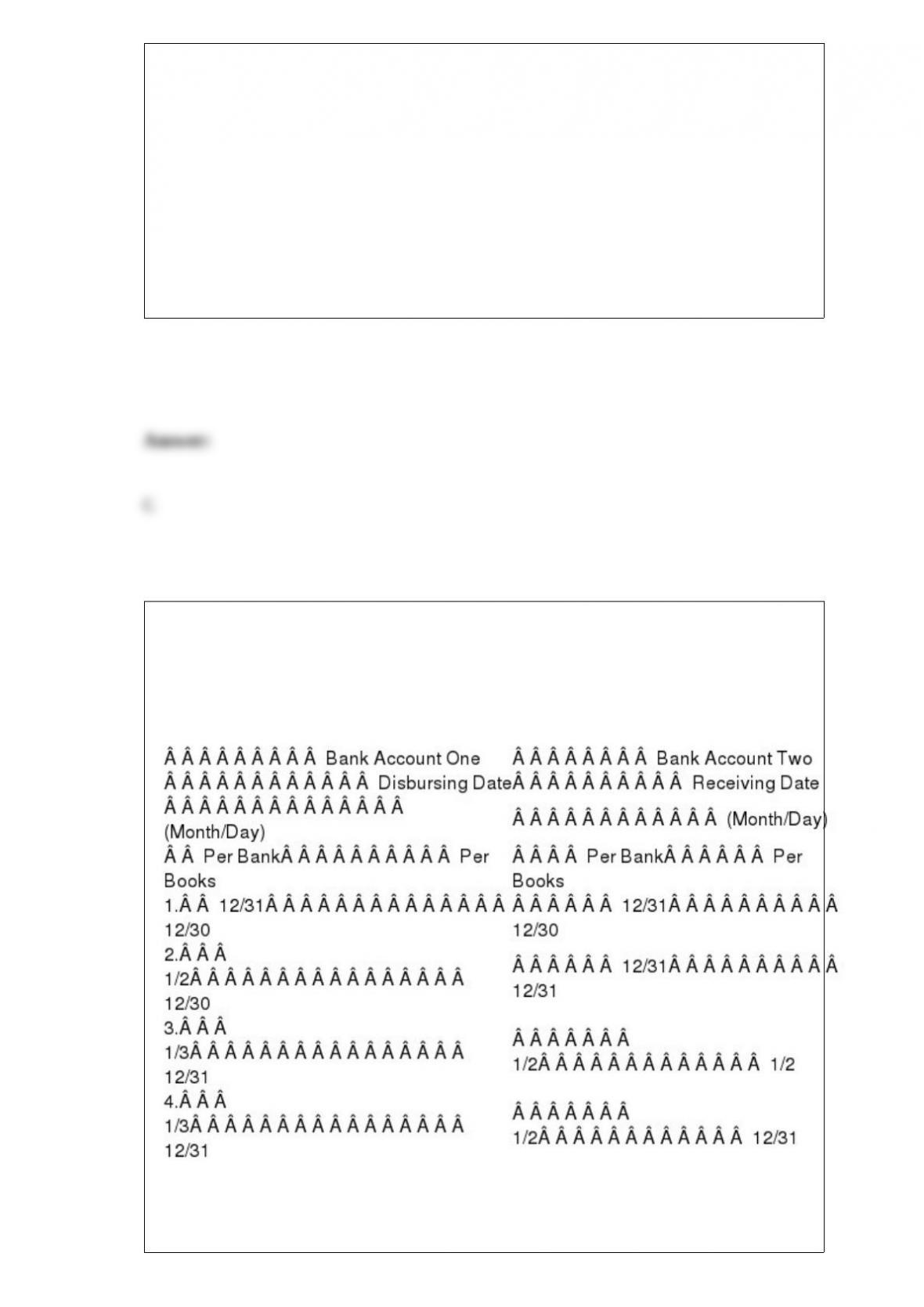
The following information applies to the questions below:
Listed below are four interbank cash transfers, indicated by the numbers 1, 2, 3, and 4,
of a client for late December 2015 and early January 2016:
Based on the schedule of interbank transfers above, which of the cash transfers
indicates an error in cash cutoff at December 31, 2015?
A) 1
B) 2
C) 3
D) 4
Internal auditors are responsible to
A) the board of directors.
B) management.
C) both A and B.
D) neither A nor B.
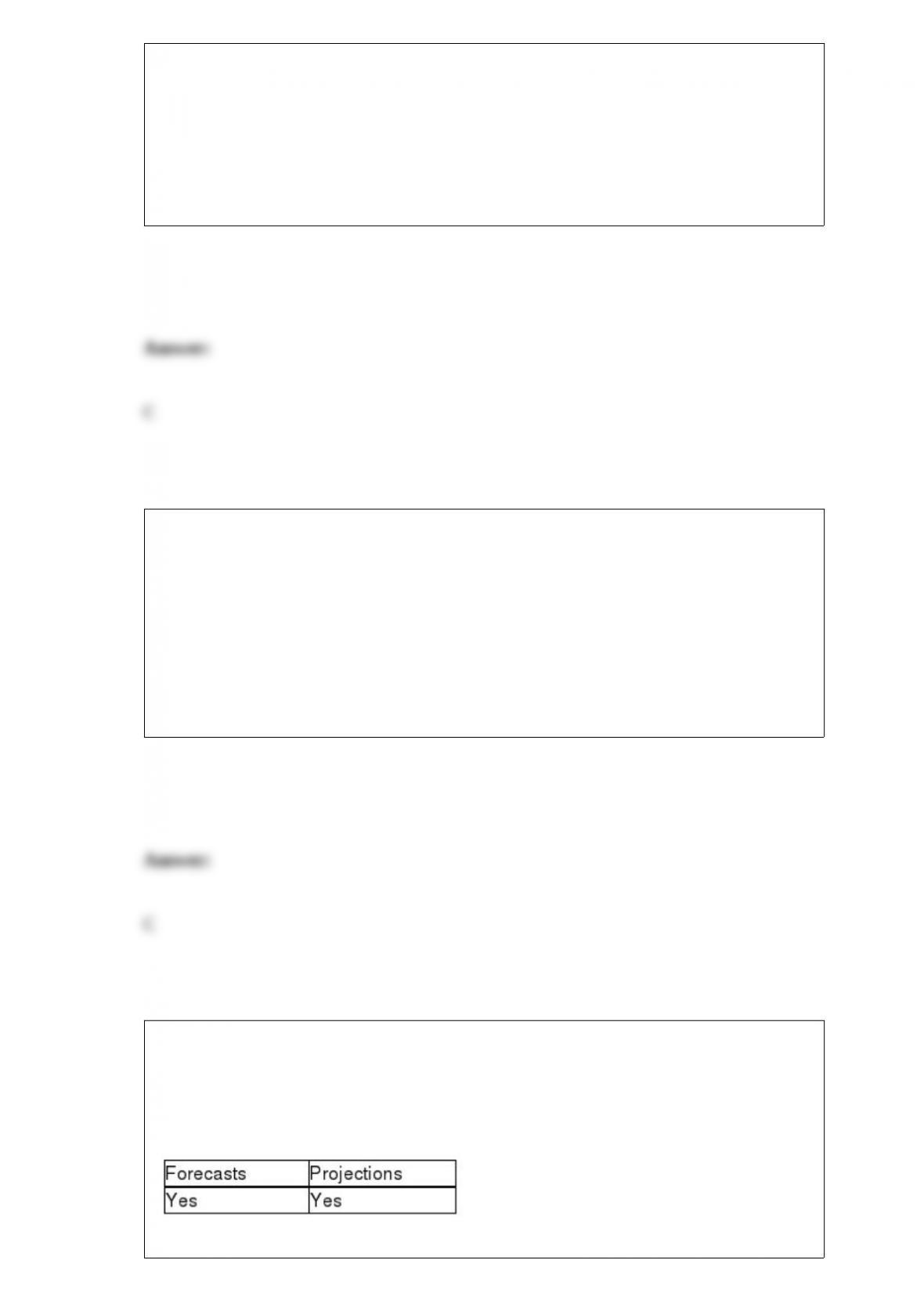
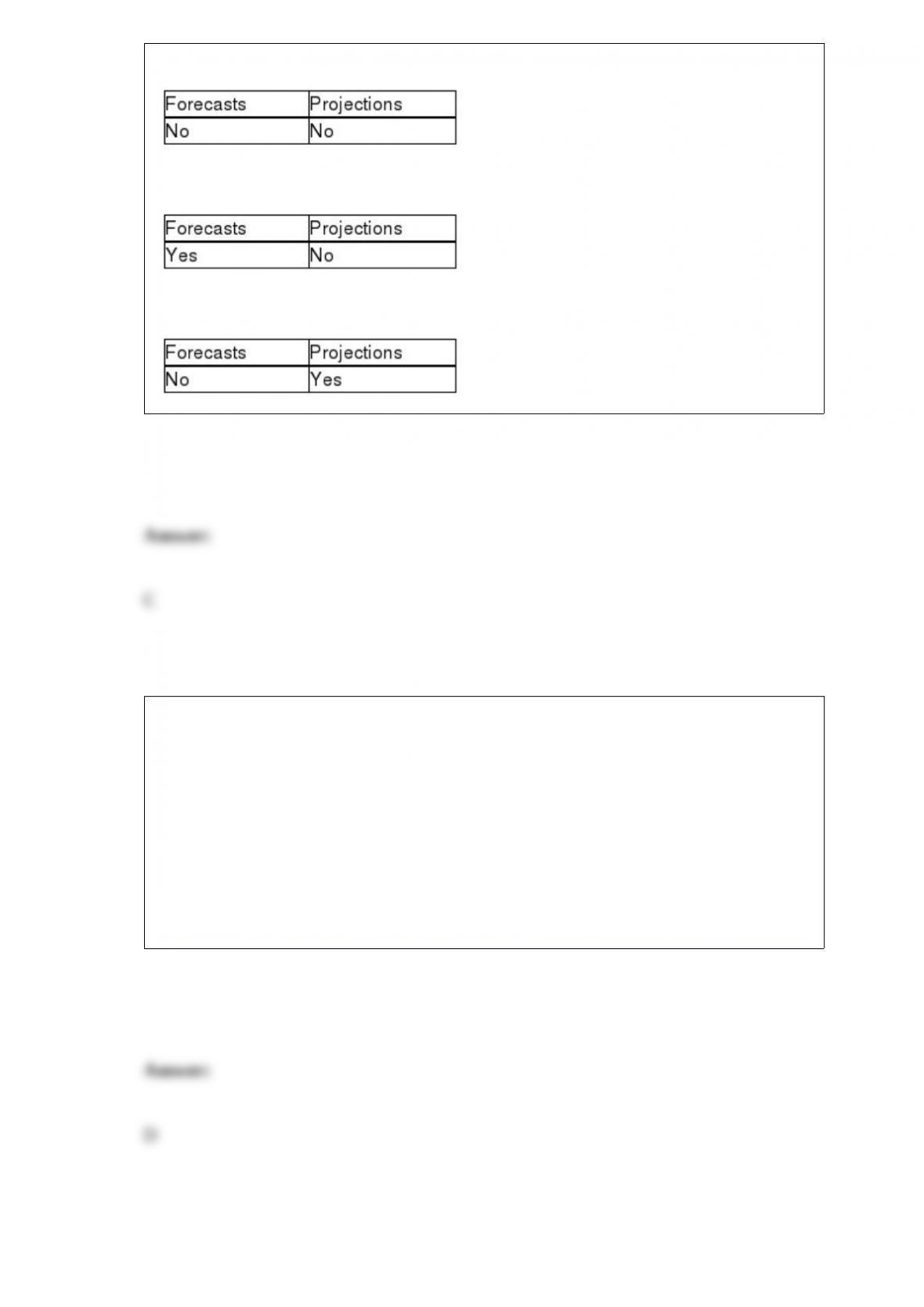
Which are prospective financial statements that present an entity’s expected financial
position, results of operations, and cash flows, to the best of the responsible party’s
knowledge and belief?
A)
B)
C)
D)
If an auditor waits until the subsequent period bank statement is available to verify
reconciling items, it is primarily a test for
A) errors.
B) omissions.
C) kiting.
D) intentional misstatements.