CHAPTER 6
ACCOUNTING AND THE TIME VALUE OF MONEY
CHAPTER LEARNING OBJECTIVES
1. Describe the fundamental concepts related to the time value of money.
2. Solve future and present value of 1 problems.
3. Solve future value of ordinary and annuity due problems.
4. Solve present value of ordinary and annuity due problems.
5. Solve present value problems related to deferred annuities, bonds, and expected cash flows.

Test Bank for Intermediate Accounting, IFRS Edition, 3e
6 – 2
TRUE-FALSE—Conceptual
1. The time value of money refers to the fact that a dollar received today is worth less than a
dollar promised at some time in the future.
2. Interest is the excess cash received or repaid over and above the amount lent or borrowed.
3. Simple interest is computed on principal and on any interest earned that has not been
withdrawn.
4. Compound interest, rather than simple interest, must be used to properly evaluate long–
term investment proposals.
5. Compound interest uses the accumulated balance at each year end to compute interest in
the succeeding year.
6. The future value of an ordinary annuity table is used when payments are invested at the
beginning of each period.
7. The present value of an annuity due table is used when payments are made at the end of
each period.
8. If the compounding period is less than one year, the annual interest rate must be converted
to the compounding period interest rate by dividing the annual rate by the number of
compounding periods per year.
9. Present value is the value now of a future sum or sums discounted assuming compound
interest.
10. The future value of a single sum is determined by multiplying the future value factor by its
present value.
11. In determining present value, a company moves backward in time using a process of
accumulation.
12. The unknown present value is always a larger amount than the known future value because
dollars received currently are worth more than dollars to be received in the future.
13. The rents that comprise an annuity due earn no interest during the period in which they are
originally deposited.
14. If two annuities have the same number of rents with the same dollar amount, but one is an
annuity due and one is an ordinary annuity, the future value of the annuity due will be
greater than the future value of the ordinary annuity.
15. The number of compounding periods will always be one less than the number of rents when
computing the future value of an ordinary annuity.
16. The future value of an annuity due factor is found by multiplying the future value of an
ordinary annuity factor by 1 minus the interest rate.
Accounting and the Time Value of Money
6 – 3
17. If two annuities have the same number of rents with the same dollar amount, but one is an
annuity due and one is an ordinary annuity, the present value of the annuity due will be
greater than the present value of the ordinary annuity.
18. The present value of an ordinary annuity is the present value of a series of equal rents
withdrawn at equal intervals.
19. The future value of a deferred annuity is less than the future value of an annuity not
deferred.
20. At the date of issue, bond buyers determine the present value of the bonds’ cash flows
using the market interest rate.
21. Under IFRS, if an estimate is being developed for a large number of items with varied
outcomes, then the expected cash flow approach is used.
22. The rate used to discount the expected cash flows when using the expected cash flow
approach includes an adjustment for credit risk.
23. The risk-free rate of return is defined as the pure rate of return.
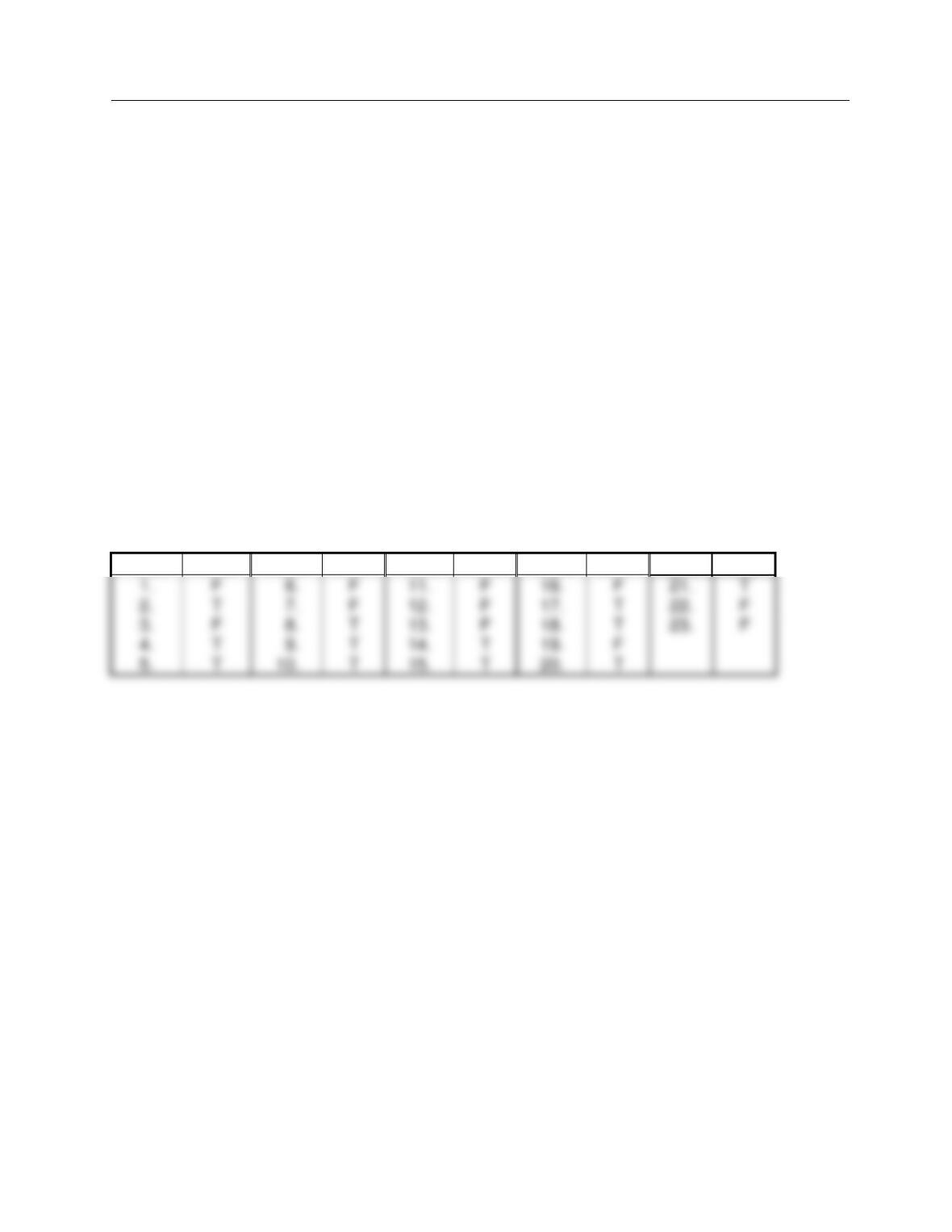
True False Answers—Conceptual
Item
Ans.
Item
Ans.
Item
Ans.
Item
Ans.
Item
Ans.
MULTIPLE CHOICE—Conceptual
24. What best describes the time value of money?
a. The interest rate charged on a loan.
b. Accounts receivable that are determined uncollectible.
c. An investment in a checking account.
d. The relationship between time and money.
25. Which of the following situations does not use an accounting measure based on present
values?
a. Pensions
b. Prepaid insurance
c. Leases
d. Sinking funds
26. What is interest?
a. Payment for the use of money
b. An equity investment
c. Return on capital
d. Loan

Test Bank for Intermediate Accounting, IFRS Edition, 3e
6 – 4
27. What is not a variable that is considered in interest computations?
a. Principal
b. Interest rate
c. Assets
d. Time
28. Charlie Corp. is purchasing new equipment with a cash cost of €150,000 for an assembly
line. The manufacturer has offered to accept €34,440 payment at the end of each of the
next six years. How much interest will Charlie Corp. pay over the term of the loan?
a. €34,440.
b. €150,000.
c. €184,440.
d. €56,640.
29. If you invest €50,000 to earn 8% interest, which of the following compounding approaches
would return the lowest amount after one year?
a. Daily
b. Monthly
c. Quarterly
d. Annually
30. Which factor would be greater — the present value of €1 for 10 periods at 8% per period
or the future value of €1 for 10 periods at 8% per period?
a. Present value of €1 for 10 periods at 8% per period
b. Future value of €1 for 10 periods at 8% per period
c. The factors are the same
d. Need more information
31. Which of the following tables would show the smallest value for an interest rate of 5% for
six periods?
a. Future value of 1
b. Present value of 1
c. Future value of an ordinary annuity of 1
d. Present value of an ordinary annuity of 1
32. Which table would you use to determine how much you would need to have deposited
three years ago at 10% compounded annually in order to have $1,000 today?
a. Future value of 1 or present value of 1
b. Future value of an annuity due of 1
c. Future value of an ordinary annuity of 1
d. Present value of an ordinary annuity of 1
33. Which table would you use to determine how much must be deposited now in order to
provide for 5 annual withdrawals at the beginning of each year, starting one year hence?
a. Future value of an ordinary annuity of 1
b. Future value of an annuity due of 1
c. Present value of an annuity due of 1
d. None of these answer choices are correct.

Accounting and the Time Value of Money
6 – 5
34. Which table has a factor of 1.00000 for 1 period at every interest rate?
a. Future value of 1
b. Present value of 1
c. Future value of an ordinary annuity of 1
d. Present value of an ordinary annuity of 1
35. Which table would show the largest factor for an interest rate of 8% for five periods?
a. Future value of an ordinary annuity of 1
b. Present value of an ordinary annuity of 1
c. Future value of an annuity due of 1
d. Present value of an annuity due of 1
36. Which of the following tables would show the smallest factor for an interest rate of 10% for
six periods?
a. Future value of an ordinary annuity of 1
b. Present value of an ordinary annuity of 1
c. Future value of an annuity due of 1
d. Present value of an annuity due of 1
37. The figure .94232 is taken from the column marked 2% and the row marked three periods
in a certain interest table. From what interest table is this figure taken?
a. Future value of 1
b. Future value of annuity of 1
c. Present value of 1
d. Present value of annuity of 1
S38. Which of the following tables would show the largest value for an interest rate of 10% for 8
periods?
a. Future amount of 1 table
b. Present value of 1 table
c. Future amount of an ordinary annuity of 1 table
d. Present value of an ordinary annuity of 1 table
S39. On June 1, 2019, Pitts Company sold some equipment to Gannon Company. The two
companies entered into an installment sales contract at a rate of 8%. The contract
required 8 equal annual payments with the first payment due on June 1, 2019. What type
of compound interest table is appropriate for this situation?
a. Present value of an annuity due of 1 table
b. Present value of an ordinary annuity of 1 table
c. Future amount of an ordinary annuity of 1 table
d. Future amount of 1 table
S40. Which of the following transactions would best use the present value of an annuity due of
1 table?
a. Fernetti, Inc. rents a truck for 5 years with annual rental payments of £20,000 to be
made at the beginning of each year.
b. Edmiston Co. rents a warehouse for 7 years with annual rental payments of £120,000
to be made at the end of each year.
c. Durant, Inc. borrows £20,000 and has agreed to pay back the principal plus interest in
three years.
d. Babbitt, Inc. wants to deposit a lump sum to accumulate £50,000 for the construction
of a new parking lot in 4 years.

Test Bank for Intermediate Accounting, IFRS Edition, 3e
6 – 6
P41. A series of equal receipts at equal intervals of time when each receipt is received at the
beginning of each time period is called an
a. ordinary annuity.
b. annuity in arrears.
c. annuity due.
d. unearned receipt.
P42. On December 1, 2019, Richards Company sold some machinery to Fleming Company.
The two companies entered into an installment sales contract at a predetermined interest
rate. The contract required four equal annual payments with the first payment due on
December 1, 2019, the date of the sale. What present value concept is appropriate for this
situation?
a. Future amount of an annuity of 1 for four periods
b. Future amount of 1 for four periods
c. Present value of an ordinary annuity of 1 for four periods
d. Present value of an annuity due of 1 for four periods
43. An amount is deposited for eight years at 8%. If compounding occurs quarterly, then the
table value is found at
a. 8% for eight periods.
b. 2% for eight periods.
c. 8% for 32 periods.
d. 2% for 32 periods.
44. Present value is
a. the value now of a future amount.
b. the amount that must be invested now to produce a known future value.
c. always smaller than the future value.
d. all of these answer choices are correct.
45. What is the primary difference between an ordinary annuity and an annuity due?
a. The timing of the periodic payment
b. The interest rate
c. Annuity due only relates to present values
d. Ordinary annuity only relates to present values
46. Which of the following is true?
a. Rents occur at the beginning of each period of an ordinary annuity.
b. Rents occur at the end of each period of an annuity due.
c. Rents occur at the beginning of each period of an annuity due.
d. None of these answer choices are correct.
47. Assume ABC Company deposits €50,000 with First National Bank in an account earning
interest at 6% per annum, compounded semi–annually. How much will ABC have in the
account after five years if interest is reinvested?
a. €67,196
b. €50,000
c. €65,000
d. €66,912
Accounting and the Time Value of Money
6 – 7
48. If a savings account pays interest at 4% compounded quarterly, then the amount of €1 left
on deposit for 6 years would be found in a table using
a. 6 periods at 4%.
b. 6 periods at 1%.
c. 24 periods at 4%.
d. 24 periods at 1%.
49. On May 1, 2017, a company purchased a new machine which it does not have to pay for
until May 1, 2019. The total payment on May 1, 2019 will include both principal and
interest. Assuming interest at a 10% rate, the cost of the machine would be the total
payment multiplied by what time value of money factor?
a. Future value of annuity of 1
b. Future value of 1
c. Present value of annuity of 1
d. Present value of 1
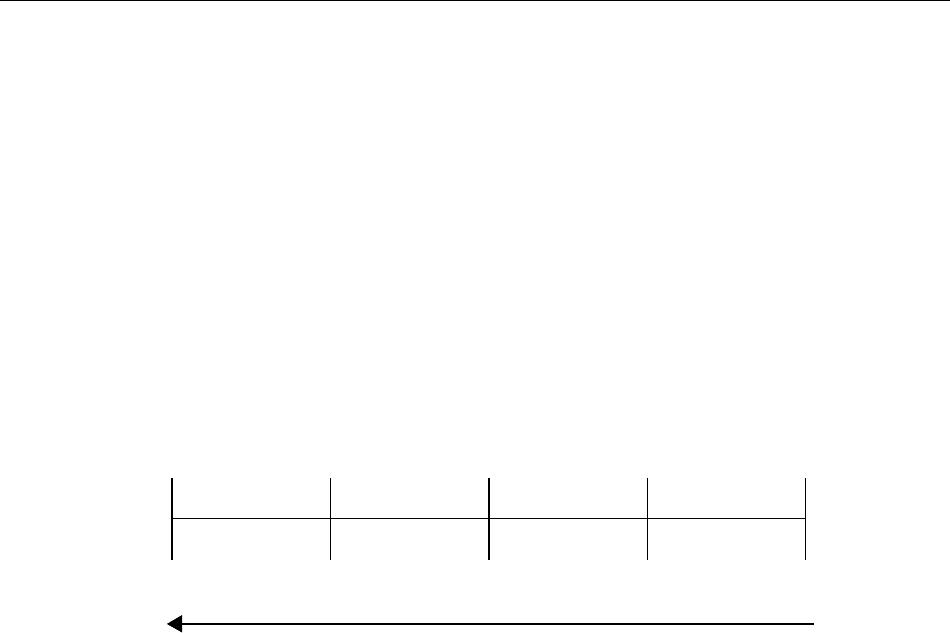
P50. In the time diagram below, which concept is being depicted?
0
1
$1
2
$1
3
$1
4
$1
PV
a. Present value of an ordinary annuity
b. Present value of an annuity due
c. Future value of an ordinary annuity
d. Future value of an annuity due
51. If the number of periods is known, the interest rate is determined by
a. dividing the future value by the present value and looking for the quotient in the future
value of 1 table.
b. dividing the future value by the present value and looking for the quotient in the
present value of 1 table.
c. dividing the present value by the future value and looking for the quotient in the future
value of 1 table.
d. multiplying the present value by the future value and looking for the product in the
present value of 1 table.
P52. Which of the following statements is true?
a. The higher the discount rate, the higher the present value.
b. The process of accumulating interest on interest is referred to as discounting.
c. If money is worth 10% compounded annually, €1,100 due one year from today is
equivalent to €1,000 today.
d. If a single sum is due on December 31, 2019, the present value of that sum decreases
as the date draws closer to December 31, 2019.

Test Bank for Intermediate Accounting, IFRS Edition, 3e
6 – 8
53. What is the relationship between the future value of one and the present value of one?
a. The present value of one equals the future value of one plus one.
b. The present value of one equals one plus future value factor for n-1 periods.
c. The present value of one equals one divided by the future value of one.
d. The present value of one equals one plus the future value factor for n+1 value
54. Peter invests €100,000 in a 3-year certificate of deposit earning 3.5% at his local bank.
Which time value concept would be used to determine the maturity value of the
certificate?
a. Present value of one.
b. Future value of one.
c. Present value of an annuity due.
d. Future value of an ordinary annuity.
55. Jerry recently was offered a position with a major accounting firm. The firm offered Jerry
either a signing bonus of £23,000 payable on the first day of work or a signing bonus of
£26,000 payable after one year of employment. Assuming that the relevant interest rate is
10%, which option should Jerry choose?
a. The options are equivalent.
b. Insufficient information to determine.
c. The signing bonus of £23,000 payable on the first day of work.
d. The signing bonus of £26,000 payable after one year of employment.
Items 56 through 58 apply to the appropriate use of interest tables. Given below are the future
value factors for 1 at 8% for one to five periods. Each of the items 56 to 58 is based on 8%
interest compounded annually.
Periods Future Value of 1 at 8%
1 1.080
2 1.166
3 1.260
4 1.360
5 1.469
56. What amount should be deposited in a bank account today to grow to €10,000 three years
from today?
a. €10,000 × 1.260
b. €10,000 × 1.260 × 3
c. €10,000 ÷ 1.260
d. €10,000 ÷ 1.080 × 3
57. If €3,000 is put in a savings account today, what amount will be available three years from
today?
a. €3,000 ÷ 1.260
b. €3,000 × 1.260
c. €3,000 × 1.080 × 3
d. (€3,000 × 1.080) + (€3,000 × 1.166) + (€3,000 × 1.260)

Accounting and the Time Value of Money
6 – 9
58. If €4,000 is put in a savings account today, what amount will be available six years from
now?
a. €4,000 × 1.080 × 6
b. €4,000 × 1.080 × 1.469
c. €4,000 × 1.166 × 3
d. €4,000 × 1.260 × 2
Items 59 through 61 apply to the appropriate use of present value tables. Given below are the
present value factors for £1 discounted at 10% for one to five periods. Each of the items 59 to 61
is based on 10% interest compounded annually.
Present Value of $1
Periods Discounted at 10% per Period
1 0.909
2 0.826
3 0.751
4 0.683
5 0.621
59. If an individual put £4,000 in a savings account today, what amount of cash would be
available two years from today?
a. £4,000 × 0.826
b. £4,000 × 0.826 × 2
c. £4,000 ÷ 0.826
d. £4,000 ÷ 0.909 × 2
60. What is the present value today of £6,000 to be received six years from today?
a. £6,000 × 0.909 × 6
b. £6,000 × 0.751 × 2
c. £6,000 × 0.621 × 0.909
d. £6,000 × 0.683 × 3
61. What amount should be deposited in a bank today to grow to £3,000 three years from
today?
a. £3,000 ÷ 0.751
b. £3,000 × 0.909 × 3
c. (£3,000 × 0.909) + (£3,000 × 0.826) + (£3,000 × 0.751)
d. £3,000 × 0.751
62. At the end of two years, what will be the balance in a savings account paying 6% annually
if €10,000 is deposited today? The future value of one at 6% for one period is 1.06.
a. €10,000
b. €10,600
c. €11,200
d. €11,236
63. Mordica Company will receive €200,000 in 7 years. If the appropriate interest rate is 10%,
the present value of the €200,000 receipt is
a. €102,000.
b. €102,632.
c. €302,000.
d. €389,744.

Test Bank for Intermediate Accounting, IFRS Edition, 3e
6 – 10
64. Dunston Company will receive £200,000 in a future year. If the future receipt is discounted
at an interest rate of 10%, its present value is £102,632. In how many years is the
£200,000 received?
a. 5 years
b. 6 years
c. 7 years
d. 8 years
65. Milner Company will invest €400,000 today. The investment will earn 6% for 5 years, with
no funds withdrawn. In 5 years, the amount in the investment fund is
a. €400,000.
b. €520,000.
c. €535,292.
d. €536,116.
66. Barber Company will receive €1,000,000 in 7 years. If the appropriate interest rate is 10%,
the present value of the €1,000,000 receipt is
a. €510,000.
b. €513,160.
c. €1,510,000.
d. €1,948,720.
67. Barkley Company will receive £300,000 in a future year. If the future receipt is discounted
at an interest rate of 8%, its present value is £189,051. In how many years is the
£300,000 received?
a. 5 years
b. 6 years
c. 7 years
d. 8 years
68. Altman Company will invest €500,000 today. The investment will earn 6% for 5 years, with
no funds withdrawn. In 5 years, the amount in the investment fund is
a. €500,000.
b. €650,000.
c. €669,115.
d. €402,087.
69. John Jones won a lottery that will pay him €2,000,000 after twenty years. Assuming an
appropriate interest rate is 5% compounded annually, what is the present value of this
amount?
a. €2,000,000
b. €5,306,600
c. €24,924,420
d. €753,780
70. Angie invested £100,000 she received from her grandmother today in a fund that is
expected to earn 10% per annum. To what amount should the investment grow in five
years if interest is compounded semi–annually?
a. £155,134
b. £161,050
c. £162,890
d. £177,156

Accounting and the Time Value of Money
6 – 11
71. Bella requires €120,000 in four years to purchase a new home. What amount must be
invested today in an investment that earns 6% interest, compounded annually?
a. €95,051
b. €98,724
c. €145,336
d. €151,497
72. What interest rate (the nearest percent) must Charlie earn on a €300,000 investment
today so that he will have €760,000 after 12 years?
a. 6%
b. 7%
c. 8%
d. 9%
73. Ethan has £50,000 to invest today at an annual interest rate of 4%. Approximately how
many years will it take before the investment grows to £101,250?
a. 18 years
b. 20 years
c. 16 years
d. 11 years
74. Jane wants to set aside funds to take an around the world cruise in four years. Assuming
that Jane has €8,000 to invest today in an account expected to earn 6% per annum, how
much will she have to spend on her vacation?
a. €6,336
b. €10,100
c. €34,997
d. €10,705
75. Jane wants to set aside funds to take an around the world cruise in four years. Jane
expects that she will need €15,000 for her dream vacation. If she is able to earn 8% per
annum on an investment, how much will she have to set aside today so that she will have
sufficient funds available?
a. €3,329
b. €20,406
c. €11,025
d. €10,208
76. What would you pay for an investment that pays you £500,000 after forty years? Assume
that the relevant interest rate for this type of investment is 6%.
a. £15,590
b. £155,900
c. £48,610
d. £51,835
77. What would you pay for an investment that pays you €20,000 at the end of each year for
the next ten years and then returns a maturity value of €300,000 after ten years? Assume
that the relevant interest rate for this type of investment is 8%.
a. €138,958
b. €134,202
c. €144,936

Test Bank for Intermediate Accounting, IFRS Edition, 3e
6 – 12
d. €273,158
78. Anna has $30,000 to invest. She requires €50,000 for a down payment for a house. If she
is able to invest at 6%, how many years will it be before she will accumulate the desired
balance?
a. 6 years
b. 7 years
c. 8 years
d. 9 years
79. On January 1, 2018, Ball Co. exchanged equipment for a £200,000 zero-interest-bearing
note due on January 1, 2021. The prevailing rate of interest for a note of this type at
January 1, 2018 was 10%. The present value of $1 at 10% for three periods is 0.75. What
amount of interest revenue should be included in Ball’s 2019 income statement?
a. £0
b. £15,000
c. £16,500
d. £20,000
80. If Jethro wanted to save a set amount each month in order to buy a new pick-up truck
when the new models are next available, which time value concept would be used to
determine the monthly payment?
a. Present value of one
b. Future value of one
c. Present value of an annuity due
d. Future value of an ordinary annuity
81. Betty wants to know how much she should begin saving each month to fund her
retirement. What kind of problem is this?
a. Present value of one
b. Future value of an ordinary annuity
c. Present value of an ordinary annuity
d. Future value of one
P82 If the interest rate is 10%, the factor for the future value of annuity due of 1 for n = 5, i =
10% is equal to the factor for the future value of an ordinary annuity of 1 for n = 5, i = 10%
a. plus 1.10.
b. minus 1.10.
c. multiplied by 1.10.
d. divided by 1.10.
83. Which statement is false?
a. The factor for the future value of an annuity due is found by multiplying the ordinary
annuity table value by one plus the interest rate.
b. The factor for the present value of an annuity due is found by multiplying the ordinary
annuity table value by one minus the interest rate.
c. The factor for the future value of an annuity due is found by subtracting 1.00000 from
the ordinary annuity table value for one more period.
d. The factor for the present value of an annuity due is found by adding 1.00000 to the
ordinary annuity table value for one less period.

Accounting and the Time Value of Money
6 – 13
84. What amount will be in an 8% bank account three years from now if £6,000 is invested
each year for four years with the first investment to be made today?
a. (£6,000 × 1.260) + (£6,000 × 1.166) + (£6,000 × 1.080) + £6,000
b. £6,000 × 1.360 × 4
c. (£6,000 × 1.080) + (£6,000 × 1.166) + (£6,000 × 1.260) + (£6,000 × 1.360)
d. £6,000 × 1.080 × 4
85. Lucy and Fred want to begin saving for their baby’s college education. They estimate that
they will need €200,000 in eighteen years. If they are able to earn 6% per annum, how
much must be deposited at the beginning of each of the next eighteen years to fund the
education?
a. €6,471
b. €6,105
c. €11,111
d. €5,924
86. Lucy and Fred want to begin saving for their baby’s college education. They estimate that
they will need €300,000 in eighteen years. If they are able to earn 5% per annum, how
much must be deposited at the end of each of the next eighteen years to fund the
education?
a. €11,618
b. €25,664
c. €24,823
d. €10,664
87. Jane wants to set aside funds to take an around the world cruise in four years. Jane
expects that she will need £15,000 for her dream vacation. If she is able to earn 8% per
annum on an investment, how much will she need to set aside at the beginning of each
year to accumulate sufficient funds?
a. £3,329
b. £20,406
c. £11,025
d. £3,082
88. Spencer Corporation will invest €20,000 every December 31st for the next six years (2018
– 2023). If Spencer will earn 12% on the investment, what amount will be in the
investment fund on December 31, 2023?
a. €82,228
b. €92,096
c. €162,304
d. €181,780
89. Tipson Corporation will invest €30,000 every January 1st for the next six years (2018 –
2023). If Linton will earn 12% on the investment, what amount will be in the investment
fund on December 31, 2023?
a. €123,342
b. €138,144
c. €243,456
d. €272,670

Test Bank for Intermediate Accounting, IFRS Edition, 3e
6 – 14
90. Renfro Corporation will invest £40,000 every December 31st for the next six years (2018 –
2023). If Renfro will earn 12% on the investment, what amount will be in the investment
fund on December 31, 2023?
a. £164,456
b. £184,192
c. £324,608
d. £363,560
91. Vannoy Corporation will invest €50,000 every January 1st for the next six years (2018 –
2023). If Wagner will earn 12% on the investment, what amount will be in the investment
fund on December 31, 2023?
a. €205,570
b. €230,240
c. €405,760
d. €454,450
92. On January 1, 2018, Kline Company decided to begin accumulating a fund for asset
replacement five years later. The company plans to make five annual deposits of £80,000
at 9% each January 1 beginning in 2018. What will be the balance in the fund, within $10,
on January 1, 2023 (one year after the last deposit)? The following 9% interest factors
may be used.
Present Value of Future Value of
Ordinary Annuity Ordinary Annuity
4 periods 3.2397 4.5731
5 periods 3.8897 5.9847
6 periods 4.4859 7.5233
a. £521,866
b. £478,776
c. £436,000
d. £400,000
Use the following 8% interest factors for questions 93 through 95.
Present Value of Future Value of
Ordinary Annuity Ordinary Annuity
7 periods 5.2064 8.92280
8 periods 5.7466 10.63663
9 periods 6.2469 12.48756
93. What will be the balance on September 1, 2024 in a fund which is accumulated by making
€20,000 annual deposits each September 1 beginning in 2017, with the last deposit being
made on September 1, 2024? The fund pays interest at 8% compounded annually.
a. €229,751
b. €178,456
c. €151,200
d. €114,932
94. If €10,000 is deposited annually starting on January 1, 2018 and it earns 8%, what will the
balance be on December 31, 2025?
a. €89,228
b. €96,366
c. €106,366
d. €114,876

Accounting and the Time Value of Money
6 – 15
95. Korman Company wishes to accumulate €500,000 by May 1, 2025 by making 8 equal
annual deposits beginning May 1, 2017 to a fund paying 8% interest compounded
annually. What is the required amount of each deposit?
a. €87,008
b. €47,007
c. €43,525
d. €50,390
96. Al Darby wants to withdraw £20,000 (including principal) from an investment fund at the
end of each year for five years. How should he compute his required initial investment at
the beginning of the first year if the fund earns 10% compounded annually?
a. £20,000 times the future value of a 5-year, 10% ordinary annuity of 1
b. £20,000 divided by the future value of a 5-year, 10% ordinary annuity of 1
c. £20,000 times the present value of a 5-year, 10% ordinary annuity of 1
d. £20,000 divided by the present value of a 5-year, 10% ordinary annuity of 1
97. Sue Gray wants to invest a certain sum of money at the end of each year for five years.
The investment will earn 6% compounded annually. At the end of five years, she will need
a total of €40,000 accumulated. How should she compute her required annual invest–
ment?
a. €40,000 times the future value of a 5-year, 6% ordinary annuity of 1
b. €40,000 divided by the future value of a 5-year, 6% ordinary annuity of 1
c. €40,000 times the present value of a 5-year, 6% ordinary annuity of 1
d. €40,000 divided by the present value of a 5-year, 6% ordinary annuity of 1
98. An accountant wishes to find the present value of an annuity of 1 payable at the beginning
of each period at 10% for eight periods. The accountant has only one present value table
which shows the present value of an annuity of 1 payable at the end of each period. To
compute the present value, the accountant would use the present value factor in the 10%
column for
a. seven periods.
b. eight periods and multiply by (1 + .10).
c. eight periods.
d. nine periods and multiply by (1 – .10).
99. If an annuity due and an ordinary annuity have the same number of equal payments and
the same interest rates, then
a. the present value of the annuity due is less than the present value of the ordinary
annuity.
b. the present value of the annuity due is greater than the present value of the ordinary
annuity.
c. the future value of the annuity due is equal to the future value of the ordinary annuity.
d. the future value of the annuity due is less than the future value of the ordinary annuity.
100. What is the relationship between the present value factor of an ordinary annuity and the
present value factor of an annuity due for the same interest rate?
a. The ordinary annuity factor is not related to the annuity due factor.
b. The annuity due factor equals one plus the ordinary annuity factor for n−1 periods.
c. The ordinary annuity factor equals one plus the annuity due factor for n+1 periods.
d. The annuity due factor equals the ordinary annuity factor for n+1 periods minus one.

Test Bank for Intermediate Accounting, IFRS Edition, 3e
6 – 16
101. Paula purchased a house for €300,000. After providing a 20% down payment, she
borrowed the balance from the local savings and loan under a 30-year 6% mortgage loan
requiring equal monthly installments at the end of each month. Which time value concept
would be used to determine the monthly payment?
a. Present value of one
b. Future value of one
c. Present value of an ordinary annuity
d. Future value of an ordinary annuity
102. Stemway requires a new manufacturing facility. Management found three locations; all of
which would provide needed capacity, the only difference is the price. Location A may be
purchased for £500,000. Location B may be acquired with a down payment of £100,000
and annual payments at the end of each of the next twenty years of £50,000. Location C
requires £40,000 payments at the beginning of each of the next twenty-five years.
Assuming Stemway’s borrowing costs are 8% per annum, which option is the least costly
to the company?
a. Location A
b. Location B
c. Location C
d. Location A and Location B
103. What amount should an individual have in a 10% bank account today before withdrawal if
€5,000 is needed each year for four years with the first withdrawal to be made today and
each subsequent withdrawal at one-year intervals? (The balance in the bank account
should be zero after the fourth withdrawal.)
a. €5,000 + (€5,000 × 0.909) + (€5,000 × 0.826) + (€5,000 × 0.751)
b. €5,000 ÷ 0.683 × 4
c. (€5,000 × 0.909) + (€5,000 × 0.826) + (€5,000 × 0.751) + (€5,000 × 0.683)
d. €5,000 ÷ 0.909 × 4
104. Pearson Corporation makes an investment today (January 1, 2018). They will receive
€25,000 every December 31st for the next six years (2018 – 2023). If Pearson wants to
earn 12% on the investment, what is the most they should invest on January 1, 2018?
a. €102,785
b. €115,120
c. €202,880
d. €227,225
105. Garretson Corporation will receive £15,000 today (January 1, 2017), and also on each
January 1st for the next five years (2018 – 2022). What is the present value of the six
£15,000 receipts, assuming a 12% interest rate?
a. £61,671
b. £69,072
c. £121,728
d. £136,335

Accounting and the Time Value of Money
6 – 17
106. Hiller Corporation makes an investment today (January 1, 2018). They will receive
€30,000 every December 31st for the next six years (2018 – 2023). If Hiller wants to earn
12% on the investment, what is the most they should invest on January 1, 2018?
a. €123,342
b. €138,144
c. €243,456
d. €272,670
107. What amount should be recorded as the cost of a machine purchased December 31,
2018, which is to be financed by making 8 annual payments of £8,000 each beginning
December 31, 2019? The applicable interest rate is 8%.
a. £56,000
b. £49,975
c. £85,093
d. £45,973
108. How much must be deposited on January 1, 2018 in a savings account paying 6%
annually in order to make annual withdrawals of €25,000 at the end of the years 2018 and
2019? The present value of one at 6% for one period is .9434.
a. €45,835
b. €47,175
c. €50,000
d. €22,250
109. How much must be invested now to receive €20,000 for 15 years if the first €20,000 is
received today and the rate is 9%?
Present Value of
Periods Ordinary Annuity at 9%
14 7.78615
15 8.06069
16 8.31256
a. €161,214
b. €175,723
c. €300,000
d. €146,250
110. Jenks Company financed the purchase of a machine by making payments of £24,000 at
the end of each of five years. The appropriate rate of interest was 8%. The future value of
one for five periods at 8% is 1.46933. The future value of an ordinary annuity for five
periods at 8% is 5.8666. The present value of an ordinary annuity for five periods at 8% is
3.99271. What was the cost of the machine to Jenks?
a. £35,264
b. £95,825
c. £120,000
d. £140,800

Test Bank for Intermediate Accounting, IFRS Edition, 3e
6 – 18
111. A machine is purchased by making payments of €15,000 at the beginning of each of the
next five years. The interest rate was 10%. The future value of an ordinary annuity of 1 for
five periods at 10% is 6.10510. The present value of an ordinary annuity of 1 for five
periods is 3.79079. What was the cost of the machine?
a. €100,734
b. €91,578
c. €62,548
d. €56,862
112. Lane Co. has a machine that cost €600,000. It is to be leased for 20 years with rent
received at the beginning of each year. Lane wants a return of 10%. Calculate the amount
of the annual rent.
Present Value of
Period Ordinary Annuity
19 8.36492
20 8.51356
21 8.64869
a. €64,068
b. €71,727
c. €89,184
d. €70,476
113. Find the present value of an investment in plant and equipment if it is expected to provide
annual earnings of £42,000 for 15 years and to have a resale value of £80,000 at the end
of that period. Assume a 10% rate and earnings at year end. The present value of 1 at
10% for 15 periods is .23939. The present value of an ordinary annuity at 10% for 15
periods is 7.60608. The future value of 1 at 10% for 15 periods is 4.17725.
a. £319,456
b. £338,606
c. £370,552
d. £649,152
114. John won a lottery that will pay him €200,000 at the end of each of the next twenty years.
Assuming an appropriate interest rate is 8% compounded annually, what is the present
value of this amount?
a. €2,120,720
b. €42,910
c. €1,963,630
d. €9,152,392
115. Jonas won a lottery that will pay him £125,000 at the end of each of the next twenty years.
Zebra Finance has offered to purchase the payment stream for £1,699,000. What interest
rate (to the nearest percent) was used to determine the amount of the payment?
a. 7%
b. 6%
c. 5%
d. 4%

Accounting and the Time Value of Money
6 – 19
116. James leases a ski chalet to his best friend, Janet. The lease term is five years with
€33,000 annual payments due at the beginning of each year. What is the present value of
the payments discounted at 8% per annum?
a. €142,300
b. €131,760
c. €125,972
d. €119,604
117. Jeremy is in the process of purchasing a car. The list price of the car is €36,000. If Jeremy
pays cash for the car, the dealer will reduce the price by 10%. Otherwise, the dealer will
provide financing where Jeremy must pay €7,705 at the end of each of the next five years.
Compute the effective interest rate to the nearest percent that Jeremy would pay if he
chooses to make the five annual payments?
a. 5%
b. 6%
c. 7%
d. 8%
118. What would you pay for an investment that pays you £20,000 at the end of each year for
the next twenty years? Assume that the relevant interest rate for this type of investment is
12%.
a. £167,316
b. £1,441,048
c. £20,734
d. £149,388
119. What would you pay for an investment that pays you €24,000 at the beginning of each
year for the next ten years? Assume that the relevant interest rate for this type of
investment is 10%.
a. €147,468
b. €162,216
c. €155,882
d. €171,470
120. Ziggy is considering purchasing a new car. The cash purchase price for the car is
€35,000. What is the annual interest rate if Ziggy is required to make annual payments of
€8,100 at the end of the next five years?
a. 4%
b. 5%
c. 6%
d. 7%
121. Charlie Corp. is purchasing new equipment with a cash cost of £125,000 for the assembly
line. The manufacturer has offered to accept £28,700 payments at the end of each of the
next six years. What is the interest rate that Charlie Corp. will be paying?
a. 8%
b. 9%
c. 10%
d. 11%

Test Bank for Intermediate Accounting, IFRS Edition, 3e
6 – 20
122. Jeremy Leasing purchases and then leases small aircraft to interested parties. The
company is currently determining the required rental for a small aircraft that cost them
€600,000. If the lease is for twenty years and annual lease payments are required to be
made at the end of each year, what will be the annual rental if Jeremy wants to earn a
return of 10%?
a. €64,070
b. €70,476
c. €10,476
d. €30,313
123. For which of the following transactions would the use of the present value of an ordinary
annuity concept not be appropriate in calculating the present value of the asset obtained
or the liability owed at the date of incurrence?
a. A capital lease is entered into with the initial lease payment due one month
subsequent to the signing of the lease agreement.
b. A capital lease is entered into with the initial lease payment due upon the signing of
the lease agreement.
c. A ten-year 8% bond is issued on January 2 with interest payable semiannually on
January 1 and July 1 yielding 7%.
d. A ten-year 8% bond is issued on January 2 with interest payable semiannually on
January 1 and July 1 yielding 9%.
124. On January 15, 2018, Dolan Corp. adopted a plan to accumulate funds for environmental
improvements beginning July 1, 2022, at an estimated cost of £8,000,000. Dolan plans to
make four equal annual deposits in a fund that will earn interest at 10% compounded
annually. The first deposit was made on July 1, 2018. Future value factors are as follows:
Future value of 1 at 10% for 5 periods 1.61
Future value of ordinary annuity of 1 at 10% for 4 periods 4.64
Future value of annuity due of 1 at 10% for 4 periods 5.11
Dolan should make four annual deposits of
a. £1,423,236.
b. £1,565,558.
c. £1,724,138.
d. £2,000,000.
125. On December 30, 2019, AGH, Inc. purchased a machine from Grant Corp. in exchange
for a zero-interest-bearing note requiring eight payments of €75,000. The first payment
was made on December 30, 2019, and the others are due annually on December 30. At
date of issuance, the prevailing rate of interest for this type of note was 11%. Present
value factors are as follows:
Present Value of Ordinary Present Value of
Period Annuity of 1 at 11% Annuity Due of 1 at 11%
7 4.712 5.231
8 5.146 5.712
On AGH’s December 31, 2019 statement of financial position, the net note payable to
Grant is
a. €353,400.
b. €385,950.
c. €392,662.
d. €428,400.

Accounting and the Time Value of Money
6 – 21
126. On January 1, 2019, Ott Co. sold goods to Flynn Company. Flynn signed a zero-interest-
bearing note requiring payment of €100,000 annually for seven years. The first payment
was made on January 1, 2019. The prevailing rate of interest for this type of note at date
of issuance was 10%. Information on present value factors is as follows:
Present Value Present Value of Ordinary
Period of 1 at 10% Annuity of 1 at 10%
6 .5645 4.3553
7 .5132 4.8684
Ott should record sales revenue in January 2019 of
a. €535,524.
b. €486,840.
c. €435,530.
d. €357,000.
127. On July 1, 2018, Ed Wynne signed an agreement to operate as a franchisee of Kwik
Foods, Inc., for an initial franchise fee of £240,000. Of this amount, £80,000 was paid
when the agreement was signed and the balance is payable in four equal annual
payments of £40,000 beginning July 1, 2019. The agreement provides that the down
payment is not refundable and no future services are required of the franchisor. Wynne’s
credit rating indicates that he can borrow money at 14% for a loan of this type. Information
on present and future value factors is as follows:
Present value of 1 at 14% for 4 periods 0.59
Future value of 1 at 14% for 4 periods 1.69
Present value of an ordinary annuity of 1 at 14% for 4 periods 2.91
Wynne should record the acquisition cost of the franchise on July 1, 2018 at
a. £174,400.
b. £196,400.
c. £240,000.
d. £270,400.
128. Which of the following is false?
a. The future value of a deferred annuity is the same as the future value of an annuity not
deferred.
b. A deferred annuity is an annuity in which the rents begin after a specified number of periods.
c. To compute the present value of a deferred annuity, we compute the present value of
an ordinary annuity of 1 for the entire period and subtract the present value of the
rents which were not received during the deferral period.
d. If the first rent is received at the end of the sixth period, it means the ordinary annuity
is deferred for six periods.

Test Bank for Intermediate Accounting, IFRS Edition, 3e
6 – 22
129. On January 2, 2019, Wine Corporation wishes to issue €3,000,000 (par value) of its 8%,
10-year bonds. The bonds pay interest annually on January 1. The current yield rate on
such bonds is 10%. Using the interest factors below, compute the amount that Wine will
realize from the sale (issuance) of the bonds.
Present value of 1 at 8% for 10 periods 0.4632
Present value of 1 at 10% for 10 periods 0.3855
Present value of an ordinary annuity at 8% for 10 periods 6.7101
Present value of an ordinary annuity at 10% for 10 periods 6.1446
a. €3,000,000
b. €2,631,204
c. €3,000,018
d. €3,318,078
130. The market price of a €500,000, ten-year, 12% (pays interest semiannually) bond issue
sold to yield an effective rate of 10% is
a. €561,445.
b. €562,312.
c. €566,635.
d. €936,180.
131. Stech Co. is issuing $6.5 million 12% bonds in a private placement on July 1, 2019. Each
£1,000 bond pays interest semi–annually on December 31 and June 30 of each year. The
bonds mature in ten years. At the time of issuance, the market interest rate for similar
types of bonds was 8%. What is the expected selling price of the bonds?
a. £8,266,764.
b. £13,566,992.
c. £8,244,598.
d. £8,310,962.
132. On January 1, 2019, Haley Co. issued ten-year bonds with a face amount of €5,000,000
and a stated interest rate of 8% payable annually on January 1. The bonds were priced to
yield 10%. Present value factors are as follows:
At 8% At 10%
Present value of 1 for 10 periods 0.463 0.386
Present value of an ordinary annuity of 1 for 10 periods 6.710 6.145
The total issue price of the bonds was
a. €5,000,000.
b. €4,900,000.
c. €4,600,000.
d. €4,388,000.
133. Moore Industries manufactures exercise equipment. Recently the vice president of
operations of the company has requested construction of a new plant to meet the
increasing demand for the company’s exercise equipment. After a careful evaluation of
the request, the board of directors has decided to raise funds for the new plant by issuing
£3,000,000 of 11% bonds on March 1, 2018, due on March 1, 2033, with interest payable
each March 1 and September 1. At the time of issuance, the market interest rate for
similar financial instruments is 10%. What is the selling price of the bonds?
a. £3,330,000
b. £1,904,664
c. £3,230,594

Accounting and the Time Value of Money
6 – 23
d. £2,536,455

Test Bank for Intermediate Accounting, IFRS Edition, 3e
6 – 24
134. Reegan Company owns a trade name that was purchased in an acquisition of Hamilton
Company. The trade name has a book value of €5,250,000, but according to GAAP, it is
assessed for impairment on an annual basis. To perform this impairment test, Reegan
must estimate the fair value of the trade name. It has developed the following cash flow
estimates related to the trade name based on internal information. Each cash flow
estimate reflects Reegan’s estimate of annual cash flows over the next 7 years. The trade
name is assumed to have no residual value after the 7 years. (Assume the cash flows
occur at the end of each year.)
Probability Assessment Cash Flow Estimate
30% €720,000
50% 1,095,000
20% 1,275,000
Reegan determines that the appropriate discount rate for this estimation is 6%. To the nearest
dollar, what is the estimated fair value of the trade name?
a. €5,250,000
b. €1,018,500
c. €3,090,000
d. €5,685,654
135. Jamison Company uses IFRS for its financial reporting. It produces machines that sell
globally. All sales are accompanied by a one-year warranty. At the end of the year, the
company has the following data:
• 2,500 units were sold during the year.
• The trend over the past five years has been that 4% of the machines were defective in
some way and had to be repaired. Of this 4%, half required a full replacement at a
cost of £3,000 per unit and half were able to be repaired at an average cost of £300.
What is the expected value of the warranty cost provision?
a. £300,000
b. £165,000
c. £330,000
d. £150,000
136. Techtronics, a technology company that uses IFRS for its financial reporting, has been
found to have polluted the property surrounding its plant. The property is leased for 12
years and Techtronics has agreed that when the lease expires, the pollution will be
remediated before transfer back to its owner. The lease has a renewal option for another
8 years. If this option is exercised, the cleanup will be done at the end of the renewal
period. There is a 70% chance that the lease will not be renewed and the cleanup will cost
€240,000. There is 30% chance that the lease will be renewed and the cleanup costs will
be €500,000 at the end of the 20 years. If you assume that these estimates are derived
from best estimates of likely outcomes and the risk-free rate is 5%, the expected present
value of the cleanup provision is
a. €318,000
b. €150,083
c. €370,000
d. €302,100
Accounting and the Time Value of Money
6 – 25
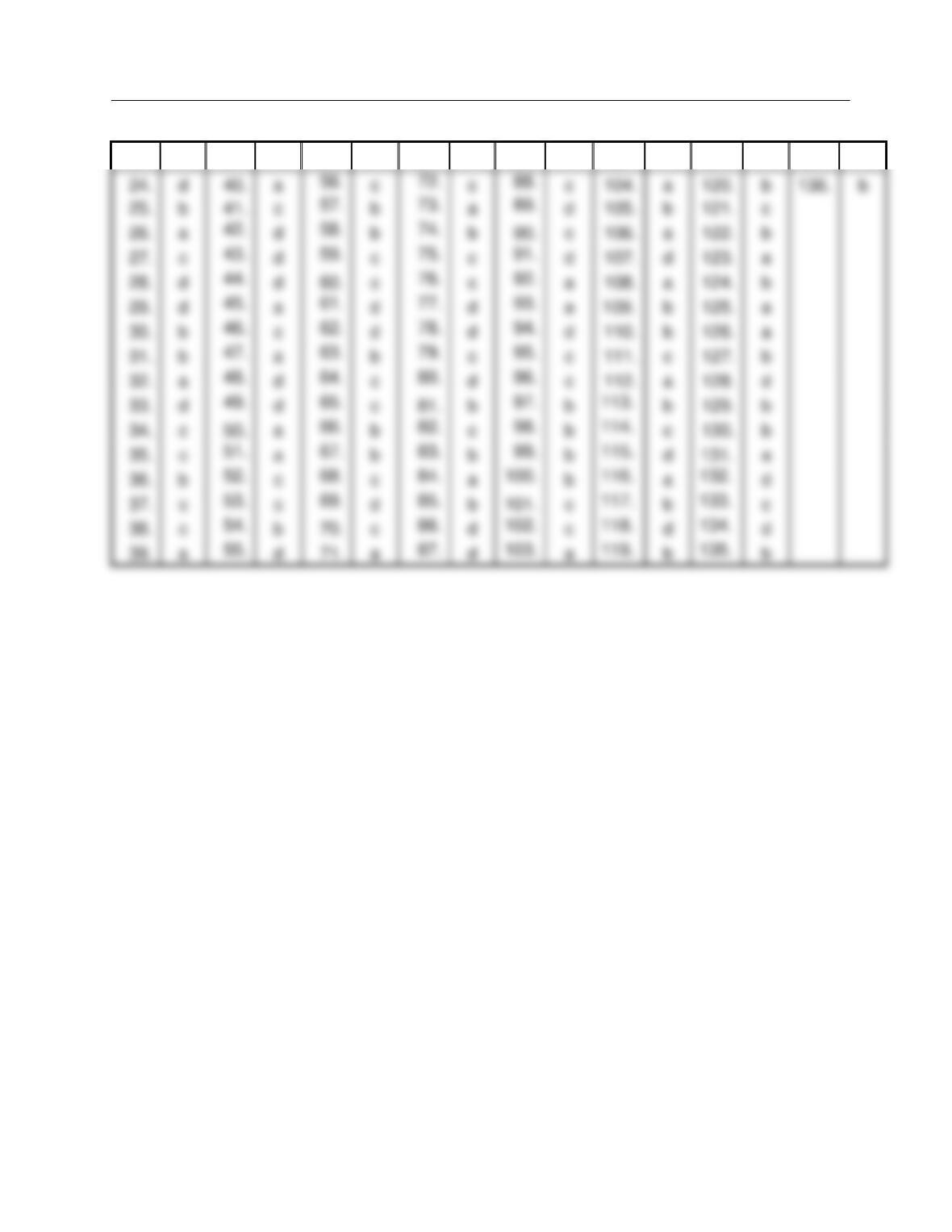
Multiple Choice Answers—Computational
Item
Ans
Item
Ans
Item
Ans
Item
Ans
Item
Ans
Item
Ans
Item
Ans
Item
Ans
Test Bank for Intermediate Accounting, IFRS Edition, 3e
6 – 26
EXERCISES
Ex. 6-137—Present and future value concepts.
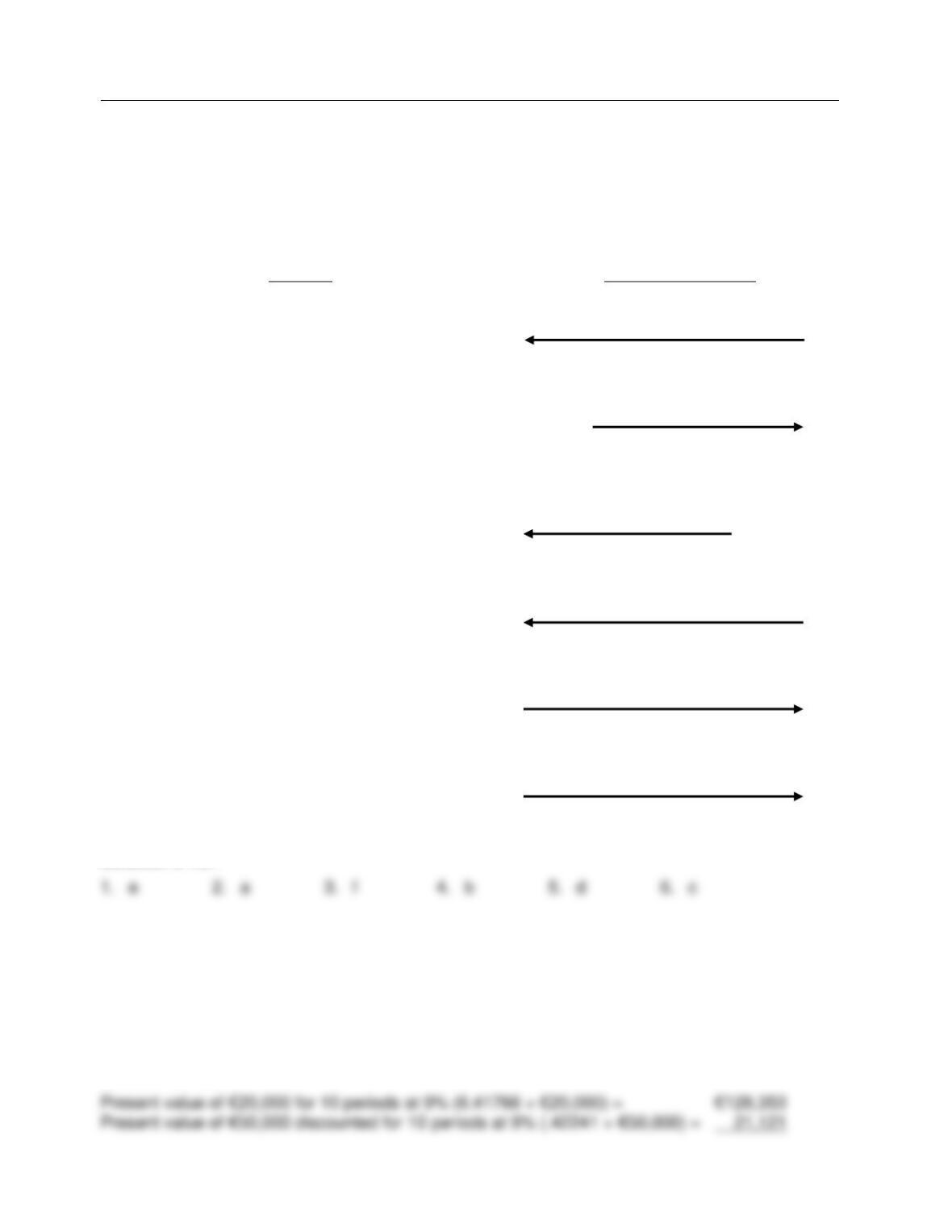
On the right are six diagrams representing six different present and future value concepts stated
on the left. Identify the diagrams with the concepts by writing the identifying letter of the diagram
on the blank line at the left. Assume n = 4 and i = 8%.
Concept Diagram of Concept
_____ 1. Future value of 1. ? $1
a. | | | | |
_____ 2. Present value of 1.
?
_____ 3. Future value of an annuity $1 $1 $1 $1
due of 1. b. |- – – – | | | |
_____ 4. Future value of an ordinary
annuity of 1. ?
$1 $1 $1 $1
_____ 5. Present value of an ordinary c. | | | |- – – – |
annuity of 1.
_____ 6. Present value of an annuity ? $1 $1 $1 $1
due of 1. d. | | | | |
$1 ?
e. | | | | |
$1 $1 $1 $1 ?
f. | | | | |
Solution 6-137
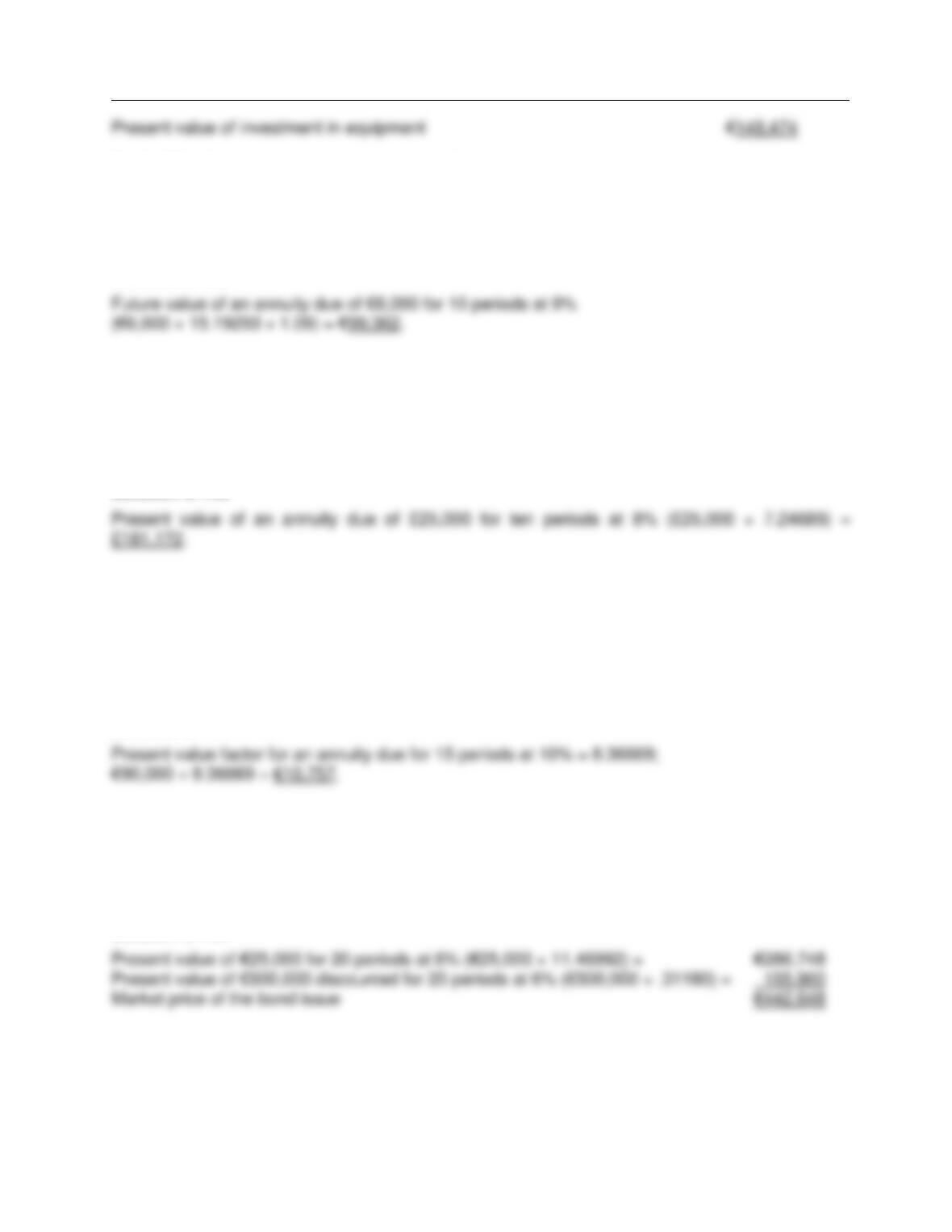
Ex. 6-138—Present value of an investment in equipment. (Tables needed.)
Find the present value of an investment in equipment if it is expected to provide annual savings of
€20,000 for 10 years and to have a resale value of €50,000 at the end of that period. Assume an
interest rate of 9% and that savings are realized at year end.
Solution 6-138
Accounting and the Time Value of Money
6 – 27
Ex. 6-139—Future value of an annuity due. (Tables needed.)
If €6,000 is deposited annually starting on January 1, 2018 and it earns 9%, how much will
accumulate by December 31, 2027?
Solution 6-139
Ex. 6-140—Present value of an annuity due.(Tables needed.)
How much must be invested now to receive £25,000 for ten years if the first £25,000 is received
today and the rate is 8%?
Solution 6-140
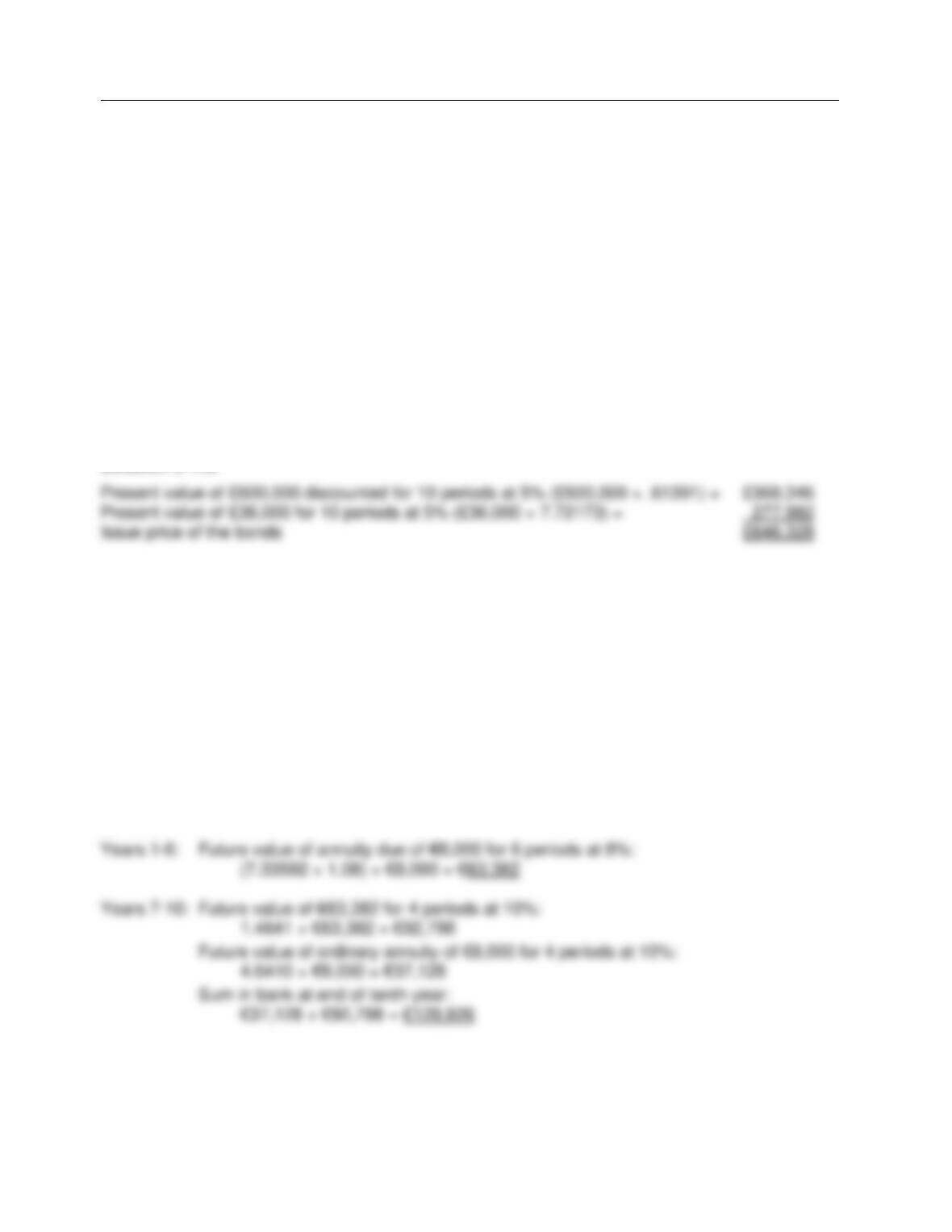
Ex. 6-141—Compute the annual rent. (Tables needed.)
Crone Co. has machinery that cost €90,000. It is to be leased for 15 years with rent received at
the beginning of each year. Crone wants a return of 10%. Compute the amount of the annual
rent.
Solution 6-141
Ex. 6-142—Calculate market price of a bond. (Tables needed.)
Determine the market price of a €500,000, ten-year, 10% (pays interest semiannually) bond issue
sold to yield an effective rate of 12%.
Solution 6-142
Test Bank for Intermediate Accounting, IFRS Edition, 3e
6 – 28
Ex. 6-143—Calculate market price of a bond.
On January 1, 2019 Lance Co. issued five-year bonds with a face value of £600,000 and a stated
interest rate of 12% payable semiannually on July 1 and January 1. The bonds were sold to yield
10%. Present value table factors are:
Present value of 1 for 5 periods at 10% .62092
Present value of 1 for 5 periods at 12% .56743
Present value of 1 for 10 periods at 5% .61391
Present value of 1 for 10 periods at 6% .55839
Present value of an ordinary annuity of 1 for 5 periods at 10% 3.79079
Present value of an ordinary annuity of 1 for 5 periods at 12% 3.60478
Present value of an ordinary annuity of 1 for 10 periods at 5% 7.72173
Present value of an ordinary annuity of 1 for 10 periods at 6% 7.36009
Calculate the issue price of the bonds.
Solution 6-143
PROBLEMS
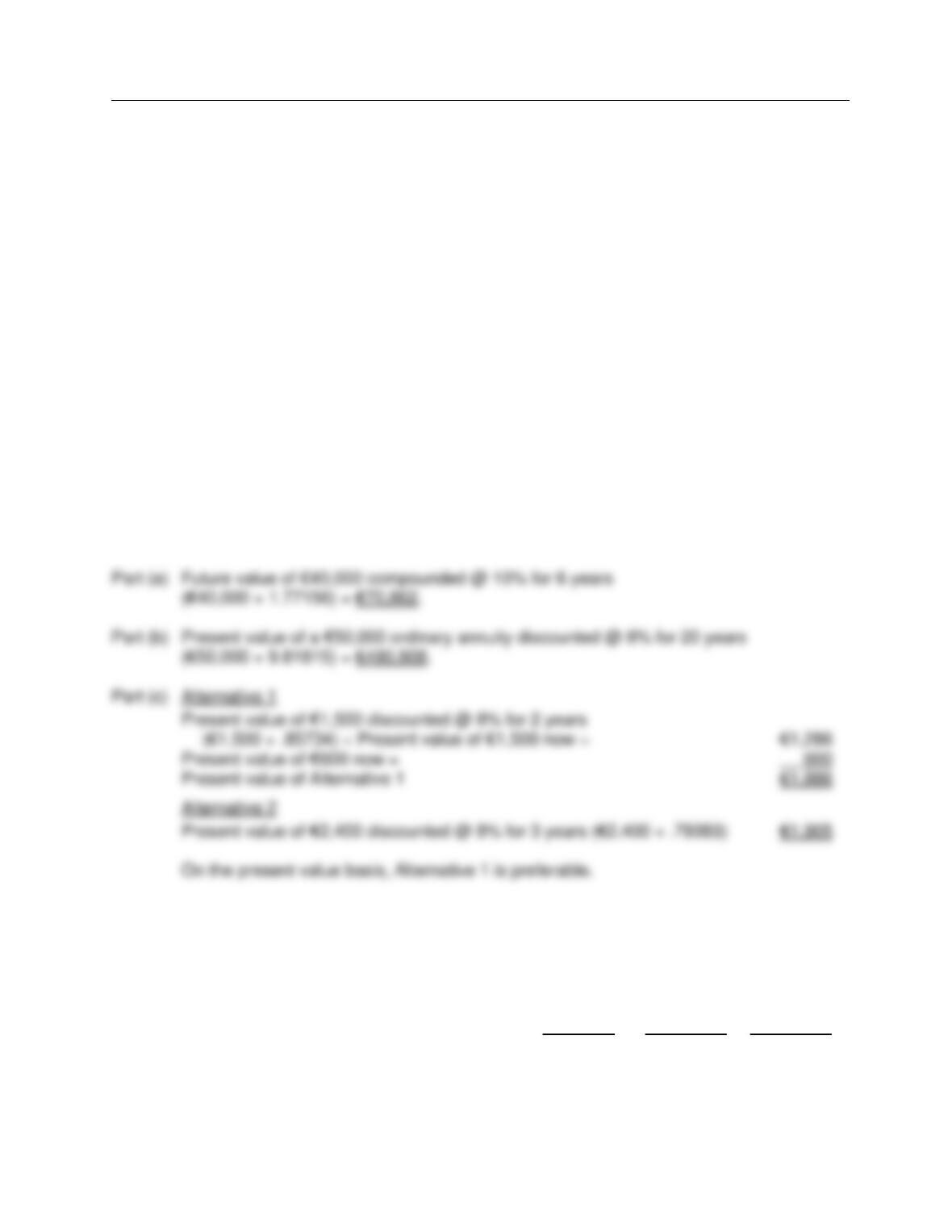
Pr. 6-144—Annuity with change in interest rate.
Jan Green established a savings account for her son’s college education by making annual
deposits of €8,000 at the beginning of each of six years to a savings account paying 8%. At the
end of the sixth year, the account balance was transferred to a bank paying 10%, and annual
deposits of €8,000 were made at the end of each year from the seventh through the tenth years.
What was the account balance at the end of the tenth year?
Solution 6-144
Accounting and the Time Value of Money
6 – 29
Pr. 6-145—Present value and future value computations.
Part (a) Compute the amount that a €40,000 investment today would accumulate at 10%
(compound interest) by the end of 6 years.
Part (b) Tom wants to retire at the end of this year (2019). His life expectancy is 20 years from
his retirement. Tom has come to you, his CPA, to learn how much he should deposit on
December 31, 2019 to be able to withdraw €50,000 at the end of each year for the next
20 years, assuming the amount on deposit will earn 8% interest annually.
Part (c) Judy Thomas has a €1,800 overdue debt for medical books and supplies at Joe’s
Bookstore. She has only €600 in her checking account and doesn’t want her parents to
know about this debt. Joe’s tells her that she may settle the account in one of two ways
since she can’t pay it all now:
1. Pay €600 now and €1,500 when she completes her residency, two years from today.
2. Pay €2,400 one year after completion of residency, three years from today.
Assuming that the cost of money is the only factor in Judy’s decision and that the cost of
money to her is 8%, which alternative should she choose? Your answer must be
supported with calculations.
Solution 6-145
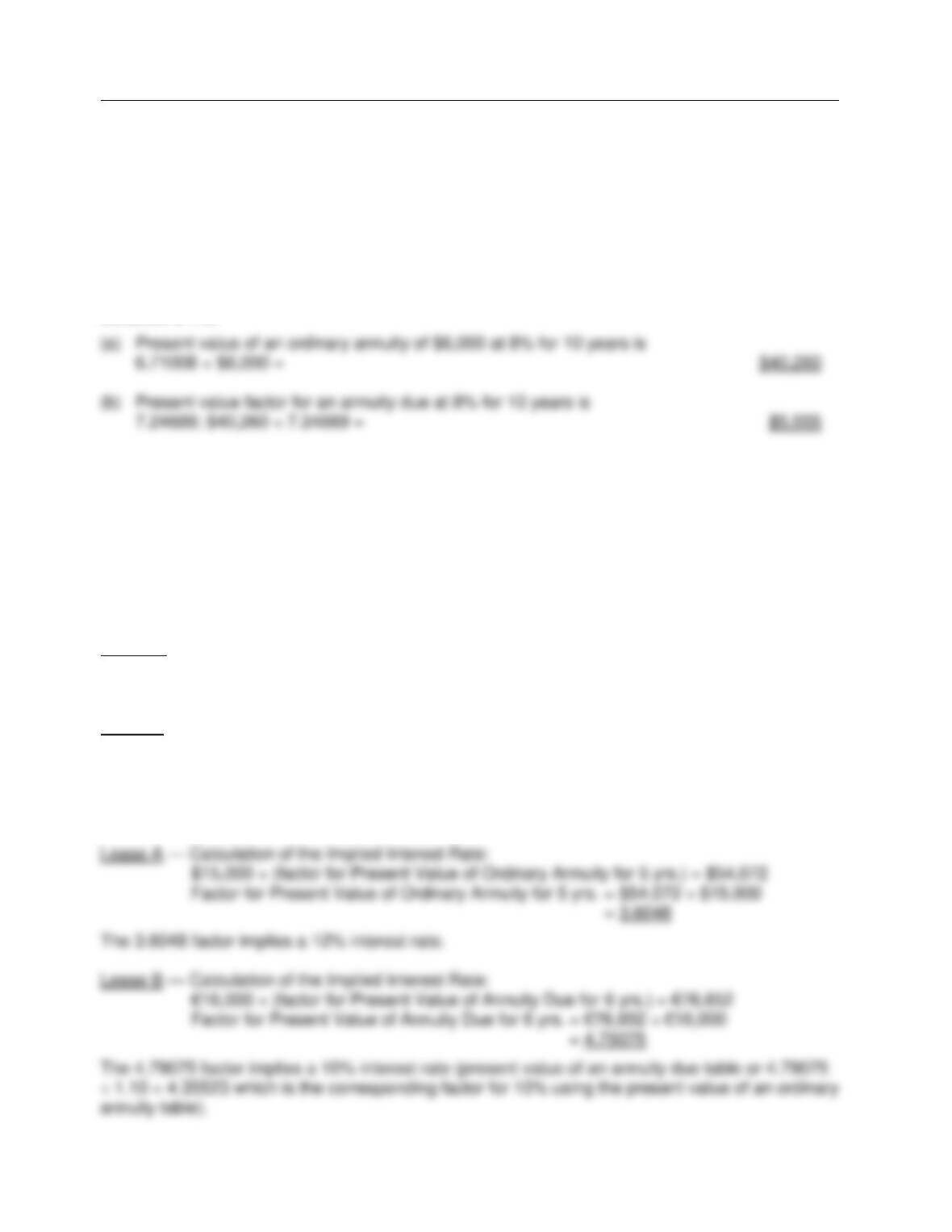
Pr. 6-146—Present value of an ordinary annuity due.
Jill Morris is presently leasing a small business computer from Eller Office Equipment Company.
The lease requires 10 annual payments of $6,000 at the end of each year and provides the lessor
(Eller) with an 8% return on its investment. You may use the following 8% interest factors:
9 Periods 10 Periods 11 Periods
Future Value of 1 1.99900 2.15892 2.33164
Present Value of 1 .50025 .46319 .42888
Future Value of Ordinary Annuity of 1 12.48756 14.48656 16.64549
Present Value of Ordinary Annuity of 1 6.24689 6.71008 7.13896
Present Value of Annuity Due of 1 6.74664 7.24689 7.71008
Test Bank for Intermediate Accounting, IFRS Edition, 3e
6 – 30
Instructions
(a) Assuming the computer has a ten-year life and will have no salvage value at the expiration of
the lease, what was the original cost of the computer to Eller?
(b) What amount would each payment be if the ten annual payments are to be made at the
beginning of each period?
Solution 6-146
Pr. 6-147—Finding the implied interest rate.
Bates Company has entered into two lease agreements. In each case the cash equivalent
purchase price of the asset acquired is known and you wish to find the interest rate which is
applicable to the lease payments.
Instructions
Calculate the implied interest rate for the lease payments.
Lease A — Lease A covers office equipment which could be purchased for $54,072. Bates
Company has, however, chosen to lease the equipment for $15,000 per year, payable at the end
of each of the next 5 years.
Lease B — Lease B applies to a machine which can be purchased for $76,652. Bates Company
has chosen to lease the machine for $16,000 per year on a 6-year lease. Payments are due at
the start of each year.
Solution 6-147

Accounting and the Time Value of Money
6 – 31
Test Bank for Intermediate Accounting, IFRS Edition, 3e
6 – 32
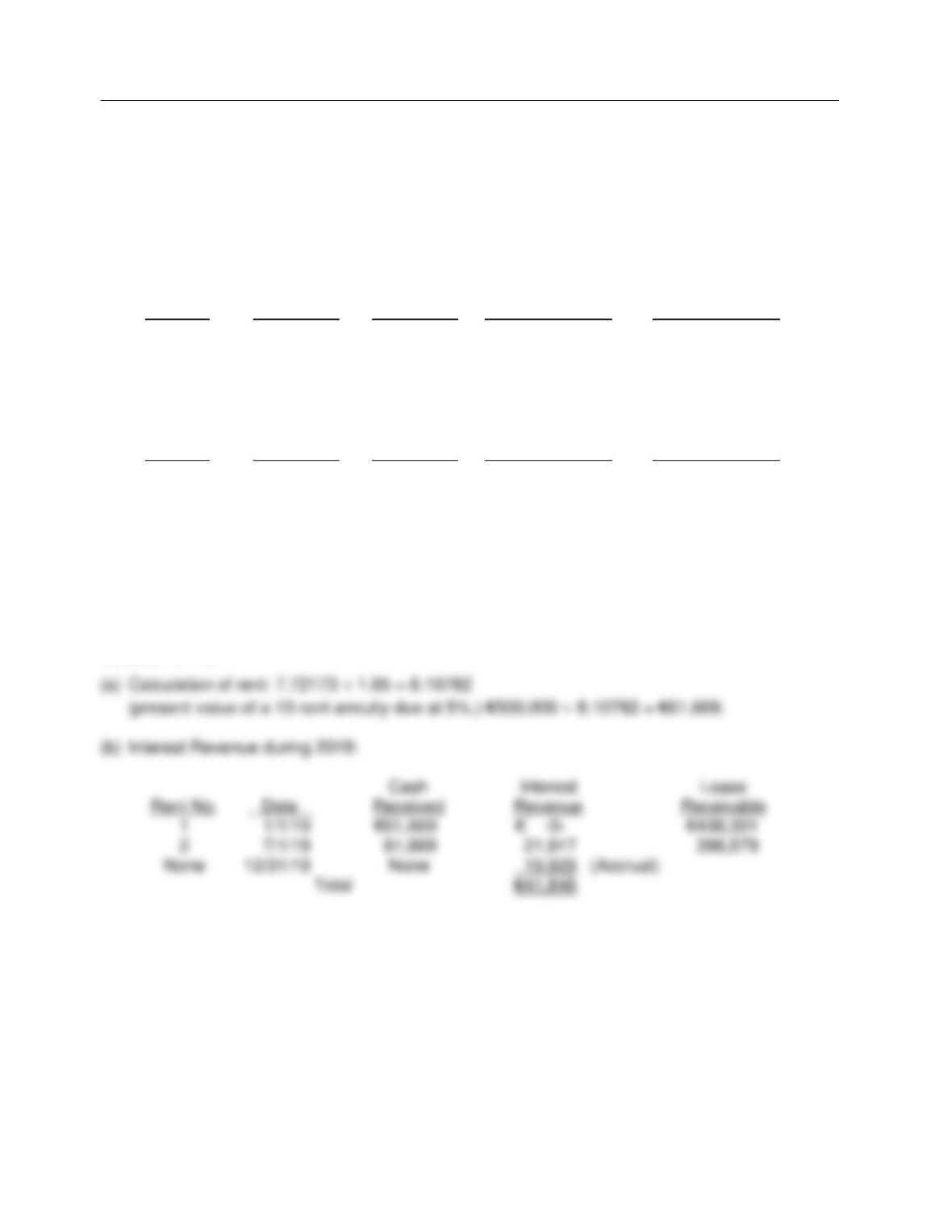
Pr. 6-148—Calculation of unknown rent and interest.
Pine Leasing Company purchased specialized equipment from Wayne Company on December
31, 2018 for €500,000. On the same date, it leased this equipment to Sears Company for 5 years,
the useful life of the equipment. The lease payments begin January 1, 2019 and are made every
6 months until July 1, 2023. Pine Leasing wants to earn 10% annually on its investment.
Various Factors at 10%
Periods Future Present Future Value of an Present Value of an
or Rents Value of $1 Value of $1 Ordinary Annuity Ordinary Annuity
9 2.35795 .42410 13.57948 5.75902
10 2.59374 .38554 15.93743 6.14457
11 2.85312 .35049 18.53117 6.49506
Various Factors at 5%
Periods Future Present Future Value of an Present Value of an
or Rents Value of $1 Value of $1 Ordinary Annuity Ordinary Annuity
9 1.55133 .64461 11.02656 7.10782
10 1.62889 .61391 12.57789 7.72173
11 1.71034 .58468 14.20679 8.30641
Instructions
(a) Calculate the amount of each rent.
(b) How much interest revenue will Pine earn in 2019?
Solution 6-148
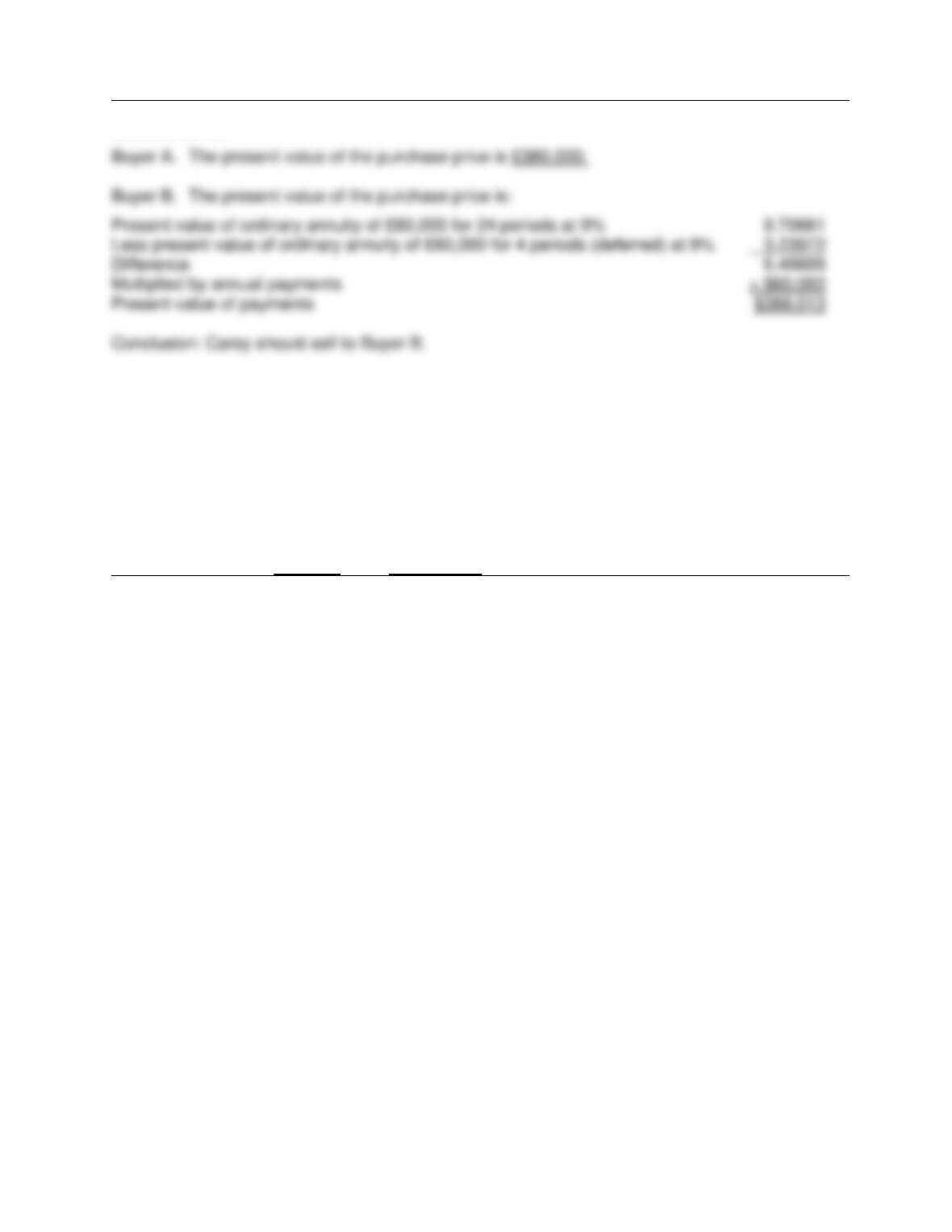
Pr. 6–149—Deferred annuity.
Carey Company owns a plot of land on which buried toxic wastes have been discovered. Since it
will require several years and a considerable sum of money before the property is fully detoxified
and capable of generating revenues, Carey wishes to sell the land now. It has located two
potential buyers: Buyer A, who is willing to pay £380,000 for the land now, and Buyer B, who is
willing to make 20 annual payments of £60,000 each, with the first payment to be made 5 years
from today. Assuming that the appropriate rate of interest is 9%, to whom should Carey sell the
land? Show calculations.
Accounting and the Time Value of Money
6 – 33
Solution 6-149
Pr. 6-150
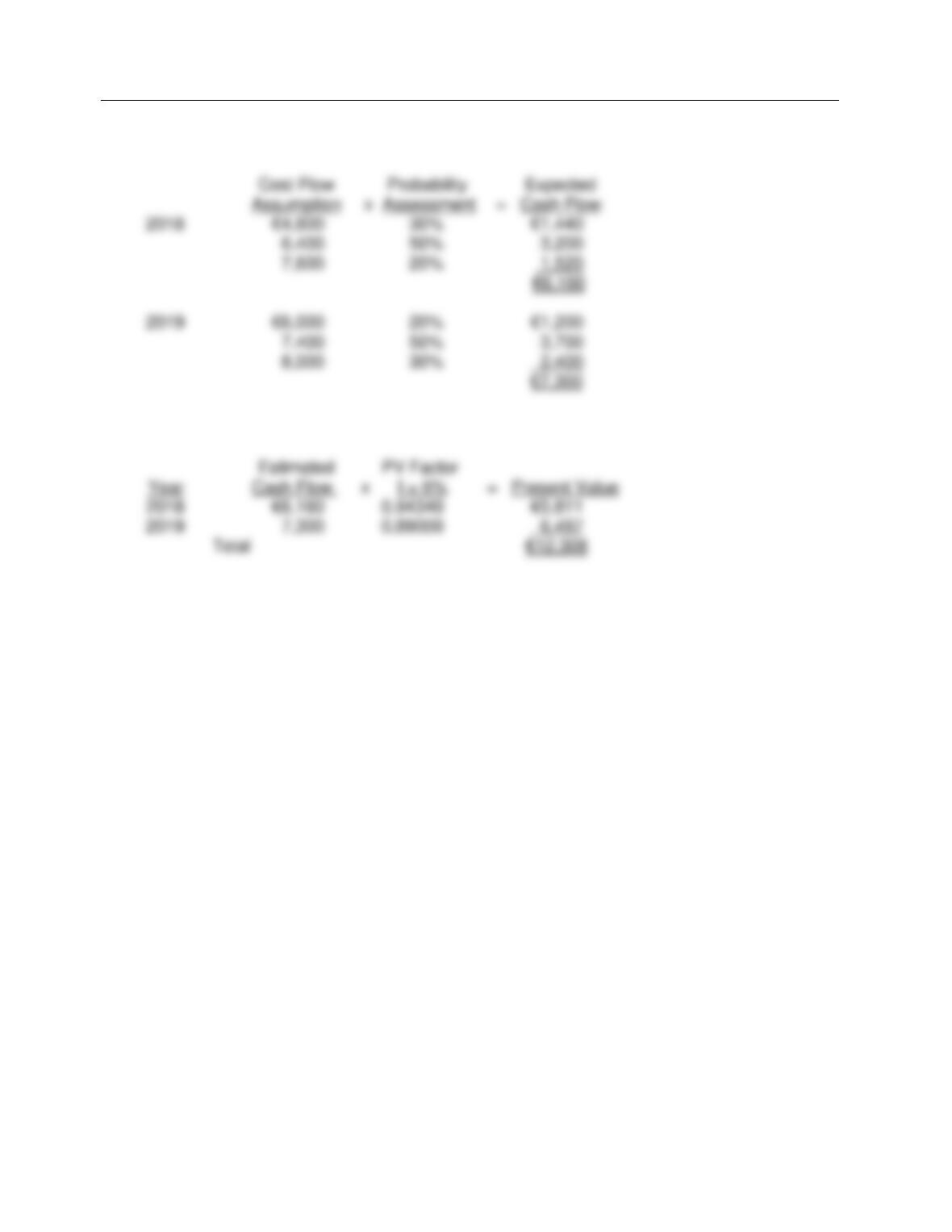
Lupo’s washers Dryers offers a 2-year warranty on all appliances sold. The company is trying to
estimate the warranty expense for 2018 and the related warranty liability at December 31, 2018.
Because there is no ready market for such warranty contracts, the company must estimate the
fair value of the contracts using the expected cash flow approach shown below are the estimated
cash flows and probability assessments for 2018 and 2019.
Cost flow Probability
Estimate Assessment
2018 €4,800 30%
6,400 50%
7,600 20%
2019 €6,000 20%
7,400 50%
8,000 30%
Instructions:
Assuming a risk-free rate of 6% and that the cash flows occurs at year-end, calculate the
warranty obligation:
Test Bank for Intermediate Accounting, IFRS Edition, 3e
6 – 34
Solution 6-150