121. A business develops a budget for many reasons beyond wanting to know what future
profits will be. Comment on the role of a firm’s strategic goals in both the master budget and the
capital budget.
122. Kurt Helfter graduated with a B.S. degree in Mechanical Engineering and joined Andrew
Consulting, a firm specializing in HVAC (heating, ventilation, and air conditioning) for small to
medium-size business structures. Kurt is knowledgeable in the use of CAD (computer-assisted
design) and was pleased during his initial employment to find Andrew Consulting a leader in the
use of CAD software.
During Kurt’s third year at Andrew, he felt a sense of unease with the firm’s slow pace in
updating computer hardware and software. Although not directly involved in budgeting for the
firm, Kurt has been satisfied with the resources that Andrew provided for his use. Kurt felt the
need to detail his concerns in a memo to his superior, in which he requested significant
investment in computer resources to “allow us to respond to clients’ needs, both in quantity and
quality.” Kurt was surprised and hurt when he received his superior’s response, which suggested
that resource allocation in the firm is decided at a higher administrative level. “But all I wanted to
do was help keep our firm competitive,” Kurt responded to his boss when visiting him about the
rejection memo. “Sorry, Kurt,” his boss said, “That’s how things get done in this firm.” Kurt now
feels lost, wondering if it’s time to look for another job.
Does this situation suggest what type of budgeting process the company is using? Is there a
problem with individual and company goal congruence in Andrew Consulting? If so, how might
Kurt’s supervisor have prevented the problem?
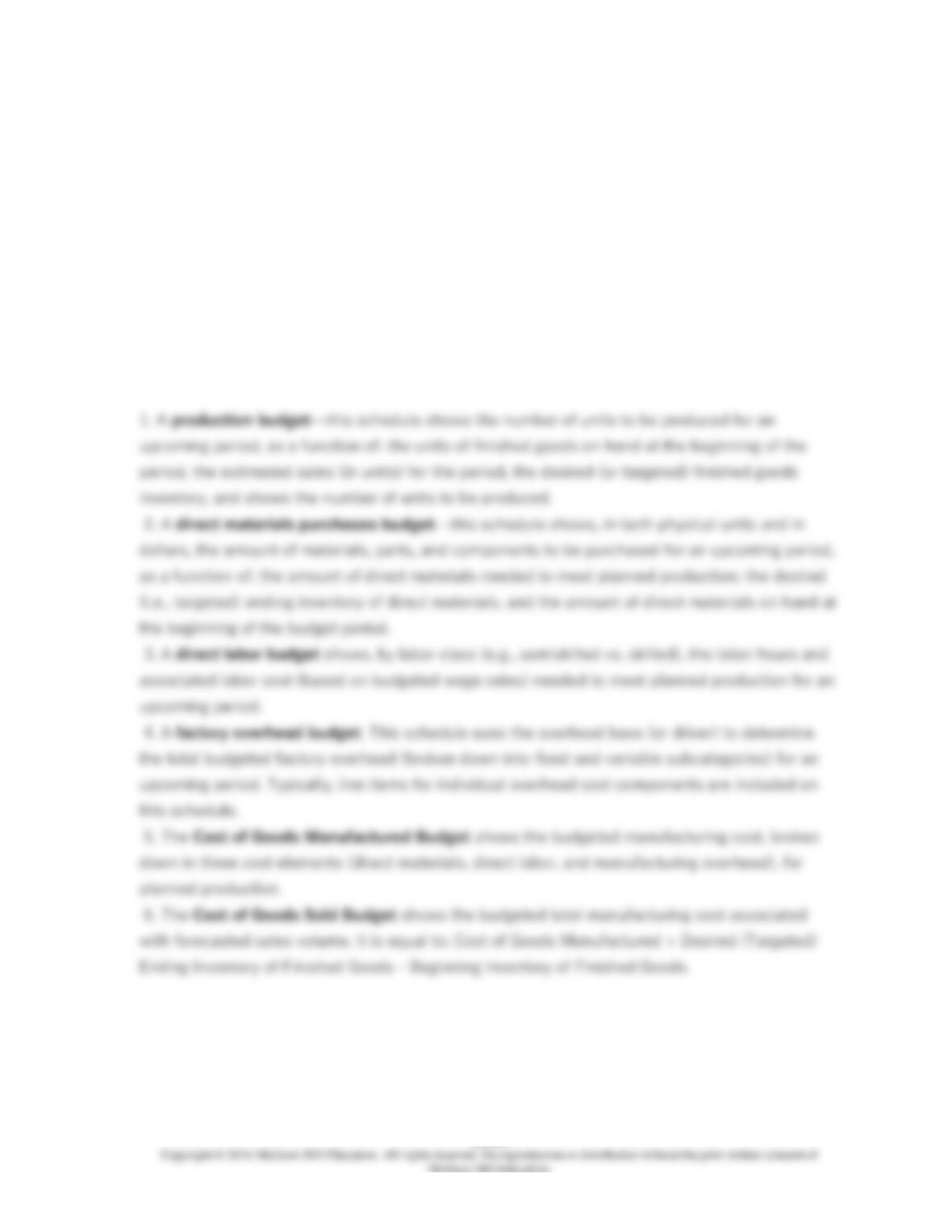
123. Discuss the components of each of the following manufacturing cost budgets:
1. Production budget
2. Direct materials purchases budget
3. Direct labor budget
4. Factory overhead budget
5. Cost of goods manufactured budget
6. Cost of goods sold budget.
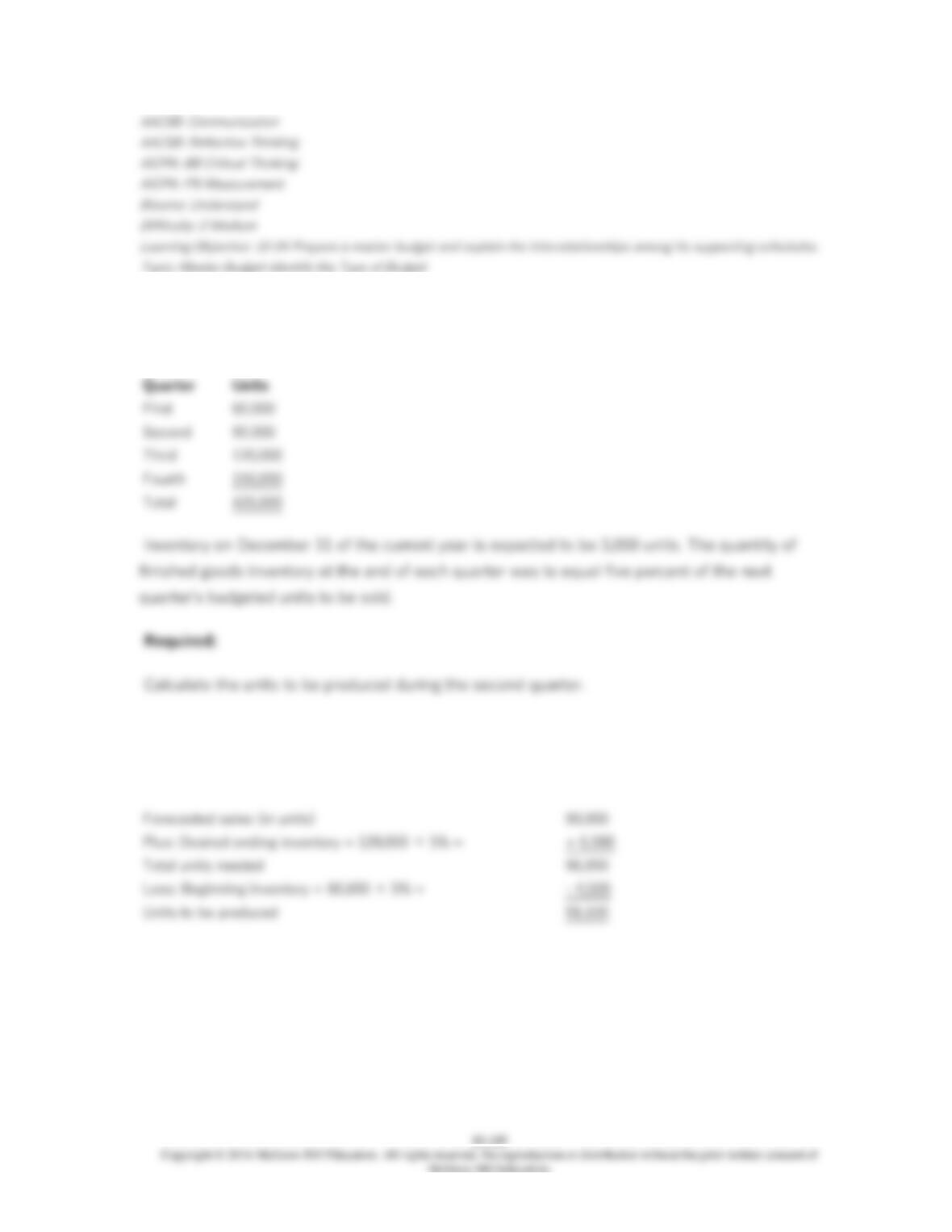
124. Ardan Company’s sales budget showed the following projections, by quarter, for the
coming year:
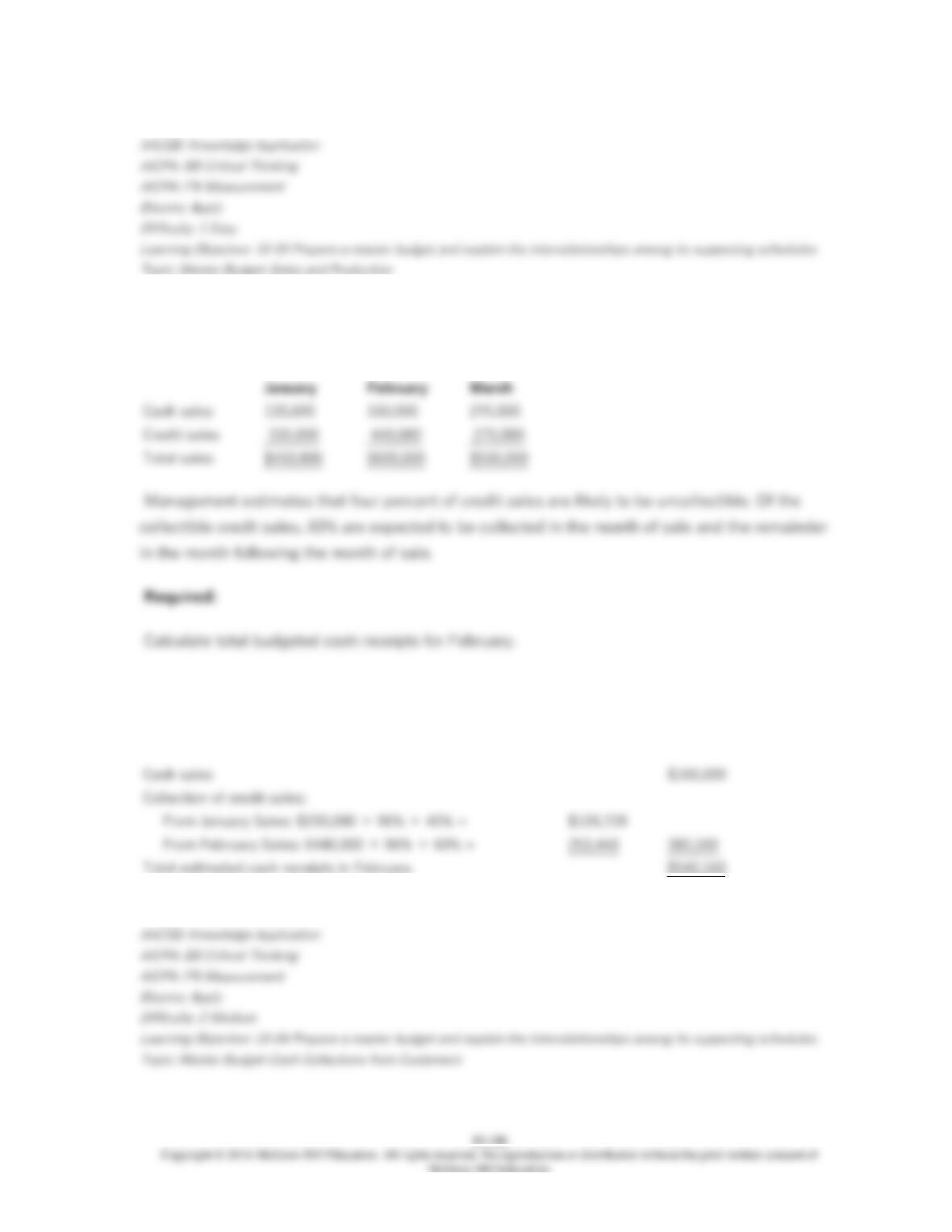
125. Information pertaining to Yek Company’s budgeted sales revenue for the first quarter of
the coming year is presented below.
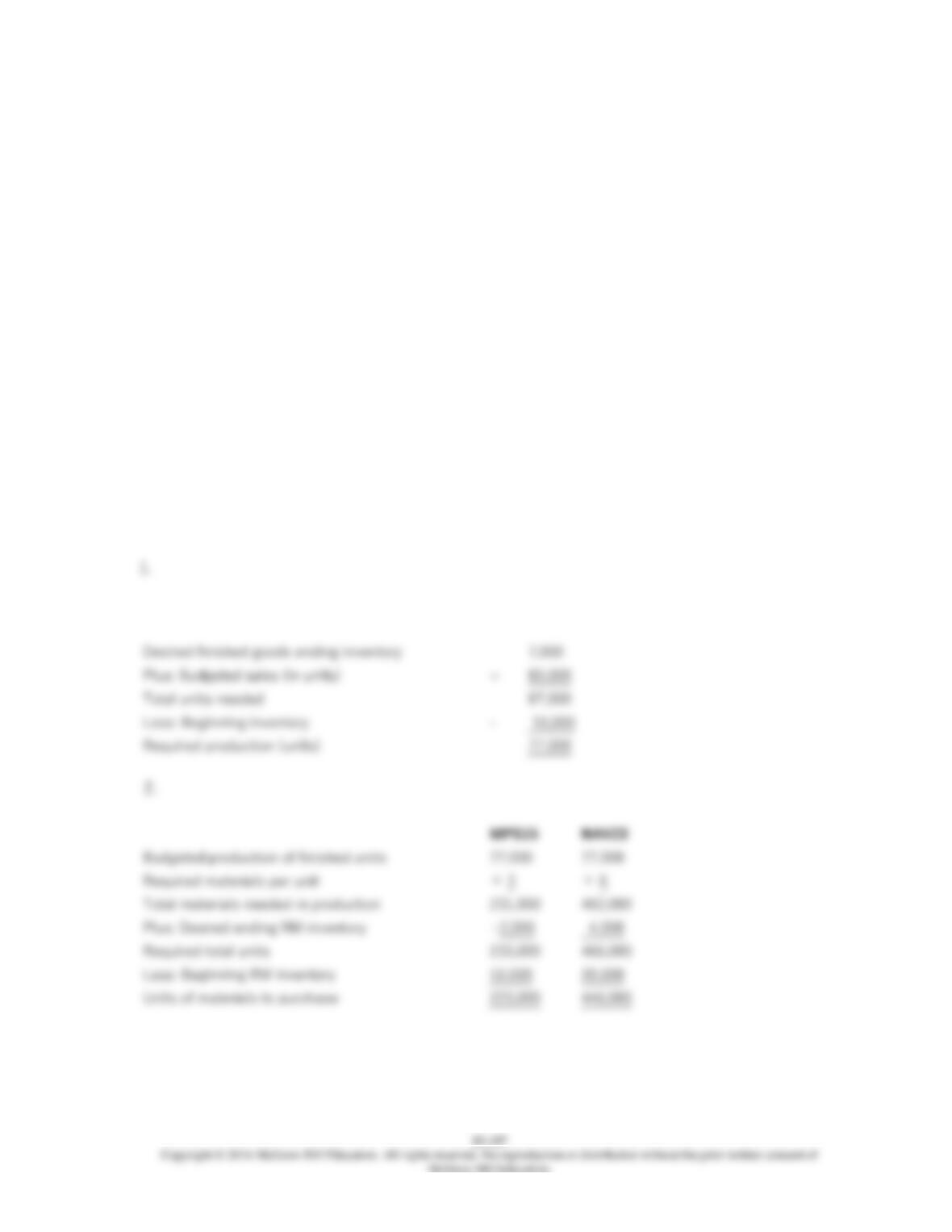
126. The budget committee for Amacom Company, with the help of the district sales manager,
projects sales of 80,000 units of its primary product next year. The budget committee and key
executives have decided that finished goods inventory should be decreased from the 10,000 units
expected at the end of the current year, to 7,000 units at the end of next year. Each unit of
finished product requires three units of material MPS15 and six units of material NAV23. At the
end of the current year, the inventory of material MPS15 is expected to be 10,000 units and
material NAV23 is expected to be 20,000 units. The budget committee believes that these
material inventories can be reduced by 80% during the coming year because of the newly
installed supply chain system.
Required:
1. Calculate the number of units Amacom expects to produce during the next year.
2. Compute the number of units that should be purchased of each of the raw materials in order to
produce the budgeted units and comply with inventory policy.
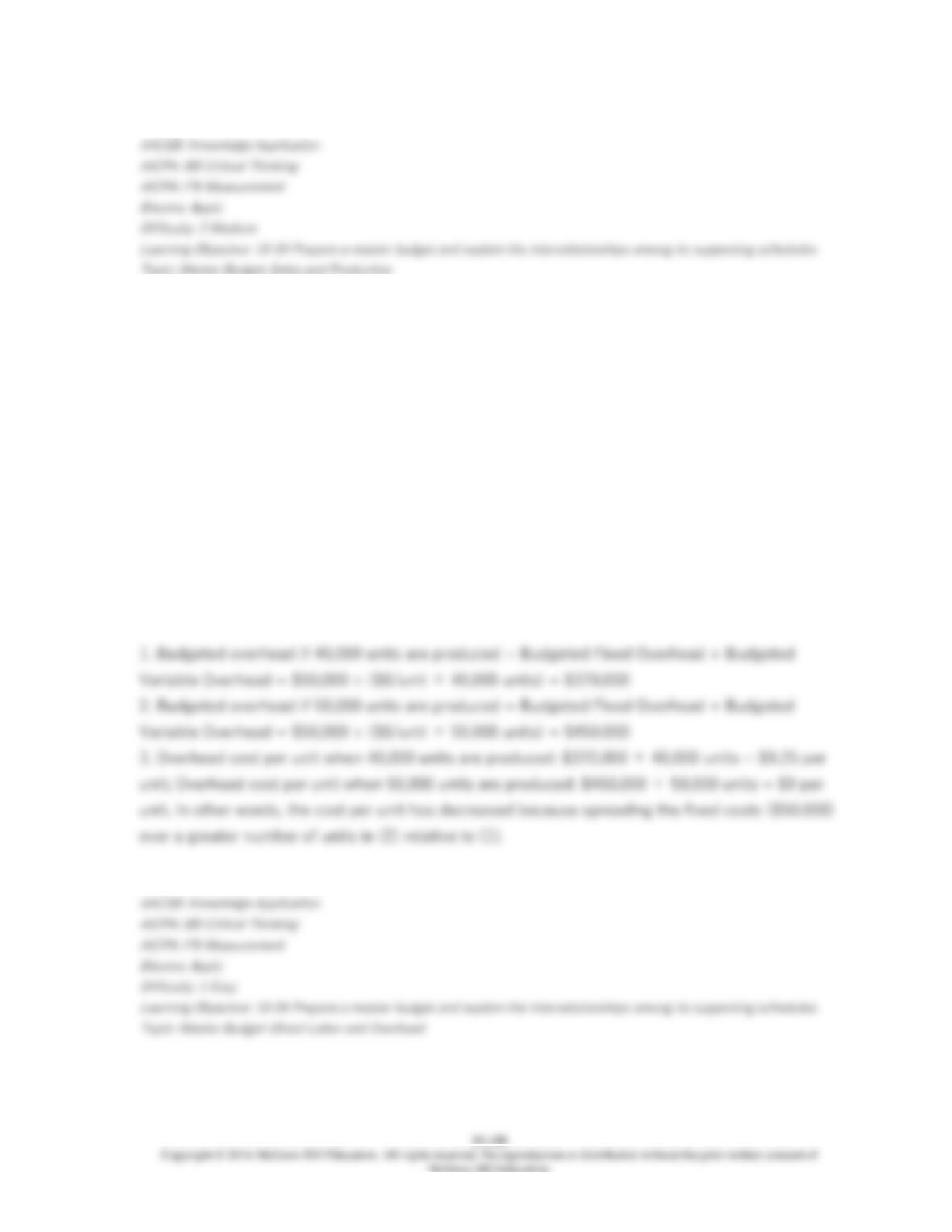
127. Willard Company anticipates that its fixed manufacturing overhead costs will be $50,000
during the next period. Its variable manufacturing overhead is expected to be $8 per unit
produced.
Required:
1. What amount of overhead should be budgeted if the production budget shows that 40,000
units are to be produced?
2. What amount of overhead should be budgeted if the production budget shows that 50,000
units are to be produced?
3. Compute the total overhead cost per unit for requirements 1 and 2.
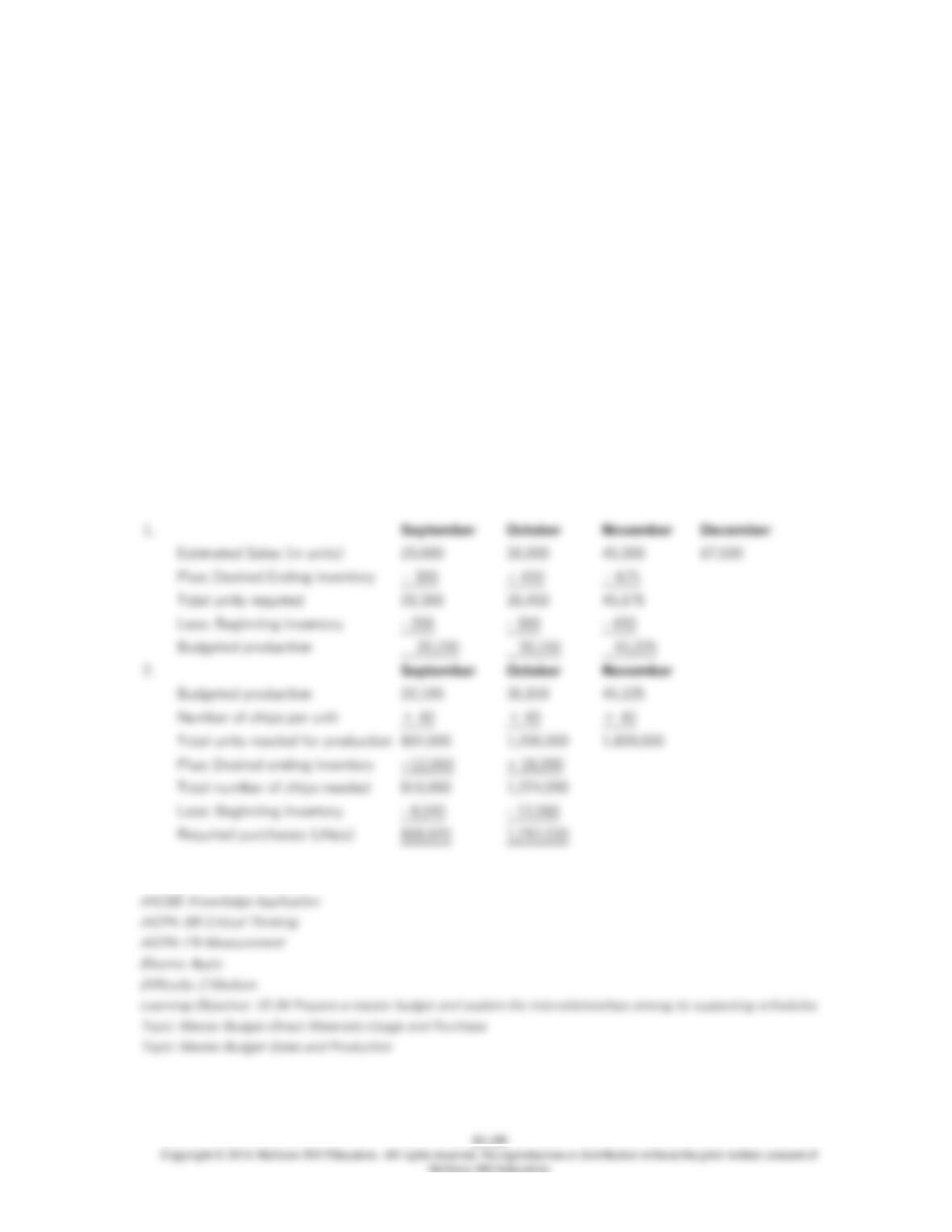
128. Uecker Enterprise expects sales of 20,000 units of T1 in September. T1 is its most
popular high-performance desktop model. The sales manager is confident that, between October
and December, the total sales will experience a 50% growth rate each month from the month
before. Each unit requires 40 sets of the Alpha-5 chip. The firm has a policy to maintain inventory
at the end of each month equal to 1% of the following month’s estimated sales. The same policy
applies to the chips and components required to assemble the finished product.
Required:
1. What is the budgeted production (in units) for each of the months September, October, and
November?
2. How many sets of Alpha-5 does the company plan to purchase in September and in October?
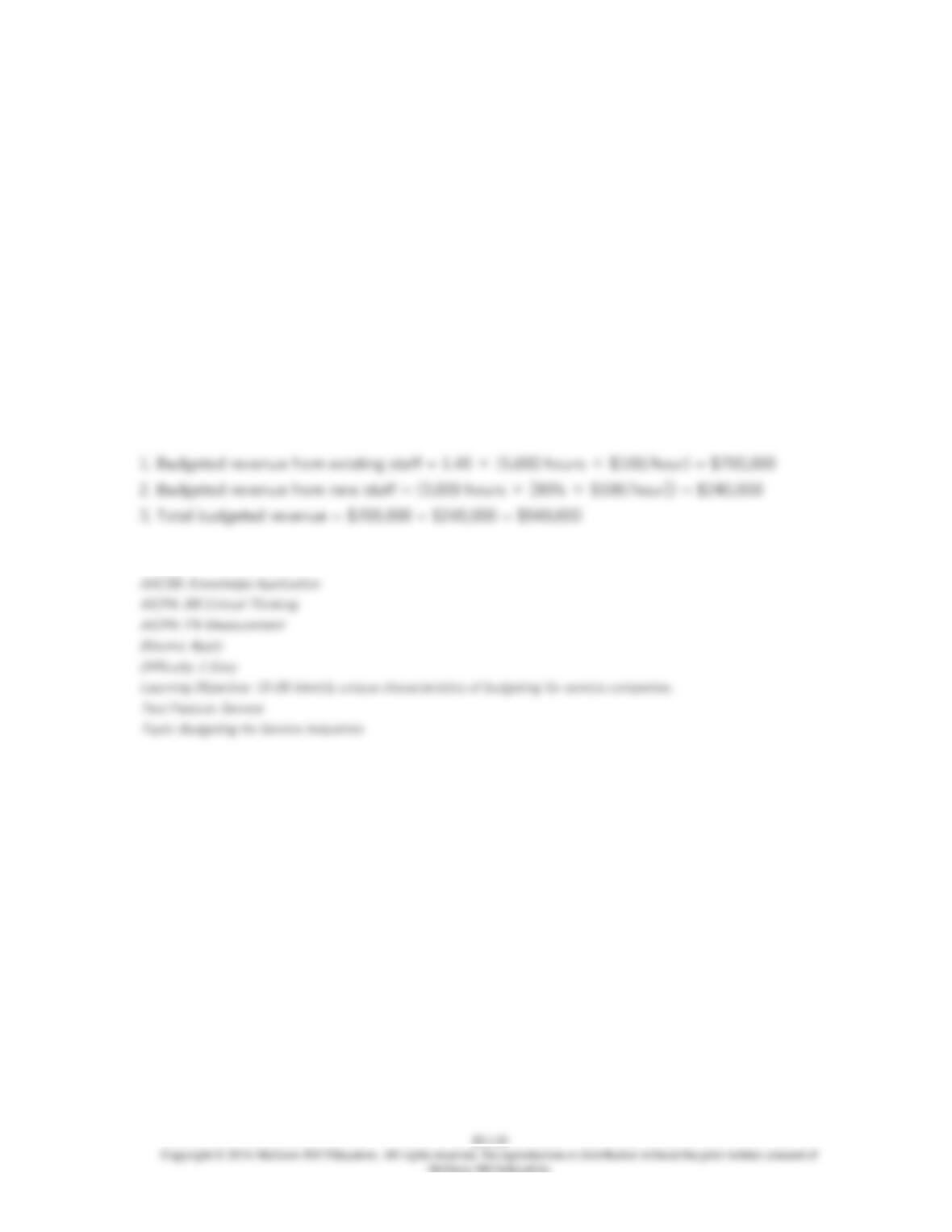
129. Enterprise Tax Services (ETS) provides tax-planning services to its clients. The company
billed 5,000 hours at $100 per hour for the year just completed. ETS, in planning next year’s
operations, is focusing on increasing the company’s share of the market. It proposes to do that by
hiring more tax specialists and by lowering its billing rate by 20% for work done by these new
specialists. ETS estimates that revenues generated from existing staff would increase in total by
40% as a result of the new billing policy and that the additional specialists will provide billings of
3,000 hours (at the reduced rate) during the coming year.
Required:
Compute the budgeted revenue amount for next year based on ETS’s plans and projections.
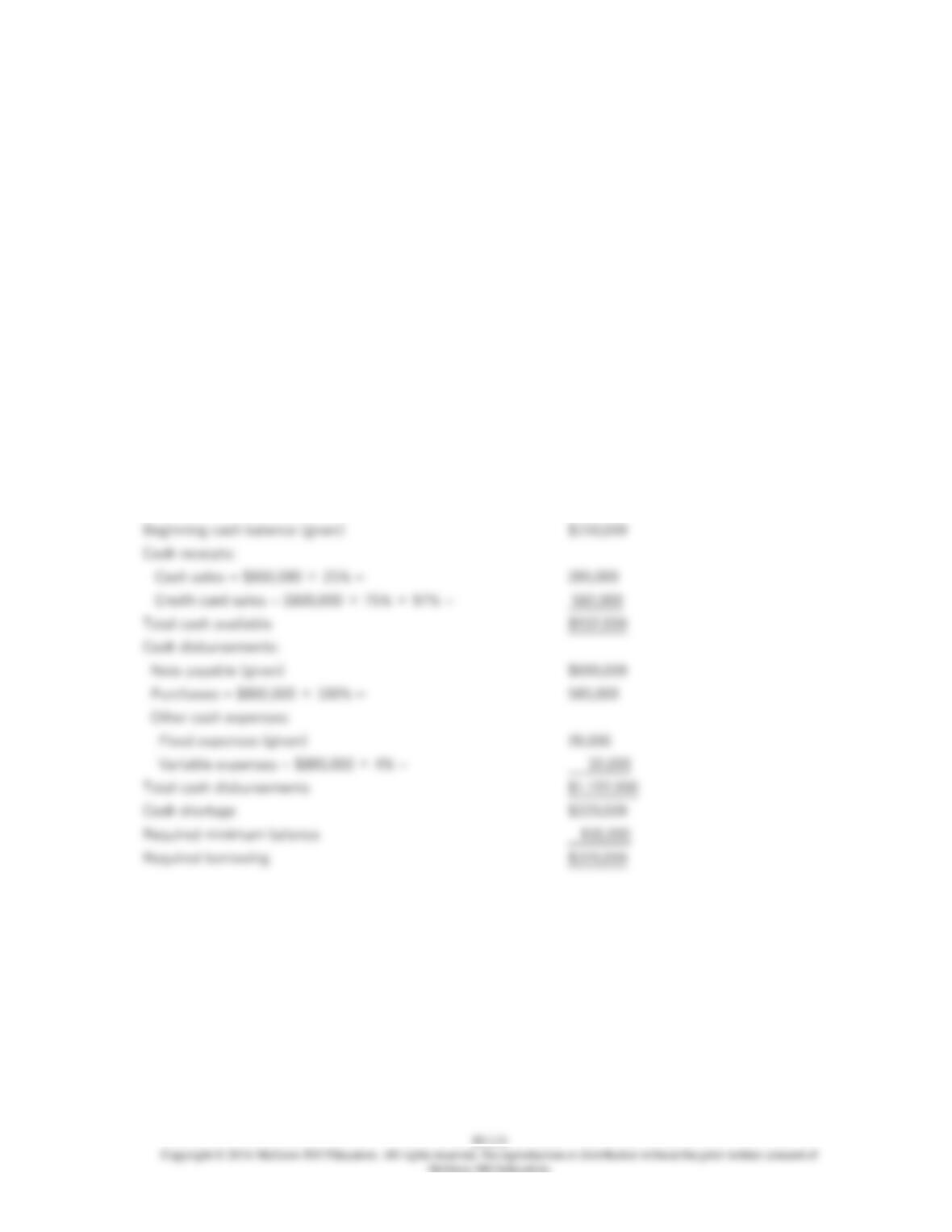
130. Transcript Company is preparing a cash budget for February. The company expects to
have $150,000 cash at the beginning of February and anticipates total February sales of
$800,000, consisting of 25% cash sales and 75% bank credit card sales. The bank charges 3
percent for credit card transactions. The company sets its selling price at 160 percent of the cost
of purchases and pays for each month’s purchases at the end of the month. Other cash
disbursements are $20,000 per month plus 4% of total sales. In addition, a $600,000 note will be
due in February for equipment purchased last August. Transcript Company has an agreement
with its bank to maintain a cash balance of $100,000.
Required:
What amount, if any, must the company borrow during February?
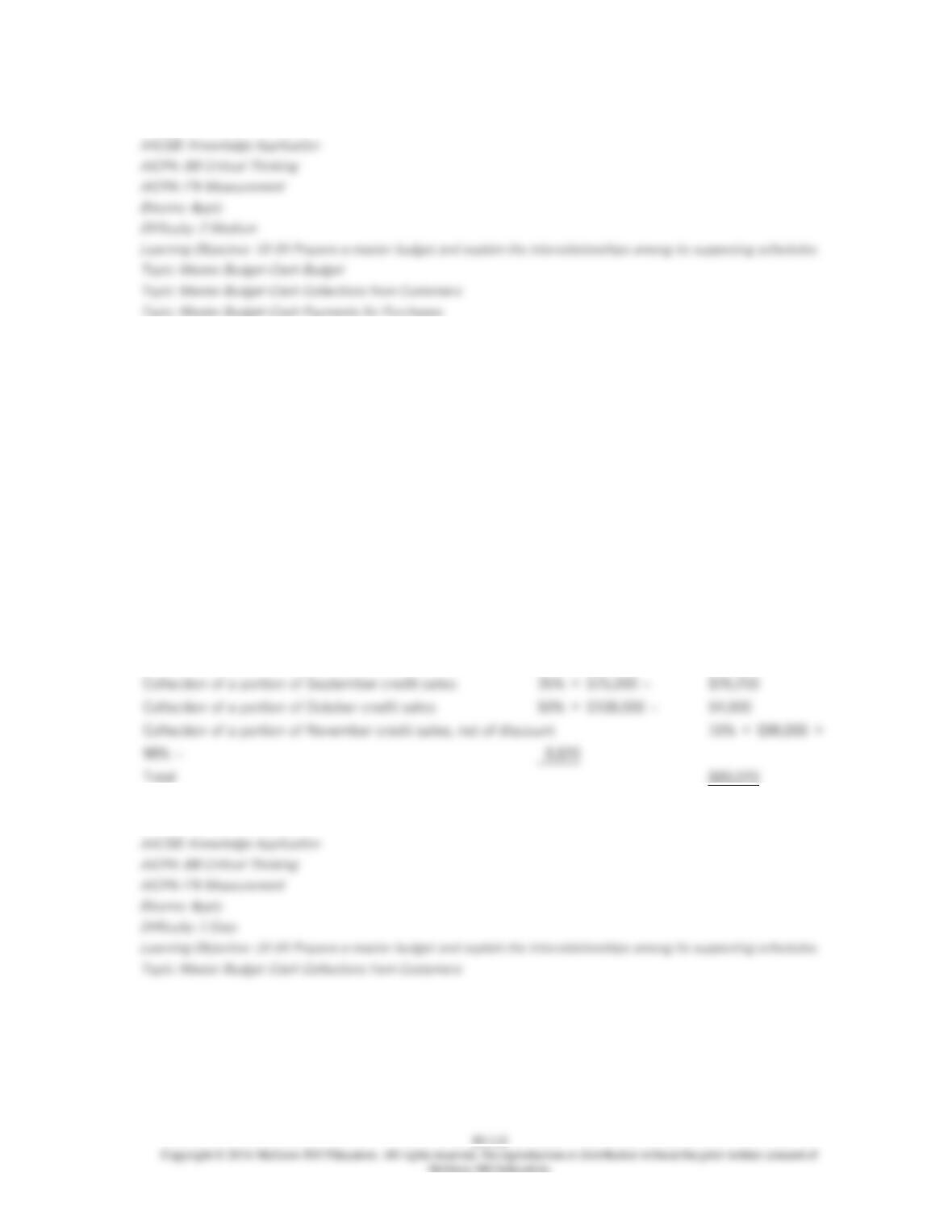
131. West Company budgeted the following credit sales during the current year: September,
$75,000; October, $108,000; November, $90,000; December, $96,000. Experience has shown that
cash from credit sales is received as follows: 10% in the month of sale, 50% in the first month
after sale, 35% in the second month after sale, and 5% is uncollectible. All collections in the
month of sale are subject to 2 percent cash discount.
Required:
How much total cash can West Company expect to collect in November?
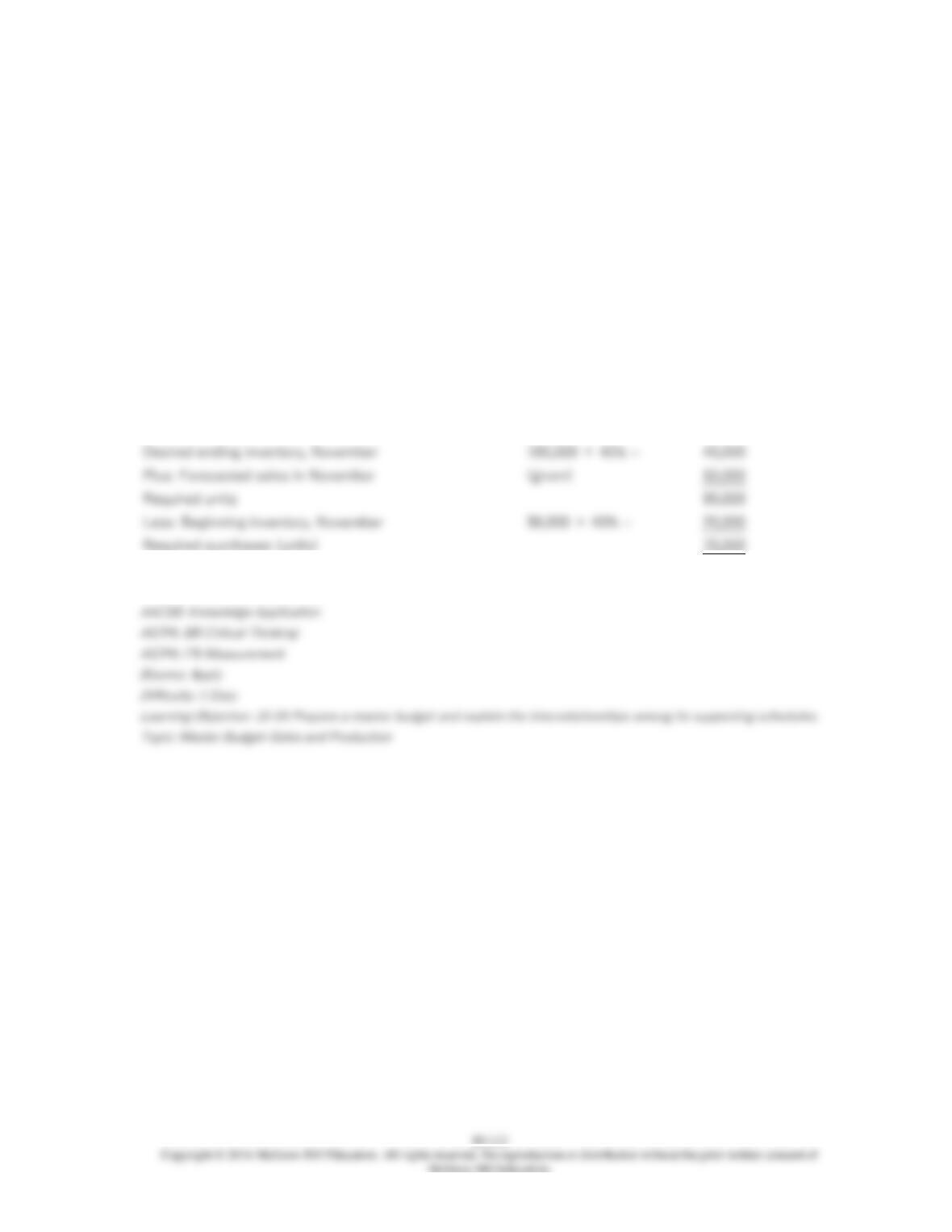
132. In preparing a budget for the first three months of the year starting in October, Dubya
Company is planning the number of units of merchandise to order each month. The company’s
policy is to have on hand at the end of each month 40% of the next month’s sales. Projected
sales for October, November, and December are 40,000 units, 50,000 units, and 100,000 units,
respectively.
Required:
How many units must be ordered in November?
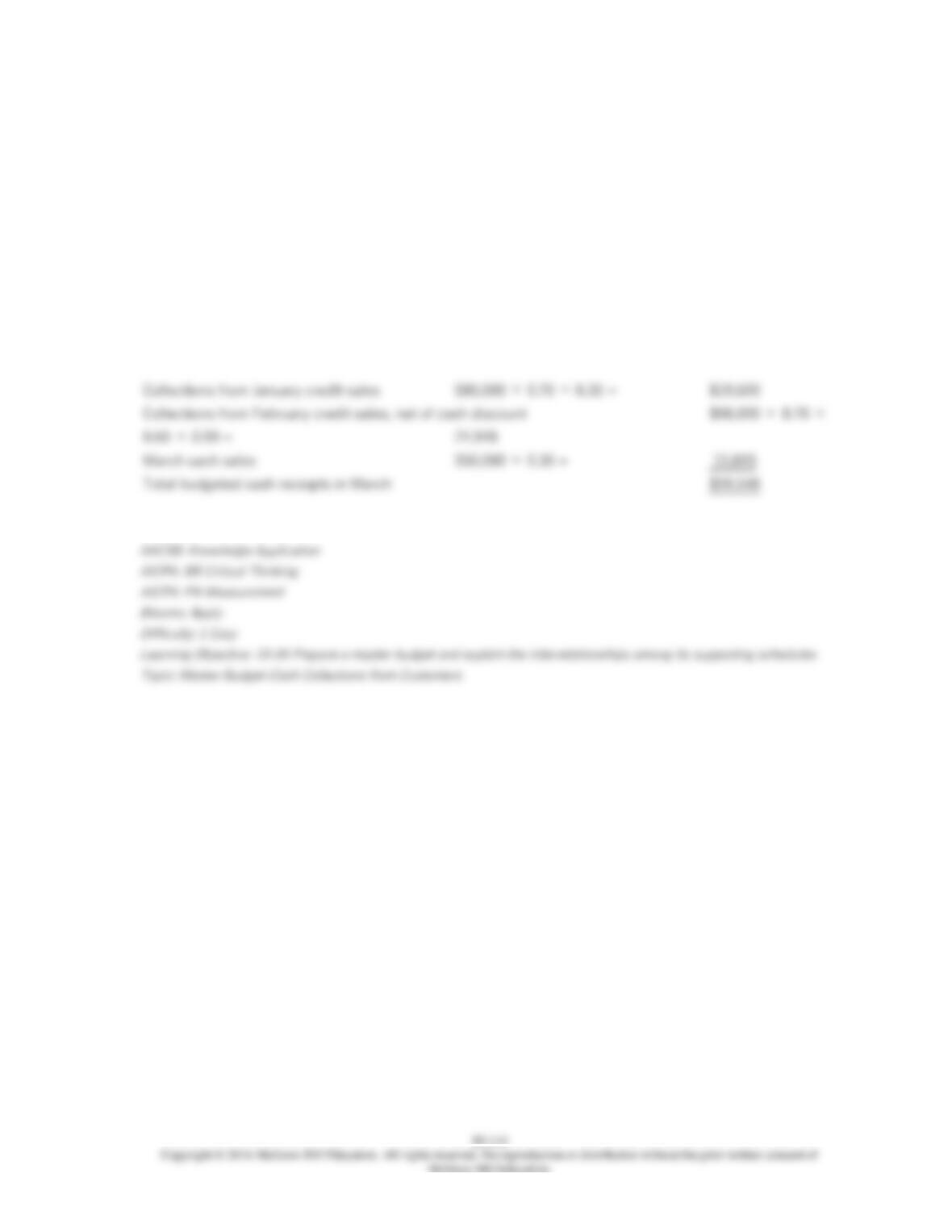
133. The Shoecraft Company’s budgeted sales for January, February, and March of $80,000,
$60,000, and $50,000, respectively. Seventy percent of sales are on credit. The company collects
60% of its credit sales in the month following sale, 35% in the second month following sale, and
5% is not collected. Shoecraft mailed all statements to credit customers at the end of the month
with a term of 1/30, n/60. What are Shoecraft’s expected (i.e., budgeted) cash receipts for
March?
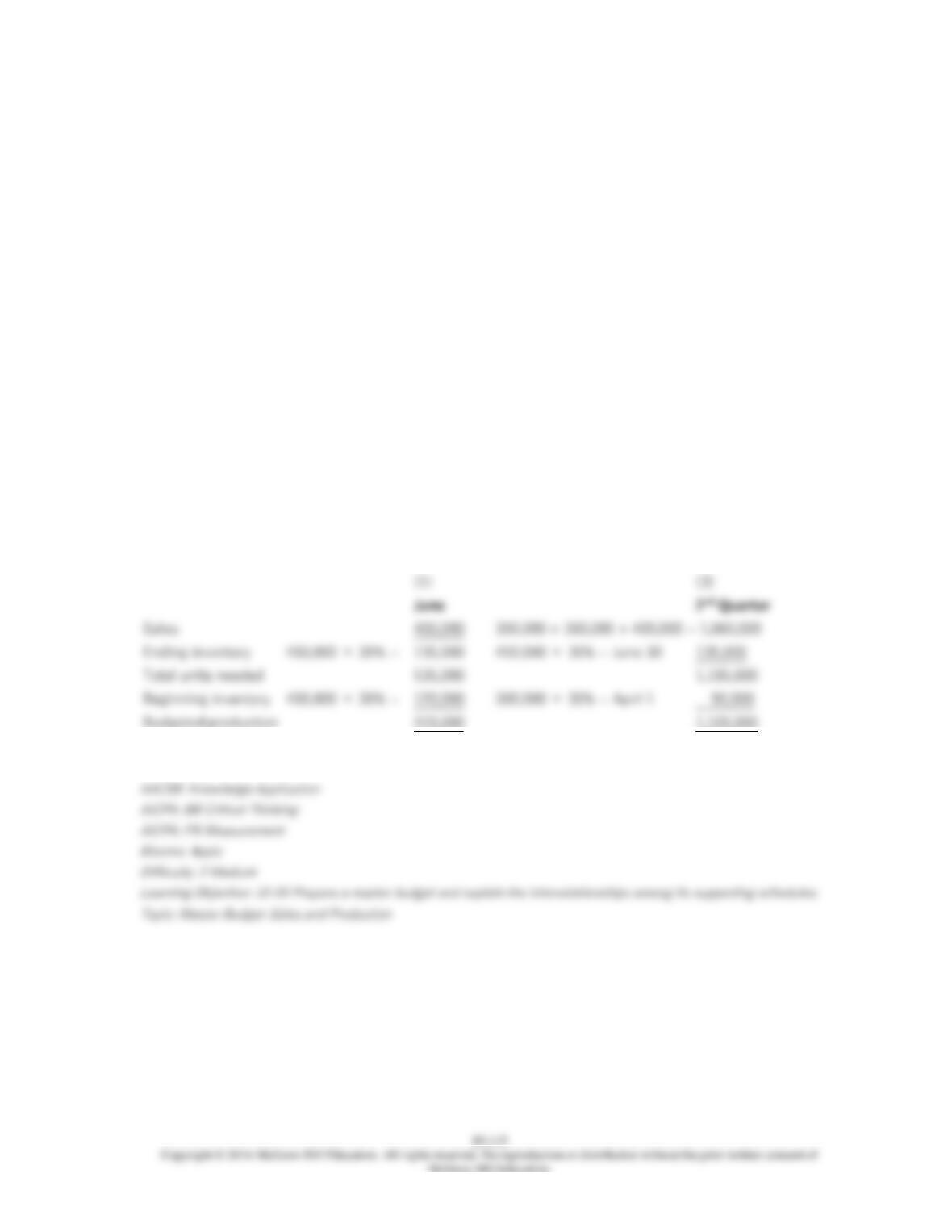
134. Papa Joe, Inc., is preparing its budget for the second quarter of the calendar year. The
following unit sales data per month have been forecasted:
April 300,000
May 360,000
June 400,000
July 450,000
August 500,000
Desired ending inventory each month = 30% of next month’s estimated sales (in units)
Required:
1. How many units should be budgeted for production in June?
2. How many units should be budgeted for production in the second quarter?
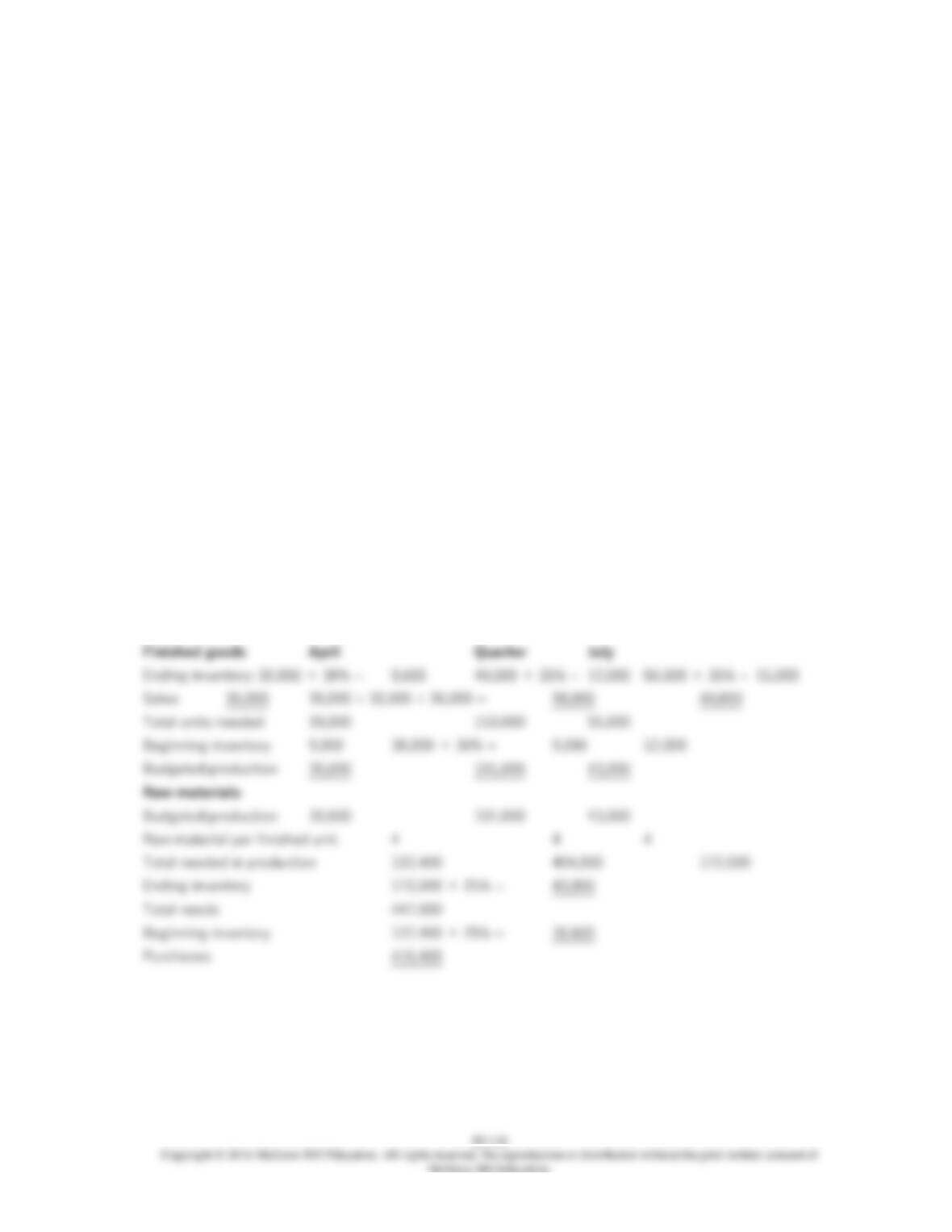
135. Dockille, Inc., is preparing its budget for the second quarter of the calendar year. The
following monthly sales data (in units) have been forecasted:
April 30,000
May 32,000
June 36,000
July 40,000
August 50,000
Additional information:
Desired ending inventory each month—Finished goods: 30% of next month’s sales
Desired ending inventory each month—Raw materials: 25% of next month’s production needs
Number of raw material units required per unit of finished product: 4
Required:
How many units of raw materials should be purchased in the 2nd quarter?

136. Olde Corporation is preparing a cash budget for the first two months of the coming year.
The following data have been forecasted:
January February
Sales $750,000 $800,000
Purchases 450,000 480,000
Operating expenses:
Payroll 146,800 167,000
Advertising 52,700 62,800
Rent 8,750 8,750
Depreciation 23,750 23,750
End-of-January balances:
Cash 120,000
Bank loan 480,000
Additional data:
(1) Sales are 40% cash and 60% credit. The term of credit sales is 2/10, n/30. The collection
pattern for credit sales is 80% in the month following the month of sale (of which 75% are
collected within 10 days), and 20% in the month thereafter. Total sales in December of the prior
year were $1,000,000.
(2) Purchases are all on credit, with 40% paid in the month of purchase and the balance the
following month.
(3) Operating expenses are paid in the month incurred.
(4) The firm desires to maintain a minimum cash balance of $150,000 at the end of each month.
(5) Loans are used to maintain the minimum cash balance. At the end of each month, interest of
1% per month is paid on the outstanding loan balance as of the beginning of the month.
Repayments are made (at the end of the month) whenever the cash balance exceeds $150,000.
Required:
Prepare the cash budget, in the form of a statement of cash flow, for February. What is the
amount of the loan balance at the end of the month (after loan repayments, if any)?