In the graph method of CVP analysis, the horizontal line above the x-axis represents the
total cost line.
The key to a company’s success is always to be the low cost producer in a particular
industry.
The higher the probability of customer churn, the higher the NPV of a customer.
The price of a bundled product is typically more than the sum of the prices of the
individual products sold separately.
Value chain refers to its value to the employee.
Normal spoilage is spoilage that is NOT considered to be inherent in a production
process.
The supply chain always occurs within a single organization.
If a company’s sales mix is 2 units of product A for every 3 units of product B, and the
company sells 3,000 units in total of both products, only 2,000 units of product A will
be sold.
Responsibility accounting focuses on control, NOT on information and knowledge.
Rework is residual material that results from manufacturing a product and can have
either a high or low sales value relative to the product with which it is associated.
An increase in the tax rate will increase the breakeven point.
For any actual level of output, the efficiency variance is the difference between actual
quantity of input used and the budgeted quantity of input allowed to produce actual
output, multiplied by the budgeted price.
If the separate activities of design, process design, and prototyping are combined into
one activity called “design” in an ABC system, management is forming one
homogeneous cost pool.
Decentralized operations organized by brand or product line might result in some
inefficiencies as support functions may be duplicated.
All accounting systems must assume that the inspection point occurs when a process is
100% complete.
Under both variable and absorption costing, research and development costs are period
costs.
In joint costing, using physical measures at split-off to allocate costs enables the
accountant to obtain individual product costs and gross margins.
Beginning inventory + cost of goods manufactured = Cost of goods sold + Ending
inventory.
The Shapley value method of allocating common costs considers each party as first the
primary party and then the incremental party and computes an average allocation.
The Cost of Goods Sold account tracks job costs from the time jobs are started until
they are completed.
To reduce the undesirable incentives to build up inventories management can institute
planning, budgeting, and other controls.
Current cost return on investment is a better measure of the current economic returns
from an investment than historical cost return on investment.
The downside to conducting inspections at too early a stage is that units spoiled at later
stages of the process may go undetected.
Planet Furniture, Inc. is currently producing well below its full capacity. The Swansea
Company has approached Plant with an offer to buy 5,000 tools at $17.50 each. Planet
sells its end table for $18.50 each; the average cost per unit is $18.30, of which $2.70 is
fixed costs. If Planet accepts the order, the increase in operating income will be $7,500.
Cost allocation is not required to cost inventories for reporting to external parties.
Designing, marketing, customer services, research and development expenses are all
examples of operating costs.
When actual cost-allocation rates are used, managers of the supplier division are
motivated to improve efficiency.
Managers looking to reduce defective units produced at bottleneck operations would
most likely be monitoring internal-business-process measures on the balanced
scorecard.
Qualitative factors are outcomes that can be easily measured in numerical terms, such
as the costs of direct labor.
The budgeted indirect cost rate is actual indirect costs divided by budgeted quantity of
the cost allocation base.
A company is considering adding a fourth product to use available capacity. A relevant
factor to consider is that corporate costs can now be allocated over four products rather
than only three.
Process costing is used to assign manufacturing costs to unique batches of a product.
Contribution margin and gross margin are terms that can be used interchangeably.
For revenue items, a favorable variance means that actual revenues are less than
expected.

Manufacturing lead time is the sum of waiting time and manufacturing time for an
order.
Merchandising companies purchase products and sell them to customers without
changing their basic form.
Timber logs are processed into standard lumber used in home construction and wood
chips that will be sold to landscapers. How would these products be classified?
A) primary products
B) main products
C) joint products
D) a primary product and a byproduct
________ is the process of varying key estimates to identify those estimates that are the
most critical to a decision.
A) The graph method
B) A sensitivity analysis
C) The degree of operating leverage
D) Sales mix
A local CPA employs ten full-time professionals. The budgeted compensation per
employee is $50,000. The maximum billable hours for each client are 400. Clients
always receive their full amount of time. All professional labor costs are included in a
single direct-cost category and are traced to jobs on a per-hour basis. Any other costs
are included in a single indirect-cost pool, allocated according to professional
labor-hours. Budgeted indirect costs for the year are $200,000 and the firm had 20
clients.
Required:
a. What is the direct-labor-cost rate per hour?
b. What is the indirect-cost rate per hour?
When spoiled goods have a disposal value, the net cost of the spoilage is computed by
________.
A) deducting disposal value from the costs of the spoiled goods accumulated to the
inspection point
B) adding the costs to complete a saleable product to the costs accumulated to the
inspection point
C) deducting the costs to complete a saleable product from the costs accumulated to the
inspection point
D) adding disposal value to the costs of the good units transferred
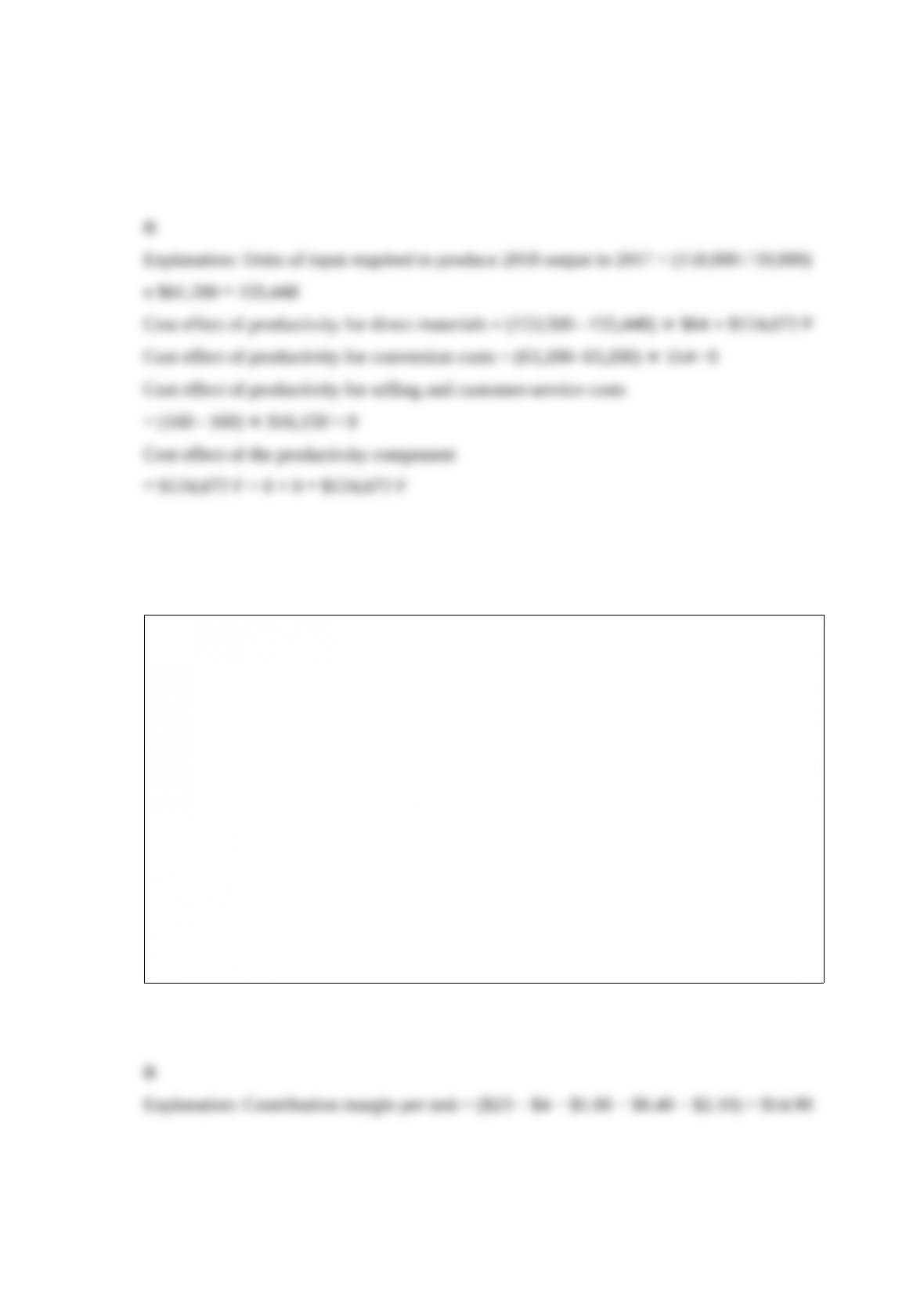
Following a strategy of product differentiation, Izzy’s Limited Company makes a
high-end Appliance, XT15. Izzy’s Limited presents the following data for the years
2017 and 2018:
Izzy’s Limited produces no defective units but it wants to reduce direct materials usage per
unit of XT15. Manufacturing conversion costs in each year depend on production capacity
defined in terms of XT15 units that can be produced. Selling and customer-service costs
depend on the number of customers that the customer and service functions are designed to
support. Izzy’s Limited had 145 customers in 2017 and 150 customers in 2018.
What is the net effect on operating income as a result of the productivity component?
(Round any intermediary calculations to two decimals and your final answer to the nearest
dollar.)
A) $1,664,016 U
B) $124,672 F
C) $1,664,016 F
D) $124,672 U
Orion Company sells several products. Information of average revenue and costs is as
follows:
Selling price per unit $23
Variable costs per unit:
Direct material $4
Direct manufacturing labor $1.60
Manufacturing overhead $0.40
Selling costs $2.10
Annual fixed costs $100,000
The company sells 12,000 units at the end of the year.
The contribution margin per unit is ________.
A) $16.50
B) $14.90
C) $18.60
D) $19.00

Kaizen budgeting is driven by ________.
A) management
B) employees
C) stockholders
D) creditors
An experience curve ________.
A) is a narrower application of the learning curve
B) measures the decline in cost per unit as production decreases for various value-chain
functions such as marketing as production increases
C) only measures the decline in labor-hours per unit as units produced increases
D) measures the increase in cost per unit as productivity increases
A favorable efficiency variance for direct materials might indicate that ________.
A) lower-quality materials were purchased
B) work is scheduled efficiently
C) there is an unexpected increase in direct labor rates
D) management hired underskilled workers
The method that restates all overhead entries in the general ledger and subsidiary
ledgers using actual cost rates rather than budgeted cost rates is called ________.
A) the adjusted allocation rate approach
B) the proration approach
C) the write-off of cost of goods sold approach
D) the weighted-average cost approach
The first step to successful balanced scorecard implementation is clarifying the
________.
A) organization’s vision and strategy
B) elements that pertain to value-added aspects of the business
C) owner’s expectations about return on investment
D) objectives of all four balanced scorecard measurement perspectives
Stark Corporation has two departments, Car Rental and Truck Rental. Central costs may
be allocated to the two departments in various ways.
Car Rental Truck Rental
Number of Vehicles in fleet 880 410
Number of employees 105 50
Sales $760,000 $380,000
If advertising expense of $456,000 is allocated on the basis of sales, the cost per cost
driver rate would be ________.
A) $0.60
B) $1.20
C) $0.40
D) $0.43

Which of the following is a disadvantage of using the standards developed by a firm
itself to develop a budget?
A) A firm’s inefficiencies will be part of the data.
B) They are not based on realized benchmarks and can be unrealistic
C) The expected future changes are not included in the standards.
D) The flexible-budget amounts are difficult to determine.
Customer response time involves ________.
A) the speed it takes a customer to respond to an advertisement and place an order
B) the speed at which an organization responds to customer requests
C) the speed it takes to develop a new product
D) the speed it takes an organization to develop a Total Quality Management (TQM)
program
One possible means of determining the difference between operating incomes for
absorption costing and variable costing is by ________.
A) subtracting sales of the previous period from sales of this period
B) subtracting fixed manufacturing overhead in beginning inventory from fixed
manufacturing overhead in ending inventory
C) multiplying the number of units produced by the budgeted fixed manufacturing cost
rate
D) adding fixed manufacturing costs to the production-volume variance
If a computer manufacturer used its common stock price as a Balanced Scorecard
control measure, it would be utilizing which of the following?
A) an external measure
B) customer related measure
C) internal business process measure
D) learning and growth measure
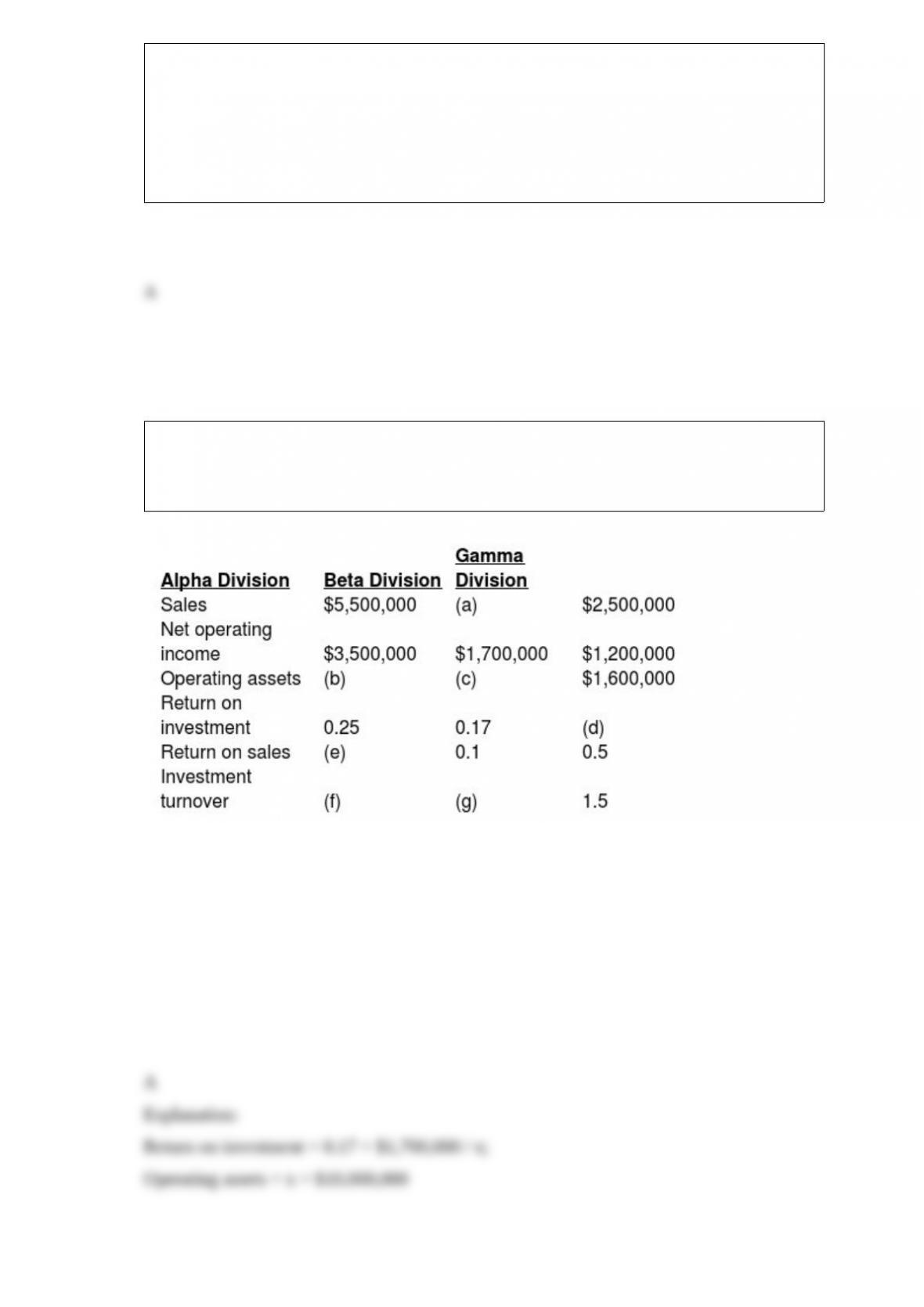
The top management at Amore Corp, a manufacturer of computer games, is attempting
to recover from a flood that destroyed some of their accounting records. The main
computer system was also severely damaged. The following information was salvaged:
What is the value of the operating assets belonging to the Beta Division (c)?
A) $10,000,000
B) $17,000,000
C) $289,000
D) $170,000

The minimum transfer price equals ________.
A) opportunity costs less the additional outlay costs
B) opportunity costs times 125% plus the additional outlay costs
C) opportunity costs divided by the additional outlay costs
D) incremental costs plus opportunity costs
Which of the following items is debited to the Work-in-Process account?
A) allocated manufacturing overhead
B) completed goods transferred out of the plant
C) accumulated depreciation on fixed assets
D) accounts receivable
For an automobile manufacturer, period costs include the cost of ________.
A) the dashboard
B) labor used for assembly
C) advertising
D) assembly-line equipment
Wilde Corporation budgeted the following costs for the production of its one and only
product for the next fiscal year:
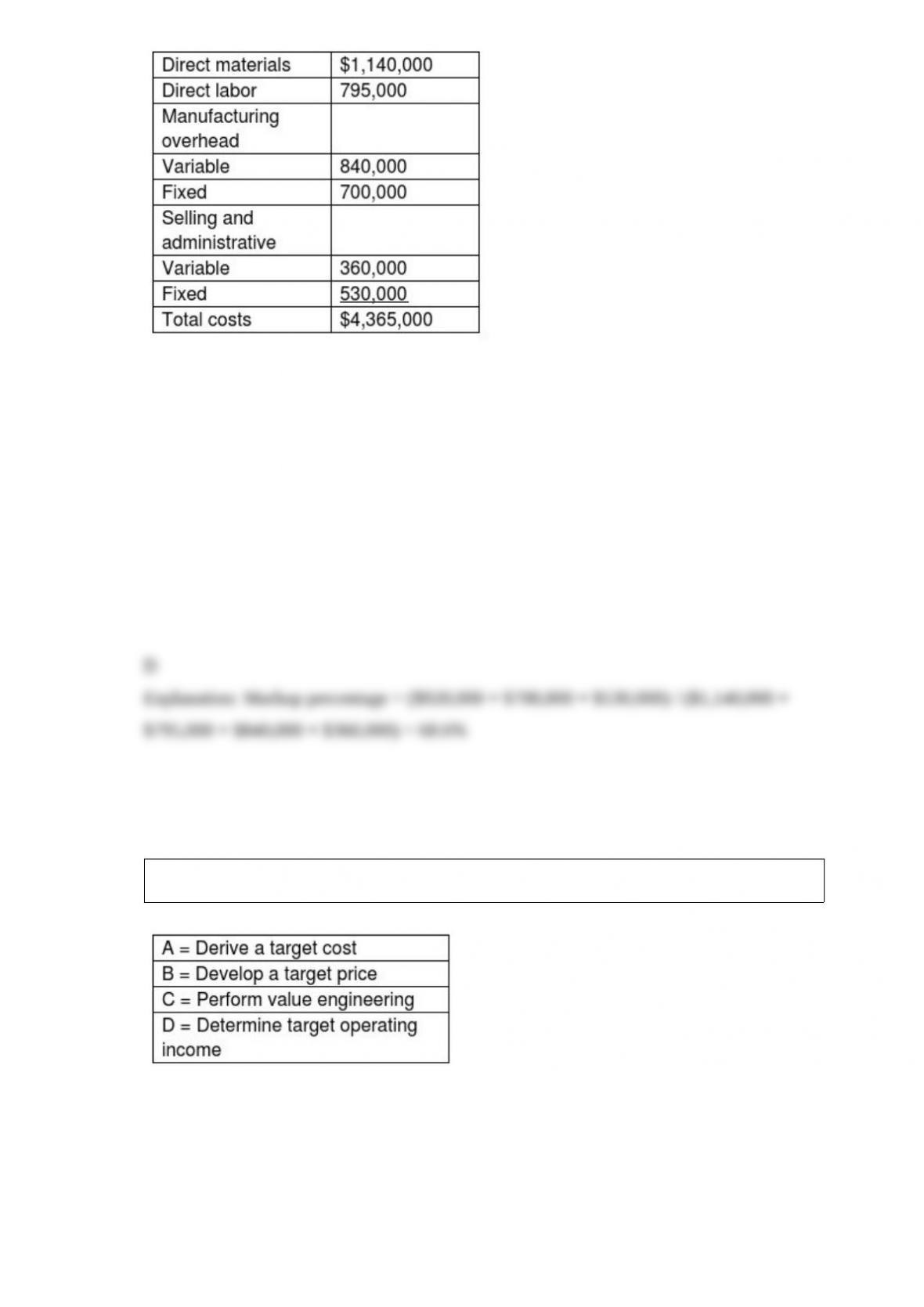
Wilde has an annual target operating income of $920,000.
The markup percentage for setting prices as a percentage of the variable cost of the product
is ________.
A) 46.3%
B) 39.2%
C) 27.5%
D) 68.6%
Place the following steps for the implementation of target costing in order:
A) B D A C
B) B A D C
C) A D B C
D) A B C D

The high-low method ________.
A) measures the difference between actual cost and estimated cost for each observation
of the cost driver
B) calculates the standard deviation of residuals
C) calculates the slope coefficient using only two observed values within the relevant
range and their respective costs
D) measures how well the predicted values, y, based on the cost driver, X, match actual
cost observations, Y
Branded Shoe Company manufactures only one type of shoe and has two divisions, the
Stitching Division and the Polishing Division. The Stitching Division manufactures
shoes for the Polishing Division, which completes the shoes and sells them to retailers.
The Stitching Division “sells” shoes to the Polishing Division. The market price for the
Polishing Division to purchase a pair of shoes is $52. (Ignore changes in inventory.)
The fixed costs for the Stitching Division are assumed to be the same over the range of
40,000-103,000 units. The fixed costs for the Polishing Division are assumed to be $24
per pair at 103,000 units.
Stitching‘s costs per pair of shoes are:
Direct materials $20
Direct labor $18
Variable overhead $16
Division fixed costs $14
Polishing‘s costs per completed pair of shoes are:
Direct materials $20
Direct labor $10
Variable overhead $5
Division fixed costs $18
What is the transfer price per pair of shoes from the Stitching Division to the Polishing
Division if the method used to place a value on each pair of shoes is 175% of variable
costs?
A) $36.75
B) $66.50
C) $94.50
D) $7.00
Which of the following involves a fundamental rethinking and redesign of business
processes to achieve improvements in critical measures of performance?
A) Strategy
B) Product differentiation
C) Product designing
D) Reengineering
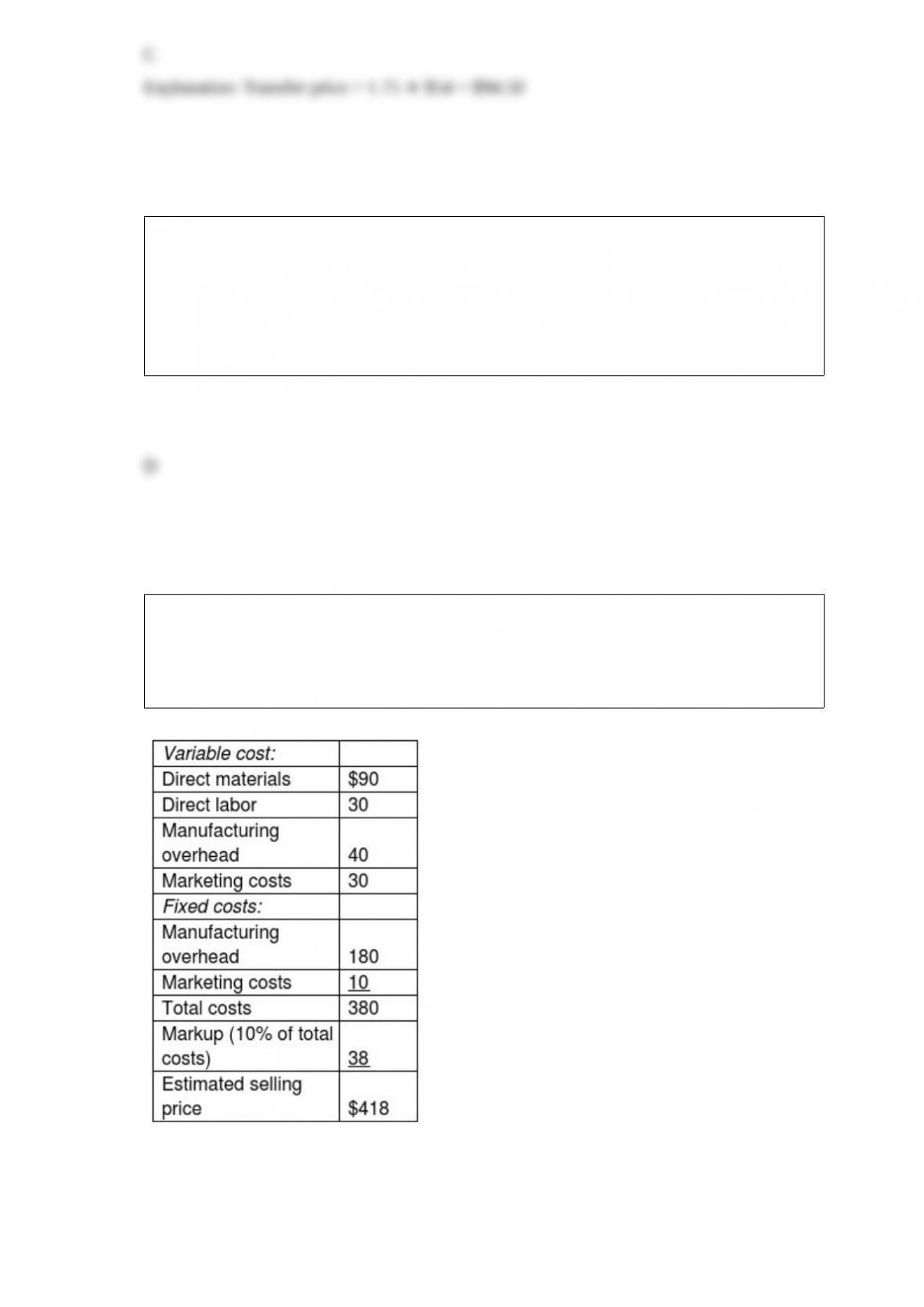
Gracius Manufacturing is approached by a European customer to fulfill a one-time-only
special order for a product similar to one offered to domestic customers. Gracius
Manufacturing has a policy of adding a 10% markup to full costs and currently has
excess capacity. The following per unit data apply for sales to regular customers:
For Gracius Manufacturing, what is the minimum acceptable price of this one-time-only
special order?
A) $120
B) $160
C) $190
D) $380
Under variable costing, if a manager’s bonus is tied to operating income, then increasing
inventory levels compared to last year would result in ________.
A) increasing the manager’s bonus
B) decreasing the manager’s bonus
C) not affecting the manager’s bonus
D) being unable to determine the manager’s bonus using only the above information
Which of the following statements about normal costing is true?
A) Direct costs and indirect costs are traced using an actual rate.
B) Direct costs and indirect costs are traced using budgeted rates.
C) Direct costs are traced using a budgeted rate, and indirect costs are allocated using
an actual rate.
D) Direct costs are traced using an actual rate, and indirect costs are allocated using a
budgeted rate.
Capity Tea Products has an exclusive contract with British Distributors. Calamine and
Capity are two brands of teas that are imported and sold to retail outlets. The following
information is provided for the month of March:
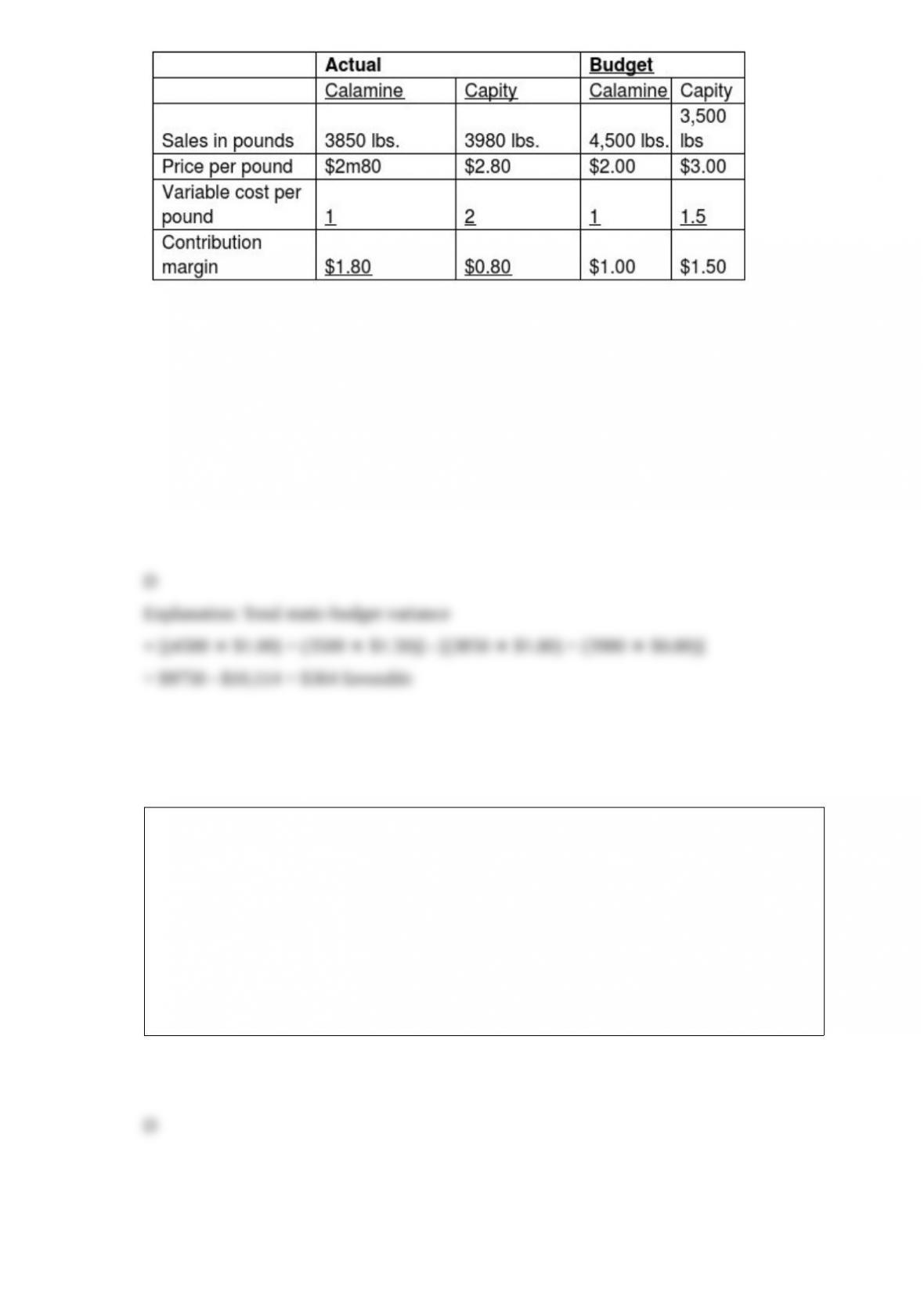
Budgeted and actual fixed corporate-sustaining costs are $1,850 and $2,300, respectively.
For the contribution margin, what is the total static-budget variance?
A) $6930 favorable
B) $364 unfavorable
C) $70 favorable
D) $364 favorable
Which of the following is true of absorption costing?
A) It enables a manager to decrease margins and operating income by producing more
beginning inventory.
B) It enables a manager to increase margins and operating income by producing more
beginning inventory.
C) It enables a manager to decrease margins and operating income by producing more
and building ending inventory.
D) It enables a manager to increase margins and operating income by producing more
and building ending inventory.
Prime costs include ________.
A) direct materials and direct manufacturing labor costs
B) direct manufacturing labor and manufacturing overhead costs
C) direct materials and manufacturing overhead costs
D) only direct materials
At what point are direct material costs per unit “locked in”?
A) designed
B) assembled
C) sold
D) delivered
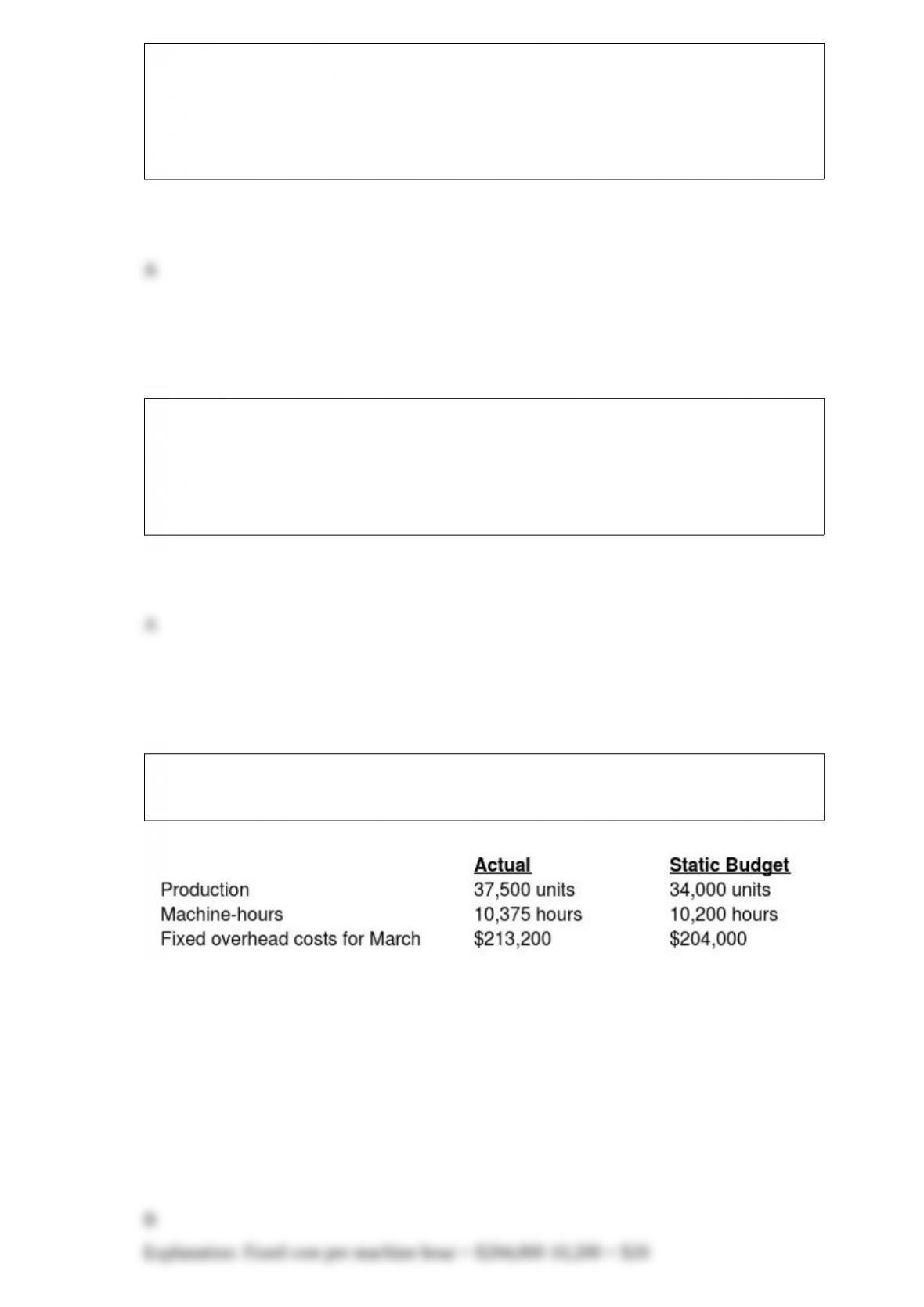
Radon Corporation manufactured 37,500 units during March. The following fixed
overhead data pertain to March:
What is the fixed overhead production-volume variance?
A) $9,200.00 unfavorable
B) $21,000.00 favorable
C) $21,000.00 unfavorable
D) $9,200.00 favorable