21
65) Software applications that combine different components of online software applications are
referred to as:
A) integrated software.
B) widgets.
C) mashups.
D) grid computing.
E) web services.
AACSB: Information Technology
LO: 5.3: What are the major types of computer software used in business and the major software
trends?
66) Which of the following software tools would you use to prepare a break-even analysis?
A) Word processing
B) Spreadsheet
C) Desktop publishing
D) Personal information management
E) Presentation graphics
AACSB: Information Technology
LO: 5.3: What are the major types of computer software used in business and the major software
trends?
67) Which of the following is an open-source operating system designed for mobile devices?
A) iOS
B) OS X
C) Chrome
D) Android
E) Apache HTTP
AACSB: Information Technology
LO: 5.3: What are the major types of computer software used in business and the major software
trends?
22
68) ________ is an operating system-independent, processor-independent, object-oriented
programming language that has become a leading interactive programming environment for the
web.
A) XML
B) SOA
C) HTML
D) Java
E) COBOL
AACSB: Information Technology
LO: 5.3: What are the major types of computer software used in business and the major software
trends?
69) ________ is free software created and updated by a worldwide community of programmers.
A) An app
B) Open-source software
C) Cloud-based software
D) A web service
E) Office software
AACSB: Information Technology
LO: 5.3: What are the major types of computer software used in business and the major software
trends?
70) The ability of a person booking a flight on Southwest.com’s website to reserve a car from
Dollar Rent-A-Car without having to leave the airline’s website is an example of the usage by
Dollar Rent-A-Car and Southwest Airlines of which of the following?
A) Cloud computing
B) Web services
C) Nanotechnology
D) SaaS
E) PaaS
AACSB: Information Technology
LO: 5.3: What are the major types of computer software used in business and the major software
trends?
71) A computer language translation program is an example of system software.
AACSB: Information Technology
LO: 5.3: What are the major types of computer software used in business and the major software
trends?
23
72) HTML specifies how text, graphics, video, and sound are placed on a document.
AACSB: Application of Knowledge
LO: 5.3: What are the major types of computer software used in business and the major software
trends?
73) HTML5 is the latest evolution of HTML, and is designed to make it much easier to embed
third-party add-ons in web pages.
AACSB: Application of Knowledge
LO: 5.3: What are the major types of computer software used in business and the major software
trends?
74) Web services can exchange information between two different systems regardless of the
operating system or programming languages on which the systems are based.
AACSB: Information Technology
LO: 5.3: What are the major types of computer software used in business and the major software
trends?
75) XML is limited to describing how data should be presented in the form of web pages, while
HTML can perform presentation, communication, and storage of data.
AACSB: Information Technology
LO: 5.3: What are the major types of computer software used in business and the major software
trends?
76) SOA is a set of self-contained web services that communicate with each other to create a
working software application.
AACSB: Information Technology
LO: 5.3: What are the major types of computer software used in business and the major software
trends?
77) A software package for a mainframe usually requires a programmer to install it.
AACSB: Information Technology
LO: 5.3: What are the major types of computer software used in business and the major software
trends?
24
78) Web browsers are the primary interface for accessing the Internet.
AACSB: Information Technology
LO: 5.3: What are the major types of computer software used in business and the major software
trends?
79) XML provides a standard format for data exchange, enabling web services to pass data from
one process to another.
AACSB: Information Technology
LO: 5.3: What are the major types of computer software used in business and the major software
trends?
80) You are starting an Internet marketing and data mining company. What types of software can
you anticipate needing, and what will these types of software be used for?
AACSB: Information Technology; Written and Oral Communication
LO: 5.3: What are the major types of computer software used in business and the major software
trends?
81) Identify and describe some of the current trends in contemporary software platforms.
AACSB: Information Technology; Written and Oral Communication
LO: 5.3: What are the major types of computer software used in business and the major software
trends?
25
82) Identify and describe the leading PC and server operating systems.
AACSB: Information Technology; Written and Oral Communication
LO: 5.3: What are the major types of computer software used in business and the major software
trends?
83) Which of the following refers to the ability of a computer, product, or system to expand to
serve a larger number of users without breaking down?
A) Modifiability
B) Scalability
C) Expandability
D) Disintermediation
E) SLA
AACSB: Information Technology
LO: 5.4: What are the principal issues in managing hardware and software technology?
84) To analyze the direct and indirect costs and determine the actual cost of specific technology
implementations, you would use a:
A) total cost of ownership model.
B) return on investment model.
C) break-even point.
D) cost benefit analysis.
E) capacity plan.
AACSB: Application of Knowledge
LO: 5.4: What are the principal issues in managing hardware and software technology?
26
85) Translating software to different languages is commonly referred to as:
A) software localization.
B) scaling.
C) service-oriented architecture.
D) outsourcing.
E) open sourcing.
AACSB: Information Technology
LO: 5.4: What are the principal issues in managing hardware and software technology?
86) In order to manage their relationship with an outsourcer or technology service provider,
firms need a contract that includes a(n):
A) TCO.
B) SOA.
C) SLA.
D) API.
E) capacity plan.
AACSB: Application of Knowledge
LO: 5.4: What are the principal issues in managing hardware and software technology?
87) In co-location, a firm:
A) purchases and owns its web server but locates the server in the physical facility of a hosting
service.
B) contracts with an external vendor to run its computer center and networks.
C) off-loads peak demand for computing power to remote, large-scale data centers.
D) utilizes an external, distributed computing grid.
E) uses only open source software to operate its computer systems.
AACSB: Information Technology
LO: 5.4: What are the principal issues in managing hardware and software technology?
88) You use ________ to predict when a computer hardware system becomes saturated.
A) capacity planning
B) virtualization
C) localization
D) measured service
E) SLAs
AACSB: Information Technology
LO: 5.4: What are the principal issues in managing hardware and software technology?
27
89) An analyst asked to perform capacity planning for a system would need to take into account
all of the following factors except:
A) the maximum number of users a system can accommodate at one time.
B) the minimum response time for processing business transactions.
C) the impact of future software applications.
D) the purchase price of new computer hardware equipment.
E) the volume of transactions.
AACSB: Analytical Thinking
LO: 5.4: What are the principal issues in managing hardware and software technology?
90) An analyst asked to perform a TCO analysis for a system would need to take into account all
of the following factors except:
A) the minimum response time for processing business transactions.
B) lost productivity if hardware or software failures cause the system to be unavailable for
processing and user tasks.
C) real estate and utility costs for housing and providing power for the technology.
D) the purchase or license of software for each user.
E) the cost to provide training to information systems specialists and end users.
AACSB: Analytical Thinking
LO: 5.4: What are the principal issues in managing hardware and software technology?
91) Allowing departments to make their own software and hardware purchases increases
efficiency and minimizes the need for centralized support.
AACSB: Information Technology
LO: 5.4: What are the principal issues in managing hardware and software technology?
92) Total cost of ownership components include costs for downtime, training, and support.
AACSB: Information Technology
LO: 5.4: What are the principal issues in managing hardware and software technology?
93) One of the main benefits of moving to mobile business computing platforms is the
dramatically lower costs of hardware.
AACSB: Information Technology
LO: 5.4: What are the principal issues in managing hardware and software technology?
28
94) Software localization refers to the entire process of converting software to operate in a
second language.
AACSB: Information Technology
LO: 5.4: What are the principal issues in managing hardware and software technology?
95) What is scalability? Why is it essential to the success of the modern business firm?
AACSB: Information Technology; Written and Oral Communication
LO: 5.4: What are the principal issues in managing hardware and software technology?
96) A small design agency you are a financial consultant for will be creating client websites and
wants to purchase a web server so they can host the sites themselves. How will you advise them
on this purchase?
AACSB: Information Technology; Written and Oral Communication
LO: 5.4: What are the principal issues in managing hardware and software technology?
29
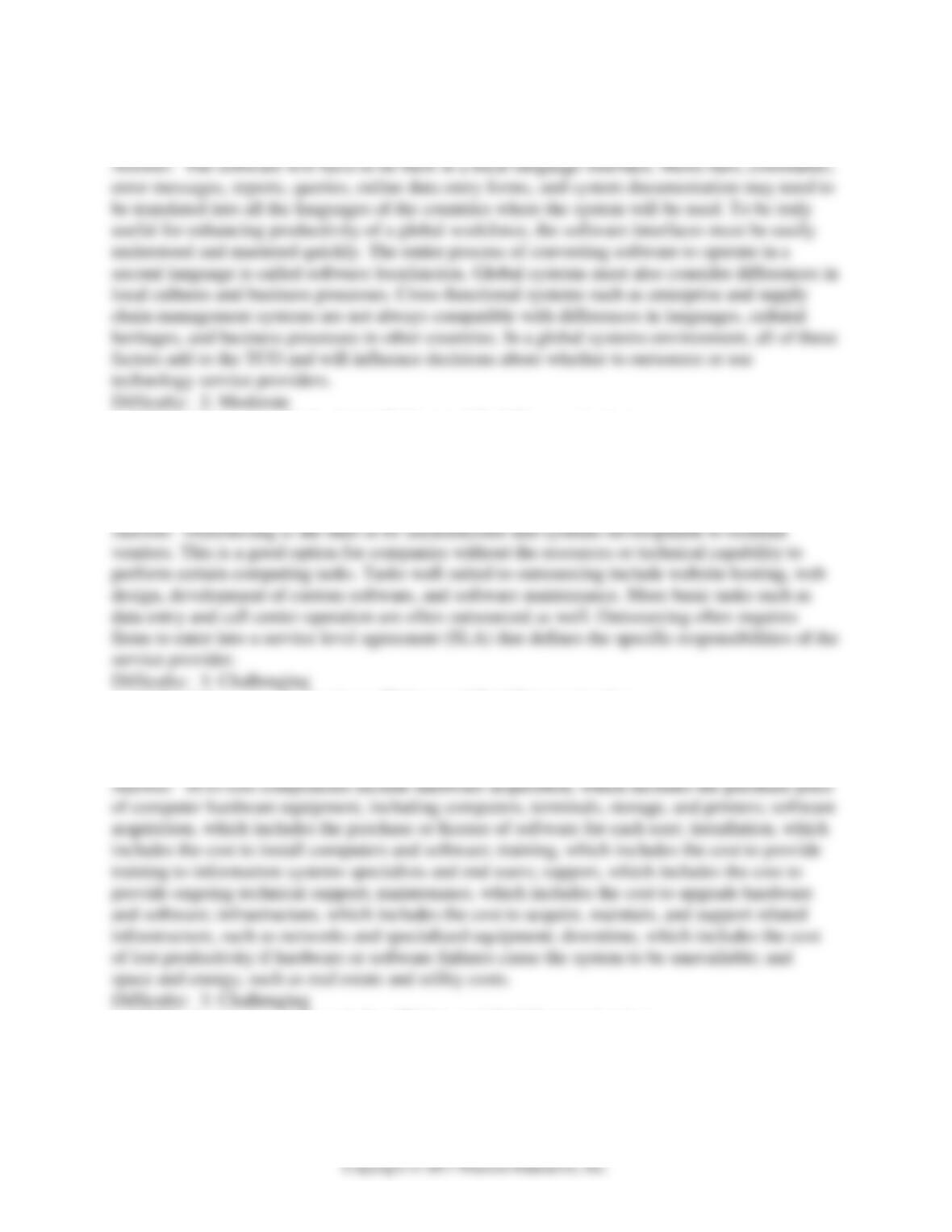
97) You have been given the task of creating localized versions of your company’s software for
overseas branches. What are your chief concerns?
AACSB: Information Technology; Written and Oral Communication
LO: 5.4: What are the principal issues in managing hardware and software technology?
98) Define outsourcing and explain some of the computing tasks that are well suited to
outsourcing.
AACSB: Information Technology; Written and Oral Communication
LO: 5.4: What are the principal issues in managing hardware and software technology?
99) What are the components that must be considered in a TCO analysis?
AACSB: Application of Knowledge; Written and Oral Communication
LO: 5.4: What are the principal issues in managing hardware and software technology?
30
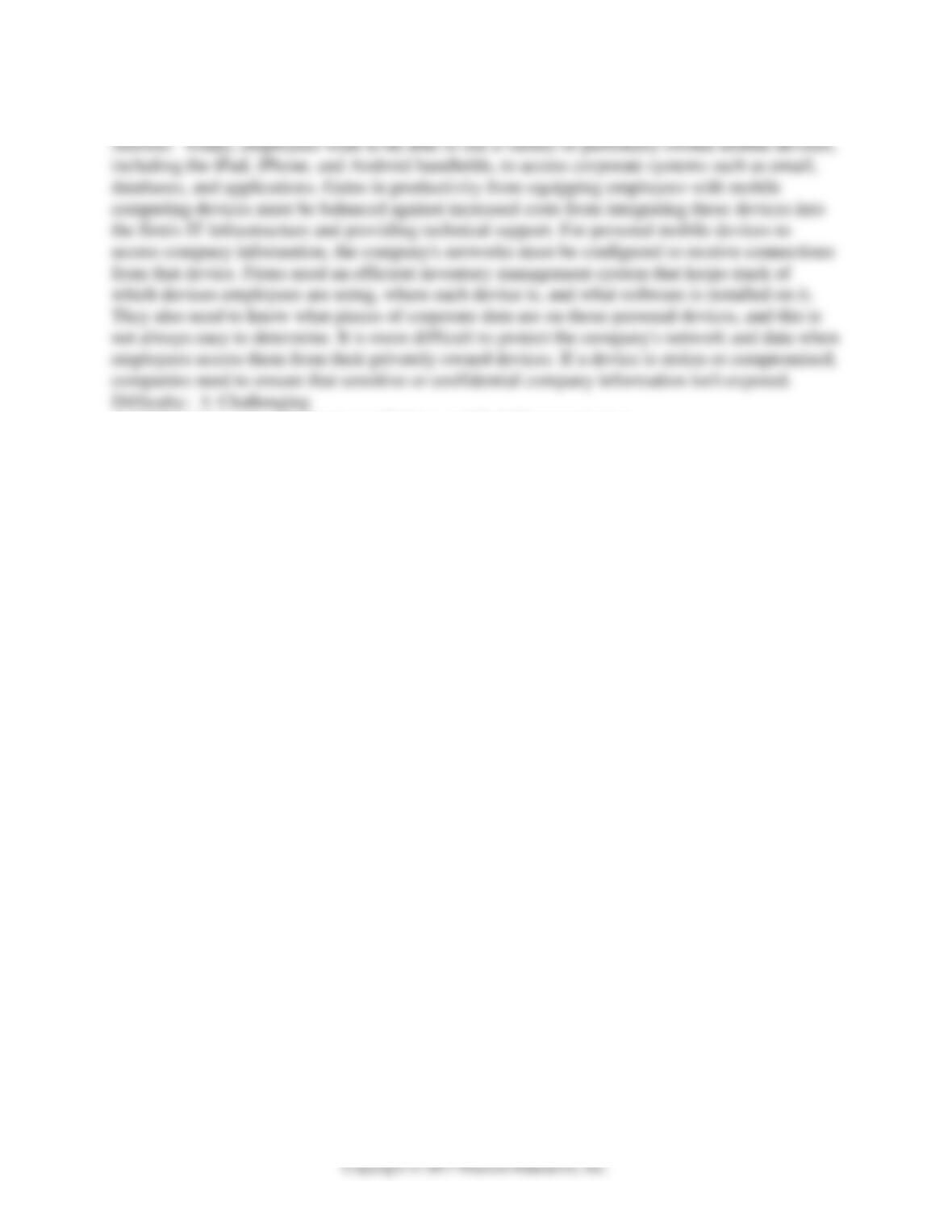
100) What are some of the challenges companies face in managing the mobile platform?
AACSB: Information Technology; Written and Oral Communication
LO: 5.4: What are the principal issues in managing hardware and software technology?