Chapter 17 – Understanding Accounting and Financial Information
17-101
297. Accounting recognizes that assets, such as machinery and buildings, lose value over
time. Accountants will record a portion of the cost of an asset as an expense each year
through the use of:
A. Asset valuation.
B. Asset audits.
C. Appreciation.
D. Depreciation.
298. The ______________ shows how the capital is structured in the business, including the
value of assets and the amount the firm owes at a specific point in time.
A. income statement
B. balance sheet
C. statement of cash flows
D. trial balance
Feedback: A balance sheet reports the firm’s assets (what the firm owns), liabilities (debts of
the firm), and owners’ equity at a specific point in time.
299.

Chapter 17 – Understanding Accounting and Financial Information
As Hector was packing to return to State University after his summer vacation, he
realized that he owned many valuable things such as a laptop computer, a stereo system,
and a DVD player. An accountant would list all of these as Hector’s:
A. assets.
B. liabilities.
C. owners’ equity.
D. intangibles.
Feedback: Assets refer to tangible or intangible resources the firm owns and uses in order to
operate the business. This question refers to personal assets the student will use for school
purposes and/or for recreation.
300. Keith will graduate from Southern State University this year. He has accumulated
$18,000 in student loans during his four years at college. An accountant would classify
the loans as:
A. assets.
B. liabilities.
C. owners’ equity.
D. intangibles.
Feedback: Liabilities represent debts or obligations of an individual or a firm.




17-106
307. A company’s income statement is important to accountants and other stakeholders. It
reveals:
A. A company’s sources of funding.
B. A company’s ability to distribute goods or services in a timely manner.
C. A company’s ability to earn a profit over time.
D. A company’s capitalized value.
Feedback: The income statement contains several elements including revenues, expenses, and
Net Profit or Loss.
308. When creating the income statement, which of the following statements is accurate?
A. Revenues, minus general operating expenses = gross profit.
B. Revenues, minus tax expense = gross profit.
C. Revenues, minus depreciation expense = gross profit.
D. Revenues, minus cost of goods sold = gross profit.
Feedback: The First line item on the income statement reports revenues earned over a period
of time. The “cost of goods sold” is subtracted from revenues in order to determine gross
profit.
309.

Chapter 17 – Understanding Accounting and Financial Information
Meg Malloy is running an income statement on her QuickBooks™ computer accounting
program. Which of the following accounts will be used to calculate gross profit?
A. Revenues, net sales, depreciation, and operating expenses
B. Revenues, general expenses
C. Revenues, cost of goods sold, tax expenses, net income before taxes
D. Revenues, cost of goods sold
Feedback: The first two elements of the income statement are 1) revenue and 2) cost of goods
sold. Revenues – cost of goods sold = gross profit.
310. Which of the following would be classified as a general expense on an income
statement?
A. Salaries paid to salespeople
B. Dividends paid to stockholders
C. Payments made for insurance
D. Costs associated with an advertising campaign
Feedback: Operating expenses are usually divided into two categories. Selling expenses
include things like salaries for salespeople and advertising costs. General expenses include
office salaries, insurance, and depreciation.








17-116
327. 10th Generation Electronics had two transformers in its inventory, one purchased in
February for $11,800 and the other acquired in September for $13,300. In December,
they sold one of the transformers to Ram Enterprises for $16,400 and reported a gross
profit of $3,100. 10th Generation Electronics evidently uses the ________ inventory
valuation method.
A. FIFO
B. LIFO
C. Average
D. Flexplus
Feedback: Using the LIFO (last in, first out) method will produce a cost of goods sold of
$13,300, the cost of the September acquisition. Sales revenue ($16,400) minus cost of goods
sold ($13,300) will reflect a gross profit of $3,100.
328.

Chapter 17 – Understanding Accounting and Financial Information
17-117
Similar to the example of FIFO and LIFO inventory accounting methods depicted in the
Spotlight on Small Business box titled, “What’s Coming and Going at the College
Bookstore?” a college store purchased sweatshirts for the upcoming fall semester. Using
the following data, where a total of 100 sweatshirts were purchased by the store and
placed in inventory, select the correct statement from the following choices.
Inventory Purchase Date 8/1
50 sweatshirts
Inventory Purchase Date 9/1
50 sweatshirts
Cost Per Sweatshirt
$12.00
Cost per Sweatshirt
$14.00
Selling Price
$28.00
Selling Price
$28.00
Total Sweatshirts sold from 8/1 – 12/31 = 50 sweatshirts
A. FIFO would provide the least profit.
B. FIFO would provide the most profit.
C. LIFO or FIFO will produce the same amount of profit.
D. LIFO would provide the most profit.
Feedback: : If the business sells the first 50 sweatshirts that it received on August 1, the cost
of goods sold = $600 [50 sweatshirts X $12/each = $600]. If the business sells the last 50
sweatshirts that it received on September 1, the cost of goods sold = $700 [50 sweatshirts X
$14/each = $700]. FIFO, first in – first out (meaning the first sweatshirts that come into
inventory are the first to sell), will provide the most profit because they cost $100 less than
the sweatshirts that were purchased on September 1.
Profit from first 50 sweatshirts: $1400 – $600 = $800 profit
Profit from last 50 sweatshirts: $1400 – $700 = $700 profit
329.
Chapter 17 – Understanding Accounting and Financial Information
Nebraska Communications is considering the purchase of a new satellite. The firm
believes the satellite will help generate future earnings. In addition, the firm recognizes
the tax benefits of a lower net income provided by the annual ________ of the asset.
A. inventory valuation
B. declining balance
C. appreciation
D. depreciation
Feedback: Businesses are permitted to use depreciation as an expense of business operations.
This extra expense will lower a firm’s taxable income.
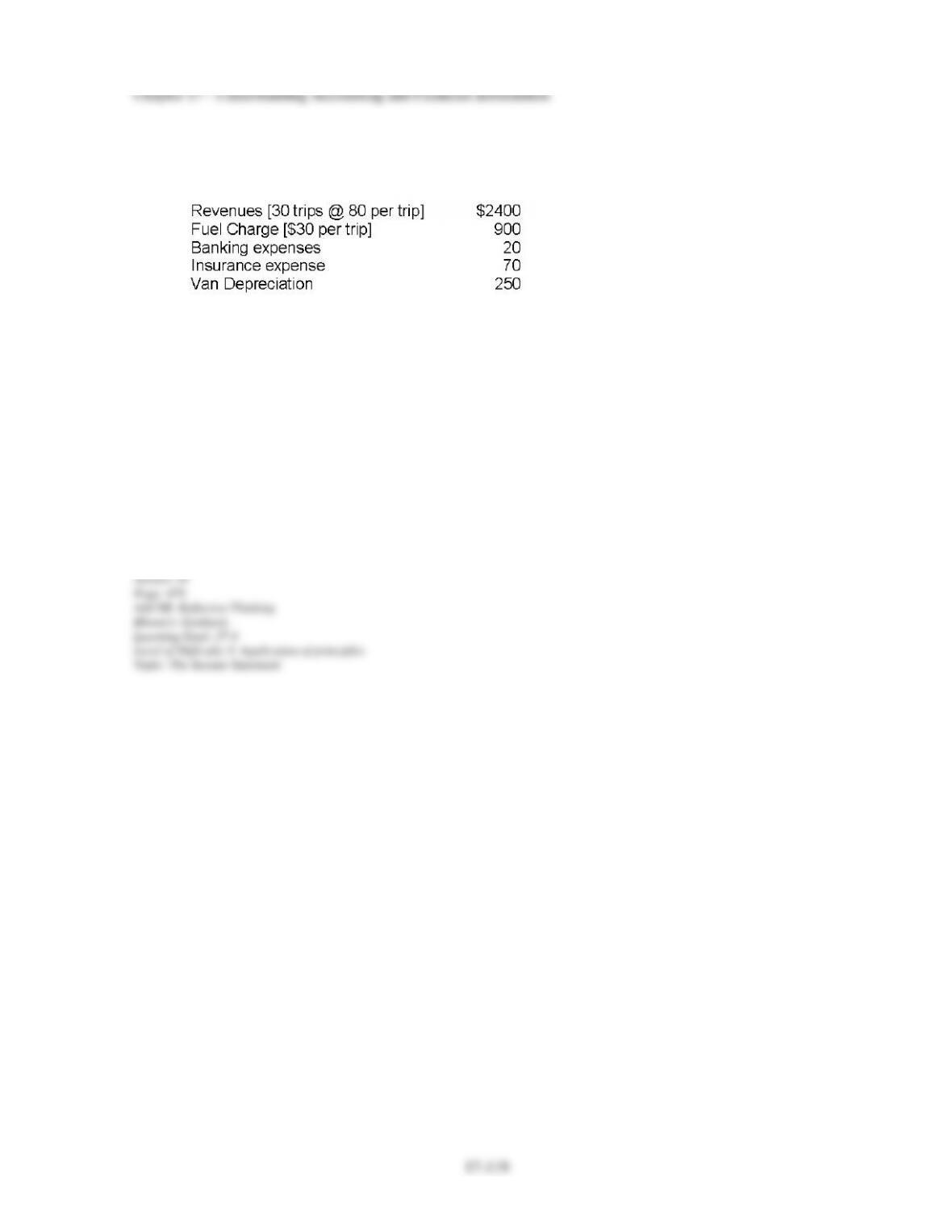
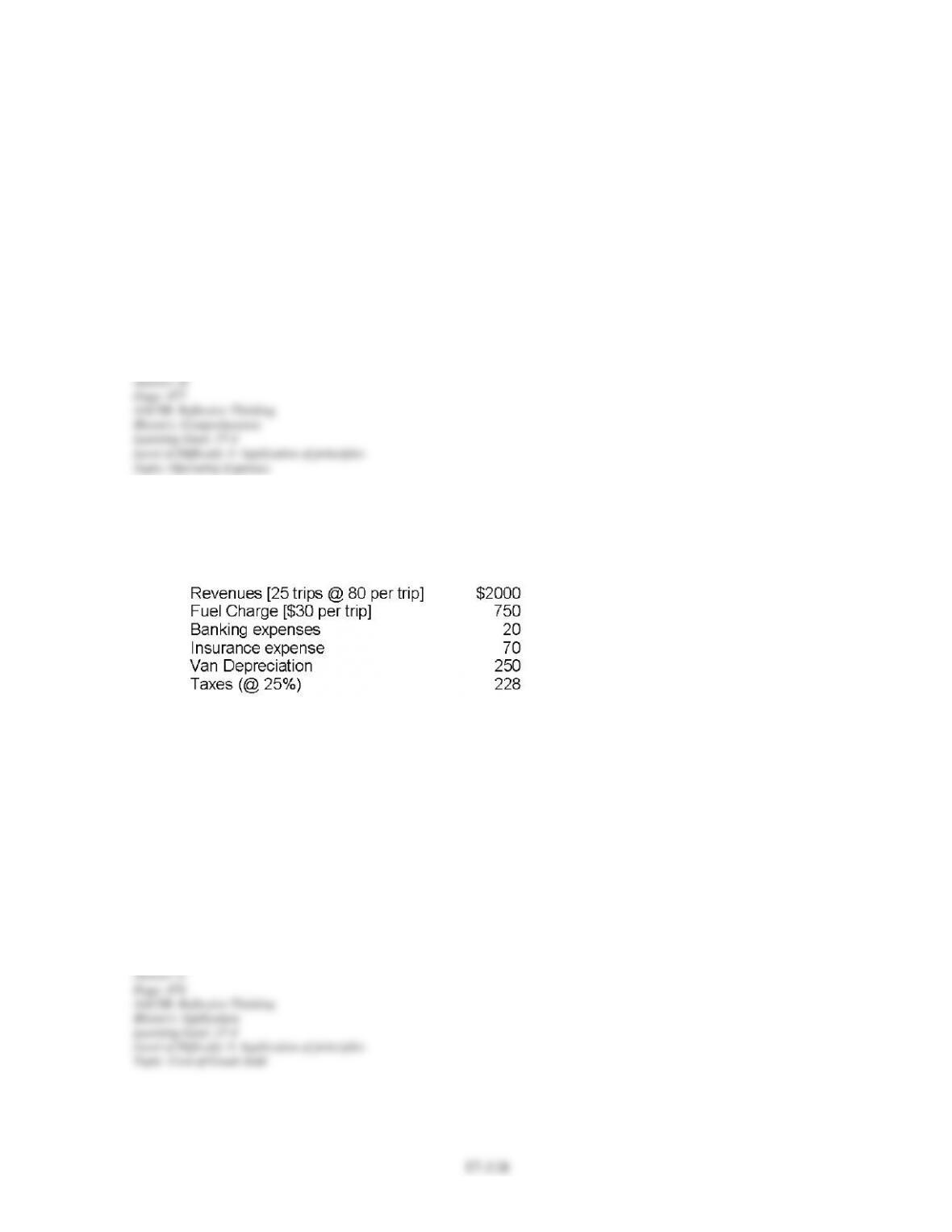
330. Carole Grand and Bonnie Lamore run a shuttle service from Western Illinois to the busy
Chicago O’Hare airport. Last month, they recorded the following:
Carole and Bonnie’s gross profit for the past month was:
A. $682.00
B. Carole: $341.00; Bonnie: $341.00
C. $1250.00
D. $2750.00
Feedback: Gross profit is calculated by subtracting cost of goods sold from revenues. Cost of
goods sold represent items that are directly related to producing the product or service. In this
problem, fuel charge represents a cost of goods sold. Revenues [$2000.00], minus cost of
goods sold [$750] = gross profit [$1250.00].