Archives
Chapter 1 Which subdiscipline of archaeology is the study
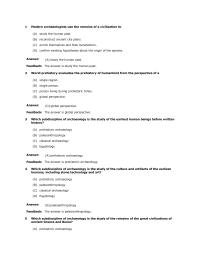
1 Modern archaeologists use the remains of a civilization to (A) study the human past. (B) reconstruct ancient city plans. (C) enrich themselves and their benefactors. (D) confirm existing hypotheses about the origin of the species. 2 World prehistory evaluates […]
Chapter 10 Although we cannot yet rule out that earlier settlement
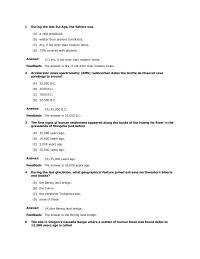
1 During the late Ice Age, the Sahara was (A) a vast grassland. (B) wetter than present conditions. (C) dry, if not drier than modern times. (D) 75% covered with glaciers. 2 Accelerator mass spectrometry (AMS) radiocarbon dates the Grotte […]
Chapter 11 Discuss evidence to suggest that Vere Gordon Childe
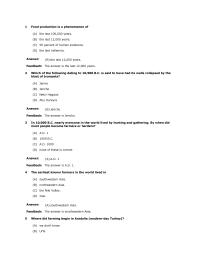
1 Food production is a phenomenon of (A) the last 100,000 years. (B) the last 12,000 years. (C) 99 percent of human existence. (D) the last millennia. 2 Which of the following dating to 10,500 B.C. is said to have […]
Chapter 12 Modern scholars recognize as having great importance
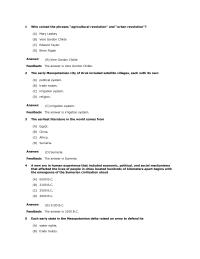
1 Who coined the phrases “agricultural revolution” and “urban revolution”? (A) Mary Leakey (B) Vere Gordon Childe (C) Edward Taylor (D) Brian Fagan 2 The early Mesopotamian city of Uruk included satellite villages, each with its own (A) political system. […]
Chapter 13 Indus Leaders Because a Their Artifacts Have Not
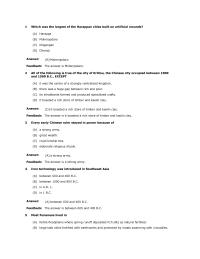
1 Which was the largest of the Harappan cities built on artificial mounds? (A) Harappa (B) Mohenjodaro (C) Kiligangan (D) Dhoraji 2 All of the following is true of the city of Erlitou, the Chinese city occupied between 1900 and […]
Chapter 14 All projectile points in North America are ultimately
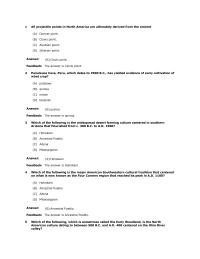
1 All projectile points in North America are ultimately derived from the ancient (A) Donner point. (B) Clovis point. (C) Aleutian point. (D) Siberian point. 2 Panalauca Cave, Peru, which dates to 2500 B.C., has yielded evidence of early cultivation […]
Chapter 15 The roots of which civilization went back at
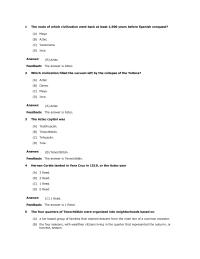
1 The roots of which civilization went back at least 1,500 years before Spanish conquest? (A) Maya (B) Aztec (C) Yanomamo (D) Inca 2 Which civilization filled the vacuum left by the collapse of the Toltecs? (A) Aztec (B) Olmec […]
Chapter 16 Andean Civilization Developed The One Along
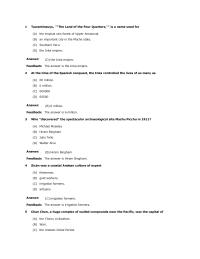
1 Tawantinsuyu, “”The Land of the Four Quarters,”” is a name used for (A) the tropical rain forest of Upper Amazonia. (B) an important city in the Moche state. (C) Southern Peru. (D) the Inka empire. 2 At the time […]
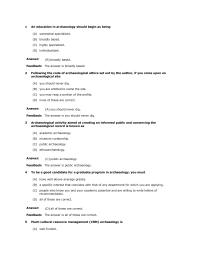
Chapter 17 An education in archaeology should begin
1 An education in archaeology should begin as being (A) somewhat specialized. (B) broadly based. (C) highly specialized. (D) individualized. 2 Following the code of archaeological ethics set out by the author, if you come upon an archaeological site (A) […]
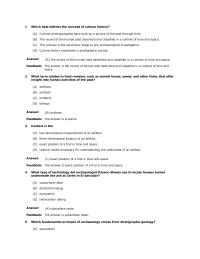
Chapter 2 Which best defines the concept of culture history
1 Which best defines the concept of culture history? (A) Cultural anthropologists have built up a picture of the past through time. (B) The record of the human past described and classified in a context of time and space. (C) […]
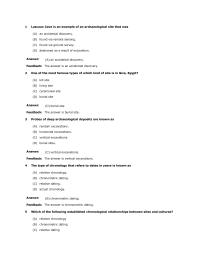
Chapter 3 Lascaux Cave is an example of an archaeological
1 Lascaux Cave is an example of an archaeological site that was (A) an accidental discovery. (B) found via remote sensing. (C) found via ground survey. (D) destroyed as a result of excavation. 2 One of the most famous types […]
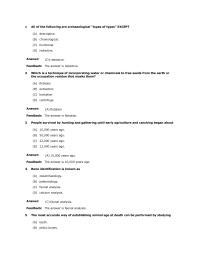
Chapter 4 People survived by hunting and gathering until early
1 All of the following are archaeological “types of types” EXCEPT (A) descriptive. (B) chronological. (C) functional. (D) redactive. 2 Which is a technique of incorporating water or chemicals to free seeds from the earth or the occupation residue that […]
Chapter 5 One of the most valuable insights into the elaborate
1 Archaeologists were able to glean all of the following information about Ötzi the Ice Man EXCEPT his (A) health. (B) nutritional history. (C) occupation. (D) way of dressing. 2 Archaeologists Higham and Thoserat believe the burial patterns at Khok […]
Chapter 6 Archaeologists Believe Today That Much Maya Art
1 Late Ice Age cave art shows that humans melded the living and spiritual worlds at least (A) 3,000 years ago. (B) 30,000 years ago. (C) 300,000 years ago. (D) 3 million years ago. 2 The study of ancient astronomical […]
Chapter 7 The Answer Descriptive Research Methods And Normative
1 The primary objects of interest to a culture historian are (A) artifacts and structures. (B) artifacts and art. (C) burial sites and art. (D) burial sites and architecture. 2 Various, often short-lived schools of archaeological thought focusing on the […]
Chapter 8 The origins of humanity date deep in geological time
1 The origins of humanity date deep in geological time, to the (A) Cenozoic era. (B) Holocene period. (C) Oligocene epoch. (D) Eocene epoch. 2 The current view of human evolution can be described as (A) punctuated equilibrium. (B) gradual […]
Chapter 9 Do you think these are reasonable criticisms
1 Eugene Dubois’ named his Trinil, Java, find, which means “ape-human which stood upright,” (A) Homo sapiens. (B) Homo habilis. (C) Pithecanthropus erectus. (D) Australopithecus africanus. 2 The out-of–Africa (or Noah’s ark) model hypothesis of modern human original holds that […]