Archives
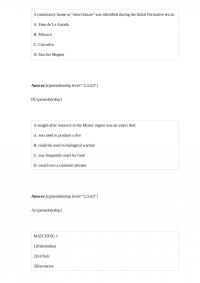
ANT 50400
A community house or “men’s house” was identified during the Initial Formative era at: A. Paso de La Amada B. Tehuacn C. Cuicuilco D. San Jos Mogote A sought-after resource in the Mixtec region was an insect that: A. was […]
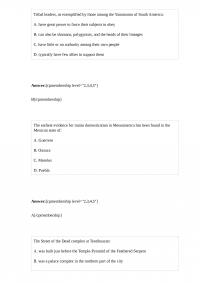
ANT 67921
Tribal leaders, as exemplified by those among the Yanomamo of South America: A. have great power to force their subjects to obey B. can also be shamans, polygynists, and the heads of their lineages C. have little or no authority […]
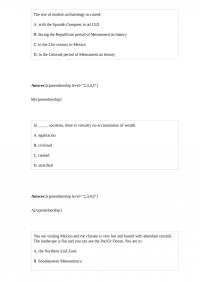
ANT 73926
The rise of modern archaeology occurred: A. with the Spanish Conquest in ad 1521 B. during the Republican period of Mesoamerican history C. in the 21st century in Mexico D. in the Colonial period of Mesoamerican history In _____ societies, […]
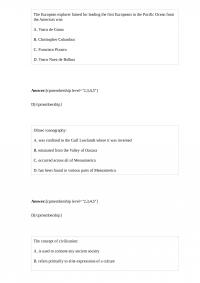
ANT 75844
The European explorer famed for leading the first Europeans to the Pacific Ocean from the Americas was: A. Vasco de Gama B. Christopher Columbus C. Francisco Pizarro D. Vasco Nuez de Balboa Olmec iconography: A. was confined to the Gulf […]
ANT 92985
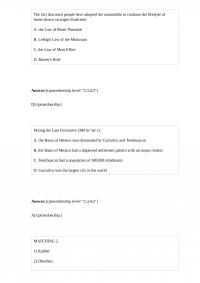
The fact that most people have adopted the automobile to continue the lifestyle of horse-drawn carriages illustrates: A. the Law of Biotic Potential B. Leibig’s Law of the Minimum C. the Law of Most Effort D. Romer’s Rule During the […]
CGS SS 10922
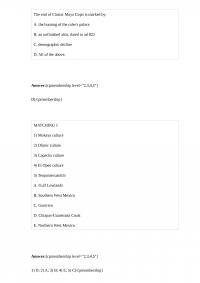
The end of Classic Maya Copn is marked by: A. the burning of the ruler’s palace B. an unfinished altar, dated to ad 822 C. demographic decline D. All of the above. MATCHING 1 1) Mokaya culture 2) Olmec culture […]
CGS SS 12074
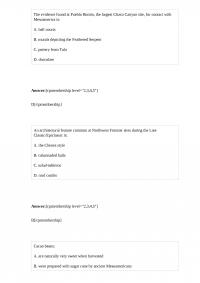
The evidence found at Pueblo Bonito, the largest Chaco Canyon site, for contact with Mesoamerica is: A. ball courts B. murals depicting the Feathered Serpent C. pottery from Tula D. chocolate An architectural feature common at Northwest Frontier sites during […]
CGS SS 24451
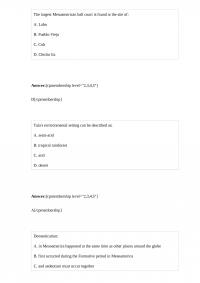
The largest Mesoamerican ball court is found at the site of: A. Labn B. Pueblo Viejo C. Cob D. Chichn Itz Tula’s environmental setting can be described as: A. semi-arid B. tropical rainforest C. arid D. desert Answer: A Domestication: […]
CGS SS 56225
During the Late Postclassic, the Maya established both a commercial center and _______ on the island of Cozumel. A. a military outpost B. a pilgrimage center C. cacao groves and processing centers D. a canoe manufacturing factory Chapultepec Hill in […]
CGS SS 95806
Archaeologists conclude that an urban revolution occurred at Teotihuacan based on the fact that: A. thousands of apartment compounds, oriented on a grid system, were built there B. the populace was organized into patrilineages C. the constructions of pyramids at […]
CGS SS 98182
Acoculco, Ching, and El Tesoro: A. developed at the time that Teotihuacan was at its peak B. provided the Teotihuacanos with the raw materials for making pottery C. were hilltop centers in the Tula region that peaked after Teotihuacan’s decline […]
SOC 16305
Guests at a feast in the house of a wealthy Aztec noble would be presented with: A. chocolate and pulque B. flowers, tobacco, and clothing C. tobacco, figurines, and hallucinogenic mushrooms D. pulque, hallucinogenic mushrooms, and tobacco Cern in El […]
SOC 24218
The Isthmus of Tehuantepec is: A. the highest mountain peak in Mesoamerica B. a broad, relatively flat plain C. a peninsula covered by tropical rainforest D. where the Aztecs established their capital city The iconography, architecture, and artifacts at Kaminaljuy […]
SOC 44424
Potbelly sculptures, stelae, and frog-shaped altars can be primarily found in _____. A. the Pacific coastal plain B. the Maya lowlands C. the Gulf lowlands D. Cuicatln Caada More colossal heads were built at _______ than at any other Olmec […]
SOC 62515
The Formative period of Mesoamerica is characterized by: A. the stability of cultural patterns throughout the region B. adjustments to post-glacial landscapes C. dynamic culture changes from simple to complex societies D. the highest populations in the Maya Lowlands Children […]
SOC 86284
Archaeologists infer that Cuetlajuchitln was a Terminal Formative trading center in Guerrero from: A. the drainage ditches at the site B. some materials and artifacts that came from other parts of Mexico C. the plan of the site, which was […]
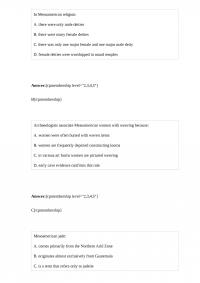
SOC 90898
In Mesoamerican religion: A. there were only male deities B. there were many female deities C. there was only one major female and one major male deity D. female deities were worshipped in round temples Archaeologists associate Mesoamerican women with […]
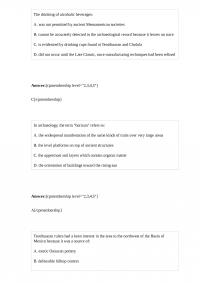
SSCI 17702
The drinking of alcoholic beverages: A. was not permitted by ancient Mesoamerican societies B. cannot be accurately detected in the archaeological record because it leaves no trace C. is evidenced by drinking cups found at Teotihuacan and Cholula D. did […]
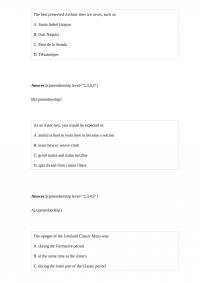
SSCI 18959
The best preserved Archaic sites are caves, such as: A. Santa Isabel Iztapan B. Guil Naquitz C. Paso de la Amada D. Tehuantepec As an Aztec boy, you would be expected to: A. attend school to learn how to become […]
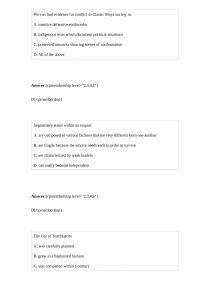
SSCI 23180
We can find evidence for conflict in Classic Maya society in: A. massive defensive earthworks B. indigenous texts which document political situations C. preserved artworks showing scenes of confrontation D. All of the above Segmentary states within an empire: A. […]
SSCI 78706
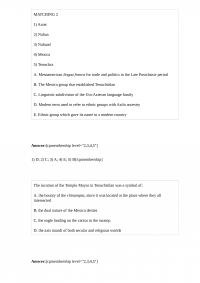
MATCHING 2 1) Aztec 2) Nahua 3) Nahuatl 4) Mexica 5) Tenochca A. Mesoamerican lingua franca for trade and politics in the Late Postclassic period B. The Mexica group that established Tenochtitlan C. Linguistic subdivision of the Uto-Aztecan language family […]
SSCI 84638
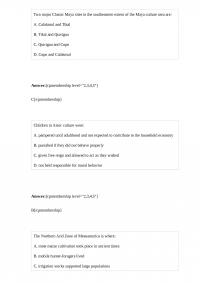
Two major Classic Maya sites in the southeastern extent of the Maya culture area are: A. Calakmul and Tikal B. Tikal and Quirigua C. Quirigua and Copn D. Copn and Calakmul Children in Aztec culture were: A. pampered until adulthood […]