Archives
978-0393639032 Chapter 1
5 a. can be inconclusive or conclusive (analogous to comma and period, respectively) 3. rhyme scheme: ending of text lines coincide with musical phrase structure 4. climax: high point in melodic line a. peak in intensity, range 5. countermelody: secondary […]
978-0393639032 Chapter 10
26 3. oboe and bassoon families: double reed a. oboe, En glish horn, bassoon, contrabassoon 4. clarinet and saxophone families: single reed a. clarinet, bass clarinet, saxophone (metal) III. Brass Instruments (Aerophones) A. Cup– shaped mouthpiece attached to metal tubing, […]
978-0393639032 Chapter 11
29 3. jazz bands: instrumentation varies a. reed section: saxophones, clarinet b. brass section: trumpets and trombones c. rhythm section: percussion, piano, double bass, and electric guitar 4. rock bands: amplified guitars, percussion, and synthesizers V. The Role of the […]
978-0393639032 Chapter 12
CHAPTERfi12 Style and Function of Music in Society OUTLINE I. Music Serves Dif fer ent Functions in Dif fer ent Socie ties A. Genres: categories of repertoire 1. sacred music: religious purposes 2. secular music: outside religious context, entertainment B. […]
978-0393639032 Chapter 13
35 OVERVIEW Chapter13 introduces a variety of issues specific to writing about music, with a focus on the ways in which students can learn to support a discussion of their reaction to a piece with ele ments of musical analy […]
978-0393639032 Chapter 14
42 b. 3 phrases, each sung 3 times c. conjunct, wavelike d. neumatic, then melismatic III. Life and Music in the Medieval Monastery A. Monasteries, other religious communities 1. religious seclusion, available to men and women 2. devoted to prayer, […]
978-0393639032 Chapter 15
45 b. enhanced impor tant feast days c. became mark of distinction D. Gaude Maria virgo (Rejoice, Virgin Mary) 1. prayer in praise of the Virgin Mary a. in the style of Pérotin, possibly by him b. three– part polyphony […]
978-0393639032 Chapter 16
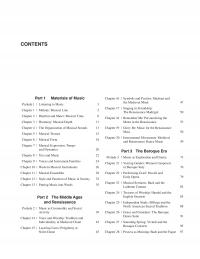
Chapter16 | Symbols and Puzzles: Machaut and the Medieval Mind 47 Chapter17 | Singing in Friendship: The Re nais sance Madrigal 50 Chapter18 | Remember Me: Personalizing the Motet in the Re nais sance 53 Chapter19 | Glory Be: Music […]
978-0393639032 Chapter 17
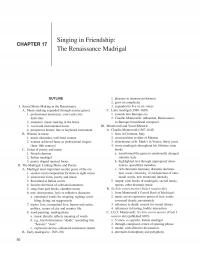
50 1. plea sure to amateur performers 2. grew in complexity 3. expanded to five or six voices C. Later madrigal (1580–1620) 1. extends into Baroque era 2. Claudio Monteverdi: influential, Renaissance- to- Baroque transitional composer III. Monteverdi and Vocal […]
978-0393639032 Chapter 18
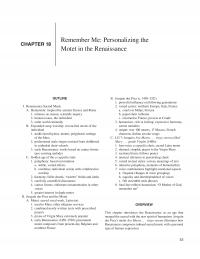
53 B. Josquin des Prez (c. 1450–1521) 1. power ful influence on following generations 2. varied career: northern Eu rope, Italy, France a. courts in Milan, Ferrara b. papal choir in Rome c. returned to France, provost at Condé 3. […]
978-0393639032 Chapter 19
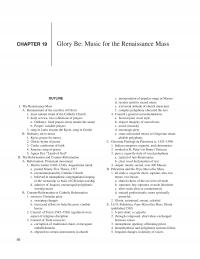
56 c. incorporation of popu lar songs in Masses d. secular spirit in sacred music e. irreverent attitude of church musicians f. complex polyphony obscured the text 4. Council’s general recommendations: a. favored pure vocal style b. re spect integrity […]
978-0393639032 Chapter 2
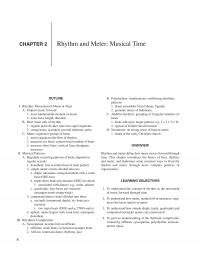
8 B. Polyrhythm: simultaneous conicting rhythmic patterns 1. drum ensembles from Ghana, Uganda 2. gamelan music of Indonesia C. Additive rhythms: grouping of irregular numbers of beats 1. beats add up to larger pattern, e.g. 2 + 3 + 3 […]
978-0393639032 Chapter 20
59 a. collection of popu lar dance types b. ronde: originated as a country dance, circle or line dance 3. LG 9: Susato, Three Dances from Danserye (published 1551) a. three rondes, each in binary form (A- A- B- B) […]
978-0393639032 Chapter 21
4. refrains bring back lines of text/music a. “My soul glorifies the Lord” b. “He has done great things for me” c. highly expressive, rich in word- painting 5. closes with doxology II. Barbara Strozzi and the Baroque Aria A. […]
978-0393639032 Chapter 22
79 CHAPTERfi22 Performing Grief: Purcell and Early Opera 2. from palace to public, widespread entertainment 3. first public opera house, Venice 4. accompanying orchestra ensemble became standard 5. Italian- style opera spread throughout Eu rope 6. turn of 18th century, […]
978-0393639032 Chapter 23
82 Musical Sermons: Bach and the Lutheran Cantata CHAPTERfi23 7. output: prolific in secular and sacred works, suites, concertos, sonatas, keyboard music, cantatas a. St.fiJohn and St.fiMatthew Passions, The Well- Tempered Clavier, The Art of Fugue, Bran– denburg Concertos B. […]
978-0393639032 Chapter 24
85 b. increased interest in choral singing D. Messiah 1. composed in 24 days, premiered in Dublin 2. performed continuously since its premiere 3. libretto: biblical verses, Old and New Testaments a. Christmas section: prophecy of the coming of Christ […]
978-0393639032 Chapter 25
88 2. frontispiece engraved by Paul Revere 3. introduction discussed basics of notation and music theory 4. music not bound by Eu ro pean traditions a. simple homophonic textures b. melody often in tenor line c. occasional passages of imitation […]
978-0393639032 Chapter 26
91 e. other dances: minuet, gavotte, bourée, passepied, hornpipe 4. sometimes opened with an overture 5. binary (A– A– B- B), or ternary (A- B- A) form a. A section: moves from home key to contrasting key b. B section: […]
978-0393639032 Chapter 27
95 CHAPTERfi27 Sounding Spring: Vivaldi and the Baroque Concerto B. Program music: Vivaldi’s The Four Seasons 1. four solo violin concertos, one for each season 2. program music: literary link a. each concerto accompanied by a poem b. poetry printed […]
978-0393639032 Chapter 28
97 2. answer: subject imitated in another voice 3. countersubject: dif fer ent theme heard against the subject 4. exposition: first section, subject presented in each voice one time 5. episodes: interludes lacking the subject 6. contrapuntal devices: augmentation, diminution, […]
978-0393639032 Chapter 29
D. Chamber music 1. two to ten performers: one player per part 2. smaller ensemble, intimate genre a. players function as a team: equal participation b. conversations without words c. predictable musical forms 3. string quartet: most impor tant chamber […]
978-0393639032 Chapter 3
11 1. resolution: relaxation, fulfillment C. Year 900: approximate date harmony introduced in Western music 1. perception of dissonance changes over time D. Asian cultures, Eu ro pean folk music: relatively simple harmonies 1. drone: single sustained tone OVERVIEW Harmony— […]
978-0393639032 Chapter 30
116 A. Orchestra ensemble established, four instrumental families 1. strings: heart of the orchestra 2. woodwinds: provided varying colors, often doubled the strings 3. brass: sustained harmonies 4. percussion: timpani, rhythmic life and vitality B. Eighteenth– century orchestra: 30 to […]
978-0393639032 Chapter 31
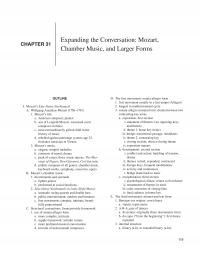
119 CHAPTERfi31 Expanding the Conversation: Mozart, Chamber Music, and Larger Forms D. The first movement: sonata- allegro form 1. first movement usually in a fast tempo (Allegro) 2. longest in multimovement cycle 3. sonata- allegro (sonata) form: drama between two […]
978-0393639032 Chapter 32
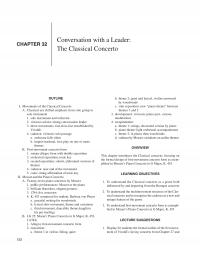
122 b. theme 2: quiet and lyrical, violins answered by woodwinds c. solo exposition: new “piano theme” between themes 1 and 2 3. development: virtuosic piano part, vari ous modulations 4. recapitulation: a. theme 1: strings, decorated version by piano […]
978-0393639032 Chapter 33
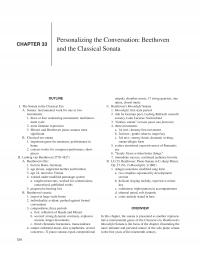
CHAPTERfi33 Personalizing the Conversation: Beethoven and the Classical Sonata output), chamber music, 17 string quartets, one opera, choral music C. Beethoven’s Moonlight Sonata 1. Moonlight: first style period 2. title by German poet, Ludwig Rellstab: moonlit scenery, Lake Lucerne, Switzerland […]
978-0393639032 Chapter 34
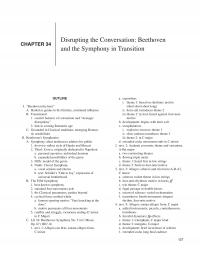
127 CHAPTERfi34 Disrupting the Conversation: Beethoven and the Symphony in Transition a. exposition: i. theme 1: based on rhythmic motive (short- short– short- long) ii. horn call introduces theme 2 iii. theme 2: lyrical, heard against four– note motive b. […]
978-0393639032 Chapter 35
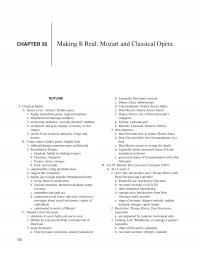
b. Leporello: Giovanni’s servant c. Donna Anna: noblewoman d. Commendatore: Donna Anna’s father e. Don Ottavio: Donna Anna’s fiancé f. Donna Elvira: one of Don Giovanni’s conquests g. Zerlina: a peasant girl h. Masetto: a peasant, fiancé to Zerlina 4. […]
978-0393639032 Chapter 36
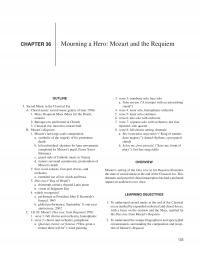
133 3. verse 3: trombone solo, bass solo a. Tuba mirum (“A trumpet with an astonishing sound”) 4. verse 4: tenor solo, homophonic orchestra 5. verse 5: tenor solo continues 6. verse 6: alto solo with orchestra 7. verse 7: […]
978-0393639032 Chapter 36 Oratorios Primarily Drew Their Stories From
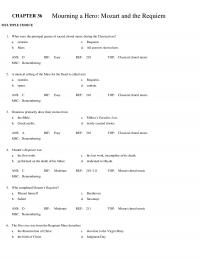
CHAPTER 36 Mourning a Hero: Mozart and the Requiem MULTIPLE CHOICE 1. What were the principal genres of sacred choral music during the Classical era? a. oratorio c. Requiem b. Mass d. All answers shown here. 2. A musical setting […]
978-0393639032 Chapter 37
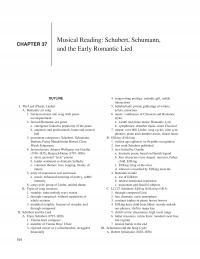
154 4. songwriting prodigy: melodic gift, subtle interactions 5. Schubertiads: private gatherings of writers, artists, musicians 6. music: confluence of Classical and Romantic styles a. Lieder and piano music: Romantic, lyric b. symphonies, chamber music: more Classical 7. output: over […]
978-0393639032 Chapter 38
158 CHAPTERfi38 Marketing Music: Foster and Early “Popu lar” Song 1. composer, born outside Pittsburgh 2. composed for Christy Minstrels, blackface minstrel show 3. first American to make living as professional songwriter, little profit 4. hit songs include: Oh! Susanna, […]
978-0393639032 Chapter 39
161 CHAPTERfi39 Dancing at the Keyboard: Chopin and Romantic Piano Music 2. age 21: moved to Paris, artistic center in 1830s 3. tumultuous affair with novelist Aurore Dudevant (George Sand) 4. works central to piano repertoire a. originated modern piano […]
978-0393639032 Chapter 4
13 1. pentatonic: five- note scale a. African, Asian, Native American musics 2. tritonic: three– note pattern a. music of some African cultures 3. microtones: intervals smaller than half step a. inection: brief microtonal dip from original pitch V. The […]
978-0393639032 Chapter 40
CHAPTERfi40 Musical Diaries: Hensel and Programmatic Piano Music B. A piano cycle: The Year (Das Jahr) 1. manuscript discovered in 1989 2. twelve character pieces (and postlude), one for each month a. each prefaced by poetic epigram b. each on […]
978-0393639032 Chapter 41
168 CHAPTERfi41 Personal Soundtracks: Berlioz and the Program Symphony d. IV. March to the Scaffold e. V. Dream of a Witches’ Sabbath 2. program by Berlioz: autobiographical a. infatuation with Harriet Smithson b. meeting the beloved; ultimate demise of the […]
978-0393639032 Chapter 42
171 Sounding Lit er a ture: Orchestral Program Music by Mendelssohn and Grieg CHAPTERfi42 3. written in Mendelssohn’s teens 4. sonata- allegro form a. introduction: the realm of the fairies b. exposition: i. theme 1: dance of the fairies ii. […]
978-0393639032 Chapter 43
174 CHAPTERfi43 Absolutely Classic: Brahms and the Nineteenth- Century Symphony II. Brahms and the Romantic Symphony A. Johannes Brahms (1833–1897) 1. German composer, conductor 2. mentored by Robert and Clara Schumann 3. moved to Vienna, enormously successful 4. traditionalist: absolute […]
978-0393639032 Chapter 44
177 CHAPTERfi44 Multimedia Hits: Verdi and Italian Romantic Opera 5. Shakespeare: favorite literary source 6. music marketed, commercially successful 7. founded, left fortune to Casa Verdi (home for aged musicians) 8. style: appealing melodies, intense dramatic situations 9. output: 28 […]
978-0393639032 Chapter 45
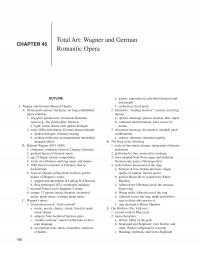
180 CHAPTERfi45 Total Art: Wagner and German Romantic Opera e. nature, super natural, glorified German land and people f. orchestra is focal point 2. leitmotifs, “leading motives”: concise recurring themes a. specific meanings: person, emotion, idea, object b. continual transformation, […]
978-0393639032 Chapter 46
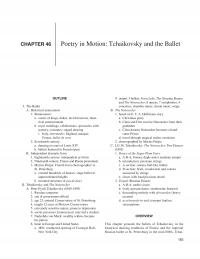
9. output: 3 ballets: Swan Lake, The Sleeping Beauty, and The Nutcracker; 8 operas, 7 symphonies, 4 concertos, chamber music, choral music, songs B. The Nutcracker 1. based on E. T. A. Hoffmann story a. Christmas party b. Clara and […]
978-0393639032 Chapter 47
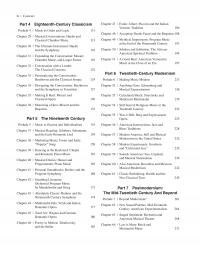
iv | Contents Chapter47 | Exotic Allure: Puccini and the Italian Verismo Tradition 186 Chapter48 | Accepting Death: Fauré and the Requiem 188 Chapter49 | Mythical Impressions: Program Music at the End of the Nineteenth Century 191 Chapter50 | Jubilees […]
978-0393639032 Chapter 48
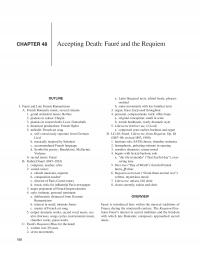
188 a. Latin liturgical texts, edited freely, phrases omitted b. some movements with less familiar texts 3. organ, brass, harp used throughout 4. personal, compassionate work; offers hope a. original conception: small in scale b. avoids bombastic, overly dramatic style […]
978-0393639032 Chapter 49
191 CHAPTERfi49 Mythical Impressions: Program Music at the End of the Nineteenth Century 2. age 11, attended Paris Conservatory a. shocked professors: bizarre harmonies, defied rules 3. age 22, won Prix de Rome 4. Pelléas and Mélisande (1902), opera: interna– […]
978-0393639032 Chapter 5
15 B. Strict imitation 1. canon: each voice enters in succession with the same melody 2. round: perpetual canon (e.g., Row, Row, Row Your Boat) OVERVIEW The intermingling of melody and harmony provides the basis of musical texture. More specifically, […]
978-0393639032 Chapter 50
194 CHAPTERfi50 Jubilees and Jubilation: The African American Spiritual Tradition 1. movement celebrating African American culture and arts 2. overlapped with “art- song” arrangements C. Swing Low, Sweet Chariot 1. intersection of cultures: a. possibly by Wallace Willis; slave in […]
978-0393639032 Chapter 51
197 CHAPTERfi51 A Good Beat: American Vernacular Music at the Close of an Era 7. strove to elevate ragtime to serious art form 8. Treemonisha (1911): 1976, awarded Pulitzer Prize posthumously 9. output: two operas, piano rags, other piano music, […]
978-0393639032 Chapter 52
216 Anything Goes: Schoenberg and Musical Expressionism CHAPTERfi52 i. rejection of tonality, key ii. highly dissonant, maximum tension iii. eventual development of “twelve- tone” method C. Pierrot lunaire (Moonstruck Pierrot) 1. song cycle; Schoenberg’s atonal- Expressionist period 2. poetry by […]
978-0393639032 Chapter 53
219 CHAPTERfi53 Calculated Shock: Stravinsky and Modernist Multimedia 1. percussive use of dissonance 2. polytonality, polyrhythms 3. monumental orchestra a. harsh, loud, constantly changing colors b. strings: successive down bows, pizzicatos c. full force of brass and barbaric percussion 4. […]
978-0393639032 Chapter 54
222 D. LG 46: Boulanger: Psalm 24 (1916) 1. Choral Psalm setting, 10 verses 2. tenor solo, SATB chorus, brass, harp, organ, timpani 3. three– part form (A– B- A) a. Introduction: dramatic, commanding tone i. fanfare for brass, harp, […]
978-0393639032 Chapter 55
a. social advocacy, oppression of disenfran– chised people, social alienation b. disturbed man moves between real ity and hallucination c. based on gruesome, real- life events 2. libretto by Berg a. three acts, five scenes each b. each scene a […]
978-0393639032 Chapter 56
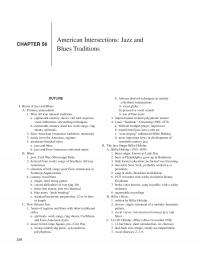
228 b. African- derived techniques in melody i. rhythmic interjections ii. vocal glides iii. percussive vocal sounds iv. use of blue notes 3. improvisation created polyphonic texture 4. Louis “Satchmo” Armstrong (1901–1971) a. brilliant trumpet player, improviser b. transformed jazz […]
978-0393639032 Chapter 57
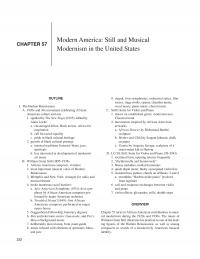
232 9. output: four symphonies, orchestral suites, film scores, stage works, operas, chamber music, vocal music, piano music, choral music C. Still’s Suite for Violin and Piano 1. drawn on established genre: modernist neo– Classical trend 2. movements inspired by […]
978-0393639032 Chapter 58
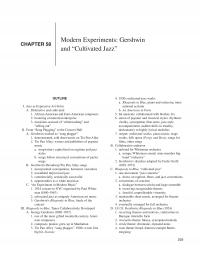
235 CHAPTERfi58 Modern Experiments: Gersh win and “Cultivated Jazz” 4. 1920s orchestral- jazz works a. Rhapsody in Blue, piano and orchestra; inter- national acclaim b. An American in Paris 5. hit musicals: collaborated with brother, Ira 6. union of popu […]
978-0393639032 Chapter 59
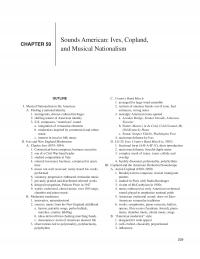
C. Country Band March 1. arranged for large wind ensemble 2. realism of amateur bands: out of tune, bad entrances, wrong notes 3. nostalgic American tunes quoted a. London Bridge, Yankee Doodle, Arkansas Traveler b. Foster: Massa’s in de Cold, […]
978-0393639032 Chapter 6
18 a. in early Western church music b. African, Native American, and African American cultures 2. ostinato: short repeated musical pattern a. unifying technique b. blues, jazz, rock, and rap D. Movement: term for a complete, in de pen dent […]
978-0393639032 Chapter 60
242 1. 1939 film score, “Mexican tragedy” celebrating heritage of native Mayan empire 2. 1961 arranged into four– movement suite, José Ives Limantour (1919–1976) 3. expanded percussion: intersections of native, African, Eu ro pean cultures 4. “Noche de Jaranas,” “tempo […]
978-0393639032 Chapter 61
245 b. rhythmic innovator: pounding rhythms, syn– copation, changing meters, ostinatos c. complex, modern dissonant counterpoint, polytonality d. adherence to Classical forms 5. works include: orchestral, five concertos, string quartets, piano music, vocal music B. Concerto for Orchestra 1. entire […]
978-0393639032 Chapter 62
CHAPTERfi62 New Sound Palettes: Mid- Twentieth- Century American Experimentalists a. vari ous materials inserted between the strings: nails, bolts, nuts, screws, bits of rub- ber, wood, or leather b. varied effects: nonpitched thump, pitch and timbre altered 2. focus on […]
978-0393639032 Chapter 63
4. age forty, first American- born conductor of New York Philharmonic 5. promoted concert music, far– reaching educa– tional efforts 6. style: straddled serious and popu lar music, accessible compositions, rooted in tonality, soaring melodies, jazzy rhythms 7. output: symphonies, […]
978-0393639032 Chapter 64
271 cians, Tehillim, Dif fer ent Trains (Classical Music Grammy, 1990) D. African influence 1. 1970, Reich studied drumming in West Africa 2. Ewe drummers: polyrhythms, interlocking patterns a. similarities with phase and pro cess music 3. minimalist style developed […]
978-0393639032 Chapter 65
274 2. style fostered by major recording producer, Leonard Chess 3. Maybelline (1955), first hit a. sold over one million copies to black and white audiences D. Roll Over Beethoven 1. second major hit, 1956 2. rhythm and blues/rock and […]
978-0393639032 Chapter 66
277 Returning with Interest: Bowie, Glass, and Postmodern Elaboration CHAPTERfi66 B. Symphony No.4 (Heroes) 1. small borrowings from Bowie/Eno Heroes album 2. six– movement work a. each based on a theme from Bowie’s album b. dramatic structure suitable for dance […]
978-0393639032 Chapter 67
280 ii. reflects journey of life iii. subtext of personal grief b. program provides evocative images 4. large orchestra, many percussion instruments a. tintinnabulation: bell– like timbres b. “chiming” draws on Asian soundscapes 5. continual expansion, several stirring climaxes D. […]
978-0393639032 Chapter 68
Contents | v Chapter68 | Underscoring Meaning: Williams and Music for Film 283 Chapter65 | Rolling Beethoven Over: Roots and Reworkings of Rock 274 Twenty- First Century 280 Chapter69 | Icons in Sound: Tavener and Postmodern Orthodoxy 286 Chapter70 | […]
978-0393639032 Chapter 69
286 C. A Hymn to the Mother of God 1. for two six– voice choirs 2. performed on Sunday in Great Lent 3. Eighth- century text by Saint John Damascene 4. influences: medieval and Re nais sance polyphony 5. short […]
978-0393639032 Chapter 7
20 2. directions to change dynamics a. crescendo: growing louder b. decrescendo or diminuendo: growing softer c. sforzando (sf): accent III. Tempo and Dynamics as Ele ments of Expression A. Tempo and dynamic markings 1. shape expressive content 2. indications […]
978-0393639032 Chapter 70
289 5. focus on last days and hours before first atomic test (1945) a. hopes and fears about the invention b. morality concerns c. psychological stresses d. apprehension and terror 6. rich and dark score a. complex texturally; multilayered, eclectic […]
978-0393639032 Chapter 8
22 OVERVIEW In this chapter we explore the relationship between music and words, focusing on the way in which the sounds and rhythms of words as well as their meanings contribute to the overall impact of a piece of music. […]
978-0393639032 Chapter 9
24 a. struck, scraped or shaken, plucked b. steel drums, rattles, mbira 4. membranophones: sound produced from tightly stretched membranes a. drum- type instruments OVERVIEW This chapter introduces the vari ous human voice types and instrument families. The striking diversity […]
978-0393639032 Prelude 1
OVERVIEW Audiences at live per for mances of art music adhere to a num– ber of par tic u lar traditions, expectations, and be hav iors that are not usually observed at popu lar music concerts and ven- ues. This […]
978-0393639032 Prelude 2
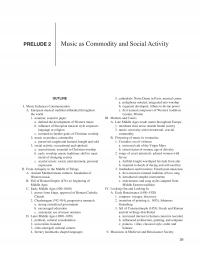
5. cathedrals: Notre Dame in Paris, musical center a. polyphony notated, integrated into worship b. organum developed, tribute to divine power c. first named composers of Western tradition: Léonin, Pérotin III. Markets and Courts A. Late Middle Ages: trade routes […]
978-0393639032 Prelude 3
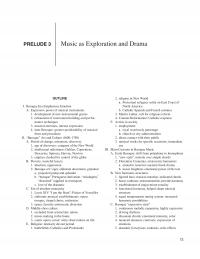
2. religion in New World a. Protestant refugees settle on East Coast of North Amer i ca b. Catholic Spanish and French colonies 3. Martin Luther, call for religious reform 4. Counter– Reformation: Catholic response F. Artists in society 1. […]
978-0393639032 Prelude 4
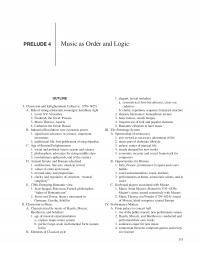
111 1. elegant, lyrical melodies a. symmetrical four– bar phrases, clear– cut cadences b. clarity: repetition, sequence; balanced structure 2. diatonic harmonies; homophonic texture 3. basic meters, steady tempos 4. frequent use of folk and popu lar ele ments 5. […]
978-0393639032 Prelude 5
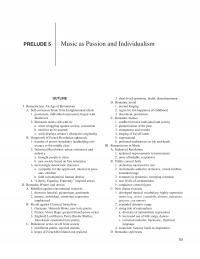
3. short- lived optimism, doubt, disenchantment D. Romantic mood 1. eternal longing 2. regret for lost happiness of childhood 3. discontent, pessimism E. Romantic themes 1. conflict between individual and society 2. glamorization of the past 3. strangeness and won […]
978-0393639032 Prelude 6
a. Tin Pan Alley, street in Manhattan b. popu lar music writers/publishers set up business c. Irving Berlin: most successful Tin Pan Alley composer D. Between Two Wars: Music in the Great Depression 1. Roaring 20s: growth of radio, film […]
978-0393639032 Prelude 7
261 II. Music in a Postmodern World A. Postmodern: definition is elusive 1. breaking away from modernist stance that mass media is incompatible with art a. technology: recordings available, hi- fi’s, tele- vi sions purchased, FM radio, MTV, YouTube 2. […]
978-0393639032 Test Bank Chapter 1
TEST BANK By Christopher Reali RAMAPO COLLEGE OF NEW JERSEY To Accompany The Enjoyment of Music THIRTEENTH EDITION By Kristine Forney, Andrew Dell’Antonio, and Joseph Machlis W • W • NORTON & COMPANY, INC. • NEW YORK • LONDON W. […]
978-0393639032 Test Bank Chapter 10
CHAPTER 10 Western Musical Instruments MULTIPLE CHOICE 1. The instruments of the Western orchestra are categorized in four groups: strings, brass, percussion, and a. flutes. c. woodwinds. b. chordophones. d. idiophones. 2. Which is the correct order of bowed string […]
978-0393639032 Test Bank Chapter 11
CHAPTER 11 Musical Ensembles MULTIPLE CHOICE 1. A fairly large group of singers who perform together is called a(n) a. orchestra. c. chorus. b. chamber ensemble. d. band. 2. The term a cappella refers to choral music performed ________ accompaniment. […]
978-0393639032 Test Bank Chapter 12
CHAPTER 12 Style and Function of Music in Society MULTIPLE CHOICE 1. What general term suggests something of the overall character of a work as well as its function? a. form c. medium b. genre d. opus 2. Titles of […]
978-0393639032 Test Bank Chapter 14
CHAPTER 14 Voice and Worship: Tradition and Individuality in Medieval Chant MULTIPLE CHOICE 1. Which of the following does NOT describe life in the medieval cloister? a. living in quiet seclusion b. being at the center of trade and commerce […]
978-0393639032 Test Bank Chapter 15
CHAPTER 15 Layering Lines: Polyphony at Notre Dame MULTIPLE CHOICE 1. Polyphony required the development of a. new musical instruments. c. music notation. b. new melodic modes. d. new performance venues. 2. In what era did the development of polyphony […]
978-0393639032 Test Bank Chapter 16
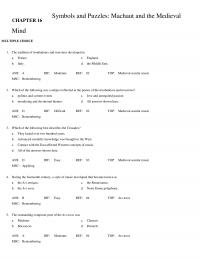
CHAPTER 16 Symbols and Puzzles: Machaut and the Medieval Mind MULTIPLE CHOICE 1. The tradition of troubadours and trouvères developed in a. France. c. England. b. Italy. d. the Middle East. 2. Which of the following was a subject reflected […]
978-0393639032 Test Bank Chapter 17
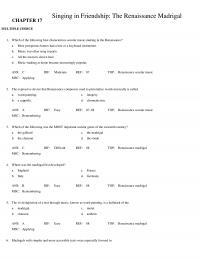
CHAPTER 17 Singing in Friendship: The Renaissance Madrigal MULTIPLE CHOICE 1. Which of the following best characterizes secular music-making in the Renaissance? a. Most prosperous homes had a lute or a keyboard instrument. b. Music was often sung in parts. […]
978-0393639032 Test Bank Chapter 18
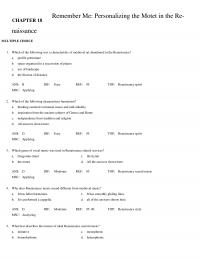
CHAPTER 18 Remember Me: Personalizing the Motet in the Re- naissance MULTIPLE CHOICE 1. Which of the following was a characteristic of medieval art abandoned in the Renaissance? a. profile portraiture b. space organized in a succession of planes c. […]
978-0393639032 Test Bank Chapter 19
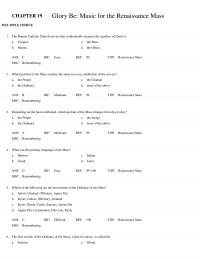
CHAPTER 19 Glory Be: Music for the Renaissance Mass MULTIPLE CHOICE 1. The Roman Catholic Church service that symbolically reenacts the sacrifice of Christ is a. Vespers. c. the Mass. b. Matins. d. the Office. 2. Which portion of the […]
978-0393639032 Test Bank Chapter 2
CHAPTER 2 Rhythm and Meter: Musical Time MULTIPLE CHOICE 1. Music is propelled forward in time by a. harmony. c. texture. b. rhythm. d. timbre. 2. What is the element of music that organizes movement in time? a. rhythm c. […]
978-0393639032 Test Bank Chapter 20
CHAPTER 20 Instrumental Movements: Medieval and Renais- sance Dance Music MULTIPLE CHOICE 1. Medieval instruments can be classified as bas or haut, meaning a. high or low. c. soft or loud. b. string or wind. d. folk or aristocratic. 2. […]
978-0393639032 Test Bank Chapter 21
CHAPTER 21 Voicing Gender: Women Composers in Baroque It- aly MULTIPLE CHOICE 1. During the seventeenth century, women who desired a public voice through music often joined a a. camerata. c. convent. b. composers’ guild. d. local church choir. ANS: […]
978-0393639032 Test Bank Chapter 23
CHAPTER 23 Musical Sermons: Bach and the Lutheran Cantata MULTIPLE CHOICE 1. Luther believed that music belonged to the a. clergy. c. cantor. b. choir. d. congregation. 2. In the Lutheran Church, the weekly hymns sung by the congregation were […]
978-0393639032 Test Bank Chapter 24
CHAPTER 24 Textures of Worship: Handel and the English Ora- torio MULTIPLE CHOICE 1. Handel’s Messiah is a(n) a. opera. c. oratorio. b. cantata. d. masque. 2. Which of the following is Handel’s MOST famous oratorio, frequently performed today? a. […]
978-0393639032 Test Bank Chapter 25
CHAPTER 25 Independent Study: Billings and the North Ameri- can Sacred Tradition MULTIPLE CHOICE 1. In seventeenth-century New England, the Puritan practice of singing that is based on call and response was called a. spiritualizing. c. lining-out. b. shape-note singing. […]
978-0393639032 Test Bank Chapter 26
CHAPTER 26 Grace and Grandeur: The Baroque Dance Suite MULTIPLE CHOICE 1. The first era of Western music history in which instrumental music was a major focus for composers was the a. Middle Ages. c. Baroque. b. Renaissance. d. Classical. […]
978-0393639032 Test Bank Chapter 27
CHAPTER 27 Sounding Spring: Vivaldi and the Baroque Concer- to MULTIPLE CHOICE 1. The instrumental form based on the contrast of two dissimilar bodies of sound is called a a. symphony. c. suite. b. sonata. d. concerto. 2. The typical […]
978-0393639032 Test Bank Chapter 28
CHAPTER 28 Process as Meaning: Bach and the Fugue MULTIPLE CHOICE 1. Which of the following was an important keyboard instrument during the Baroque? a. the harpsichord c. the organ b. the clavichord d. All answers shown here. 2. The […]
978-0393639032 Test Bank Chapter 29
CHAPTER 29 Musical Conversations: Haydn and Classical Chamber Music MULTIPLE CHOICE 1. In musical compositions, a theme is a. the composition’s underlying meaning. b. the composition’s overall mood. c. a musical idea that is used as a building block. d. […]
978-0393639032 Test Bank Chapter 3
CHAPTER 3 Harmony: Musical Depth MULTIPLE CHOICE 1. The depth resulting from simultaneous events in music is described by the term a. texture. c. dissonance. b. harmony. d. melody. 2. Harmony is to music as ________ is to painting. a. […]
978-0393639032 Test Bank Chapter 30
CHAPTER 30 The Ultimate Instrument: Haydn and the Symphony MULTIPLE CHOICE 1. The Classical symphony had its roots in the a. concerto. c. opera overture. b. sonata. d. ballet. 2. How many movements are typical of pre-Classical symphonies? a. two […]
978-0393639032 Test Bank Chapter 31
CHAPTER 31 Expanding the Conversation: Mozart, Chamber Music, and Larger Forms MULTIPLE CHOICE 1. Mozart’s Eine kleine Nachtmusik is an example of a a. symphony. c. sonata. b. serenade. d. concerto. 2. Eine kleine Nachtmusik is a. German for A […]
978-0393639032 Test Bank Chapter 32
CHAPTER 32 Conversation with a Leader: The Classical Concer- to MULTIPLE CHOICE 1. How many movements are in a Classical concerto? a. two c. four b. three d. six 2. A typical feature of a concerto is a free solo […]
978-0393639032 Test Bank Chapter 33
CHAPTER 33 Personalizing the Conversation: Beethoven and the Classical Sonata MULTIPLE CHOICE 1. Which of the following was a favored sonata instrumentation during the late eighteenth century? a. piano alone c. piano and cello b. piano and violin d. All […]
978-0393639032 Test Bank Chapter 34
CHAPTER 34 Disrupting the Conversation: Beethoven and the Symphony in Transition MULTIPLE CHOICE 1. Which composer both maintained and disrupted the balance of the Classical style? a. Beethoven c. Haydn b. Mozart d. Bach 2. With which symphony did Beethoven […]
978-0393639032 Test Bank Chapter 35
CHAPTER 35 Making It Real: Mozart and Classical Opera MULTIPLE CHOICE 1. During the Classical era, the prevalent form of opera, which contained many recitatives and arias designed to display virtuosity, was called a. opera seria. c. opéra comique. b. […]
978-0393639032 Test Bank Chapter 37
CHAPTER 37 Musical Reading: Schubert, Schumann, and the Early Romantic Lied MULTIPLE CHOICE 1. The German term for the art song is a. Gesang. c. durchkomponiert. b. Lied. d. chorale. 2. A song whose text is a short lyric poem […]
978-0393639032 Test Bank Chapter 38
CHAPTER 38 Marketing Music: Foster and Early “Popular” Song MULTIPLE CHOICE 1. Which of the following describes American popular music of the nineteenth century? a. The music often brought financial profit to the composers. b. The music seems to belong […]
978-0393639032 Test Bank Chapter 39
CHAPTER 39 Dancing at the Keyboard: Chopin and Romantic Piano Music MULTIPLE CHOICE 1. The most important keyboard instrument of the Romantic period was the a. harpsichord. c. organ. b. piano. d. clavichord. 2. Which of the following characterizes the […]
978-0393639032 Test Bank Chapter 4
CHAPTER 4 The Organization of Musical Sounds MULTIPLE CHOICE 1. How many notes in a scale does an octave span? a. five c. eight b. six d. ten 2. In Western music, the octave is divided into ________ equal intervals. […]
978-0393639032 Test Bank Chapter 40
CHAPTER 40 Musical Diaries: Hensel and Programmatic Piano Music MULTIPLE CHOICE 1. Which of the following best describes the role of women in nineteenth-century music? a. None pursued a career in music. b. Women were leaders in innovative changes of […]
978-0393639032 Test Bank Chapter 41
CHAPTER 41 Personal Soundtracks: Berlioz and the Program Symphony MULTIPLE CHOICE 1. Instrumental music endowed with literary, philosophical, or pictorial associations is called ________ music. a. absolute c. background b. program d. pure 2. Which of the following compositions is […]
978-0393639032 Test Bank Chapter 42
CHAPTER 42 Sounding Literature: Orchestral Program Music by Mendelssohn and Grieg MULTIPLE CHOICE 1. The concept of a program overture had its origin in the a. program symphony. c. symphonies of Beethoven. b. concert overture. d. opera overture. 2. Music […]
978-0393639032 Test Bank Chapter 43
CHAPTER 43 Absolutely Classic: Brahms and the Nineteenth– Century Symphony MULTIPLE CHOICE 1. Which of the following are types of absolute music? a. the concerto, the symphony, the piano trio b. the program symphony, incidental music, concert overture c. the […]
978-0393639032 Test Bank Chapter 44
CHAPTER 44 Multimedia Hits: Verdi and Italian Romantic Opera MULTIPLE CHOICE 1. Which nineteenth-century opera singer made a great impression in America by performing both opera excerpts and parlor songs? a. Louise Bertin c. Giuseppina Strepponi b. Jenny Lind d. […]
978-0393639032 Test Bank Chapter 45
CHAPTER 45 Total Art: Wagner and German Romantic Opera MULTIPLE CHOICE 1. Which of the following characterizes Singspiel? a. It was the immediate predecessor of German Romantic opera. b. Mozart’s opera The Magic Flute is an example of this genre. […]
978-0393639032 Test Bank Chapter 46
CHAPTER 46 Poetry in Motion: Tchaikovsky and the Ballet MULTIPLE CHOICE 1. The concept of ballet dates back to the a. Middle Ages. c. Baroque. b. Renaissance. d. Classical era. 2. The masque was a spectacle incorporating dance in a. […]
978-0393639032 Test Bank Chapter 47
CHAPTER 47 Exotic Allure: Puccini and the Italian Verismo Tra- dition MULTIPLE CHOICE 1. What name is given to the expansion and intensification of late Romantic trends? a. Impressionist c. minimalist b. post-Romantic d. Expressionist 2. Which of the following […]
978-0393639032 Test Bank Chapter 48
CHAPTER 48 Accepting Death: Fauré and the Requiem MULTIPLE CHOICE 1. Which of the following major musical streams did French Romantic composers reject? a. Wagner’s music dramas c. grand operatic productions b. ballet d. salon piano music 2. French composers […]
978-0393639032 Test Bank Chapter 49
CHAPTER 49 Mythical Impressions: Program Music at the End of the Nineteenth Century MULTIPLE CHOICE 1. The earliest practitioners of modernism were artists and writers from a. Russia. c. France. b. Spain. d. Germany. 2. Impression Sunrise, the painting that […]
978-0393639032 Test Bank Chapter 5
CHAPTER 5 Musical Texture MULTIPLE CHOICE 1. The element that describes the musical fabric, or the relationship of musical lines within a work, is called a. harmony. c. texture. b. meter. d. timbre. 2. A texture featuring a single, unaccompanied […]
978-0393639032 Test Bank Chapter 50
CHAPTER 50 Jubilees and Jubilation: The African-American Spiritual Tradition MULTIPLE CHOICE 1. What was the Second Great Awakening? a. a political movement seeking to free slaves b. a musical movement that turned to European influences c. a Christian movement at […]
978-0393639032 Test Bank Chapter 51
CHAPTER 51 A Good Beat: American Vernacular Music at the Close of an Era MULTIPLE CHOICE 1. An important American instrumental ensemble of the nineteenth century was the a. symphony orchestra. c. brass band. b. minstrel show. d. jazz band. […]
978-0393639032 Test Bank Chapter 52
CHAPTER 52 Anything Goes: Schoenberg and Musical Expres- sionism MULTIPLE CHOICE 1. Which of the following describes dissonance? a. It is the element of rest in music. b. It was a normal sound for most audiences. c. It played a […]
978-0393639032 Test Bank Chapter 53
CHAPTER 53 Calculated Shock: Stravinsky and Modernist Mul- timedia MULTIPLE CHOICE 1. Which Russian figure played a crucial role in the development of twentieth-century ballet? a. Marius Petipa c. Mily Balakirev b. Serge Diaghilev d. Modest Musorgsky 2. Which of […]
978-0393639032 Test Bank Chapter 54
CHAPTER 54 Still Sacred: Religious Music in the Twentieth Cen- tury MULTIPLE CHOICE 1. One composer in Paris who explored post-Impressionist trends was a. Schoenberg. c. Berg. b. Ravel. d. Satie. 2. Which of the following composers won the Prix […]
978-0393639032 Test Bank Chapter 55
CHAPTER 55 War is Hell: Berg and Expressionist Opera MULTIPLE CHOICE 1. The twelve-tone method a. revolutionized composition in the twentieth century. b. was a dead-end style that influenced few other styles. c. reestablished tonality in twentieth-century music. d. was […]
978-0393639032 Test Bank Chapter 56
CHAPTER 56 American Intersections: Jazz and Blues Traditions MULTIPLE CHOICE 1. Which of the following popular American musical styles has its roots in African American music? a. ragtime c. jazz b. blues d. All answers shown here. 2. Which of […]
978-0393639032 Test Bank Chapter 57
CHAPTER 57 Modern America: Still and Musical Modernism in the United States MULTIPLE CHOICE 1. During which decade did the Harlem Renaissance begin? a. 1900s c. 1920s b. 1910s d. 1930s 2. Which of the following was referred to as […]
978-0393639032 Test Bank Chapter 59
CHAPTER 59 Sounds American: Ives, Copland, and Musical Na- tionalism MULTIPLE CHOICE 1. Who was one of the more innovative, and misunderstood, composers of the early twentieth century? a. Stephen Foster c. George Gershwin b. Louis Moreau Gottschalk d. Charles […]
978-0393639032 Test Bank Chapter 6
CHAPTER 6 Musical Form MULTIPLE CHOICE 1. What quality of a work of art refers to its structure or shape? a. theme c. form b. melody d. harmony 2. The basic structural concepts in the element of form are a. […]
978-0393639032 Test Bank Chapter 60
CHAPTER 60 Also American: Revueltas and Mexican Musical Modernism MULTIPLE CHOICE 1. The music scene in early twentieth-century Mexico was strongly influenced by a. Spanish music. c. Amerindian culture. b. Hispanic culture. d. All answers shown here. 2. During the […]
978-0393639032 Test Bank Chapter 61
CHAPTER 61 Classic Rethinking: Bartók and the Neo-Classical Turn MULTIPLE CHOICE 1. The early twentieth-century style that sought to revive certain principles and forms of earlier music was a. neo-Classicism. c. Impressionism. b. post-Romanticism. d. Expressionism. 2. Which of the […]
978-0393639032 Test Bank Chapter 62
CHAPTER 62 New Sound Palettes: Mid-Twentieth-Century American Experimentalists MULTIPLE CHOICE 1. Who studied the music of Japan, India, and Iran and combined Asian instruments with traditional Western ensembles? a. John Cage c. Henry Cowell b. Aaron Copland d. Harry Partch […]
978-0393639032 Test Bank Chapter 63
CHAPTER 63 Staged Sentiment: Bernstein and American Musical Theater MULTIPLE CHOICE 1. Which of the following is considered America’s unique contribution to theater? a. operetta c. the musical b. pantomime d. ballad opera 2. Who wrote The Mikado and The […]
978-0393639032 Test Bank Chapter 64
CHAPTER 64 Less is More: Reich and Minimalist Music MULTIPLE CHOICE 1. What is process music? a. serial music c. music for a procession b. music that changes gradually d. chance music 2. Which of the following composers is/are (a) […]
978-0393639032 Test Bank Chapter 65
CHAPTER 65 Rolling Beethoven Over: Roots and Reworkings of Rock MULTIPLE CHOICE 1. What was the MOST important music phenomenon of the second half of the twentieth century? a. minimalism c. rock-and-roll b. chance music d. atonal music 2. Rock-and-roll […]
978-0393639032 Test Bank Chapter 66
CHAPTER 66 Returning with Interest: Bowie, Glass, and Post- modern Elaboration MULTIPLE CHOICE 1. Which artist began his career as a folk-rocker in the 1960s and released the album Blackstar in 2016? a. Bob Dylan c. Philip Glass b. David […]
978-0393639032 Test Bank Chapter 67
CHAPTER 67 Neo-Romantic Evocations: Higdon and Program Music into the Twenty-First Century MULTIPLE CHOICE 1. The postmodern approach that mixes styles from the nineteenth century with contemporary ones is called a. minimalism. c. post-Romanticism. b. post-minimalism. d. neo-Romanticism. 2. What […]
978-0393639032 Test Bank Chapter 68
CHAPTER 68 Underscoring Meaning: Williams and Music for Film MULTIPLE CHOICE 1. Why is music important to motion pictures? a. It can reveal the emotions of the characters. b. It can set the mood of the film. c. It can […]
978-0393639032 Test Bank Chapter 69
CHAPTER 69 Icons in Sound: Tavener and Postmodern Ortho- doxy MULTIPLE CHOICE 1. Which of the following characterizes spiritual minimalism? a. It is inspired by religious beliefs. b. It has simple chains of tonal progressions. c. It is nonpulsed music. […]
978-0393639032 Test Bank Chapter 70
CHAPTER 70 Reality Shows: Adams and Contemporary Opera MULTIPLE CHOICE 1. Which of the following characterizes historical opera? a. It seeks documentary-like authenticity. b. It is a recent development in opera plots. c. It evokes the emotions of historical figures. […]
978-0393639032 Test Bank Chapter 8
CHAPTER 8 Text and Music MULTIPLE CHOICE 1. The term nonlexical refers to a text that a. is in a vernacular language. c. has no repetitions. b. consists of nonsense syllables. d. features a play on words. 2. Scat-singing is […]
978-0393639032 Test Bank Chapter 9
CHAPTER 9 Voices and Instrument Families MULTIPLE CHOICE 1. What are the four properties of musical sound? a. pitch, duration, volume, timbre b. texture, pitch, volume, timbre c. duration, texture, volume, pitch d. timbre, texture, duration, volume 2. The quality […]
Chapter 13 Aaron Copland Sensuous Plane
CHAPTER 13 Putting Music into Words MULTIPLE CHOICE 1. Which of these is part of the three planes of listening described by composer Aaron Copland? a. the sensuous c. the musical b. the expressive d. All answers shown here. 2. […]
Chapter 22 A Highly Emotional Song In An Opera Is Called
CHAPTER 22 Performing Grief: Purcell and Early Opera MULTIPLE CHOICE 1. A drama that is sung is called a(n) a. madrigal. c. cantata. b. opera. d. motet. 2. The vocal style in opera that imitates the natural inflections of speech […]
Chapter 58 George Gershwin First Broke Into The Music Business As A
CHAPTER 58 Modern Experiments: Gershwin and “Cultivated Jazz” MULTIPLE CHOICE 1. George Gershwin first broke into the music business as a a. band leader. c. song plugger. b. film composer. d. composer of chamber music. 2. Where did George Gershwin […]
Chapter 7 Musical Expression Tempo And Dynamics
CHAPTER 7 Musical Expression: Tempo and Dynamics MULTIPLE CHOICE 1. The rate of speed at which a piece of music is played is its a. meter. c. movement. b. tempo. d. mood. 2. What emotional response would MOST likely be […]