Archives
978-0134320540 Chapter 1 Lecture Notes
CHAPTER 1 Strategic Compensation: A Component of Human Resource Systems Learning Objectives 1.1. Define strategic compensation. 1.2. Summarize the role of compensation as a strategic business partner. 1.3. Explain strategic compensation decisions. 1.4. Identify and discuss the building blocks and […]
978-0134320540 Chapter 1 Solution Manual
IX. Discussion Questions and Suggested Answers 1.1. Define compensation. Compensation represents both the intrinsic and extrinsic rewards employees receive for 1.2. Identify two companies—one that you believe pursues a lowest-cost strategy and another that pursues a differentiation strategy. Relying on […]
978-0134320540 Chapter 10 Lecture Notes
CHAPTER 10 Legally Required Benefits Learning Objectives 10-1. Discuss the origins of legally required benefits. 10-2. Summarize the four main categories of legally required benefits. 10-3. Describe fee-for-service plans, traditional managed care approaches, and more recent consumer-driven approaches to providing […]
978-0134320540 Chapter 10 Solution Manual
VII. Discussion Questions and Suggested Answers 10.1. Except for the Patient Protection and Affordable Care Act, the remaining legally required benefits were conceived more than a decade ago. What changes in the business environment and society might affect the relevance […]
978-0134320540 Chapter 11 Lecture Notes
CHAPTER 11 Compensating Executives Learning Objectives 11-1. Explain the difference between executive pay and pay for nonexecutives. 11-2. Define executive status. 11-3. List the components of executive compensation packages. 11-4. Discuss the principles and processes of setting executive compensation. 11-5. […]
978-0134320540 Chapter 11 Solution Manual
VIII. Discussion Questions and Suggested Answers 11.1. What can be done to make the function of compensation committees consistent with shareholders’ interest? Explain your answer. A compensation committee is made up of members within and outside the company, also known […]
978-0134320540 Chapter 12 Lecture Notes
CHAPTER 12 Compensating the Flexible Work Force: Contingent Employees and Flexible Work Schedules Learning Objectives 12-1. Describe the four groups of contingent workers. 12-2. Discuss pay and benefits issues for contingent workers. 12-3. Summarize the three categories of flexible work […]
978-0134320540 Chapter 12 Solution Manual
VIII. Discussion Questions and Suggested Answers 12.1. Discuss some of the problems that companies are likely to face when both contingent workers and core employees work in the same location. Does it matter whether contingent workers and core employees are […]
978-0134320540 Chapter 13 Lecture Notes
CHAPTER 13 Compensating Expatriates Learning Objectives 13-1. Discuss competitive advantage and how international activities fit in. 13-2. Describe and explain preliminary considerations compensation professionals should take under advisement before designing international compensation programs. 13-3. List the main components of international […]
978-0134320540 Chapter 13 Solution Manual
IX. Discussion Questions and Suggested Answers 13.1. Discuss the strengths and weaknesses of the following methods for establishing base pay in international contexts: home country-based pay, headquarters-based pay, and host country-based pay. 13.2. For a country of your choice, conduct […]
978-0134320540 Chapter 14 Lecture Notes
CHAPTER 14 Pay and Benefits Outside the United States Learning Objectives 14-1. Explain the pertinent concepts for quantifying important economic elements in the discussion of pay and benefits outside the United States. 14-2. For North America (Canada and Mexico), summarize […]
978-0134320540 Chapter 14 Solution Manual
VIII. Discussion Questions and Suggested Answers 14.1. Discuss the main differences between the minimum pay regulations in the United States (Chapter 2) and one other country’s practices discussed in this chapter. How do these differences affect companies’ ability to compete […]
978-0134320540 Chapter 15 Lecture Notes
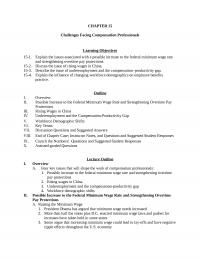
CHAPTER 15 Challenges Facing Compensation Professionals Learning Objectives 15-1. Explain the issues associated with a possible increase to the federal minimum wage rate and strengthening overtime pay protections. 15-2. Discuss the issue of rising wages in China. 15-3. Describe the […]
978-0134320540 Chapter 15 Solution Manual
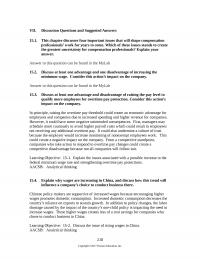
VII. Discussion Questions and Suggested Answers 15.1. This chapter discusses four important issues that will shape compensation professionals’ work for years to come. Which of these issues stands to create the greatest uncertainty for compensation professionals? Explain your answer. Answer […]
978-0134320540 Chapter 2 Lecture Notes
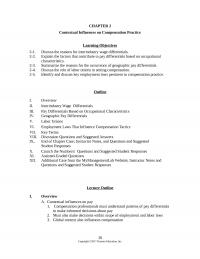
CHAPTER 2 Contextual Influences on Compensation Practice Learning Objectives 2-1. Discuss the reasons for interindustry wage differentials. 2-2. Explain the factors that contribute to pay differentials based on occupational characteristics. 2-3. Summarize the reasons for the occurrence of geographic pay […]
978-0134320540 Chapter 2 Solution Manual
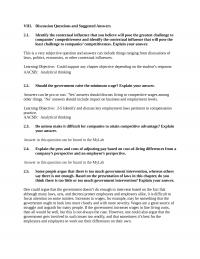
VIII. Discussion Questions and Suggested Answers 2.1. Identify the contextual influence that you believe will pose the greatest challenge to companies’ competitiveness and identify the contextual influence that will pose the least challenge to companies’ competitiveness. Explain your answer. 2.2. […]
978-0134320540 Chapter 3 Lecture Notes
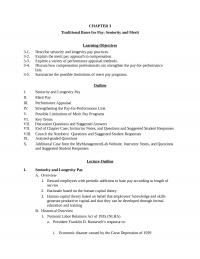
CHAPTER 3 Traditional Bases for Pay: Seniority and Merit Learning Objectives 3-1. Describe seniority and longevity pay practices. 3-2. Explain the merit pay approach to compensation. 3-3. Explore a variety of performance appraisal methods. 3-4. Discuss how compensation professionals can […]
978-0134320540 Chapter 3 Solution Manual
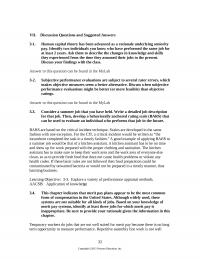
VII. Discussion Questions and Suggested Answers 3-1. Human capital theory has been advanced as a rationale underlying seniority pay. Identify two individuals you know who have performed the same job for at least 2 years. Ask them to describe the […]
978-0134320540 Chapter 4 Lecture Notes
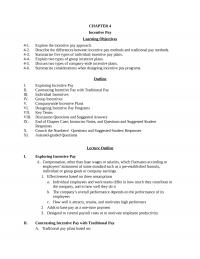
CHAPTER 4 Incentive Pay Learning Objectives 4-1. Explore the incentive pay approach. 4-2. Describe the differences between incentive pay methods and traditional pay methods. 4-3. Summarize five types of individual incentive pay plans. 4-4. Explain two types of group incentive […]
978-0134320540 Chapter 4 Solution Manual
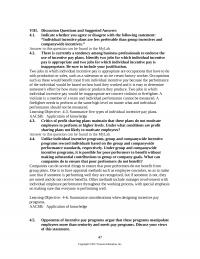
VIII. Discussion Questions and Suggested Answers 4.1. Indicate whether you agree or disagree with the following statement: “Individual incentive plans are less preferable than group incentives and companywide incentives.” Answer to this question can be found in the MyLab 4.2. […]
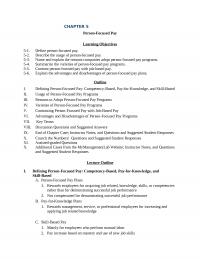
978-0134320540 Chapter 5 Lecture Notes
CHAPTER 5 Person-Focused Pay Learning Objectives 5-1. Define person-focused pay. 5-2. Describe the usage of person-focused pay. 5-3. Name and explain the reasons companies adopt person-focused pay programs. 5-4. Summarize the varieties of person-focused pay programs. 5-5. Contrast person-focused pay […]
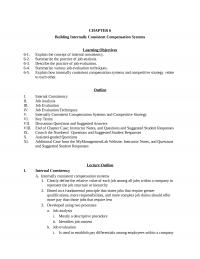
978-0134320540 Chapter 6 Lecture Notes
CHAPTER 6 Building Internally Consistent Compensation Systems Learning Objectives 6-1. Explain the concept of internal consistency. 6-2. Summarize the practice of job analysis. 6-3. Describe the practice of job evaluation. 6-4. Summarize various job evaluation techniques. 6-5. Explain how internally […]
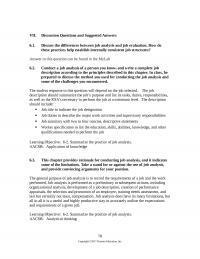
978-0134320540 Chapter 6 Solution Manual
VII. Discussion Questions and Suggested Answers 6.1. Discuss the differences between job analysis and job evaluation. How do these practices help establish internally consistent job structures? Answer to this question can be found in the MyLab 6.2. Conduct a job […]
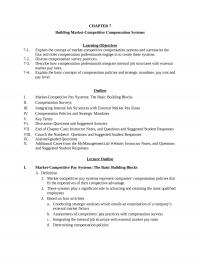
978-0134320540 Chapter 7 Lecture Notes
CHAPTER 7 Building Market-Competitive Compensation Systems Learning Objectives 7-1. Explain the concept of market-competitive compensation systems and summarize the four activities compensation professionals engage in to create these systems. 7-2. Discuss compensation survey practices. 7-3. Describe how compensation professionals integrate […]
978-0134320540 Chapter 8 Lecture Notes
CHAPTER 8 Building Pay Structures That Recognize Employee Contributions Learning Objectives 8-1. Explain the concept of pay structures and the five steps necessary to construct pay structures. 8-2. Discuss the components of merit pay systems. 8-3. Summarize the features of […]
978-0134320540 Chapter 8 Solution Manual
VII. Discussion Questions and Suggested Answers 8.1. Respond to the following statement: “Pay grades limit a company’s ability to achieve competitive advantage.” Do you agree? Provide rationale for your position. Pay grades group jobs for pay policy application. Human resource […]
978-0134320540 Chapter 9 Lecture Notes
CHAPTER 9 Discretionary Benefits Learning Objectives 9-1. Discuss the origins of discretionary benefits. 9-2. Explain the three categories of discretionary benefits. 9-3. Summarize legislation that pertains to discretionary benefits. 9-4. Discuss the fundamentals of designing and planning the benefits program. […]
978-0134320540 Chapter 9 Solution Manual
VII. Discussion Questions and Suggested Answers 9.1. Many compensation professionals are faced with making choices about which discretionary benefits to drop because funds are limited and the costs of these benefits continually increase. Assume you make such choices. Rank order […]
978-0134320540 Content Content
Instructor’s Manual to Accompany Strategic Compensation: A Human Resource Management Approach, 9e Preface This Instructor’s Manual provides instructors with course outlines as well as suggested responses for the end-of-chapter Discussion Questions and other activities. In addition, answers to case questions […]
BUA 26655
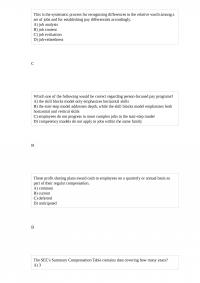
This is the systematic process for recognizing differences in the relative worth among a set of jobs and for establishing pay differentials accordingly. A) job analysis B) job content C) job evaluation D) job-relatedness Which one of the following would […]
Chapter 5 Person-focused Pay Job Examples
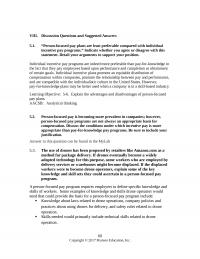
VIII. Discussion Questions and Suggested Answers 5.1. “Person-focused pay plans are least preferable compared with individual incentive pay programs.” Indicate whether you agree or disagree with this statement. Detail your arguments to support your position. Individual incentive pay programs are […]
Chapter 7 Internal Consistency Or Market Competitiveness
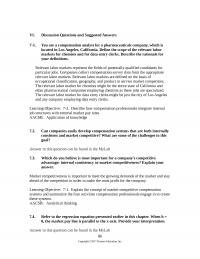
VI. Discussion Questions and Suggested Answers 7-1. You are a compensation analyst for a pharmaceuticals company, which is located in Los Angeles, California. Define the scope of the relevant labor markets for chemists and for data entry clerks. Describe the […]
EMBA 18324
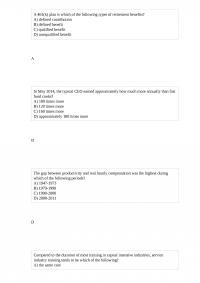
A 401(k) plan is which of the following types of retirement benefits? A) defined contribution B) defined benefit C) qualified benefit D) nonqualified benefit In May 2014, the typical CEO earned approximately how much more annually than fast food cooks? […]
EMBA 20760
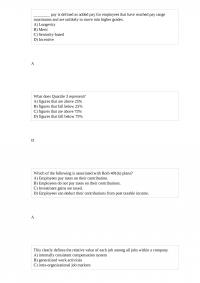
________ pay is defined as added pay for employees that have reached pay range maximums and are unlikely to move into higher grades. A) Longevity B) Merit C) Seniority-based D) Incentive What does Quartile 3 represent? A) figures that are […]
Management 36896
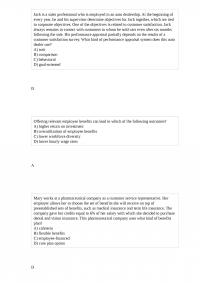
Jack is a sales professional who is employed in an auto dealership. At the beginning of every year, he and his supervisor determine objectives for Jack together, which are tied to corporate objectives. One of the objectives is related to […]
Management 91950
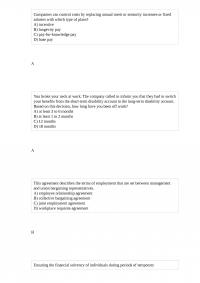
Companies can control costs by replacing annual merit or seniority increases or fixed salaries with which type of plans? A) incentive B) longevity pay C) pay-for-knowledge pay D) base pay You broke your neck at work. The company called to […]
MGMT 45608
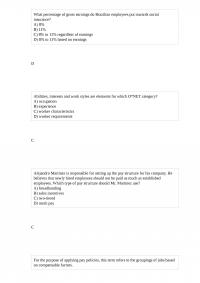
What percentage of gross earnings do Brazilian employees put towards social insurance? A) 8% B) 11% C) 8% to 11% regardless of earnings D) 8% to 11% based on earnings Abilities, interests and work styles are elements for which O*NET […]
MGMT 56112
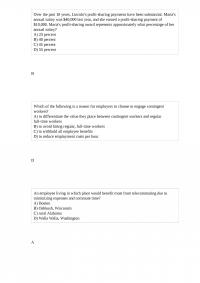
Over the past 10 years, Lincoln’s profit-sharing payments have been substantial. Maria’s annual salary was $40,000 last year, and she earned a profit-sharing payment of $10,000. Maria’s profit-sharing award represents approximately what percentage of her annual salary? A) 25 percent […]
MGT 86887
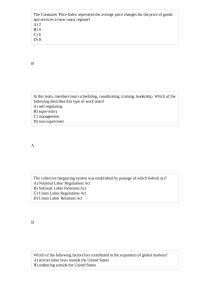
The Consumer Price Index represents the average price changes for the price of goods and services in how many regions? A) 2 B) 4 C) 6 D) 8 In this team, members learn scheduling, coordinating, training, leadership. Which of the […]
OBHR 13876
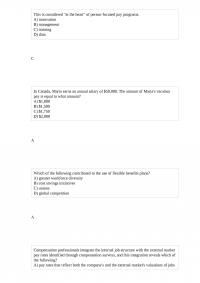
This is considered “at the heart” of person-focused pay programs. A) innovation B) management C) training D) data In Canada, Maria earns an annual salary of $50,000. The amount of Maria’s vacation pay is equal to what amount? A) $1,000 […]
OBHR 24387
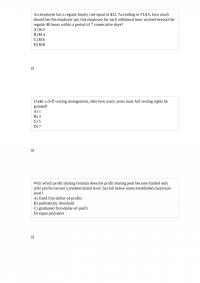
An employee has a regular hourly rate equal to $12. According to FLSA, how much should her/his employer pay this employee for each additional hour worked beyond the regular 40 hours within a period of 7 consecutive days? A) $12 […]
OBHR 50613
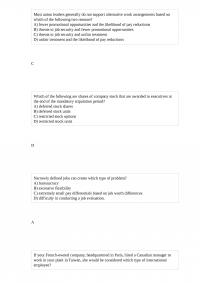
Most union leaders generally do not support alternative work arrangements based on which of the following two reasons? A) fewer promotional opportunities and the likelihood of pay reductions B) threats to job security and fewer promotional opportunities C) threats to […]
OBHR 96855
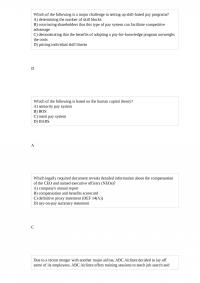
Which of the following is a major challenge in setting up skill-based pay programs? A) determining the number of skill blocks B) convincing shareholders that this type of pay system can facilitate competitive advantage C) demonstrating that the benefits of […]
PRST 18946
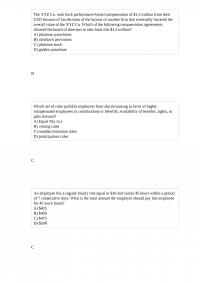
The XYZ Co. took back performance-based compensation of $1.2 million from their CEO because of his decision of the buyout of another firm that eventually lowered the overall value of the XYZ Co. Which of the following compensation agreements allowed […]
PRST 89784
Compare health benefits and paid time off benefits in India and People’s Republic of China. This concept describes a company’s success when the company acquires or develops capabilities that facilitate outperforming the competition. A) differentiation B) capital C) compensation practices […]