Archives
978-0132145763 Chapter 1 Part 1
Enterprise Systems for Management, 2e (Motiwalla/Thompson) Chapter 1 Introduction to Enterprise Systems for Management 1) The Hershey’s example shows the complexity of implementing ERP systems in organizations. 2) In the early days of ERP implementation, management clearly understood the magnitude […]
978-0132145763 Chapter 10 Part 1
Enterprise Systems for Management, 2e (Motiwalla/Thompson) Chapter 10 Global, Ethics, and Security Management 1) Outsourcing ERP systems helps to lower the cost of software ownership and maintenance. 2) All companies can benefit from outsourcing their ERP systems. Answer: FALSE Diff: […]
978-0132145763 Chapter 11 Part 1
Enterprise Systems for Management, 2e (Motiwalla/Thompson) Chapter 11 Supply Chain Management 1) A complete SCM solution includes customers, service providers and partners. 2) SCM focuses on a few key parties and processes. Answer: FALSE Diff: 2 Page Ref: 304 3) […]
978-0132145763 Chapter 12 Part 1
Enterprise Systems for Management, 2e (Motiwalla/Thompson) Chapter 12 Customer Relationship Management 1) CRM implementations should be technology driven. 2) CRM stands for “Customer Reporting Management.” Answer: FALSE Diff: 1 Page Ref: 333 3) CRM is a brand new concept. Answer: […]
978-0132145763 Chapter 2 Part 1
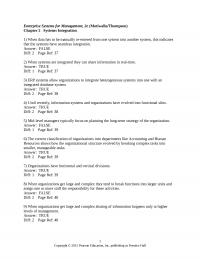
Enterprise Systems for Management, 2e (Motiwalla/Thompson) Chapter 2 Systems Integration 1) When data has to be manually re-entered from one system into another system, this indicates that the systems have seamless integration. 2) When systems are integrated they can share […]
978-0132145763 Chapter 3 Part 1
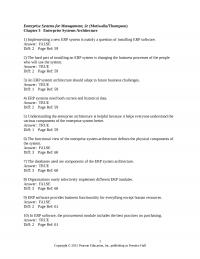
Enterprise Systems for Management, 2e (Motiwalla/Thompson) Chapter 3 Enterprise Systems Architecture 1) Implementing a new ERP system is mainly a question of installing ERP software. 2) The hard part of installing an ERP system is changing the business processes of […]
978-0132145763 Chapter 4 Part 1
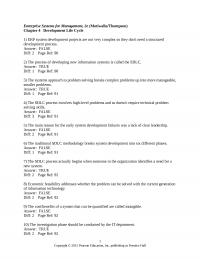
Enterprise Systems for Management, 2e (Motiwalla/Thompson) Chapter 4 Development Life Cycle 1) ERP system development projects are not very complex so they don’t need a structured development process. 2) The process of developing new information systems is called the SDLC. […]
978-0132145763 Chapter 5 Part 1
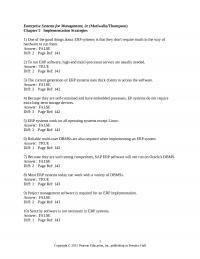
Enterprise Systems for Management, 2e (Motiwalla/Thompson) Chapter 5 Implementation Strategies 1) One of the good things about ERP systems is that they don’t require much in the way of hardware to run them. 2) To run ERP software, high-end multi-processor […]
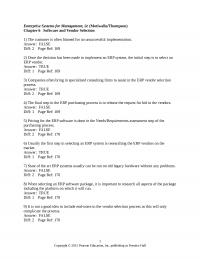
978-0132145763 Chapter 6 Part 1
Enterprise Systems for Management, 2e (Motiwalla/Thompson) Chapter 6 Software and Vendor Selection 1) The customer is often blamed for an unsuccessful implementation. 2) Once the decision has been made to implement an ERP system, the initial step is to select […]
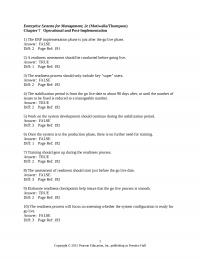
978-0132145763 Chapter 7 Part 1
Enterprise Systems for Management, 2e (Motiwalla/Thompson) Chapter 7 Operational and Post-Implementation 1) The ERP implementation phase is just after the go live phase. 2) A readiness assessment should be conducted before going live. Answer: TRUE Diff: 1 Page Ref: 192 […]
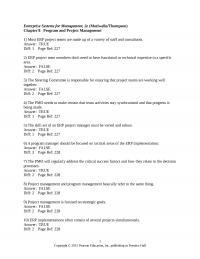
978-0132145763 Chapter 8 Part 1
Enterprise Systems for Management, 2e (Motiwalla/Thompson) Chapter 8 Program and Project Management 1) Most ERP project teams are made up of a variety of staff and consultants. 2) ERP project team members don’t need to have functional or technical expertise […]
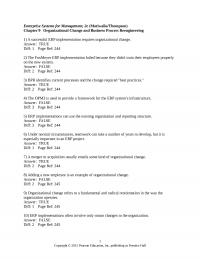
978-0132145763 Chapter 9 Part 1
Enterprise Systems for Management, 2e (Motiwalla/Thompson) Chapter 9 Organizational Change and Business Process Reengineering 1) A successful ERP implementation requires organizational change. 2) The FoxMeyer ERP implementation failed because they didn’t train their employees properly on the new system. Answer: […]
Finance Chapter 1 On corporate intranets, ERP functionality is delivered
Copyright © 2012 Pearson Education, Inc. publishing as Prentice Hall Enterprise Systems for Management, 2e (Motiwalla/Thompson) Chapter 1 Introduction to Enterprise Systems for Management 1) The Hershey’s example shows the complexity of implementing ERP systems in organizations. Answer: TRUE Diff: […]
Finance Chapter 10 Globalization And Offshoring
Copyright © 2012 Pearson Education, Inc. publishing as Prentice Hall Enterprise Systems for Management, 2e (Motiwalla/Thompson) Chapter 10 Global, Ethics, and Security Management 1) Outsourcing ERP systems helps to lower the cost of software ownership and maintenance. Answer: TRUE Diff: […]
Finance Chapter 11 Supply webs, also known as exchanges, are virtual locations where
Copyright © 2012 Pearson Education, Inc. publishing as Prentice Hall Enterprise Systems for Management, 2e (Motiwalla/Thompson) Chapter 11 Supply Chain Management 1) A complete SCM solution includes customers, service providers and partners. Answer: TRUE Diff: 2 Page Ref: 304 2) […]
Finance Chapter 12 Recent Gartner Study Showed That
Copyright © 2012 Pearson Education, Inc. publishing as Prentice Hall Enterprise Systems for Management, 2e (Motiwalla/Thompson) Chapter 12 Customer Relationship Management 1) CRM implementations should be technology driven. Answer: FALSE Diff: 2 Page Ref: 333 2) CRM stands for “Customer […]
Finance Chapter 2 Decision support systems take data from the TPSs in the organization to help
Copyright © 2012 Pearson Education, Inc. publishing as Prentice Hall Enterprise Systems for Management, 2e (Motiwalla/Thompson) Chapter 2 Systems Integration 1) When data has to be manually re-entered from one system into another system, this indicates that the systems have […]
Finance Chapter 3 Gui Resides The Tiera Logical Presentation
Copyright © 2012 Pearson Education, Inc. publishing as Prentice Hall Enterprise Systems for Management, 2e (Motiwalla/Thompson) Chapter 3 Enterprise Systems Architecture 1) Implementing a new ERP system is mainly a question of installing ERP software. Answer: FALSE Diff: 2 Page […]
Finance Chapter 4 The value proposition helps to ensure that the ERP solution
Copyright © 2012 Pearson Education, Inc. publishing as Prentice Hall Enterprise Systems for Management, 2e (Motiwalla/Thompson) Chapter 4 Development Life Cycle 1) ERP system development projects are not very complex so they don’t need a structured development process. Answer: FALSE […]
Finance Chapter 5 The decision to modify or not modify an ERP system
Copyright © 2012 Pearson Education, Inc. publishing as Prentice Hall Enterprise Systems for Management, 2e (Motiwalla/Thompson) Chapter 5 Implementation Strategies 1) One of the good things about ERP systems is that they don’t require much in the way of hardware […]
Finance Chapter 6 The Actual Cost The Erp Software Itself
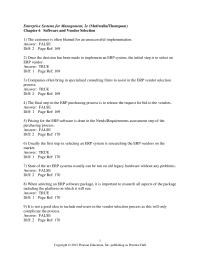
Copyright © 2012 Pearson Education, Inc. publishing as Prentice Hall Enterprise Systems for Management, 2e (Motiwalla/Thompson) Chapter 6 Software and Vendor Selection 1) The customer is often blamed for an unsuccessful implementation. Answer: FALSE Diff: 2 Page Ref: 169 2) […]
Finance Chapter 7 Some ERP system problems can be identified in advance
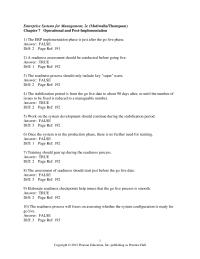
Copyright © 2012 Pearson Education, Inc. publishing as Prentice Hall Enterprise Systems for Management, 2e (Motiwalla/Thompson) Chapter 7 Operational and Post-Implementation 1) The ERP implementation phase is just after the go live phase. Answer: FALSE Diff: 2 Page Ref: 191 […]
Finance Chapter 8 Erp Projects Typically Have High Risks But
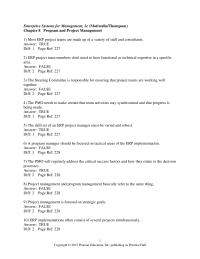
Copyright © 2012 Pearson Education, Inc. publishing as Prentice Hall Enterprise Systems for Management, 2e (Motiwalla/Thompson) Chapter 8 Program and Project Management 1) Most ERP project teams are made up of a variety of staff and consultants. Answer: TRUE Diff: […]
Finance Chapter 9 The overall policy, budget, and scope of the project
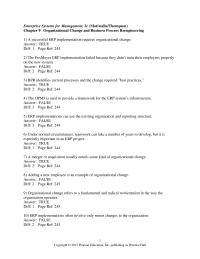
Copyright © 2012 Pearson Education, Inc. publishing as Prentice Hall Enterprise Systems for Management, 2e (Motiwalla/Thompson) Chapter 9 Organizational Change and Business Process Reengineering 1) A successful ERP implementation requires organizational change. Answer: TRUE Diff: 1 Page Ref: 244 2) […]