Archives
BUSMKT 24119
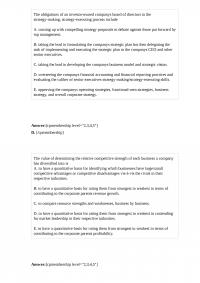
The obligations of an investor-owned companys board of directors in the strategy-making, strategy-executing process include A. coming up with compelling strategy proposals to debate against those put forward by top management. B. taking the lead in formulating the companys strategic […]
CE 37874
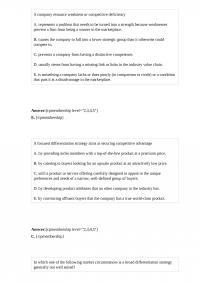
A company resource weakness or competitive deficiency A. represents a problem that needs to be turned into a strength because weaknesses prevent a firm from being a winner in the marketplace. B. causes the company to fall into a lower […]
CE 41818
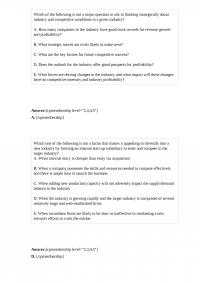
Which of the following is not a major question to ask in thinking strategically about industry and competitive conditions in a given industry? A. How many companies in the industry have good track records for revenue growth and profitability? B. […]
Marketing 15671
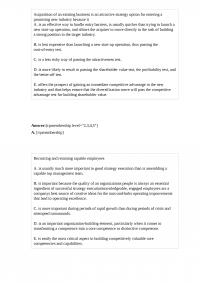
Acquisition of an existing business is an attractive strategy option for entering a promising new industry because it A. is an effective way to hurdle entry barriers, is usually quicker than trying to launch a new start-up operation, and allows […]
MET 65690
Which one of the following is not a reasonable option for deploying a diversified company’s financial resources? A. Making acquisitions to establish positions in new businesses or to complement existing businesses B. Concentrating most of a company’s financial resources in […]
MET 76377
The payoff of good scouting reports on rivals is improved ability to A. predict what strategic moves rivals are likely to make next, thereby allowing a company to prepare defensive countermoves and develop strategies to exploit rivals’ missteps. B. determine […]
MET AD 44374
A company’s competitive strategy should A. be well matched to its internal situation and predicated on leveraging its collection of competitively valuable resources and competencies. B. be aligned toward being at least an average performer within the industry. C. be […]
MET AD 71961
The chief difference between a low-cost leader strategy and a focused low-cost strategy is A. whether the product is strongly differentiated or weakly differentiated from rivals. B. the degree of bargaining power that buyers have. C. the size of the […]
MET AD 86666
Which of the following is not a typical reason for a company to expand into the markets of foreign countries? A. To gain access to new customers B. To strengthen its capability to employ offensive strategies, especially those that involve […]
MGMT 15501
Which one of the following is not a substantive culture-changing action that a company’s managers can undertake to alter a problem culture? A. Promoting individuals who have stepped forward to advocate the shift to a different culture and who can […]
MGMT 66381
It is normal for a companys strategy to end up being A. left unchanged from managements original planned set of actions and business approaches since making on-the-spot changes is too risky. B. a combination of defensive moves to protect the […]
MK 10267
The “driving forces” in an industry A. are usually triggered by changing technology or stronger learning/experience curve effects. B. usually are spawned by growing demand for the product, the outbreak of price-cutting, and big reductions in entry barriers. C. are […]
MT 11949
A companys values concern A. whether and to what extent it intends to operate in an ethical and socially responsible manner. B. how aggressively it will seek to maximize profits and enforce high ethical standards. C. the beliefs and operating […]
MT 12652
The aim of the best-cost provider strategy is to create a competitive advantage by A. incorporating attractive or upscale product attributes at a lower cost than rivals. B. offering buyers the industry’s best-performing product at the best cost and best […]
MT 21578
Which of the following is not a common trait of an unhealthy company culture? A. A politicized internal environment B. Hostility to change and a wariness of people who champion new ways of doing things C. An aversion to looking […]
MT 72478
Which one of the following is not an accurate attribute of an organization’s strategic vision? A. A clearly articulated view of “where we are going” B. Describing the company’s future product-customer-market-technology focus C. Pointing an organization in a particular direction […]
MT 87500
The options for internally performed value chain activities and improve a company’s cost competitiveness include: A. investing in productivity-enhancing, cost-saving technological improvements. B. outsourcing internally performed activities to those able to perform the activities at a lower cost. C. implementing […]