Archives
978-0078112638 Chapter 10 Lecture Note
Chapter 10 – Organizational Design and Control CHAPTER 10 Organizational Design and Control Learning Objectives LO10-1 Explain why the design of organizational structure is important to international companies. LO10-2 Discuss the organizational dimensions that must be considered when selecting organizational […]
978-0078112638 Chapter 11 Lecture Note
Chapter 11 – Global Leadership Issues and Practices CHAPTER 11 Global Leadership Issues and Practices Learning Objectives LO11-1 Discuss the importance of creating a company “global mindset.” LO11-2 Describe what distinguishes the practice of global leadership from its domestic counterpart. […]
978-0078112638 Chapter 12 Lecture Note
Chapter 12 – Assessing International Markets CHAPTER 12 Assessing International Markets Learning Objectives LO1 Discuss environmental analysis and two types of market screening. LO2 Explain market indicators and market factors. LO3 Describe some statistical techniques for estimating market demand and […]
978-0078112638 Chapter 12 Solution Manual
Chapter 12 – Assessing International Markets Answers to Questions 1. Select a country and a product that you believe your firm can market there. Make a list of the sources of information you will use for each screening. Sources are […]
978-0078112638 Chapter 13 Lecture Note
Chapter 13 – Entry Modes CHAPTER 13 Entry Modes Learning Objectives LO 13-1 Explain the pros and cons of entering markets as a “market pioneer” versus being a “fast follower.” LO 13-2 Explain the international market entry methods. LO 13-3 […]
978-0078112638 Chapter 14 Lecture Note
Chapter 14 – Export and Import Practices CHAPTER 14 Export and Import Practices Learning Objectives LO14-1 identify the sources of export counseling and support LO14-2 discuss the meaning of the various terms of sale known as Incoterms LO14-3 identify some […]
978-0078112638 Chapter 15 Lecture Note
Chapter 15 – Marketing Internationally CHAPTER 15 Marketing Internationally Learning Objectives LO15-1 explain why there are differences between domestic and international marketing LO15-2 discuss why international marketing managers may wish to standardize the marketing mix LO15-3 explain why it is […]
978-0078112638 Chapter 15 Solution Manual
Chapter 15 – Marketing Internationally Answers to Questions 1. Louis Vitton CEO Yves Carcelle says, “One to two thousand people is all you need. You can’t judge by average income-average doesn’t mean anything.” Although he was speaking about the luxury […]
978-0078112638 Chapter 16 Lecture Note
Chapter 16 – Global Operations and Supply Chain Management CHAPTER 16 Global Operations and Supply Chain Management Learning Objectives LO 16-1 Understand the concept of supply chain management. LO 16-2 Recognize the relationship between design and supply chain management. LO […]
978-0078112638 Chapter 17 Lecture Note
Chapter 17 – Managing Human Resources in an International Context CHAPTER 17 Managing Human Resources in an International Context Learning Objectives LO 17-1 Discuss several of the major factors that may affect the quantity and quality of labor in a […]
978-0078112638 Chapter 17 Solution Manual
Chapter 17 – Managing Human Resources in an International Context Answers to End of Chapter Questions 1. Why is the average age of the population increasing in some nations, particularly the developed countries? What are some of the implications of […]
978-0078112638 Chapter 18 Lecture Note
Chapter 18 – International Accounting and Financial Management CHAPTER 18 International Accounting and Financial Management Learning Objectives LO18-1 Identify the major international accounting issues that international firms face, operating in foreign currencies. LO18-2 Describe the relationship between accounting and culture […]
978-0078112638 Chapter 3 Lecture Note
CHAPTER 3 International Institutions from an International Business Perspective Learning Objectives LO3-1 Explain the importance of international institutions to business decision makers and their firms. LO3-2 Describe the various types of institutions, drawing on institutional theory. LO3-3 Outline the United […]
978-0078112638 Chapter 6 Lecture Note
CHAPTER 6 Political and Trade Forces Learning Objectives LO 6-1 Discuss nationalization and privatization of business. LO 6-2 Explain what terrorism is and the range of activities that terrorists can engage in, as well as countermeasures that companies and their […]
978-0078112638 Chapter 8 Lecture Note
Chapter 08 – The International Monetary System and Financial Forces CHAPTER 8 The International Monetary System and Financial Forces Learning Objectives LO8-1 Describe the international monetary system’s evolution LO8-2 Explain the Trin paradox LO8-3 Describe the oating currency exchange rate […]
978-0078112638 Chapter 9 Lecture Note
Chapter 9 – International Competitive Strategy CHAPTER 9 International Competitive Strategy Learning Objectives LO 9-1 Explain international strategy, competencies, and international competitive advantage. LO 9-2 Describe the steps in the global strategic planning process. LO 9-3 Explain the purpose of […]
BUS 27180
Every importer should know how the U.S. Customs calculates import duties and know the importance of the product classification. Foreign direct investment may be an attempt by foreign companies to establish competitive advantage over potential competitors in other markets, due […]
BUS 33565
While indirect production-oriented goods have been the focus of management attention for many years, the purchasing of goods and services that are part of finished goods— termed indirect procurement—is also critical. The following is an area in which the UN […]
BUS 51336
If a Chinese worker earns $1 a day, then goods produced by this worker will cost less than the same goods produced by an American earning $18 an hour. No worldwide court has the power to enforce its decrees. TRUE […]
BUS 55913
Acceptable leadership traits across cultures, according to Project GLOBE, include: A. directive, not afraid of criticizing others, and direct. B. planning, able to stick to schedule, and able to stay within budget. C. effective bargainer, dependable, win-win problem solver, and […]
BUS 70463
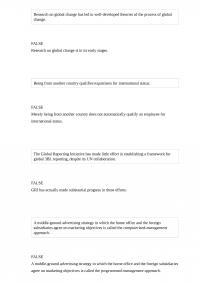
Research on global change has led to well-developed theories of the process of global change. Being from another country qualifies expatriates for international status. FALSE Merely being from another country does not automatically qualify an employee for international status. The […]
BUS 89980
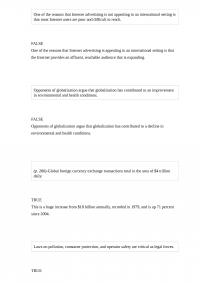
One of the reasons that Internet advertising is not appealing in an international setting is that most Internet users are poor and difficult to reach. Opponents of globalization argue that globalization has contributed to an improvement in environmental and health […]
BUS 90159
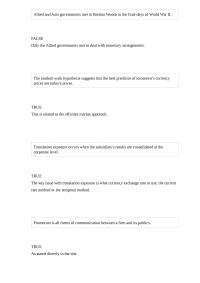
Allied and Axis governments met in Bretton Woods in the final days of World War II. The random walk hypothesis suggests that the best predictor of tomorrow’s currency prices are today’s prices. TRUE This is related to the efficient market […]
ECO 16919
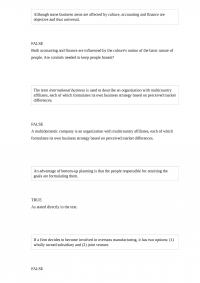
Although some business areas are affected by culture, accounting and finance are objective and thus universal. The term international business is used to describe an organization with multicountry affiliates, each of which formulates its own business strategy based on perceived […]
ECO 26170
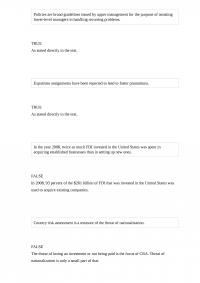
Policies are broad guidelines issued by upper management for the purpose of assisting lower-level managers in handling recurring problems. Expatriate assignments have been reported to lead to faster promotions. TRUE As stated directly in the text. In the year 2008, […]
ECO 35973
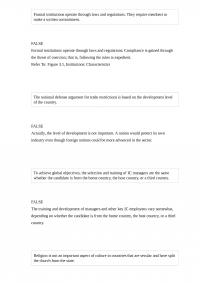
Formal institutions operate through laws and regulations. They require members to make a written commitment. The national defense argument for trade restrictions is based on the development level of the country. FALSE Actually, the level of development is not important. […]
ECO 46567
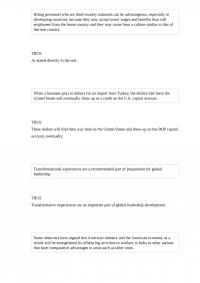
Hiring personnel who are third-country nationals can be advantageous, especially in developing countries, because they may accept lower wages and benefits than will employees from the home country and they may come from a culture similar to that of the […]
ECO 56303
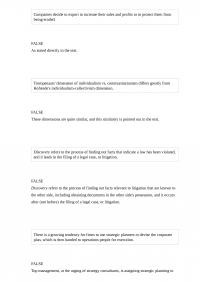
Companies decide to export to increase their sales and profits or to protect them from being eroded. Trompenaars’ dimension of individualism vs. communitarianism differs greatly from Hofstede’s individualism-collectivism dimension. FALSE These dimensions are quite similar, and this similarity is pointed […]
ECO 86890
A nation’s relative ability to design, produce, distribute, or service products within an international trading context, while earning increasing returns on its resources, is known as national competitiveness. Country and segment are units of analysis for market screening. TRUE As […]
ECON 66253
Hall’s high and low context is based upon communication styles and specifically on the role of: A. the speakers. B. nonverbal behavior. C. the medium. D. context. Reliance on subsidiary management can depend on items such as: A. two of […]
ECON 71423
The Alien Tort Statute allows foreigners to: A. sue in U.S. courts for residency in the United States. B. file claims in U.S. courts for violations of international law that may have occurred beyond U.S. borders. C. file claims in […]
ECON 76728
Importing and foreign direct investment are two approaches to meeting overseas demand. There is a trend toward treating third-country nationals the same as home-country expatriates in terms of their compensation plans. TRUE As stated directly in the text. Direct exporting […]
ECON 76936
Because inventory is carried at each stage in the supply chain, and because inventory ties up money, it has been argued that the ultimate goal of effective supply chain management systems is to reduce inventory. Estimation by analogy is an […]

ECON 78316
The international environment is composed of all the uncontrollable forces that surround and influence the firm’s life and development. In a DAP (delivered at named place), the seller assumes risk when the goods leave the seller’s factory or warehouse. FALSE […]
MGMT 34353
CFR (cost and freight, foreign port) is similar to CIF except that the buyer purchases the insurance because it can obtain it at lower cost or because its government, to save foreign exchange, insists that it use a local insurance […]
MGMT 40296
The export marketing plan is essentially the same as the domestic marketing plan. Geographical proximity is rarely a major reason for trade. FALSE To the contrary, geographical proximity often explains trade relationships. The GLED model suggests that there are some […]
MGMT 54446
Teams with strong heartbeats may meet less regularly than at their launch and during crisis. In designing an international organization, it is essential that the structures and systems being implemented are consistent not merely with each other but also with […]
MGMT 87004
Knowing the number of imports to a specific country provides a firm with a complete measure of market potential. In high-context cultures, people tend to form long-lasting relationships that endure over time. TRUE In contrast, LC cultures tend to have […]
MGT 11025
New exporters always come to the process with a carefully developed marketing strategy. Outsourcing is the relocation of some or all of a business’s activities or processes to a foreign location. FALSE Offshoring is the relocation of some or all […]
MGT 18271
The UN Environment Programme laid the groundwork for the Climate Change Convention, which led to the Kyoto Protocol. Export pricing and sales agreements for foreign representatives are part of the marketing mix. TRUE As stated directly in the text. In […]
MGT 25680
The degree to which a country’s legal system is based on the rule of law makes no difference; it is personal relationships that matter in foreign environments. In 2009, the top 10 exporting and importing nations collectively accounted for over […]
MGT 59415
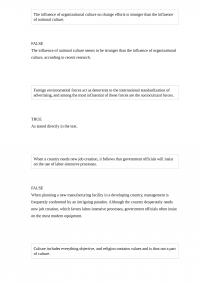
The influence of organizational culture on change efforts is stronger than the influence of national culture. Foreign environmental forces act as deterrents to the international standardization of advertising, and among the most influential of these forces are the sociocultural forces. […]
MGT 78699
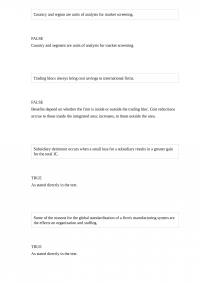
Country and region are units of analysis for market screening. Trading blocs always bring cost savings to international firms. FALSE Benefits depend on whether the firm is inside or outside the trading bloc. Cost reductions accrue to those inside the […]