Archives
978-0077861421 Chapter 1
1 Chapter 1: The American Legal System Chapter 1 The American Legal System This chapter introduces students to the law and the legal system in the United States. The material in this chapter may be redundant for students who have […]
978-0077861421 Chapter 10
1 Chapter 10: Protection of News Source/Contempt Power Chapter 10 Protection of News Sources/Contempt Power This chapter focuses on both constitutional and statutory protection of news sources and journalistic materials, and the law relating to contempt. It also addresses the […]
978-0077861421 Chapter 11 &12
1 Chapters 11 and 12: Free Press–Fair Trial Chapters 11 and 12 Free Press–Fair Trial Instructors should know that there are several additions to chapters 11 and 12. While much of the law has not changed, and these chapters have […]
978-0077861421 Chapter 13
1 Chapter 13: Regulation of Obscene and Other Erotic Material Chapter 13 Regulation of Obscene and Other Erotic Material What’s the Big Picture for Chapter 13? Chapter 13 tends to be extremely popular with most students. It has broad appeal […]
978-0077861421 Chapter 14
1 Chapter 14: Copyright and Trademark Copyright © 2018 McGraw-Hill Education. All rights reserved. No reproduction or distribution without the prior written consent of McGraw-Hill Education. Chapter 14 Copyright and Trademark Many students find copyright and trademark to be the […]
978-0077861421 Chapter 15
1 Chapter 15: Regulation of Advertising Chapter 15 Regulation of Advertising What’s The Big Picture for Chapter 15? Chapter 15 is one of those chapters that are necessary for students who are advertising majors, public relations majors, or marketing majors […]
978-0077861421 Chapter 16
1 Chapter 16: Telecommunications Regulation Chapter 16 Telecommunications Regulation The tension in Chapter 16 is between telling the story of what was and telling the story of what is. In other areas of the law, when precedent becomes outdated and […]
978-0077861421 Chapter 2 & 3
1 Chapters 2 and 3: The First Amendment Chapters 2 and 3 The First Amendment What’s the Big Picture for Chapter 2? Like Chapter 1, Chapter 2 is also an essential, foundational chapter. It introduces students to the notion of […]
978-0077861421 Chapter 4,5 & 6
1 Chapters 4, 5, and 6: Libel Chapters 4, 5, and 6 Libel Defamation remains the most tortuous topic in mass media law. The law is dense with scores of ifs, ands, or buts scattered through the legal landscape. It […]
978-0077861421 Chapter 7 & 8
1 Chapters 7 and 8: Invasion of Privacy Chapters 7 and 8 Invasion of Privacy What’s the Big Picture for Chapters 7 and 8? Chapters 7 and 8 concentrate on four distinct privacy torts. A tort is a civil cause […]
978-0077861421 Chapter 9
1 Chapter 9: Gathering Information Chapter 9 Gathering Information The flow of information between the government and the people is critical in a democracy like the United States, and the press plays an important role in this information flow. Recent […]
978-0077861421 Test Bank Chapter 1
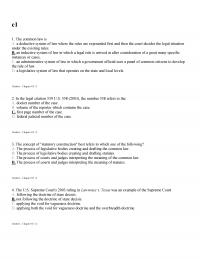
c1 1. The common law is 2. In the legal citation 539 U.S. 558 (2003), the number 558 refers to the: A. docket number of the case. B. volume of the reporter which contains the case. C. first page number […]
978-0077861421 Test Bank Chapter 10
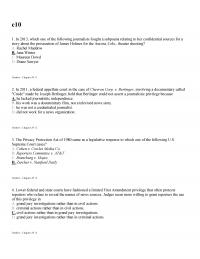
c10 1. In 2013, which one of the following journalists fought a subpoena relating to her confidential sources for a story about the prosecution of James Holmes for the Aurora, Colo., theater shooting? 2. In 2011, a federal appellate court […]
978-0077861421 Test Bank Chapter 11
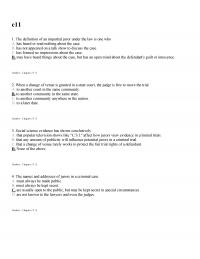
c11 1. The definition of an impartial juror under the law is one who 2. When a change of venue is granted in a state court, the judge is free to move the trial A. to another court in the […]
978-0077861421 Test Bank Chapter 12
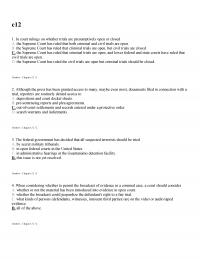
c12 1. In court rulings on whether trials are presumptively open or closed 2. Although the press has been granted access to many, maybe even most, documents filed in connection with a trial, reporters are routinely denied access to A. […]
978-0077861421 Test Bank Chapter 13
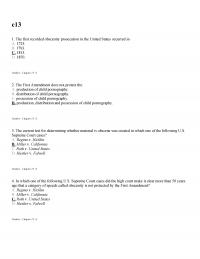
c13 1. The first recorded obscenity prosecution in the United States occurred in 2. The First Amendment does not protect the: A. production of child pornography. B. distribution of child pornography. C. possession of child pornography. D. production, distribution and […]
978-0077861421 Test Bank Chapter 14
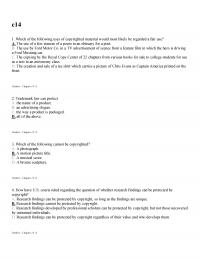
c14 2. Trademark law can protect A. the name of a product. B. an advertising slogan. C. the way a product is packaged. D. all of the above. Pember – Chapter 14 #2 3. Which of the following cannot be […]
978-0077861421 Test Bank Chapter 15
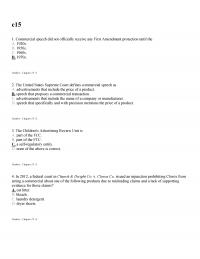
c15 1. Commercial speech did not officially receive any First Amendment protection until the 2. The United States Supreme Court defines commercial speech as A. advertisements that include the price of a product. B. speech that proposes a commercial transaction. […]
978-0077861421 Test Bank Chapter 16
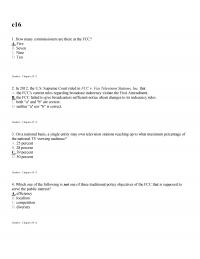
c16 1. How many commissioners are there at the FCC? 2. In 2012, the U.S. Supreme Court ruled in FCC v. Fox Television Stations, Inc. that A. the FCC’s current rules regarding broadcast indecency violate the First Amendment. B. the […]
978-0077861421 Test Bank Chapter 2
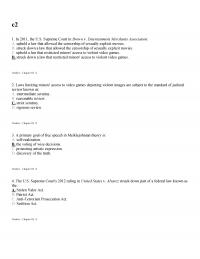
c2 1. In 2011, the U.S. Supreme Court in Brown v. Entertainment Merchants Association: 2. Laws limiting minors’ access to video games depicting violent images are subject to the standard of judicial review known as: A. intermediate scrutiny. B. reasonable […]
978-0077861421 Test Bank Chapter 3
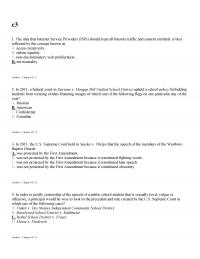
c3 1. The idea that Internet Service Providers (ISPs) should treat all Internet traffic and content similarly is best reflected by the concept known as 2. In 2011, a federal court in Dariano v. Morgan Hill Unified School District upheld […]
978-0077861421 Test Bank Chapter 4
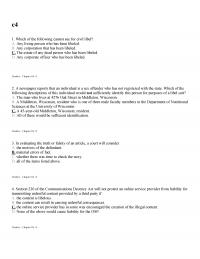
c4 1. Which of the following cannot sue for civil libel? 2. A newspaper reports that an individual is a sex offender who has not registered with the state. Which of the following descriptions of this individual would not sufficiently […]
978-0077861421 Test Bank Chapter 5
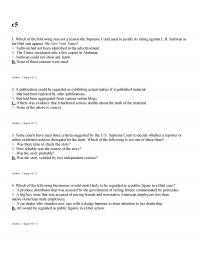
c5 1. Which of the following was not a reason the Supreme Court used to justify its ruling against L.B. Sullivan in his libel suit against The New York Times? 2. A publication could be regarded as exhibiting actual malice […]
978-0077861421 Test Bank Chapter 6
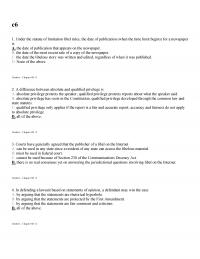
c6 1. Under the statute of limitation libel rules, the date of publication (when the time limit begins) for a newspaper is 2. A difference between absolute and qualified privilege is A. absolute privilege protects the speaker; qualified privilege protects […]
978-0077861421 Test Bank Chapter 7
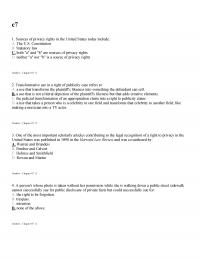
c7 1. Sources of privacy rights in the United States today include: 2. Transformative use in a right of publicity case refers to A. a use that transforms the plaintiff’s likeness into something the defendant can sell. B. a use […]
978-0077861421 Test Bank Chapter 8
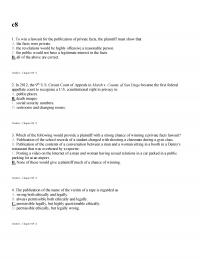
c8 1. To win a lawsuit for the publication of private facts, the plaintiff must show that 2. In 2012, the 9th U.S. Circuit Court of Appeals in Marsh v. County of San Diego became the first federal appellate court […]
978-0077861421 Test Bank Chapter 9
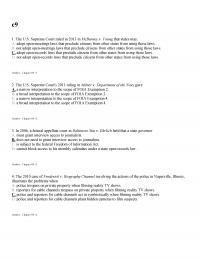
c9 1. The U.S. Supreme Court ruled in 2013 in McBurney v. Young that states may: 2. The U.S. Supreme Court’s 2011 ruling in Milner v. Department of the Navy gave A. a narrow interpretation to the scope of FOIA […]