
1
Introduction
Choices & Connections: An Introduction to Communication presents a sound starting point for
planning and developing your introduction to communication course. The textbook is rooted in
three expressed purposes. First, it prompts students to understand that the communication
choices they make are connected to the outcomes that follow. With this recognition, students
can begin to be self-reflective about their communication knowledge and abilities. Second, the
textbook aims to show students how different types of communication are connected in
fundamental ways. When students see how their critical self-reflection skills can help them
manage their speech anxiety or how perception-checking can help them handle conflicts in
To help you translate the approach of Choices & Connections into a meaningful learning
experience for your students, this Instructor’s Resource Manual (IRM) provides suggestions
and advice to get the most out of the text. Rather than being prescriptive, the IRM poses ideas
about thoughtful course and lesson design. Rather than being restrictive, it jump-starts
possibilities for using Choices & Connections in a way that is consistent with your teaching
philosophy and style. Because the pedagogical features found within the text are sufficient for

2
course design is ultimately centered on identified student learning outcomes. Ultimately, this
manual is a tool for thinking about how to attain your identified learning outcomes.
The manual is divided into two parts. Part I overviews a philosophy of teaching the
introductory communication course, covers basic course design principles, and focuses on
strategies for promoting effective student learning. Part II is a chapter-by-chapter guide to
planning student learning in your course. Every chapter includes the following:
• Chapter Outcomes
• Chapter Outline
ESTABLISHING COURSE GOALS AND OBJECTIVES
Even though an institution establishes course content parameters through its curriculum
process, specific course goals and objectives are often left to the discretion of the instructor.
Effective course design begins with deciding what your course goals and objectives will be and
what pedagogical methods you will pursue to achieve these learning outcomes. The structure
of Choices & Connections is sufficiently comprehensive to afford you flexibility in making
decisions about course goals and objectives and choosing pedagogical methods.
Specifically, the textbook emphasizes the building blocks of communication theory, skill
development, and skill implementation. By introducing students to communication theory, the
text provides students with the basis for understanding and managing their communication

skills. Students who grasp the fundamentals of social penetration theory, for instance, are
better prepared to appreciate the need for self–disclosure skills or small group skills. Students’
understanding of how communication works is fundamental to becoming more aware and
ESTABLISHING A TEACHING PHILOSOPHY
The structure of Choices & Connections allows you to frame a teaching philosophy for your
course that is either largely theoretical, primarily skill based, or a blending of theory and skill
development. However, a multitude of factors may influence the philosophical underpinnings
of your course.

philosophical adaptation to the program requirements, which typically have a heavy skills-
development emphasis.
Finally, a factor strongly influencing your philosophical stance would be your own training
and habits. It is important to openly consider your assumptions and biases about the
ACHIEVING COURSE GOALS AND OBJECTIVES
Your philosophical approach to teaching the introductory communication course is achieved
through pedagogy and the evaluation of student learning. If your teaching philosophy, methods,
and evaluation are misaligned, you may attain mixed results in achieving your course goals. For
example, an instructor could claim that skill development is the overall outcome of the course,
INSTRUCTIONAL METHODS
Approaches to teaching can be located on a continuum of learner engagement, from passive
involvement to active engagement of the learner. A detailed discussion of commonly used
instructional methods appears later in the section “Developing the Learning Experience.” A
couple of things are worth emphasizing at this point, however.

5
First, the lecture approach is sometimes thought of as a second-rate teaching method that
fails to actively involve learners. However, the classroom lecture remains an efficient means of
delivering instruction, particularly in classes exceeding 25 students. Moreover, a good lecturer
employing simple strategies of engagement (provocative questions, enticing visual aids,
interesting media clips, humor, and intermittent discussions and activities) can successfully
methods. You will find that some methods are more conducive to meeting particular course
objectives than others. For example, lecture and reading may be effective for imparting
communication principles and concepts. On the other hand, skill development through
individual and collaborative group work with guided feedback will work better for developing
and implementing new communication skills.
Second, if your primary learning objective is to maximize skill development, you may want
to explore the concept of a flipped classroom, which allows you to assign some lecture
materials online as homework; this, in turn, frees up class time for discussion, group activities,
and the delivery of speeches. Educational literature (and now conventional wisdom) is replete
EVALUATING STUDENT LEARNING
In addition to using instructional methods that support your course philosophy, you should
choose tools for evaluating student learning and assigning grades that are consistent with your
course goals and objectives. Four tools for evaluating student learning are common in teaching

the introductory communication course: examinations, written theme assignments, reflective
assignments, and skill assessments.
Examinations
Traditionally, written examinations are a staple of college and university teaching. By the time
students get to college, they are highly familiar with testing as a means of measuring learning.
Brief tests, such as pop quizzes and planned chapter tests, can be an effective means of
ensuring student reading and assessing their understanding of what they have read. You can
develop tests using multiple-choice, true/false, matching, and fill-in-the-blank questions that
assess various levels of understanding. These require little time in grading, and the payoff in
Quite often, instructors choose to give more extensive examinations covering several
chapters. These tests may have some of the same types of questions used in brief tests, they
may be essay based, or they may be a combination. Also, these tests may evaluate higher
levels of learning such as analysis, evaluation, application, and integration of course concepts.
Doyle (2008) claims that an effective practice promoting deep student learning is the use of
cumulative examinations. This manner of testing requires you to identify foundational

many students report anxiety related to taking tests, or they simply have poor test–taking skills.
In either case, many institutions provide workshops, one–on-one tutorials, and additional
information to help students effectively cope with these problems and become better test
takers. You can usually find these resources in learning support labs or centers, student
counseling services, student life offices, or online. As an instructor, you can reduce test anxiety
seating arrangement, the placement of all personal items (including cell phones) in a peripheral
location, and the reordering of the first few test questions so that students who look to their
neighbor for help may see what they believe to be a completely different test!
The third drawback relates to the difficulty of writing valid and reliable exam questions. A
useful practice is to write exam questions as part of the lesson-planning process. This increases

8
Many textbooks, including Choices & Connections, provide test banks that include a variety
of question types (multiple-choice, matching, true/false, short answer, and essay questions) for
every chapter. The test banks can be used as testing material or as a jumping-off point for
writing your own test questions.
Written Theme Assignments
Having students write about course concepts in the form of theme assignments is another
common means of evaluating student learning and assigning grades. Writing is a powerful way
to engage students individually or collaboratively in the learning process. Written theme
assignments can range from a brief reaction to a classroom exercise to a multiple-page
personal essay or research paper. The pedagogical features of Choices & Connections offer a
great deal of help in developing written theme assignments. Consider, for example, the “How
to Communicate” and “Making Communication Choices” features found in each chapter. The
Furthermore, a clear explanation of how the assignment will be graded should be given to
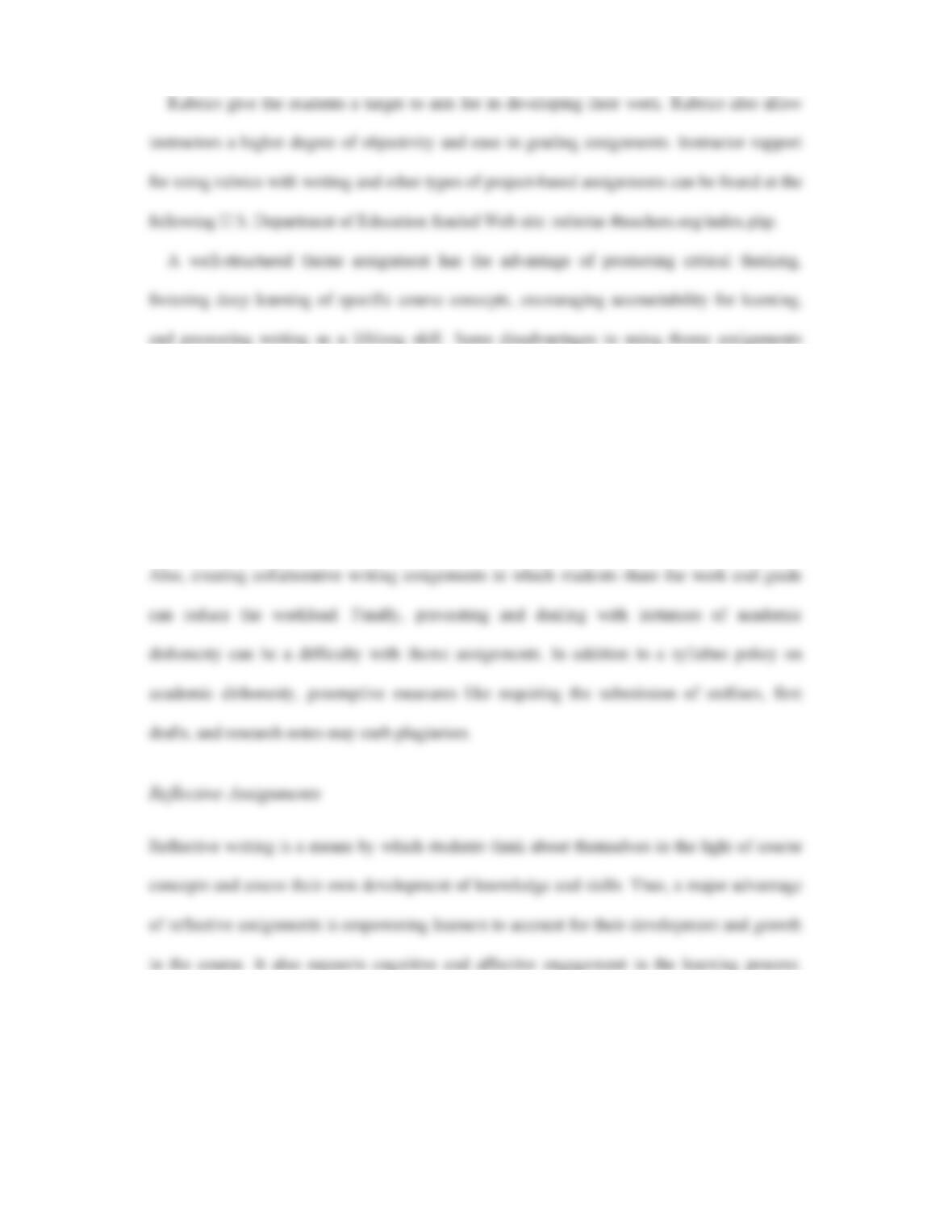
students in advance. Rubrics are effective tools for managing written assignments. Although
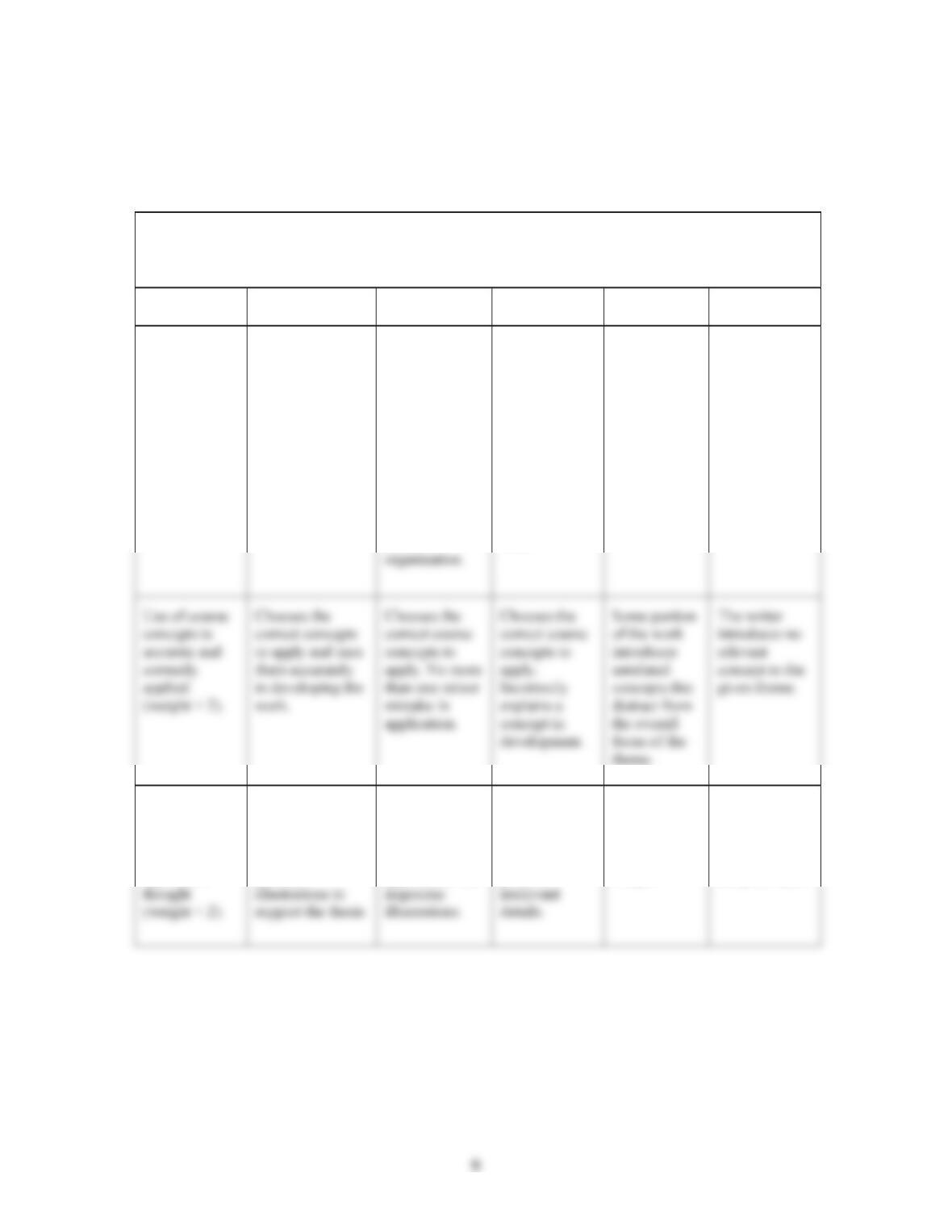
the development of a good rubric can require a great deal of work on the front end, it is time
well invested. Here is an example of a rubric for grading a brief theme assignment:
Theme Assignment Rubric
25 possible points
Criteria
5 = Excellent
4 = Good
3.5 = Average
3 = Fair
2.5 = Poor
Writing and its
presentation
represent
college
–
level
work
.
Well–focused and
developed ideas.
Appearance,
spelling,
grammar, and
organization are
sound.
Overall
strengths
outweigh the
weaknesses.
Some
improvements
are needed in
terms of
appearance,
spelling,
grammar,
and/or
Several
improvements
with respect to
appearance,
spelling,
grammar,
and/or
organization
are required as
a means of
clarifying the
work.
Need for
revision
outweighs the
strengths.
Some portion
hints at what
the writer has
in mind.
Lacks a real
focus or
theme.
Mistakes in
spelling,
grammar,
and/or
organization
impede overall
understanding.
The work
reflects
meaningful
and/or
significant
Shows the
connection of
concepts. Uses
appropriate and
precise
Attempts to
connect related
concepts.
Presents
appropriate but
Simply
rephrases and
re
–
illustrates
concepts or
presents
States the
obvious with
no integration
of personal
insight.
Lacks clarity
of focus or
meaning
related to the
assigned topic.
10
include the challenges inherent in responding to the range of students’ writing abilities.
Requiring students to submit a simple, ungraded writing sample within the first week provides
you with an early alert to those students who might be referred to campus writing-assistance
centers when the first graded assignment is given. Another drawback to written themes is the
workload of reading and grading. As mentioned previously, rubrics streamline the workload.
Students have some latitude in addressing their own learning needs and interests in the course,
which is of particular importance to adult learners. Reflective assignments also present
challenges not unlike theme assignments in that they require time and attention in grading if

11
they are to provide students with meaningful feedback about their learning. Students may be
reluctant to explore personal learning challenges and ideas because these will be subject to
review and a grade. Although it is probably unlikely that you will elicit the trust and
confidence of every student in this regard, you can establish a climate of trust and
confidentiality through your classroom conduct and professionalism as well as by explicitly
REFLECTIVE ASSIGNMENT ON MAKING COMMUNICATION CHOICES
The reflective writing assignment will help you in developing your communication skills in
this course. Literature on personal development suggests that reflective writing about yourself
and your experiences supports the integration of new learning. For this assignment, you will
write a brief paper based on these guidelines:
2. Reflect on your own experiences and identify a similar communication dilemma. Explain
what happened and recall (as best you can) what was said or what messages were sent.
3. Discuss how the skills mentioned in “Making Communication Choices” could have altered
the communication outcome or your relationships.
REQUIREMENTS
• Reflective assignments should be typed, double-spaced.
“B” response—Above expectations
• Response meets all assignment requirements.
• Most of the response probes beneath the surface in addressing questions and analyzing
experience.
• Most of the response shows reflective thought and judgment about self; response could have

“D” and “F” responses—Below expectations
• One or more assignment requirements are not met.
• Routine, unreflective discussion of questions and experiences.
• Use of course concepts is mostly inaccurate.
• Appearance, spelling, grammar, and/or organization impede understanding of the work.
Skill Assessments
Perhaps the least frequently used means of evaluating student learning and assigning grades is
through skill assessments. Skill assessments require students either to produce a written
response to a given prompt or to verbally work through a role-play scenario, dyadic interview,
or simulation. The assessments provide instructors with an opportunity to observe and give
Skill assessments provide direct insight into how well students have attained given skills, at
least within the test condition. They are also the primary means of evaluating student learning in
any course whose objective is skill development. One disadvantage of skill assessments is the
lack of authenticity; it is difficult for many students to role-play or to produce skilled responses
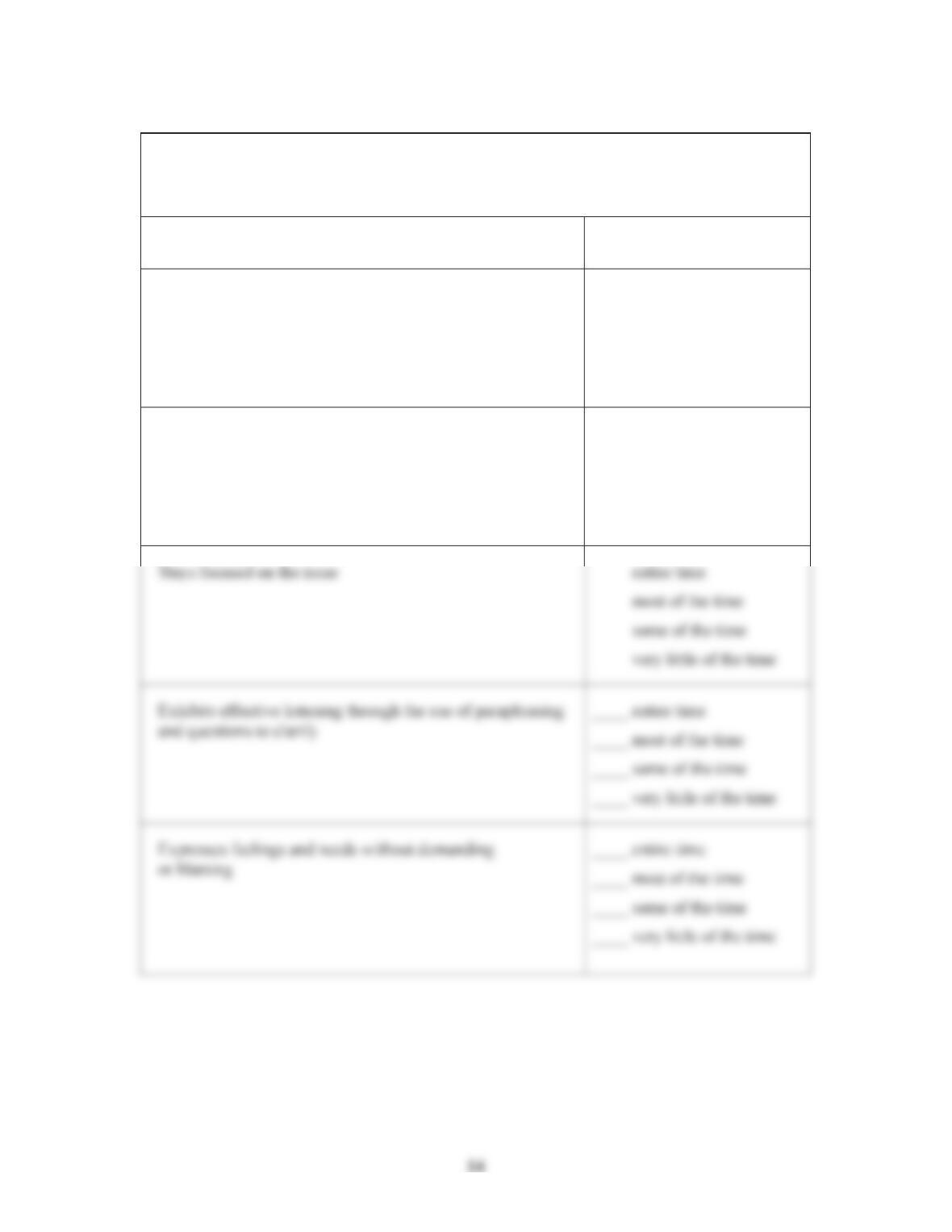
Sample Skills Checklist
Conflict Management
Behaviors
Rating
Nonverbal expressions are open and invite connection
with the other person
____ entire time
____ most of the time
____ some of the time
____ very little of the time
Uses concrete language to name or describe the problem
____ entire time
____ most of the time
____ some of the time
____ very little of the time
____ entire time
____ very little of the time