
28
Developing the Course Structure
CLASSROOM POLICIES
Decisions about classroom policies are driven by two primary factors. First, institutions
typically issue academic policy statements on academic dishonesty, the Americans with
Disabilities Act accommodation provisions, academic grievances, and the like. Familiarize
yourself with all official school and department policies as a means of thinking about and
developing your classroom policies. Your institution or department may require that certain
institutional policy statements be reprinted or referenced in your course syllabus. Absent any
such requirements, it is still a good idea to advise students in writing to read and review all
institutional policies as outlined in the student handbook or catalog.
Although it is difficult to anticipate every classroom scenario that you might face in a given
term, and you don’t want to overlegislate student behavior, there are common matters on
which every instructor needs to develop a policy stance. These include class attendance,
behavioral expectations, grade policies, late assignments and makeup tests, academic
dishonesty, and instructor availability.

29
CLASS ATTENDANCE
Mandating class attendance is fraught with a range of controversial issues. Among the
proponents of a mandatory attendance policy are those who believe that financial resources
(public and private dollars) are wasted when poor class attendance translates to poor academic
achievement. Others argue that class attendance provides students with a lived, quality learning
experience that cannot be duplicated by simply reading the text. A practical argument in favor
of mandating attendance is that it reduces the amount of housekeeping and remedial work that
Philosophical positions on attendance notwithstanding, a detailed attendance policy statement
is important to any syllabus. Questions to consider in developing such a statement are
• Is class attendance voluntary or required?
• What constitutes an absence? When will you take attendance? Does arriving after roll call
mean the student is absent? What about leaving early?
• How are late arrivals and early departures treated?
• Are there excusable absences? What are they? What kind of proof or advance notice needs
to be provided?
• What is the student’s responsibility for picking up missed notes, handouts, and/or
assignments?

30
• What are the exact consequences of absences? How are grades affected? What is the effect,
if any, on continued class enrollment?
• What are the consequences of missing a speech?
• What are the consequences of missing in-class activities?
Finally, how much leeway you give students with class absences depends entirely on the
demographic profile of the class. I have always thought it appropriate to give students a modest
number of opportunities to miss class to attend to the realities of life (i.e., illness,
BEHAVIORAL EXPECTATIONS
All classrooms develop norms that express the range of acceptable behavior in the given
setting. Norms emerge quietly over a short series of interchanges. Say, for example, a student
enters the classroom late, offering no reason or apology for doing so, and the instructor makes
no comment about the action. The next time the class meets, another student—or even the
same student—does the same thing, with still no comment by the instructor. Meanwhile all the
other students (especially the wily ones) are observing what is happening here. Because you’ve
failed to comment or express any displeasure for the lateness, students now perceive a norm of
31
This example demonstrates the need for instructors to make behavioral expectations known
a priori. Behavioral expectations can be presented as a syllabus statement or developed in
Some instructors, because of personal preference or the class’s demographic profile, may
choose to write a behavioral policy without getting input from students. In these cases, a
statement might address behavioral expectations related to the following areas:
• Class attendance and punctuality
• Eating and drinking in class
• Responsibility for class preparation
• Class participation
• Use of cell phones and/or electronic devices
GRADE POLICIES
No area of teaching provides more occasions for dissatisfaction and grief than grading. Much of
this malaise can be avoided by establishing a clear policy regarding how individual assignments

are graded and how final grades for the course are determined. Good grading policy is then
buttressed by conscious efforts to keep students informed about their performance.
As mentioned before, clearly written assignments, including expectations and grading
standards, offer students a blueprint for how to succeed in your course. Written assignment
expectations and the attendant grading standards also serve as a tool for talking with students
about grades. Devoting time to writing and explaining assignment expectations can also preempt
students’ complaints about your expectations or their perception of unfair grading practices.
Moreover, the syllabus should detail the manner by which the final course grade is
determined. Are assignments weighted? Are individual assignments totaled to determine the
final grade? Will some assignments be dropped? What is the point scale or percentage scale for
assigning a final grade? In other words, what is the percentage required to get an A, B, and so
forth, in the course? Students should be able to determine from the course syllabus the basis on

33
LATE ASSIGNMENTS AND MAKEUP TESTS
As with the practical argument for mandating class attendance, there is less housekeeping for
instructors when students turn in assignments and complete tests on time. But life happens, and
there may be legitimate reasons why students are unable to complete assignments on time or
meet test dates. An effective course syllabus will speak to whether (and how) you will
accommodate late assignments and missed tests. Some possible considerations in such a
statement would be
• Provision for a grace period
• Deduction on the assignment or test
• Opportunity to drop the lowest assignment or test grade
ACADEMIC DISHONESTY
Opportunities for student plagiarism and cheating have become increasingly frequent through
insidious uses of technology. Literally hundreds of Web sites offer speeches, term papers, and
essays for purchase. Additionally, instructors began banning cellular telephones during written

34
examinations after they discovered students using them either to take photographs of the exam
or to surreptitiously text-message answers to each other. Interestingly, the academic world has
developed some technological defenses in the form of Turnitin.com and iThenticate.com. Both
are costly yet viable solutions to discouraging plagiarism. Check with your institution to see if
they have an available system in place for your use.
The problem of academic dishonesty arises from many factors. Students often have many
demands on their time, which leads them to wait until the last minute to prepare for tests or
write papers. The pressure may lead them to make poor decisions that include cheating or
Curbing academic dishonesty can be accomplished in at least four ways. First, develop a
syllabus statement on academic dishonesty that references your institution’s policy. Your
statement can further delineate examples of dishonesty that are relevant to your particular
course. You should clearly state the consequences of cheating and plagiarism. To ensure that
all students understand the policy, it is best to discuss the consequences with them early in the
term, as many students do not read the syllabus thoroughly. Second, anticipate the
opportunities students might take to be dishonest in their academic work. When administering
a test, attend to the room setup, and monitor conditions that may allow cheating (i.e., bathroom

35
INSTRUCTOR AVAILABILITY
Another important policy issue is to formally account for your availability to students. Your
syllabus should state your office hours, telephone number, and e-mail address. Depending on
your faculty assignment status, you may not be required to maintain formal office hours; but
nevertheless, it is good practice to give students clear direction on how they can meet with you
outside of class should the need arise. At least one telephone number for reaching you should
be in the syllabus. You will need to decide if you will share your cell-phone number on your
syllabus. You may find that this is the simplest way to manage contact with students. However,
if you do decide to share your cell-phone number, be clear about the times that you will accept
calls and texts. Otherwise, students may expect immediate responses at all hours of the day and
night. Some institutions may require that a department telephone number be included as well

36
POSITIVE LEARNING ENVIRONMENTS
Students learn best in classroom environments that have clear structure, provide meaningful
engagement, and are relatively safe. Ambiguous and stressful conditions cause people to shut
down. Although you may not be able to control everything that contributes to a positive
learning environment, there are four variables over which you can exercise some control.
These variables are the first class, the course syllabus, your professional manner, and a class
behavior contract.
THE FIRST CLASS
First impressions have a major impact on student attitudes and responses to the course. It is
important that your first meeting provide students an opportunity to engage with you and each
other; to engage with the course material in some small meaningful way; and finally, to learn
about the course requirements. Your primary objective in your first class should be to reduce
student uncertainty about the course.
A simple getting-acquainted activity can be used to break the ice and begin the process of
building the trust and rapport that are critical to effective learning environments. Several print
and Web resources exist with ideas on getting acquainted and icebreaker activities to engage

37
respond. This does not have to take up more than 10 to 20 minutes, but it will send a message
to students that your course will engage them in learning.
Highlighting the course syllabus is another important part of your first class. This first
meeting can convince a student to remain in the class or to drop it, and the decision can depend
on the student’s assessment of the course requirements. Although it is unnecessary and
ROLE OF THE SYLLABUS
A recurring theme in the “Classroom Policies” section previously is the importance of the
syllabus in setting a tone for the course, establishing your expectations, and preempting
problems. It bears repeating that your syllabus should address any academic matter that might
become a concern (i.e., attendance, late papers, speech requirements, and behavior
expectations).
Once the syllabus is distributed, two things are vital to ensuring that it supports a positive
learning environment. First, only with good reason should changes be made in the syllabus.
38
INSTRUCTOR’S PROFESSIONALISM
The professionalism that you bring to the classroom establishes a tone that supports a positive
learning environment for students. Aside from how you manage the first class meeting and the
content of your syllabus, there is an array of attitudes and behaviors that you enact in the
classroom that model effective habits of learning and civility. Some of these habits include
• Starting class on time
• Being prepared for class
• Using humor and language in an appropriate way
• Learning and using student names
• Being clear about lesson objectives and staying on task
• Returning student work in a timely manner
• Indicating your availability

39
THE CLASS CONTRACT
Some instructors may find it useful to spend the first few class periods establishing a contract
to govern classroom behavior. Creating a contract with students can be a messy process,
requiring great skill at group facilitation. The payoff is that you increase the likelihood of the
class abiding by the rules of acceptable classroom behavior and the sanctions for aberrant
behavior. Classes of primarily adult learners are especially amenable to contracts.
Although there are a number of ways of establishing a class contract, here is a fairly
straightforward method:
1. Divide the class into small groups and have each group brainstorm a list of student and
3. Collate the culled “top five” lists from each small group and present them to the entire
class for further discussion and voting (majority rule or two-thirds majority).
5. Finally, photocopy the approved contract and distribute it for each student to sign.
An interesting phenomenon of developing a class contract is that the group discussion can
have a powerful effect on group bonding. As a result, the class may assume responsibility for
monitoring and responding to contract violations with little direction required from you. It is
likely that all you may have to do is occasionally review the contract prior to the start of class
sessions.
SAMPLE COURSE SYLLABUS AND COURSE OUTLINES

40
How you choose to organize your teaching of the chapters of Choices & Connections will
depend on your teaching philosophy and your course learning objectives. The following pages
SAMPLE COURSE SYLLABUS
Instructor Contact Information
Name
Office location
Conference hours
Telephone
E-mail
41
Course Description
This Introduction to Communication course will explore and examine human communication
in a variety of contexts including interpersonal relationships, small groups, intercultural
contexts, and public speaking. Emphasis will be placed on acquiring the knowledge necessary
to identify communicative events in your own lives, evaluate them, and respond in appropriate
and effective ways.
LEARNING OUTCOMES
The student will be able to
• Understand the components of the communication process.
• Express how self-perception leads to effective communication.
• Demonstrate respect for the opinions of others and cultural differences.
• Analyze and utilize nonverbal aspects of communication.
• Understand and demonstrate effective listening skills.
A POSITIVE LEARNING ENVIRONMENT
Successful learning experiences take place best in settings that are safe and respectful. Students
should feel free to discuss and ask questions without fear of consequence from the instructor or
other students. Additionally, positive learning environments are fostered when students are
42
thoughtful, prepared for each class, and behave in ways that a reasonable person would judge
as civil, ethical, and cooperative.
As your instructor, I will maintain a commitment to a positive learning environment by
ATTENDANCE
Attendance is extremely important. Research on student success shows that class attendance,
participation in discussions, forming relationships with other students, and getting acquainted
with instructors are all positively associated with the successful completion of college courses.
This course has many skill-based activities to provide you an opportunity to develop your
ASSIGNMENTS
I encourage you to start assignments early and to seek assistance if you need it.
All late written work will be discounted 20 percent of the point total. A 24-hour grace
period will be given on request. Some homework will be checked in class, and these
assignments can only be credited during the class period. All in-class activities and
presentations are due on the assigned date. Some in-class activities will be unannounced;
43
therefore, attendance is pertinent. If you are not present, you will not be eligible for makeup
points on these assignments without prior permission.
What follows is a brief description of the graded assignments for this course. I will allow
ample time to answer questions as we approach each assignment. In the meantime, here’s a
glimpse of how you’ll be graded:
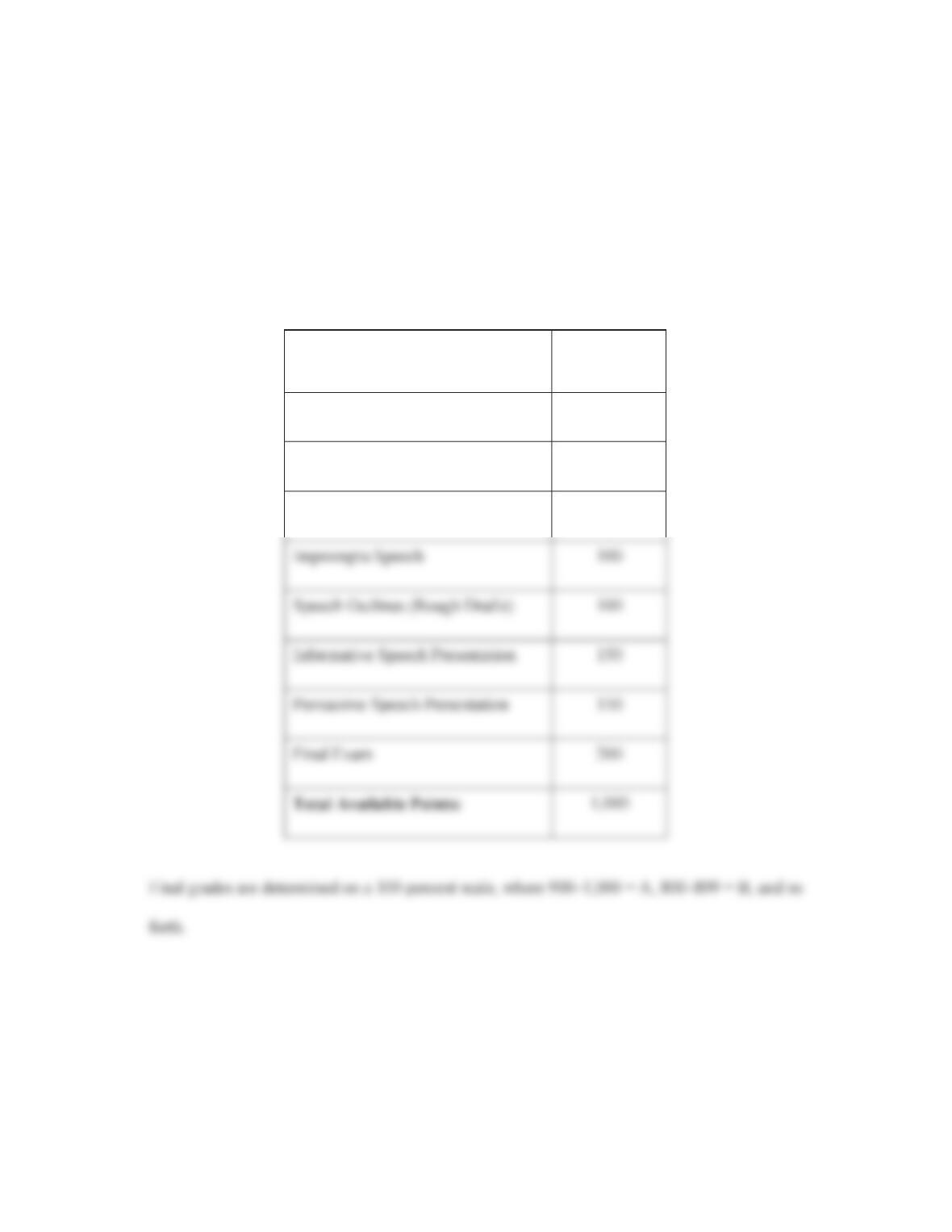
Assignments
Total Points
In-Class Activities (25 points each)
125
Introduction Speech
75
Midterm Exam
100
Note: The instructor reserves the right to make changes in the course policies, assignments,
and/or schedule as needed.
100
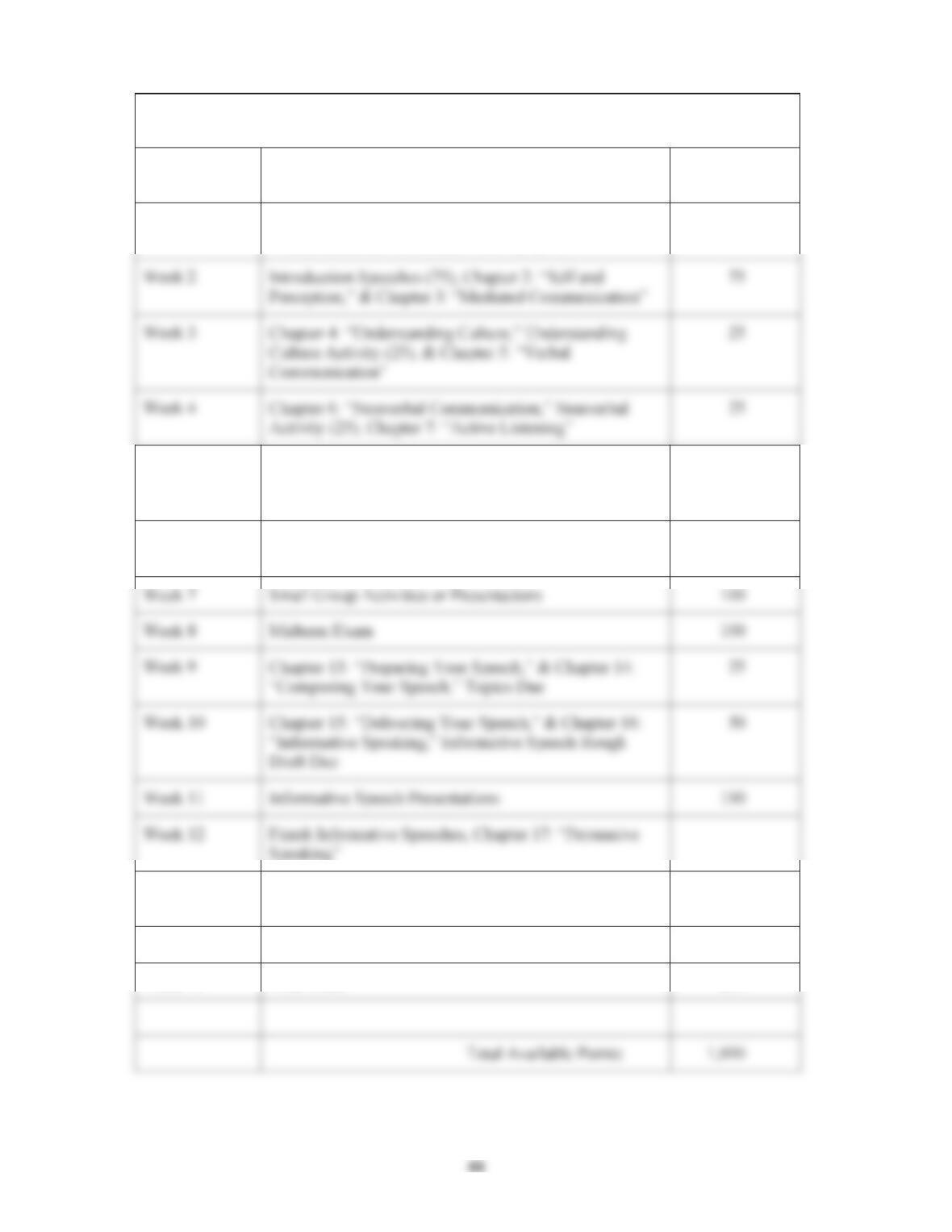
Sample Course Schedule for 15-
Week Term with Three Speaking Assignments
Course Week
Chapter Readings and Assignment Schedule Points
Available
Week 1
Syllabus
Review & Chapter 1: “Introduction to
Communication,
” Icebreaker Activity (25)
25
Week 5
Chapter 8:
“Managing Conflict,” Chapter 9: “
Principles
of Interpersonal Communication
,” & Chapter 10:
“Managing Interpersonal Relationships
”
Week 6
Chapter 11:
“Small Group Communication,”
& Chapter
12:
“Leadership in Group Communication”
Week 13
Informative
Speech Outline Due (50) & Persuasive
Activities (25)
75
Week 14
Persuasive Speech Presentations
150
Week 15
Final Exam
200
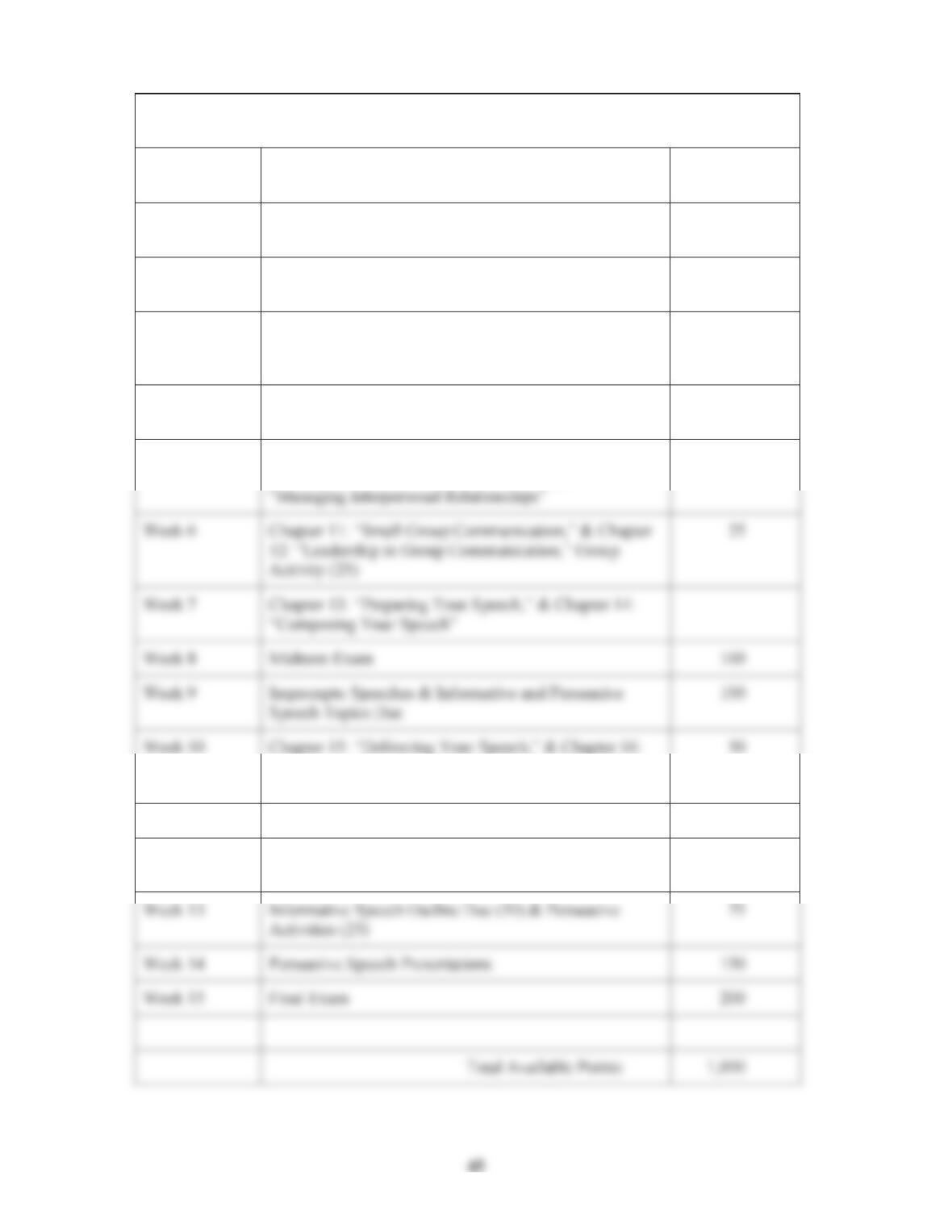
Sample Course Schedule for 15-
Week Term with Four Speaking Assignments
Course Week
Chapter Readings and Assignment Schedule Points
Available
Week 1
Syllabus
Review & Chapter 1: “Introduction to
Communication,
” Icebreaker Activity (25)
25
Week 2
Introduction Speeches (75), Chapter 2:
“Self and
Perception
,” & Chapter 3: “
Mediated Communication”
75
Week 3
Chapter 4:
“Understanding Culture,” Understanding
Culture Activity (25)
, & Chapter 5: “Verbal
Communication
”
25
Week 4
Chapter 6:
“Nonverbal Communication,” Nonverbal
Activity (25), Chapter 7:
“Active Listening”
25
Week 5
Chapter 8:
“Managing Conflict,” Chapter 9: “
Principles
of Interpersonal Communication
,” & Chapter 10:
“Informative Spe
aking,” Informative Speech Rough
Draft Due
Week 11
Informative Speech Presentations
150
Week 12
Finish Informative Speeches, Chapter 17:
“
Persuasive
Spe
aking”
Week 13
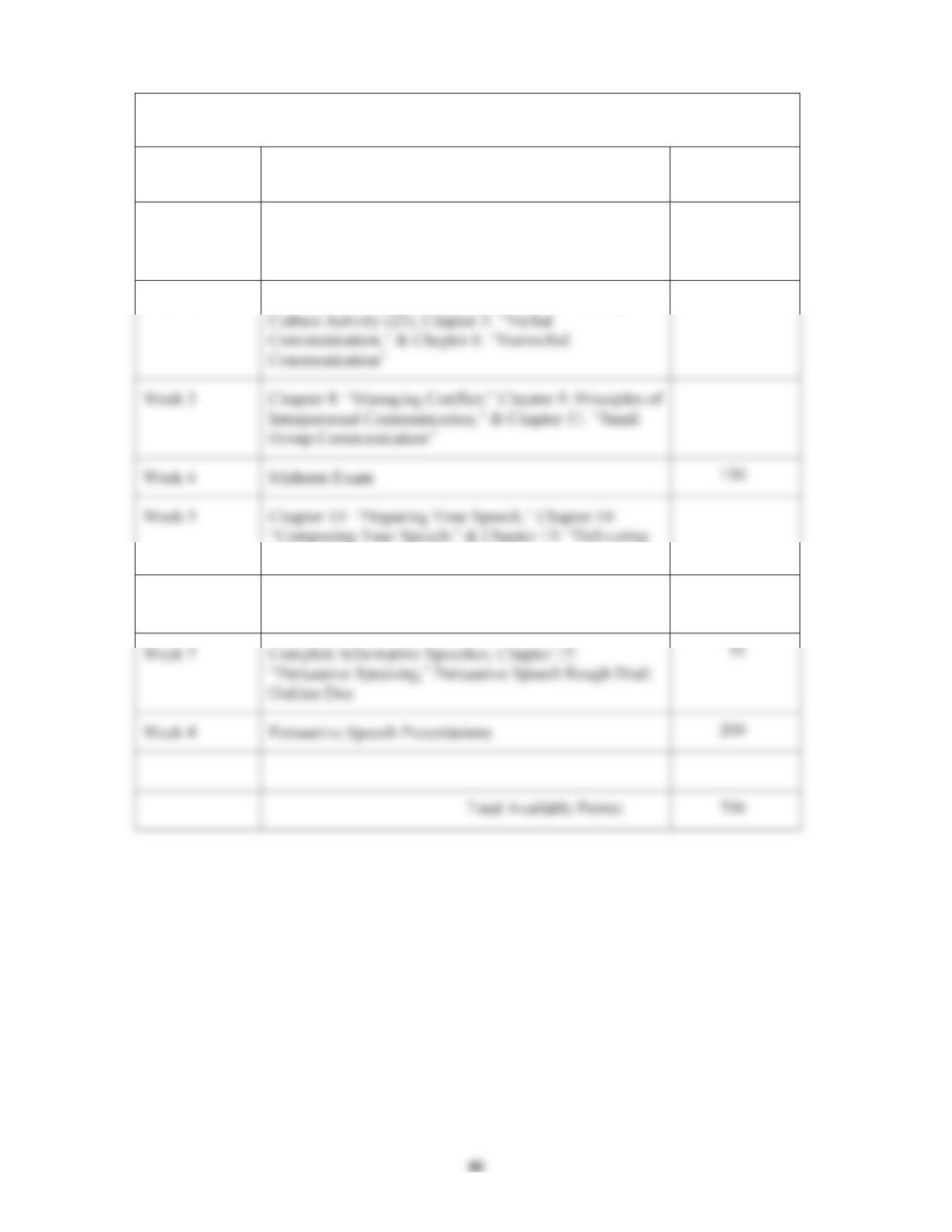
Sample Course Schedule for 8-
Week Term with Three Speaking Assignments
Course Week
Chapter Readings and Assignment Schedule Points
Available
Week 1
Syllabus
Review, Chapter 1: “Introduction to
Communication,
” Chapter 2: “Self and Perception,”
Introduction Speeches (75)
100
Week 2
Chapter 4:
“Understanding Culture,” Understanding
25
Your Speech
”
Week 6
Chapter 16:
“Informative Speaking,”
Begin Informative
Speech Presentations
150