
CHAPTER 9
UNCERTAINTY REDUCTION THEORY
Outline
I. Introduction.
A. Charles Berger notes that the beginnings of personal relationships are fraught with
uncertainties.
B. Uncertainty reduction theory focuses on how human communication is used to gain
knowledge and create understanding.
C. Any of three prior conditions—anticipation of future interaction, incentive value, or
deviance—can boost our drive to reduce uncertainty.
II. Uncertainty reduction: To predict and explain.
A. Berger’s emphasis on explanation (our inferences about why people do what they do)
comes from the attribution theory of Fritz Heider.
B. There are at least two types of uncertainty.
III. An axiomatic theory: Certainty about uncertainty.
A. Berger proposes a series of axioms to explain the connection between uncertainty
and eight key variables.
B. Axioms are traditionally regarded as self-evident truths that require no additional
proof.
1. Axiom 1, verbal communication: As the amount of verbal communication
2. Axiom 2, nonverbal warmth: As nonverbal affiliative expressiveness increases,
3. Axiom 3, information seeking: High levels of uncertainty cause increases in
4. Axiom 4, self-disclosure: High levels of uncertainty in a relationship cause
6. Axiom 6, similarity: Similarities between persons reduce uncertainty, while
dissimilarities produce increases in uncertainty.

8. Axiom 8, shared networks: Shared communication networks reduce uncertainty,
while a lack of shared networks increases uncertainty.
IV. Theorems: The logical force of uncertainty axioms.
V. Message plans to cope with uncertain responses.
A. Berger concluded that most social interaction is goal-driven: we have reasons for
saying what we say.
1. Berger claims plans are hierarchically organized with abstract representations at
2. Switching strategies at the top of the hierarchy causes changes down the
hierarchy, altering behavior.
B. Uncertainty is central to all social interaction.
C. There is an interaction between uncertainty reduction theory and plan-based
message production that suggests various strategies individuals use to cope with
uncertainty and hedge against risk when deploying messages.
1. Uncertainty reduction theorists have outlined four approaches we can use to
reduce uncertainty.
2. The complexity of a message plan is measured in two ways—the level of detail
3. Berger catalogs a series of planned hedges that allow a somewhat gracious
retreat to “save face” when at least one of them miscalculated.
4. The hierarchy hypothesis: When individuals are thwarted in their attempts to
VII. Reducing uncertainty in ongoing relationships: Relational turbulence theory
A. Can uncertainty also wreak havoc in ongoing relationships?
B. Leanne Knobloch suggests that uncertainty in close relationships arises from
whether we’re sure about our own thoughts, those of the other person, and the

Copyright © 2018 McGraw-Hill Education. All rights reserved. No reproduction or distribution without the
prior written consent of McGraw-Hill Education.
F. Over time, turbulence leads to even more uncertainty and interference, which then
creates more turbulence—a vicious cycle that could threaten the health of the
relationship.
G. Knobloch’s research supports the relational turbulence theory across many types
of romantic relationships, ranging from couples facing clinical depression to
military spouses returning from deployment.
VIII. Critique: Nagging doubts about uncertainty.
• Berger’s uncertainty reduction theory was an early prototype of what an objective
theory should be and it continues to inspire a new generation of scholars today.
• As Berger himself admits, his original statement contained some propositions of
dubious validity.
2. The tight logical structure of the theory doesn’t allow us to reject one theorem
without questioning the axioms behind it.
4. Kellermann and Rodney Reynolds challenge the motivational assumption of
5. They also have undermined the claim that motivation to search for information is
increased by anticipation of future interaction, incentive value, and deviance.
• Michael Sunnafrank challenges Berger’s claim that uncertainty reduction is the key
to understanding early encounters.
D. Walid Afifi thinks both theories are too narrow. In his theory of motivated information
management, he suggests we’re most motivated to reduce anxiety rather than
uncertainty.
E. Despite these problems, Berger’s theory has stimulated considerable discussion
within the discipline.
Key Names and Terms
Charles Berger
A communication theorist at the University of California, Davis, who developed
uncertainty reduction theory.
Attribution theory
A systematic explanation of how people draw inferences about the character of others
based on observed behavior.
Uncertainty reduction

Increased knowledge of what kind of person another is that provides an improved
forecast of how a future interaction will turn out.
Axiom
Theorem
A proposition that logically and necessarily follows from two axioms.
Message plans
Mental representations of action sequences that may be used to achieve goals.
Passive strategy
Impression formation by observing a person interact with others.
Active strategy
Impression formation by searching the Internet for information about a person.
Plan complexity
A characteristic of message plan based on the level of detail it provides and the number
of contingencies it covers.
Hedging
Use of strategic ambiguity and humor to provide a way for both parties to save face
when a message fails to achieve its goals.
Hierarchy hypothesis
The prediction that when people are thwarted in their attempts to achieve goals, their
first tendency is to alter lower-level elements of their message.
Leanne Knobloch
Communication scholar at the University of Illinois who explores uncertainty in ongoing
relationships and the resulting relational turbulence.
Relational uncertainty
Negative emotions arising from perceived problems in a close relationship.
Kathy Kellermann and Rodney Reynolds
Communication scholars who have questioned the motivational assumption of Berger’s
axiom 3 and the claim that motivation to search for information is increased by
anticipation of future interaction, incentive value, and deviance.
Michael Sunnafrank

Predicted outcome value
A forecast of future benefits and costs of interaction based on limited experience with
the other.
Walid Afifi
Principal Changes
This chapter has been edited for clarity and precision. Based on recently published
scholarship, the treatment of the relational turbulence model has been altered to reflect the
development of relational turbulence theory.
Kick-off Questions & Interaction Starters
• Why do you want to know your partner?
• What causes you the most amount of uncertainty- not being able to explain a partner
(current tense) or not being able to predict (future tense)?
• Do we have any choice or are we just propelled to reduce uncertainty?
• Knowing you cannot trade certainty for uncertainty once it’s been reduced, are there
times when you would prefer to preserve the unknown?
Suggestions for Discussion
Theories with lots of moving parts
As mentioned in the preface of the manual, theories vary in the amount of “moving
parts” they contain. When introducing Berger, particularly if you have followed the book in
order, students encounter a theory with lots of pieces, which can appear overwhelming at first.
The ideas may be less complex than, say, CMM, but there are a lot of them and students get
Comparison with other theories
You might want to push students to consider their basic and often unexplored
assumptions about communication. Berger’s approach to getting to know someone isn’t

exactly the same as Altman and Taylor’s, yet they share important assumptions about
communication and the human psyche worth discussing with your class. Although they differ
on the motivation for communicating with strangers, both theories view communication as
primarily informative in nature and the self as a stable, fixed entity that exists prior to
interpersonal interaction. Theorists such as Mead (symbolic interactionism) and Pearce (CMM)
Berger’s empirical approach toward interpersonal communication
No doubt your students will comment—some enthusiastically and some disparagingly—
on the thoroughgoing empiricism of uncertainty reduction theory. Along these lines, it’s
important for them to see not only that this theory is empirically grounded, but that it posits the
average communicator as an amateur scientist at heart whose first interest is the pursuit of
knowledge for its own sake. As the first major heading in the chapter declares, predictability
and explanation—those scientific pillars emphasized earlier in Chapter 3—become the basic
motivators of our talk. Berger theorizes humans in conversation as cerebral, primarily
Teaching Science: Axioms and theorems
Depending on how your department is structured or your students’ exposure to
research methods, Berger’s theory can become more manageable with a little training in the
terminology and approaches of empirical methods. Two key concepts are useful: variables and
positive/negative relationships. A variable is an element that can assume different values; in
other words, it can vary. I like to emphasis that it is concept or construct, a subunit. In
Berger’s case, the theory is built on 9 variables (uncertainty and 8 other concepts). Changes in
one variable affect the other as stated in the axioms and theorems. If they change in the same
direction, they have a positive relationship. But, I usually have to underscore that positive
Math-phobic students may turn off suddenly when faced with understanding how the
28 theorems and the corresponding relationships are derived from the initial eight. For some
students, the plus/minus chart in the textbook may be confusing and for these students, you
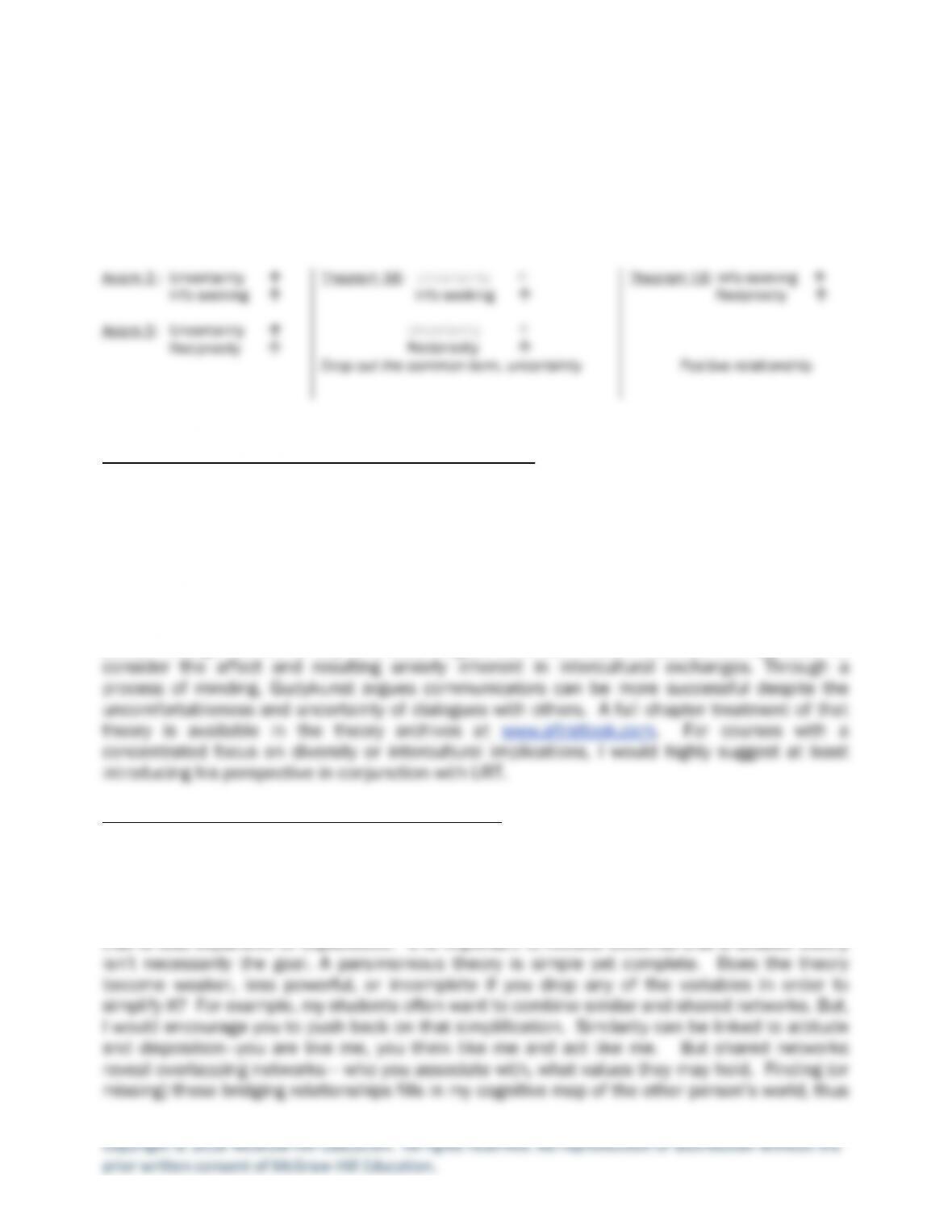
may want to stress that the theorems take two different variables each with a relationship to
uncertainty. Just as in mathematical fractions, the axioms can be made to have a common
term, which then drops out. For example:
Strategies to reduce uncertainty & cultural implications
Various attempts to cope with uncertainty—such as hedging or the passive, active,
interactive, or extractive strategies for seeking information—have different meanings in
different cultures. In some cultural contexts, direct requests for information about people are
considered rude, while other cultures may view such messages as natural. Confucian modesty
dictates that one downplay one’s own ability in making requests—giving the concept of hedging
particular salience. Ask students to reflect on examples of cultural implications of the
strategies to reduce uncertainty, drawing on their own experiences or examples from literature
and film. Gudykunst’s Anxierty-Uncertainty Management Theory (AUMT) further develops this
point. Though suffice to say it is less elegant than URT, AUMT expands the approach to
The loss of parsimony and the difficulty of teaching
URT epitomizes the “big hat, small rabbit” approach to theory building. It is ambitious,
powerful, and precise, but also bulky and difficult to maneuver. One consequence of the big
hat is that the theorist sacrifices—or at least compromises—the scientific criterion of simplicity,
a point emphasized in the critique. You might want to point this out to your students and ask if
they would discard any of the specific axioms in favor of a more streamlined approach, but one
that is less expansive or explanative. It is important to remind students that a smaller theory
Axiom 3 : Uncertainty
Info seeking
Axiom 5: Uncertainty
Reciprocity
Theorem 16: Uncertainty
Info seeking
Uncertainty
Reciprocity
Theorem 16: Info seeking
Reciprocity
Drop out the common term, uncertainty
Positive relationship

Copyright © 2018 McGraw-Hill Education. All rights reserved. No reproduction or distribution without the
prior written consent of McGraw-Hill Education.
reducing uncertainty, but it may not be synonymous with similar ways of thinking or acting.
Thus, combining the variables means I would lose the distinctions.
Sample Application Log
Alicia
I hate meeting new people. In fact, I pride myself on having very bad first impressions of all my
dearest friends. First meetings always overwhelm me, with their stilted conversation and
suspicious feelings on both sides. This theory helped me to formulate a new plan for the next
Exercises and Activities
Classroom response systems (“clickers”)
If you have access to classroom response systems (“clickers”), URT provides a good
opportunity to do some quick and easy testing of students’ knowledge. By posing simple
questions on interactive slides (i.e. “When uncertainty goes up… what happens to liking?”),
students can quickly buzz in with their clickers. By mixing both axioms and theorems, you
Applying uncertainty reduction strategies
We have found it helpful to keep a consistent example and show how each type of
uncertainty reduction strategy may be used to gather more information in the same situation.
For example, when spotting an attractive member of the opposite sex for the first time, how
might you use passive, active, interactive or extractive strategies to size them up? How about
starting a new job or taking a class from an unknown professor? Be sure to probe when each
type of strategy may be more/less useful, and more/less appropriate.
College orientation programs may serve as useful vehicles for thinking about and
applying uncertainty reduction theory. It may be productive to discuss the sessions your
students attended as they became members of your campus community. Working through the

Copyright © 2018 McGraw-Hill Education. All rights reserved. No reproduction or distribution without the
prior written consent of McGraw-Hill Education.
If yours is a residential campus, your campus may have programming that aims to
acclimate students to dorm life. This can serve as a site for exploring URT that resonates with
students’ personal experiences. When Andrew teaches this theory at TCU, he shows a YouTube
video from the campus that tries to help students get along with their roommate. If your
campus has material like that on the web, you might consider whether the advice of your
school fits with the advice of URT.
Feature film and literary illustrations
A number of feature films would provide good source material for URT clips. One of my
students’ favorites, Mean Girls (2004) has a number of useful scenes fairly early on in the
movie. When Cady, a homeschool transfer student, first enrolls in her new school, her
experiences at the various lunch tables humorously demonstrates the theory’s axioms. By
showing a few minutes of these scenes without initial comments, you can encourage students
to label her experiences by the variables and the corresponding impact on her uncertainty.
Set in the 1960s, the film Guess Who’s Coming to Dinner is the story of an African–
American family (the Prentices) and a European-American family (the Draytons) that are
suddenly thrown together by the prospect of an unexpected interracial marriage that will unite
Speed-friending
Darien Garard from Santa Barbara City College shared this great idea with us to illustrate URT:
Using the concept of speed-dating as the premise, I create the classroom to
resemble a session of “speed-friending.” Before class I arrange all the desks to face
each other in pairs, which is about 20 pairs in my classroom. I then tell students we’re
going to have 10 rounds of speed-friending today. I give them a handout to keep track
of their new friends, and to gauge how much they know about this person. For each
round, I simply tell students they’re meeting someone to “find a friend” and they fill out
the same two questions at the end of each round (“What is the most important piece of
information you learned about the person?” and “On a scale from 1 to 5, how much do
you know this person?”). The specific questions/topics discussed during their

Copyright © 2018 McGraw-Hill Education. All rights reserved. No reproduction or distribution without the
prior written consent of McGraw-Hill Education.
they have more time, and also their anxiety is reduced knowing they have more time. I
have the last round run 10 minutes because I want to create some awkwardness,
where students run out of things to say. So far, that hasn’t happened. Students still
can fill up 10 minutes pretty easily.
After the exercise, I have students debrief and discuss as a whole class the
following questions:
1. When did you first start experiencing uncertainty during today’s class period?
How did you reduce it (passive, active, interactive)? Were you motivated to
reduce uncertainty? Why/How?
2. Looking back at Berger’s eight axioms, explain how four of the axioms were
3. Looking back at what you learned about your partners, in what ways,
positively and negatively, did the amount of time for each round influence
your reduction of uncertainty about them? Examples?
4. Overall, what have you learned about initial interactions and reducing
uncertainty? Has Charles Berger done a good/adequate/poor job helping us
to understand initial interactions with his theory?
We then talk about how initial interactions at first are quite scripted, yet when
uncertainty is reduced (especially with more time) the conversation inevitably goes off
on any number of tangents. The axioms also connect well to illustrate how/why
tangents were developed.
The entire experience takes up my whole class period (80 minutes). I’ve really
had success with the exercise so far, making connections to the theory, and students
Further Resources
Uncertainty reduction in close relationships
▪ Kimberly J. M. Downs, “Family Commitment Role Perceptions, Social Support, and Mutual
Children in Remarriage: A Test of Uncertainty Reduction Theory,” Journal of Divorce &
Remarriage, Vol. 40, 2004, pp. 35–54.

Uncertainty, and the Reduction of Uncertainty,” Human Communication Research, Vol. 34,
2008, pp. 625-654.
Relational Turbulence Theory
As alluded to in the chapter, there is an explosion of research on relational turbulence in
recent years. Just a sampling of some of those projects includes:
▪ Natalie K. Ellis and Andrew M. Ledbetter, “Why Might Distance Make the Heart Grow
Fonder?: A Relational Turbulence Model Investigation of the Maintenance of Long Distance
and Geographically Close Romantic Relationships,” Communication Quarterly, Vol. 63,
2015, pp. 568-585.
Uncertainty reduction in the digital age
▪ Marjolijn L. Antheunis, Alexander P. Schouten, Patti M. Valkenburg, and Jochen Peter,
“Interactive Uncertainty Reduction Strategies and Verbal Affection in Computer-mediated
Communication,” Communication Research, Vol. 39, 2012, pp. 757-780.
▪ Cédric Courtois, Anissa All, and Hadewijch Vanwynsberghe, “Social Network Profiles as
Information Sources for Adolescents’ Offline Relations,” CyberPsychology, Behavior &
Social Networking, Vol. 15, 2012, pp. 290–295.
▪ Amy May and Kelly E. Tenzek, “Seeking Mrs. Right: Uncertainty Reduction in Online
Surrogacy Ads,” Qualitative Research Reports in Communication, Vol. 12, 2011, pp. 27-33.
▪ Cynthia Palmieri, Kristen Prestano, Rosalie Gandley, Emily Overton, and Qin Zhang,”The
Facebook Phenomenon: Online Self-disclosure and Uncertainty Reduction,” China Media
Research, Vol. 8, 2012, pp. 108–113.
Anxiety-Uncertainty Management Theory (AUM)
▪ In previous editions, Griffin covered AUM in a separate chapter. That treatment is available
on the website www.afirstlook..com, under the “Theory Archive.”
▪ For some other articles applying AUMT and URT, see

o Ann Neville Miller and Jennifer A. Samp, “Planning Intercultural Interaction:
Extending Anxiety/Uncertainty Management Theory,” Communication Research
Reports, Vol. 24, 2007, pp. 87-95.
URT in the classroom
For some other teaching ideas, see