
Chapter 9
Practices for Effective Interpersonal Relationships
C
CHAPTER OBJECTIVES
• Learn the importance of maintaining a variety of relationships through daily behavior and
through use of technology.
CHAPTER OUTLINE
CHAPTER INTRODUCTION
• The chapter opens describing the relationship dynamics of a couple, Marcie and Darin. They
seem to be a fun-loving couple who have discovered ways to keep their marriage afloat. Because
Marcie often has to be away from home for her career as a pilot, the couple has come up with
several strategies for negotiating their expectations of one another. They have developed a
RELATIONAL MAINTENANCE
• We associate stable relationships with desired levels of mutual control, trust, liking, and
commitment.
• Relational maintenance refers to the actions we take to sustain these desired levels in our
relationships.
• We protect several relational characteristics when they fall below our desired levels:
Mutual control is feeling that your benefits match your contributions.
• When you feel as though you are giving more than you’re getting, you may
experience distress in the form of anger and depression.
Trust, when questioned or lost, can lead to suspicion between partners.
• Betrayal is reported as one of the most common reasons for ending friendships.
Although love is central to personal relationships, another essential element is liking,

• Openness: Being direct, sharing private thoughts and feelings, giving advice,
listening, and discussing the future
• Assurances: Encouraging, comforting, and meeting needs
• Maintaining Relationships with Technology
We often use e-mails and social media to maintain both our offline and our online
relationships.
We also use technology to reconnect with old friends, stay in touch with family
MAINTAINING DIFFERENT TYPES OF RELATIONSHIPS
• Managing close relationships well requires being able to figure out the best behavior to use for
each type.
• All six types of maintenance—positivity, openness, assurances, social networks, sharing tasks,
and sharing activities—are generally helpful in your relationships.
• Romantic Relationships
Forty-four percent of couples report being really annoyed with each other on a daily
basis.
It’s not enough for us to just enter into romantic relationships. We must actively
maintain them or they will deteriorate.
Positivity and assurances
• Partners who link their happiness to being positive report that the top two
Sharing tasks
• Asking partners if they need help, giving them rides, and working together on
household chores are all forms of sharing tasks or doing things together.
Social networks
• Close relationships don’t exist in isolation. Their survival relies on the approval
of their social network—especially for gay and lesbian and interethnic couples.
• Friendships
Friends can sustain their commitments with less contact than those in romantic
relationships, but they, too, must actively maintain their relationship so that it survives
over time and distance.
Positivity
Openness
• Another cornerstone to friendship is simply catching up or sharing personal
information.
Cross-sex friendships: special considerations
• Cross-sex friendships, while confusing at times, can be emotionally rewarding.
• Most cross-sex friends try to remain platonic mainly because they think that
• Workplace Relationships
Workplace peers, whether collegial or special, can thrive if both partners can handle the
stress of job competition and work demands.
Some of the most-used maintenance actions are combinations of positivity (to offset the
often stressful environment) and assurances (to make it clear that you value a work
friend as more than just a colleague).
People make decisions to act based on their interpretation of what’s going on around
them.
• Meet Connecting Bids.
Connecting bids are those daily overtures of connection that we make to our partners.
Whether deep or superficial, verbal or nonverbal, direct or indirect, they are critical to
maintaining our relationships.
There are three possible responses to any connecting bid.
• A turning-away response is where your partner recognizes your bid and then
quickly shifts to self-centered interests.
• In response to the partner’s news that his or her movie script is finally
• Take Action Based on Knowledge.
Those who choose to avoid rather than engage are more stressed and unhappy.
We learn the rules and values of relationships through our caregivers, the media, popular
culture, books, our social networks, and our own experiences.
The knowledge that we gain deeply guides our inferences and actions in our own
relationships, but this knowledge is helpful only if it is grounded in reality.
• Nurture Mutual Commitment.
When you perceive that you are putting in and receiving about the same amount as the
MANAGING INTERPERSONAL CONFLICT
• Conflict is inevitable, chaotic, and messy.
• Because many of us see conflict as a win-lose battle, we usually try to avoid it.
• It’s natural for individuals with unique thoughts, feeling, needs, and goals to clash.
Accepting this reality can help us manage these episodes of conflict.
• What Is Interpersonal Conflict?
Relational rules
• We make our own rules for relationships based on our experiences, the people in
our lives, and other outside influences.
• When our partners don’t mold to our expectations, conflict may ensue.
• Partners also can find themselves in conflict over various forms of rule breaking,
such as cheating.
Personality
• Benefits of Interpersonal Conflict
Constructive conflict can improve both our understanding of our partners and our
relationship with them.
During periods of conflict, partners can hear each other’s perspective and possibly
change their behavior.
We also use conflict to regulate our relationships.
STYLES AND PATTERNS OF CONFLICT
• Behavior can be broken down into a range of styles, from destructive to constructive.
• Six Conflict Styles
Competitive fighting: direct and uncooperative
• Competitive fighting involves taking control to get what you want.
• Competitive fighters do this by accusing, blaming, joking in a hostile
manner, and calling their partner names.
Collaborating: direct and cooperative
• Collaborating involves working toward a solution that’s beneficial to both
partners.

• Unhealthy Conflict Patterns
Conflict patterns are the ways that partners react to each other and these reactions
affect the conflict.
Negative reciprocity
• When negativity (for example, name calling, accusations, yelling, and dismissals)
triggers more negativity, the result is negative reciprocity.
Common couple violence
• The pattern of common couple violence involves violence and emerges when
partners believe they have no control in the relationship, feel ignored, or want to
vent their anger but don’t know how.
Demand-withdraw
• The demand-withdraw pattern occurs when one partner demands a change
while the other partner, benefiting from the way things are, withdraws.
Cascading negativity
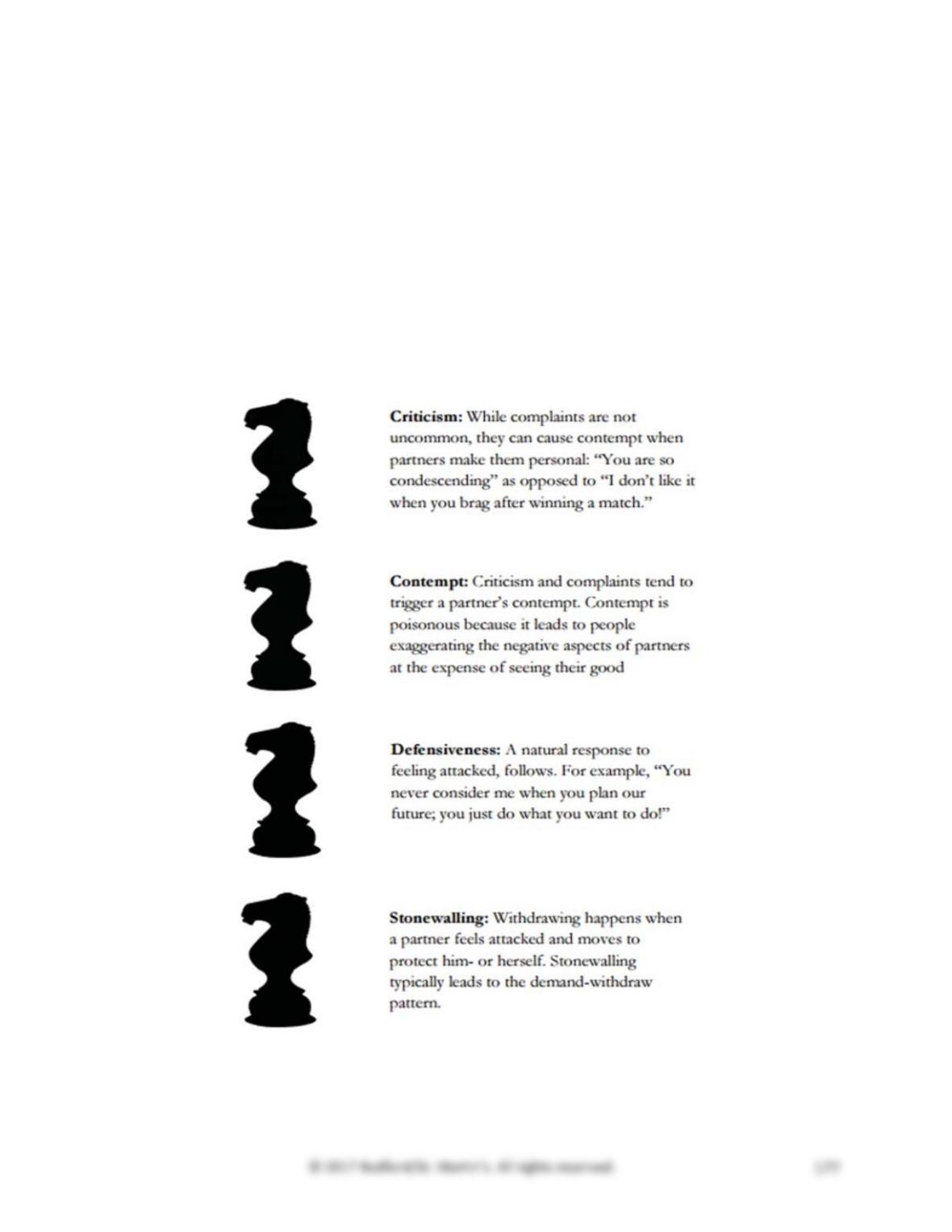
• Psychologist John Gottman’s Four Horsemen of the Apocalypse model
STAYING RESPECTFUL, STRONG, AND POSITIVE IN CONFLICT
Accept cyclical conflict.
• Recognizing cyclical conflict allows you to accept that some issues will keep coming up
over time.
• It doesn’t mean that you didn’t solve the problem the first time. It’s normal to face these
issues and then renegotiate them as they resurface.
Monitor your emotions.
• Emotional flooding occurs when emotions of hurt or anger become intense enough to
Express criticisms gently and respectfully.
• Kindness is particularly hard during conflict, but it’s possible to remain kind while also
expressing your anger or hurt.
Engage in conflict with positive expectations.
• Seeing your partner in a positive light and giving him or her the benefit of the doubt
L
LIST OF KEY TERMS
relational maintenance
commitment
positivity
openness
assurances
social networks
sharing tasks
sharing activities
connecting bids
C
CLASS DISCUSSION QUESTIONS
1. What are a few relational characteristics that we act to protect if they fall below our desired levels?
• Have students think of things that make them put their guard up in relationships when
responding to this question. People want to feel secure when they are in a relationship, and if
certain things feel a bit “off,” we try to protect ourselves. Having that insecure feeling could
lead to some rocky roads ahead.
2. What are the six common relational maintenance behaviors? What are some ways in which you
have applied them in a particular relationship?
• Relationships take work. It’s not enough for us just to enter into romantic relationships, we
must actively maintain them, or they will deteriorate. When responding to this question, have
students think about how they maintain romantic relationships. How do they make them
work? See if the students have similar responses to the authors, and perhaps provide them
3. What are connecting bids? What are three possible responses to them, and in what instances have
you experienced each?
• Students likely won’t be familiar with this term. Having them define the term connecting bid in
their own words for comprehension is important for this question. Explain to them that
connecting bids are simply saying to someone, “Hey, I want to connect with you” (without
4. What is interpersonal conflict, and what are the benefits to engaging in such conflict?
• Interpersonal conflict is a struggle that occurs when partners reveal what they see as
incompatible interests, and it’s inevitable in any relationship, but most people try to avoid it
because they don’t want the awkward conversation. But conflict doesn’t have to be a
negative thing and can be used to regulate our relationships. Our friends or partners can’t
5. What are some ways that you can engage in conflict in a positive manner?
• Have students reflect on a time when they were engaged in conflict with a partner. How did
they handle that conflict, and was it appropriate for the situation? If not, have them think of
ways in which it could have been handled more productively and positively. If they cannot
think of any right off the bat, have them take a sheet of paper and spend five minutes
reflecting on and answering the question.
• Accept cyclical conflict. Recognizing cyclical conflict allows you to accept that some issues
APPLY YOUR SKILLS
APPLY YOUR SKILLS FROM CHAPTER 9
1. Look at the “Apply Your Skills” activity on page 281 in the text. After students complete the
activity, have them answer the following questions, either in a small group, in a class discussion, or
in writing:
• When applying these negative communication behaviors to your own life, think of a time
when you criticized a partner or vice versa. This can be seen as an attack on a person’s
character. How could you (or they) have complained without placing blame in that situation?
• Next, think of a time when you used contempt in your approach to communicating with
MORE “APPLY YOUR SKILLS” IDEAS
1. Review the illustration “Workplace Romantic Relationships” on page 262 in the text. Have
students reflect on how the communication behaviors are different in each illustration. What would
be the consequences of engaging in romantic communication behaviors in a professional work
environment? Why should couples refrain from using work technology for personal matters?
PERSONAL WRITING ASSIGNMENTS
1. Think about a time when a friend or significant other moved away. Why is it sometimes difficult
to maintain a long-distance relationship, and what are some relational maintenance behaviors you
can use to maintain one?
3. Reflect on an interpersonal relationship and the role that technology played in that. In terms of
relationship maintenance, how can technology play a beneficial role? Conversely, how can the use of
technology be detrimental to a relationship?
CLASSROOM ACTIVITIES
1. Have students imagine that they are planning a trip with a friend and both of them are looking at
Groupon to find the best deal. Your friend says, “What about Portland, Maine? I’ve heard they have
great lobsters there, and this photo shows a cool looking lighthouse!” This is a bid for connection
because your friend is trying to start a conversation with you. Look at the following responses, and
determine the best possible response in the given situation. Also, identify each response as being a
turning-toward approach, turning-away approach, and turning-against approach:
2. Have students form groups of four or five, and assign them each a negative communication
behavior linked to Gottman’s Four Horsemen of the Apocalypse Model (complaints, contempt,
3. Have students form groups of four or five. Have them reflect on a friendship or a romantic
relationship where interacting with each other’s social circles seemed to be either peaceful and
engaging or problematic. Give them 15 minutes to share their experiences with the group, and have
4. Have students watch the one-minute video “John Gottman: The Magic Relationship Ratio”
(2007) in class. Have them take out a sheet of paper and write down the name of a person with
whom they have a close friendship or romantic relationship. Next, have them write down one
5. The television series Naked and Afraid, shown on the Discovery Channel, demonstrates that
humans need interpersonal communication for their survival. Select an episode to watch in class,
and have students respond to the following prompts in class discussion:
• Based on the personal data given to the audience at the start of the show, did you anticipate
that the participants would get along, or did you anticipate personality conflicts? If you
A
ADDITIONAL MEDIA RESOURCES AND ACTIVITIES
1. Search for and watch the video “Four Horsemen of the Apocalypse | The Gottman Institute”
(2014). What are the four main negative communication behaviors that, if not remedied, will lead to
the end of any relationship? What are the remedies to each behavior, and what remedies have you
practiced in your own relationships?
2. Watch the movie Friends with Benefits (ScreenGems, 2011). The authors suggest that relatively few
people in FWB relationships are directly open about their ground rules. Instead, they avoid
discussing what to call the relationship, its status, and its future. At what points in the movie did the
H
HANDOUTS AND READY–TO–PRINT ACTIVITIES
Gottman’s Four Horsemen of the Apocalypse
(Cascading Negativity)
This worksheet can assist you with activities related to Chapter 9 in the text. It also
can be used as a reminder of how these negative communication behaviors are
detrimental to any relationship. If you find that you are in a relationship that exhibits
any of these behaviors, you should address the behavior and change it if you want the
relationship to survive.