
Chapter 8
Principles of Interpersonal Communication
C
CHAPTER OBJECTIVES
• Learn why interpersonal communication, particularly in the dyad, is so important to our personal
and social lives.
CHAPTER OUTLINE
CHAPTER INTRODUCTION
• The chapter opens with a story of two females whose friendship has lasted over several decades.
Kelley and Terri met in their Philippine high school biology class when both of their fathers
served in the American military. They attended the same college but after graduation accepted
jobs in different states. Even though they established careers on opposite sides of the country,
INTERPERSONAL COMMUNICATION IN THE DYAD
• Interpersonal communication occurs in the interactions between people who find each other
unique and irreplaceable.
• The dyad is a two-person social unit.
• Intimacy means having access to more information about each other and richer insights into
the other person.
• The Benefits of Interpersonal Relationships
Self-expansion is the opportunity to deepen and broaden one’s personal identity.
Belonging
• One of humans’ top needs is to belong.
• Whether in person or online, most people seek out others to find acceptance for
who they are.
Emotional, psychological, and physical well-being
• Interpersonal relationships help our emotional life in several ways:

• The Nature and Type of Close Dyads
Interdependence is a reliance on each other.
Friendships
• A friendship is a close dyad defined by strong affinity, warmth, and affection.
Work peers
support.
o A virtual peer is a coworker who communicates through mediated
communication (such as those in different geographical locations).
o Their closeness depends on how much they interact.
Romantic relationships
• Romantic relationships have characteristics not found in other types of close
dyads, such as a higher level of social and physical access.
• These relationships require a level of commitment that is not found in most
SELECTING A FEW FROM THE MANY
• Initially, we constantly scan our environment and draw assumptions about those around us
based on what we see and hear.
We continue to move in closer perceptually and make our selections based on things like
the roles we place others in and our interpretations of their nature.
After we’ve whittled down the pool, we need to stay connected long enough to foster
any potential close relationships.
• The Secrets of Attraction: Noticing

• Task attraction refers to being drawn to others who complete jobs in ways we
value and agree with.
Brain chemistry
• The chemistry of attraction is most pronounced in brain hormones like
acetylcholine and phenylethylamine, which has led some scholars to argue that
romantic love is actually caused by hormones.
Proximity
• The Secrets of Initiating: Opening Moves
Noticing someone directs your focus, yet you have to decide whether you are going to
make any opening moves.
Introductions
• Cortisol, the stress hormone, increases when we meet a stranger.
o This is because we are aware of being assessed by another person.
• Introductions—what some experts call safe, “ritualistic openers”—are necessary
CAPTURING RELATIONAL MOVEMENT
• All of us have our own stories depicting relational movement—or how and why our
relationships move through time as they do.
• The Straightforward Path
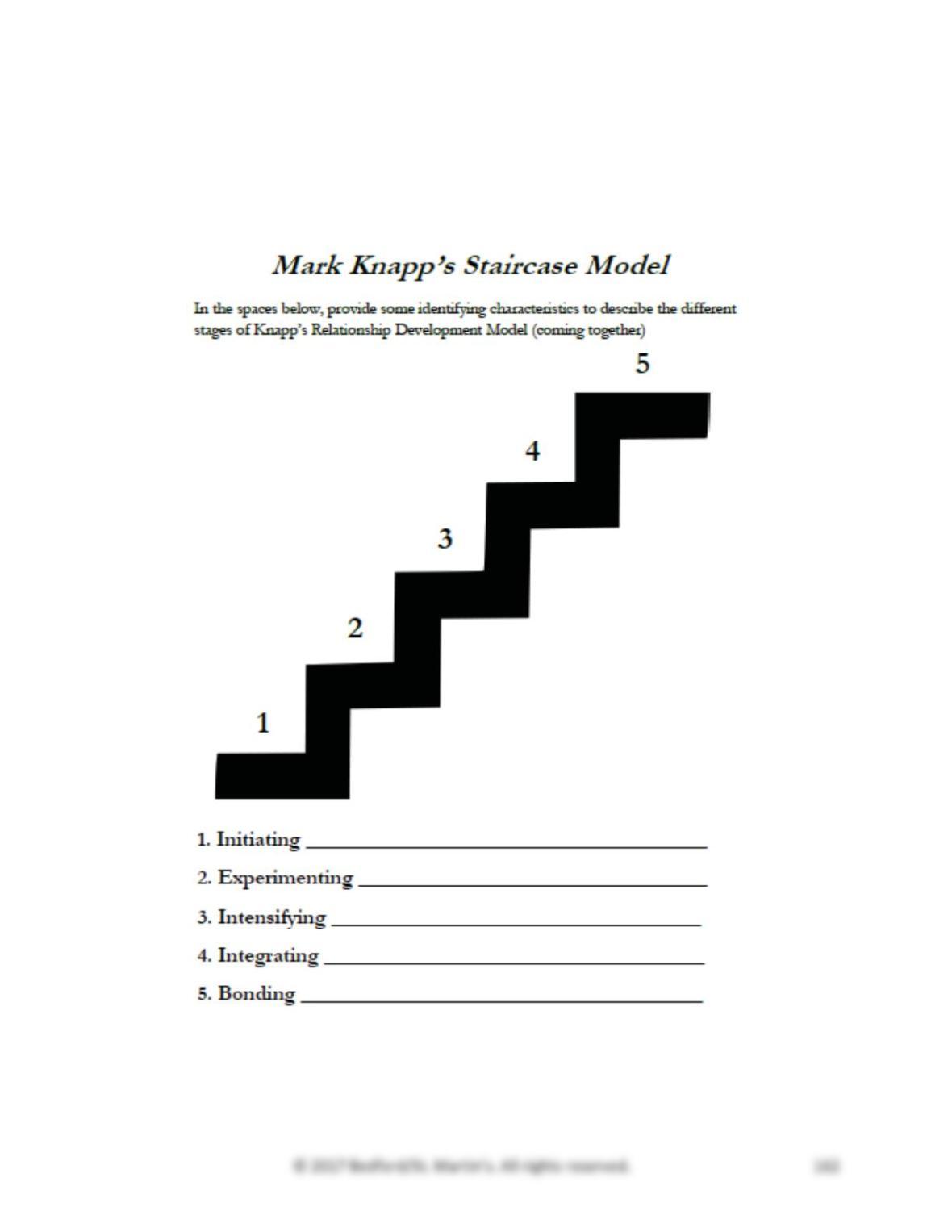
Knapp’s staircase model, with five steps moving toward intimacy (initiating,
experimenting, intensifying, integrating, and bonding) and five steps moving away from
intimacy (differentiating, circumscribing, stagnating, avoiding, and terminating) is one of

partners feel distanced and spend time apart.
• Unless the partners resolve their problems, the relationship ends.
• The Turbulent Path
Imagined trajectories
• Honeycutt’s imagined trajectories model states that relationships are mainly
• Due to opposing forces in the relationship, partners are consistently adjusting in
these periods of calm and upheaval.
SELF-DISCLOSURE AND PRIVACY
• Self-disclosure is what we reveal about ourselves to others (and what they reveal to us).
• One way to think about self-disclosure is the Johari window, which describes the different
degrees of what we know about ourselves and what others know about us.
The Johari window breaks this up into four quadrants—open, blind, hidden, and
unknown.
• Social Penetration Theory
Social penetration theory explains that our close relationships are the result of
“penetrating” the more hidden informational layers of the other person, as if peeling
away the layers of an onion.

• Communication Privacy Management Theory
The communication privacy management (CPM) theory is built on two ideas—that
we “own” our information and that we have the right to control access to it.
Communication experts use a boundary metaphor to explain this control of private
information.
• Safe information is enclosed by a thinner boundary.
information.
Privacy rules
• Everyone makes up his or her own set of “privacy rules” to regulate how and
when to share private information.
o The five factors influencing these rules are personality, biological sex,
motivation, culture, and the relationship of the person that one is
disclosing to.
Privacy violations
• Boundary turbulence is the friction that occurs when privacy rules are
threatened or broken.
• Relational embarrassment occurs when a relational partner acts
inappropriately toward the other partner in front of others.
UNDERSTANDING AND MANAGING DIALECTICAL TENSIONS
• Moving from acquaintances to friends or lovers is a big step—and though these types of
interpersonal relationships are vital for our health and well-being, they come with a new set of
challenges.
• Dialectical Tensions
Dialectical tensions are contradictory forces that push and pull the partners in
opposing directions.
• Centripetal forces are forces that push us together.
o Centripetal forces include openness, stability, loyalty, warmth, respect,
and caring.

Openness/closedness
• The second most common dialectical tension is between openness and
closedness.
• Many believe that the mark of a good relationship is complete openness and
honesty with the other person—in other words, no secrets.
• But in the messy reality of relationships, people often regulate what and how
much they share.
Predictability/novelty
• Managing Dialectical Tensions
Separation
• The most common management strategy is separating one opposing force
from the other in certain situations or when dealing with particular topics.
Selection
• When partners use selection strategies, they select or value one opposing
force while ignoring the existence of the other.
Balance
LIST OF KEY TERMS
interpersonal relationship
interpersonal communication
dyad
intimacy
self-expansion
reciprocal altruism
interdependence
friendship
professional peer
collegial peer
special peer

Knapp’s staircase model
imagined trajectories model
cyclical tensions model
self-disclosure
Johari window
social penetration theory
communication privacy management (CPM) theory
CLASS DISCUSSION QUESTIONS
1. What are the four categories of work peers, and how do they differ? (If you have a job, think
about who might fill each of these roles.)
• When students think of interpersonal relationships, they sometimes forget that these include
relationships with coworkers.
• Professional peer: Professional peers work side-by-side, giving each other practical as well as
personal support.
2. Do you agree that romantic love is caused by hormones?
• Allow students to ponder this question for a few minutes before they respond. Those
students who have had a feeling of being “in love” may have thought of it as being almost a
euphoric feeling where they can’t get enough of their significant other.

3. How might Knapp’s staircase model conflict with the relationship paths of people who live in
cultures that practice arranged marriages?
• When discussing Knapp’s staircase model, it’s a good idea to have students talk through
what happens at each stage of a relationship. Steps can be skipped, and people can be in
different stages at the same time. This model is used in many cultures, including American.
4. What is the definition of small talk? What topics of conversation are involved in small talk? Why
don’t you engage in more self-disclosure when you meet someone for the first time? At what point
do you feel comfortable disclosing more information about yourself?
• Small talk is polite and usually superficial conversation. Making small talk allows people to
connect cautiously while avoiding potential rejection that might come from revealing too
much personal information.
5. How would you define attraction, and what are three types of attraction?
• Allow students to come up with their own definitions and share them aloud. Some students
will say “I’m attracted to a funny personality,” but how do they know they will perceive
someone as “funny” before they have met them? Attraction usually first stems from physical
characteristics. One thing that will likely be similar in students’ responses is that attraction is
the driving force behind wanting to get to know someone better.

A
APPLY YOUR SKILLS
APPLY YOUR SKILLS FROM CHAPTER 8
1. Look at the “Apply Your Skills” activity on page 249 in the text. After students complete the
activity, have them answer the following questions, either in a small group, in a class discussion, or
in writing:
MORE “APPLY YOUR SKILLS” IDEAS
1. Review the illustration “No Social Connections” on page 221 in the text. What are the
disadvantages of not having a social circle? What are the benefits of having interpersonal
relationships? For further reflection, are there any disadvantages to having too many social
connections? If so, what are they?
2. Review the illustration “Proximity Then and Now” on page 228 in the text. It’s likely unsurprising
that the people we live, work, and socialize near are easier to connect with. How has technology
PERSONAL WRITING ASSIGNMENTS
1. Opposites attract, but similarity plays a role in the development of interpersonal relationships.
Have your students reflect on previous relationships. Have they ever found themselves in a
relationship (friend or romantic partner) with someone who was their polar opposite? What factors
drew them together?
2. Ask students to think about what initially attracts them to someone. Have them describe the
external characteristics that typically draw them to someone. Is it safe to say that we all have our

C
CLASSROOM ACTIVITIES
1. In class, play the one-and-one-half-minute snippet of Cast Away (DreamWorks, 2000) entitled
“Cast Away—Fight with Wilson” (viewer discretion advised due to language). How does this scene
demonstrate the need for interpersonal relationships? What are the consequences of living a life with
no relationships?
2. Have students take out a sheet of paper and draw a circle that takes up almost the entire page.
Then have them draw four more circles within each other, creating an onion-like illustration. Ask
them to think of how relationships develop and create an illustration that helps them visualize it:
• On the outer circle, have them write information that they share freely with strangers.
• Within the second layer, have them write information that they share with acquaintances.
The picture depicts how self-disclosure in social penetration theory works. The closer we get to
people, the more personal information they know about us.
3. Have students form pairs, and ask them to role-play the first stage of Knapp’s staircase model—
initiating. Partners should turn their desks face-to-face as they engage in a surface-level conversation
for five minutes. After five minutes, students may turn their desks back to their original positions.
4. Have students form groups of four or five, and allow them to reflect on a friendship or a
romantic relationship that developed over time. Have the students discuss the following prompts:
Where and when did they first meet? What did they discuss in their initial conversations, and were
they conducted via text, phone call, or face-to-face? Has the relationship experienced some tensions
along the way? Provide students 15 to 20 minutes of class time to share their stories with one
5. Have students take out a sheet of paper and spend five minutes listing five dialectical tensions that
they experience in either friendships or romantic relationships (They can refer to the Dialectical
ADDITIONAL MEDIA RESOURCES AND ACTIVITIES
1. Have students watch the movie Hitch (Columbia Pictures, 2005). Have each student pick a
romantic relationship to focus on (either between Hitch and Sarah or between Albert and Alegra)

2. Have students search for and watch the snippet of Shrek (DreamWorks Pictures, 2001) titled
“Ogres Are Like Onions—Analogies.” How does this one-minute analogy help explain social
penetration theory in interpersonal relationships?
3. Search for and watch the 19-minute video titled “Johari Window in Interpersonal
Communication” by Lori Zakel, professor and chair of the communication department at Sinclair
College, Dayton, Ohio. Have students select one of their own interpersonal relationships (such as
H
HANDOUTS AND READY–TO–PRINT ACTIVITIES


Johari Window
Reflect on an interpersonal relationship that you have—perhaps with a family
member, a significant other, or a coworker. To gain a better understanding of how
My Johari window describes my relationship with ________________________
__________________________________________________________________.
Known to Self Unknown to Self
Known
to
Others
Open self
(Information about you that you know and the other
person knows)
Blind self
(Information about you that you are blind to but the other person
knows to be true; provide a hypothetical example here)