What is the difference between a thesis statement and a specific purpose? Give an example
of a general purpose, a specific purpose, and a thesis statement.
The specific purpose describes in action form what outcome you want to achieve with the
speech. The thesis statement concisely declares, in a single idea, what the speech is about.
What are some factors to consider when narrowing a topic?
1. Those aspects of the topic that most interest you
2. The audience’s interests, knowledge, and needs
What does it mean to make your thesis statement relevant?
Making the thesis statement relevant means to express it in a way that will motivate the audience
ACTIVITIES
What Are Your Personal Interests? (also for online courses)
Purpose: To help students generate a list of potential speech topics.
Instructions: Have students use the brainstorming techniques listed in the textbook (word
association, topic mapping, Internet search tools) to generate potential speech topics.
They can use the following questions to help guide them:
1. What are your interests?
2. What are your hobbies, or what do you do in your spare time?
3. Where are you from, and what is unique about this location?
9. What types of food do you like?
10. What types of entertainment do you like?
11. What is your major?
12. If you work, what is your job? What is your ideal job?
I
Don’t Have a Topic
Instructions: This should be done as a homework assignment so that students will have time to
think about it. Students should generate a list of ten topics for each of the three general speech
Brainstorming
Purpose: Learning the guidelines to brainstorming and using creativity and teamwork to solve
problems.
Instructions: This assignment can be divided into three stages, each of which can be a separate
activity. Alternatively, all three stages can be combined into one large activity/project. If
Stage 1: Arrange students in groups of four or five. Each group should generate a list of current
problems or issues that its members face as students. These problems can involve social,

1. Designate one person in the group to write down all the topic ideas, using any
appropriate subheadings to organize the list.
3. Once the list has been completed, the group should evaluate the suggested topics:
How relevant is the topic to the audience as a whole (all class members)? Is the
topic interesting, substantive, meaningful, and important? Can it be dealt with
within the allotted time? At this time, topics that do not meet the above
4. Compile a final list of topics.
Stage 2: Each
group will select one of the problems or issues from the list compiled in stage 1.
Groups should then engage in the same process of brainstorming to generate
solutions for these
issues. This group should use the same guidelines
as before.
Stage 3: Groups (or individuals) should pick one of these solutions and create a short
Audience Concerns and Interests
Purpose: To help students understand the importance of taking audience concerns and interests
into account when selecting a topic; to give them some ideas about what their audience might
enjoy listening to; and to generate additional topics for speech assignments.
Instructions:
Using the topic map in Chapter 7 of the textbook as a guide, instruct students to
make a “classroom interests” map. This can be done in groups or individually. Students should
talk to each of their classmates, and write down their concerns and interests. Once they have
Fact or
Fiction: Unusual Information
Purpose: To provide students with the opportunity to learn about something that is unusual or
little known, as well as to generate potential speech topics.
Instructions: Students can choose any of the topics that emerged from the previous exercises
(such as What Are Your Personal Interests? and Audience Concerns and Interests). Using library
sources or the Internet, during class time or as a homework assignment, ask them to research
information about a little-known topic. Students should find two additional “unusual topics” and
Topic, Purpose, Thesis: Knowing All the Pieces

Purpose: To understand and be able to identify and generate a topic, a purpose statement, a
thesis statement, and a thesis statement with relevance.
Instructions: Provide students a list of five to ten topics (these can come from lists generated
Discussion: The instructor should ask students to read their examples. He or she should point out
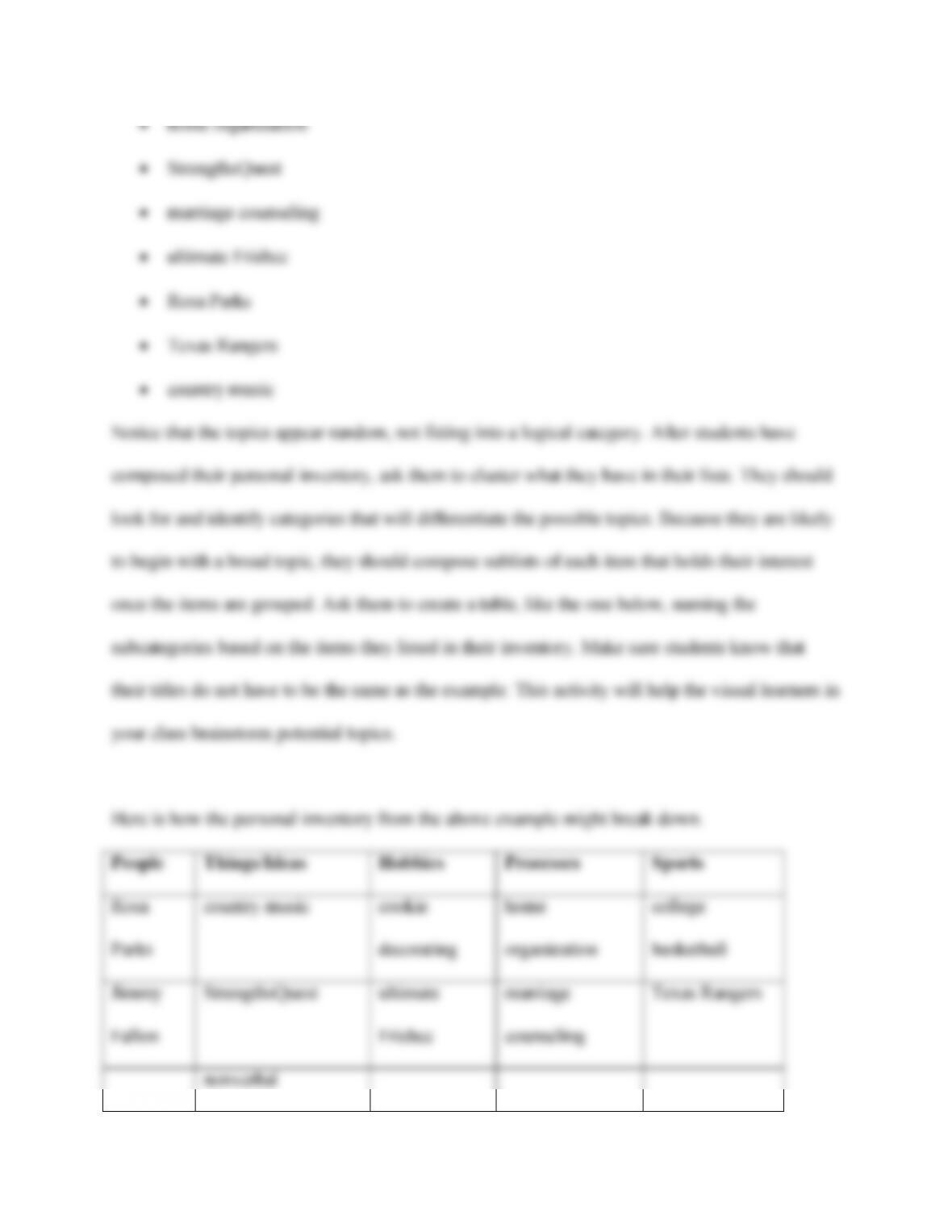
Making a Personal Inventory for Topic Selection (also for online courses)
Purpose: To help students select speech topics that are reflective of their personal interests.
Instructions: Students should begin by taking a personal inventory of their interests and
hobbies. Consider the following as an example:
My Personal Inventory
cookie decorating
Jimmy Fallon
college basketball
nonverbal communication

communication
Brainstorming Using Topic Mapping
Purpose: To give students an opportunity to try the topic mapping technique for brainstorming
speech topics.
Instructions: Using the word-association brainstorming technique, generate a list of fifteen to
twenty speech topics that are suitable for an informative speech. Start with some of the following
Crafting a Thesis
Purpose: To give students an opportunity to practice crafting proper thesis statements.
Instructions: Write five different thesis statements for five different topics. Be prepared to
report your work to the class.

class assignment. You can also ask students to write thesis statements that reflect different
The Impact of Demographics on Topic Selection
Purpose: To encourage students to consider how an audience’s demographic characteristics
affect topic selection.
Instructions: Describe those elements of an audience’s characteristics that affect topic selection
(e.g., age, gender, religion).
Students should list such things as age, gender, religion, and so forth. Have them discuss each
Narrowing a Topic
Purpose: To give students the opportunity to practice narrowing a topic.
Instructions: Start searching online or browsing with general keywords or topics, then narrow

One option for this activity is to reserve a computer room or lab on campus and have students
conduct an online search during class. Another option is to have students conduct an online
Brainstorming Informative Topics by Category
Purpose: To give students an opportunity to practice brainstorming informative topics by
category.
Instructions: List the categories for informative speeches on the board (objects, people, events,
concepts, processes, and issues). Have students generate a list of possible speech topics for each
category. Then vote on the most and least interesting topics. Discuss reasons for student voting
patterns.
IV. GROUP ACTIVITIES
Group Current Event/Local Issue Brainstorming

Purpose: To give students an opportunity to practice brainstorming topics based on current
events or local issues appropriate for the classroom audience.
Instructions: In a group of four or five people, list ten current events or local issues that would
Group Word Association Brainstorming
Purpose: To give students an opportunity to practice word-association brainstorming in a group.
Instructions: Try brainstorming a topic in a group of three to four people. One person should
write down the first word or phrase that comes to mind. That person then passes the paper to

Creating a Demographic Questionnaire
Purpose: To give students the opportunity to create a demographic questionnaire in a group.
Instructions: In a group of three to four people, formulate a questionnaire to be circulated
throughout the class asking for demographic information about the audience (e.g., gender,
academic major, ethnic or racial background, age, hobbies). The questionnaire can be altered by
each group member in order to obtain specific information that may relate to each person’s
speech topic.