89
VIDEO SCENARIOS
HOW TO COMMUNICATE: CROSS-CULTURAL COMPETENCE
This video feature shows students competent communication skills in action based on the
scenario following. The first video illustrates an ideal outcome, whereas the What if? activity
challenges them to apply their own skills to times when their communication partner is more
difficult. To access the videos, go to macmillanhighered.com/choicesconnections2e. Assign
students to watch the videos and answer the questions before class. During class, they will be
prepared to discuss the ways they would respond to each variation of the scenario.
1. Openly support Lily’s authority as group leader, even though you may see her as an
2. Avoid an open display of anger, instead keeping your face neutral or smiling and
3. Support the group sentiment, even though it may mean sacrificing your own desires.
“As there obviously is a consensus, I’m happy to support what everyone else in the group
wants to do.”
90
Instructor note: Online, students will be asked a multiple-choice question after the first video.
For Chapter 4, the question is as follows:
Which cultural influence is Paul acknowledging when he says “I’m happy to support what
everyone else in the group wants to do”?
A. Monochronic time orientation
[The * indicates the right answer. Depending on whether the student answers the question
correctly or incorrectly, one of these two feedback options should appear:
Right answer: Congratulations, you are correct!
Wrong answer: Incorrect. By minimizing his dissent, Paul is acknowledging the collectivist
cultures of his group members. See the sections “Individualistic versus Collectivistic
WHAT IF?
This section challenges students to adapt their skills and communication plans when things
don’t work out as shown previously. Students will view two videos. In each video, the
91
1. What if you realize Lily is trying to adapt to you when she says “Don’t let my position as
group leader keep you from expressing your own opinions. What do you really think
about my idea?”
• Remind students that although we want to respect Lily’s position as the leader, we still
want to make sure the group selects the best topic. For example, “I like your idea, but
2. How would you respond to Lily’s encouraging question: “I want to make sure everyone is
happy. Is there something you would rather do instead?”
• Help students recognize that being a supportive member of the group does not always
mean going along with the leader’s ideas. Presenting your ideas can be helpful if you
remain calm and help the leader and group see the advantages of examining various
CLASSROOM ACTIVITIES
1. Defining Culture Skits
Goal: To help students understand that cultures are learned, communicated, layered, and
lived
Time: 60 minutes
1. Divide the class into four groups.
2. Assign each group one of the following topics:
a. Culture is learned.
3. Give students 15 to 20 minutes to design a short skit to help demonstrate their topic
4. Have students perform their skits for the class, and then discuss how each concept
plays out in daily communication.
2. Kidney Transplant Committee
1. Make copies of the Kidney Transplant Committee handout following for your class.

2. Assign the students to five-member Kidney Transplant committees. Give each
committee a copy of the handout.
3. Inform the committees that they must each select four kidney transplant candidates
from the nine patients listed on the handout to receive the next four available
4. Bring all committees back together in a circle. The next task is for the entire class to
come to an agreement on the top four candidates as one large committee.
5. While the class is “debating” their decisions, you should jot down the various
6. Once the class has reached their decision, discuss the process they used to select
their final four candidates. Discuss whether or how stereotypes affected their
decision-making process. If time permits, strategize other less biased ways to make
the same decision.
ACTIVITY #2 HANDOUT
Kidney Transplant Committee
Tonight, the Kidney Transplant Committee of First United Hospital meets to consider
applicants for kidney transplants. Each of the patients described following has been evaluated
by the medical staff, and it has been determined that each patient will probably die in three to
six weeks without a transplant. The best statistical estimates are that only about four donors
will be available during that period. The committee must establish a priority list of who will
get the kidneys by selecting and ranking their top four applicants. They are as follows:
2. Maria Saxena. Age 39. Unmarried. College graduate; holds a Master’s in physical
3. Pamela Watson. Age 23. Married, no children. College graduate. Teaches history and is
4. Johnson Smith. Age 57. Divorced. Three children, a daughter 19 and two sons 17 and
15. High school graduate. Owner and operator of Smith Industries, a machine shop that
5. Morris Johnson. Age 11. One of seven children of Mr. and Mrs. Toby Johnson. Mr.
7. Bajah Penick. Age 34. Divorced. Three children, a daughter 7 and twin sons 5, all in her
8. Laura Parenti. Age 12. IQ 87. Teachers describe her as shy, withdrawn, and inhibited.
9. Juan Moralas. Age 47. Married, eight children. Migrant worker. Wife and three oldest
3. The Media and Stereotypes
1. For homework, ask students to print a picture of a character from a popular
television show or movie who negatively represents a culture or race.
2. Ask students to present their selections to the class and explain how the character
embodies common stereotypes. Why do they find the character’s behavior offensive?
4. Discrimination Do-Over
Goal: To help students understand that prejudice and discrimination come in a variety of
forms and learn how to apply the communication accommodation theory
Time: 25 minutes
1. This activity will work best if you begin by telling the class a personal story that
involves discrimination. Review the concept of the communication accommodation
2. Divide class into groups of four.
3. Each group member should tell the group a personal story that relates to one of the
following:
97
4. Ask each group to pick one of their stories and rewrite the situation using the
communication accommodation theory.
5. Have each group share their chosen story and then their “improved” version.
5. If the World Was a Village of 100 People
Goal: To help students understand the concept of world-mindedness and ethnocentrism
Time: 20 minutes
1. Divide the class into groups of three.
2. Ask students to imagine that the world is comprised of 100 people, and then have
3. Have the students return to the larger group, and then reveal the answers to each
4. This activity is based on the following Web site: http://www.100people.org
/statistics_100stats.php. To check on the latest figures and statistics for this activity,
visit the Web site for updates.

98
ACTIVITY #5 HANDOUT
a. Out of 100, how many would be from which major regions of the world?
_______ would be Asian
_______ would be African
_______ would be European
_______ would be from the Americas
b. Out of 100, how many would speak what languages?
_______ would speak Chinese
_______ would speak English
_______ would speak Hindi or Urdu
_______ would speak Spanish
_______ would speak Russian
_______ would speak Arabic
_______ would speak Bengali
_______ would speak Portuguese
_______ would speak Japanese
_______ would speak the 200 other languages
c. Out of 100, how many would practice what religions?
_______ would be Christians
_______ would not be aligned with a religion
_______ would be Muslims
_______ would be Hindus
_______ would be Buddhists

99
_______ would practice other religions
d. Out of 100, how many would have what degree of education?
_______ would have a college education
e. Out of 100, how many would own or share a computer?
_______ would own or share a computer
f. Out of 100, how many would be malnourished?
_______ would be dying of starvation
_______ would be undernourished
_______ would be overweight
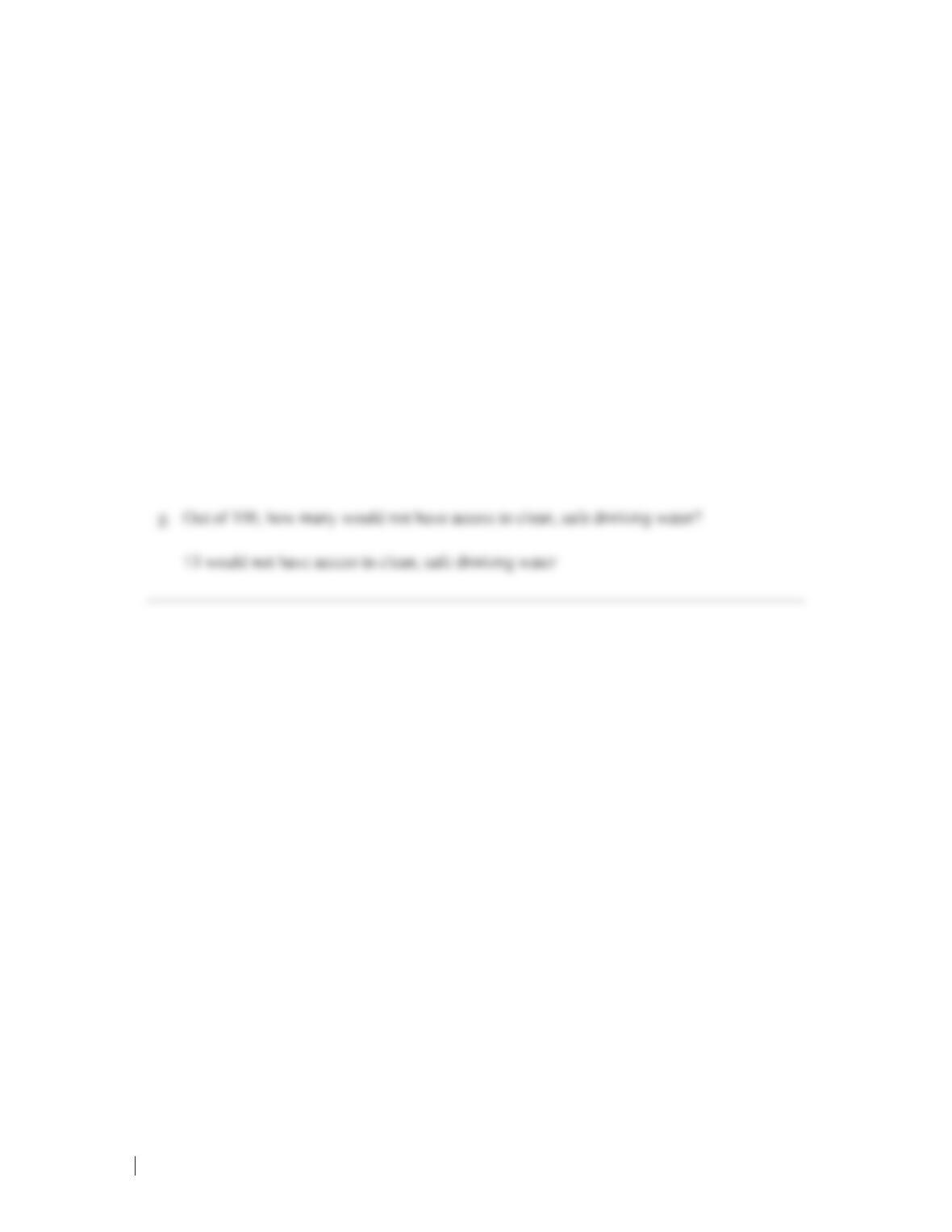
g. Out of 100, how many would not have access to clean, safe drinking water?
_______ would not have access to clean, safe drinking water

100
ACTIVITY #5 HANDOUT ANSWER SHEET
a. Out of 100, how many would be from which major regions of the world?
60 would be Asian
15 would be African
14 would be from the Americas
11 European
b. Out of 100, how many would speak what languages?
12 would speak Chinese
5 would speak Spanish
5 would speak English
3 would speak Arabic
3 would speak Hindi
3 would speak Bengali
3 would speak Portuguese
2 would speak Russian
c. Out of 100, how many would practice what religions?
33 would be Christians
22 would be Muslims
14 would be Hindus
7 would be Buddhists
12 would practice other religions
101
12 would not be aligned with a religion
d. Out of 100, how many would have what degree of education?
7 would have a college education
e. Out of 100, how many would own or share a computer?
22 would own or share a computer
f. Out of 100, how many would be malnourished?
1 would be dying of starvation
15 would be undernourished
21 would be overweight

MEDIA RESOURCES
1. Culturally Speaking: Individualism–Collectivism
This 4-minute video uses narration and a series of photos to explain the concepts of
individualism and collectivism in different cultures. It can be found on YouTube at
https://www.youtube.com/watch?v=4uFa0hBPqOY&list=PLBC30DF069745E20C.
2. Low- and High-Context Cultures
This 4-minute video uses narration and a series of photos to explain low– and high-
context cultures and how each affects communication. The narrator discusses
anthropologist Edward T. Hall’s ideas about high-context and low-context messages.
The video can be found on YouTube at https://www.youtube.com/watch?v=
3. Cultural Diversity Examples: Avoid Stereotypes While Communicating
This 1 minute and 50 second humorous video provides a great example of how important
it is to avoid using cultural stereotypes in effective communication. Two joggers meet and
quickly demonstrate the perils of judging someone by their looks. The video can be found
on YouTube at https://www.youtube.com/watch?v=XUO59Emi3eo.
4. Bend It Like Beckham (Kintop Pictures, 2002)
This movie provides a glimpse into the difficulties of blending traditional Indian culture

5. The Power of Vulnerability
This 20-minute TED Talk by Brené Brown discusses the importance of understanding