CHAPTER 33
MUTED GROUP THEORY
Outline
I. Introduction.
A. To Cheris Kramarae, language is a man-made construction.
B. Women’s words and thoughts are discounted in our society.
C. When women try to overcome this inequity, the masculine control of communication
places them at a disadvantage.
D. Women are a muted group because man-made language aids in defining,
depreciating, and excluding them.
II. Muted groups: Black holes in someone else’s universe.
A. Anthropologist Edwin Ardener first proposed that women are a muted group.
B. He noted that many ethnographers claimed to have “cracked the code” of a culture
without referencing female speech.
C. He and Shirley Ardener discovered that mutedness is caused by the lack of power
that besets any group of low status.
III. The masculine power to name experience.
A. Kramarae’s basic assumption is that women perceive the world differently from men
because of women’s and men’s different experiences and activities rooted in the
division of labor.
B. Kramarae argues that because of their political dominance, men’s system of
perception is dominant, impeding the free expression of women’s alternative models
of the world.
IV. Men as the gatekeepers of communication.
A. Even if the public mode of expression contained a rich vocabulary to describe
feminine experience, women would still be muted if their modes of expression were
ignored or ridiculed.
1. Kramarae points out that both the law and the conventions of proper etiquette
have served men well.
2. Kramarae observes that most gatekeepers are men—a “good ole boys” cultural
3. Mainstream communication is “malestream” expression.
B. Authors such as Virginia Woolf and Dorothy Smith have argued that women have not
been given their rightful place in history.
C. Many women have suppressed their feminine identity to satisfy the demands of a
male gatekeeper.
D. To some extent, Kramarae thinks advances in technology create new spaces where
women can make their voices heard.
V. Speaking women’s truth in men’s talk: The problem of translation.
A. Kramarae believes that in order to participate in society, women must transform
their own models in terms of the received male system of expression.
B. This translation process requires constant effort and leaves women wondering if they
said it right.
C. According to Kramarae, women have to choose their words carefully in a public
forum.
VI. Speaking out in private: Networking with women.
A. Kramarae believes that females are likely to find ways to express themselves outside
the dominant public modes of expression used by males.
B. She labels women’s outlets the female “sub–version” that runs beneath the surface
of male orthodoxy.
VII. Enriching the lexicon: A feminist dictionary.
A. The ultimate goal of muted group theory is to change the man-made linguistic system
that oppresses women including challenging sexist dictionaries.
B. Traditional dictionaries pose as authoritative guides to proper language use, but
because of their reliance on male literary sources, lexicographers systematically
exclude words coined by women.
Copyright © 2018 McGraw-Hill Education. All rights reserved. No reproduction or distribution without the
prior written consent of McGraw-Hill Education.
C. Kramarae and Paula Treichler have compiled a feminist dictionary that offers
definitions for women’s words that don’t appear in Merriam–Webster’s Collegiate
Dictionary and presents alternative feminine readings of words that do.
VIII. Sexual harassment: Coining a term to label experience.
A. The popularization of the term sexual harassment represents a great victory for
feminist communication scholarship—encoding women’s experience into the
received language of society.
B. Although unwanted sexual attention is not new, until recently it went unnamed.
C. The battle over sexual harassment is as much a struggle over language as it is over
sexual conduct.
1. Communication professor Ann Burnett (North Dakota State University) identifies
2. Uncertainty favors men—and mutes women—before, during, and after date rape.
IX. Critique: Do men mean to mute?
A. Feminist scholars insist that “the key communication activities of women’s
experiences—their rituals, vocabularies, metaphors, and stories—are an important
part of the data for study.”
B. The theory has inspired many scholars to take the voices of women and other muted
groups seriously.
C. Few other interpretive theories in this book can claim such wide-ranging support and
enthusiasm.
D. Steeped in the critical tradition, muted group theory is exceedingly candid about
trying to clarify values.
Key Names and Terms
Cheris Kramarae
Professor emeritus from the University of Illinois and research associate at the Center
for the Study of Women at the University of Oregon; leader in the study of muted group
theory.
Muted group
People belonging to low-power groups who must change their language when
communicating publicly and, thus, their ideas are often overlooked; e.g., women.
Edwin Ardener
A social anthropologist at Oxford University who first proposed the idea that women are
a muted group.
Shirley Ardener
An Oxford University researcher who collaborated with Edwin Ardener on the
development of muted group theory.
Virginia Woolf
Malestream expression
Traditional mainstream mass media, controlled by men.
Gatekeepers
Editors and other arbiters of cultures who determine which books, essays, poetry, plays,
film scripts, etc. will appear in the mass media.
Dale Spender
A British author who hypothesizes that men realize that listening to women would
involve a renunciation of their privileged position.
Paula Treichler
Kramarae’s collaborator on a feminist dictionary.
Sexual harassment
Principal Changes
This chapter has been edited for clarity. In addition, the discussion about the tech
industry has been altered to include the views of Sheryl Sandberg of Facebook. The brief
Kick-off Questions & Interaction Starters
• What’s the difference, if any, between being muted and being silenced?
• What are some ways that language favors certain groups over other groups?
• Does intention matter? If you’ve been muted or muted someone else, does it matter
if they meant to do it?
• What happens when something is lost in translation? Can it ever be reclaimed or
found?
Suggestions for Discussion
Consider students’ reactions
In our experience, students’ opinions regarding muted group theory tend to be rather
fiery—and not always in predictable directions. One Dale Spender quote cited in the critique
tends to elicit a mix of responses: “The crucial issue here is that if women cease to be muted,
men cease to be so dominant and to some males this may seem unfair because it represents
a loss of rights.” On some occasions, the male students will adamantly object to their portrayal
as controlling, exclusionary, or ignorant; alternatively, men might be reluctant to say anything
for fear of attack or of being seen to promote the type of domination Kramarae describes. The
responses of women are equally varied ranging from animated endorsement to perturbed
disagreement. Some women fiercely protest the characterization of women as powerless, a
point you may want to clarify. Kramarae does not assert that women have no power, but
instead she argues that they do not have equal standing with their male counterparts (and
some college women would maintain their disagreement, seeing sexism as something in the
Just one of the girls: Gender-specific language
The issue of gender-specific pronouns and terms is highly relevant to muted group
theory. You may have some students who are perplexed by—or perhaps even resent—the
implication that gender-specific language is sexist. They’ll protest, “Why do I have to say ‘he or
she’ when everyone knows that I include both males and females when I say ‘he’?” The Sapir–
Whorf hypothesis is a good vehicle for understanding the potential effect of non-inclusive
language. To turn the tables, it may be helpful to ask students how, for example, a male flight
attendant would feel if passengers referred to him by the supposedly generic term
“stewardess.” Or, to bring it closer to home, ask students how they might respond if, rather
than using the colloquial term, “guys,” an instructor referred to their students in the collective
plural as “ladies” or “gals”? Men may feel as though they weren’t being addressed or that
whatever was being said didn’t apply to them. Try it out on your class—begin by calling them to
doing the more difficult thing—and modifying their language. Kramarae might counter that
male students have no impetus to change since using the term “guys” serves their best
interest and maintains their position of power.
Contrasting Kramarae with Tannen, Harding, and Wood
If you have sequenced your course to follow the textbook’s layout, you will have
previously covered Tannen, Harding, and Wood’s perspectives on gender, and it is likely worth
a recap of where these three positions converge and their many points of divergence. Are
Tannen’s equality claims now more welcomed or viewed as rather mealy-mouthed? She is
likely easier for everyone to accept, but perhaps to some folks that middle ground fails to
produce a happy medium as no one is completely satisfied with the answer. In regards to
Constructing a new language
Along with sexual harassment, another legal issue that relates to muted group theory is
the traditional standard of the “reasonable man.” In the early 1990s, the 9th Circuit Court of
Appeals (Ellison v. Brady) argued for a “reasonable woman” concept that applies to situations
Other muted groups
In the quote from Kramarae that opens the chapter, she notes that not only women, but
also “members of other subordinate groups,” can be muted. Depending on the interests of
your students, you may wish to probe this additional dimension of muted group theory. How
are ethnic minorities, the poor, or members of the LGBTQ community muted in our society?
What alternative discursive modes—the equivalent of the female “sub–version” of discourse
other critical scholars tend to view as a socially powerful group), their lack of employment
rendered them powerless and muted.
Business ownership
Given their status as a muted group, Kramarae contends that women may seek
alternate avenues for expression when conventional channels are blocked. This trend may be
replicated in professions as well. Women have been historically under-represented in the
students how these choices (of a different career path or location for one’s business) may be a
reaction to being muted—but do they also keep women more compartmentalized? Are these
empowering moves, or do they contribute to hegemony? Could they do both?
Muted, not silenced
Kramarae contends that low-power groups are muted but not completely silent.
Traditionally, these groups have found other outlets that afford at least some avenues for
expression. By way of analogy, you might compare the mutedness and subsequent
resourcefulness of these groups with modern televisions. The sound does not stop when a
television channel is “muted,” we just can’t hear it. When the action continues without verbal
dialogue, something is lost. Many modern televisions are programmed so that, by default,
#metoo
As noted in chapter 3, both empirical and interpretive theorists value theories that have
practical application and can help to create positive societal changes. Teaching muted group
theory can sometimes be an uphill battle as students may wince at Kramarae’s strong stance
on intentionality and implication that mutedness is anything but accidental. You might consider
in the wake of allegations raised by actors Alyssa Milano and Rose McGowan, the hashtag
#metoo became a rallying cry. Time Magazine named the “silence breakers” as persons of the
year for 2017 for their ability to push harassment into the spotlight and to call for reform
across a variety of domains. One important point you might want to raise with students is that
these stories of harassment, abuse and rape have spanned many years and, in most cases,
the situation persisted despite being reported by the female victims. Kramarae is likely not
When might men be muted?
When Andrew teaches the chapter, he tries to frame muting as a potential experience
for many people by addressing occasions when men might feel muted. Certainly, this must be
done carefully in order to avoid doing violence to Kramarae’s central contention, which is that
the nature of society (and particularly language) strongly favors men. Still, it is worth
considering whether there be cases where certain streams of discourse favor women. Toward
that end, Andrew relates the experience of being an expectant father, walking into a baby store
with its pastel (feminine) colors, and seeing a slogan emblazoned on a carseat: “Graco—Ask
Moms Who Know.” (Apparently a father can’t have an informed opinion on a carseat?) That
store also had a breastfeeding room for women—totally understandable—but did not provide
Sample Application Log
Anders
Learning about Muted Group Theory was a fascinating and, to be honest, somewhat
uncomfortable lesson. Thinking about how often I regularly greet my group of friends (males
and females) by saying “hey guys” or text something along the lines of “when do you guys want
to meet” for whatever event we have planned for that night, is much more frequent than I
would care to admit. Reading Kramarae’s theory of how this kind of language is completely
self-serving for males was undoubtedly convicting.
A couple days after reading Kramarae’s ideas about women as a muted group, I
witnessed a situation that would have made Kramarae shudder. On a plane to Phoenix, I sat in
a row with a male who was in his thirties and a female who was a sophomore in college. I
overheard their conversation as I tried to focus on my homework. About halfway through the
conversation, though, my ears perked up. The male was talking about his college experience
and explained how he had multiple “girls” who were his friends. He then began talking about
his male friends as “guys.” The male realized the problem with using that word to describe
Exercises and Activities
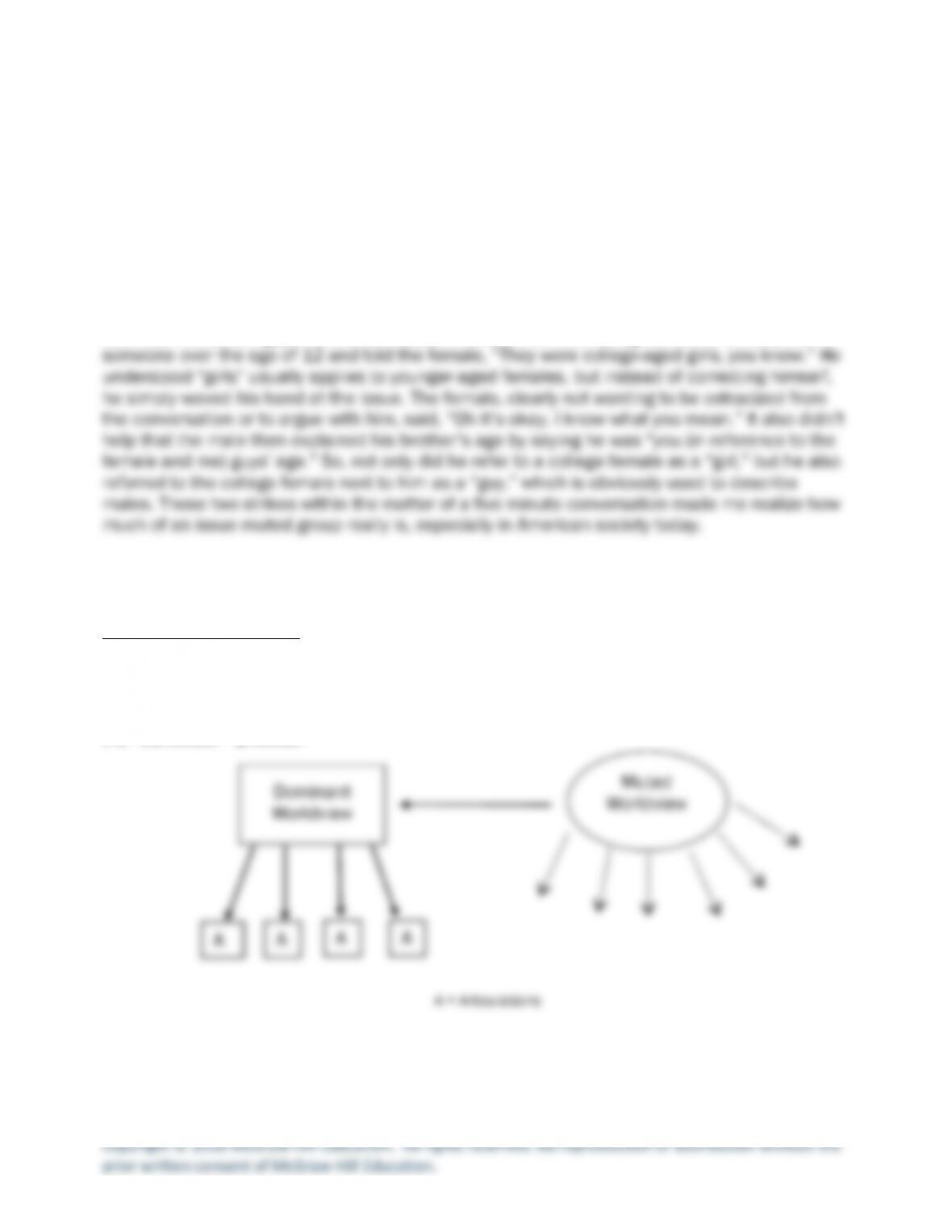
Diagramming mutedness
I have found it useful to show the diagram from Kramarae’s Women and Men Speaking
and to ask students how they would explain it to someone unfamiliar with the muted group
theory. How does this process of mutedness occur so that the experiences of one group must
be translated into the language of the other before they can be articulated? What happens in
the “translation” process?
Is it possible that there are some messages that lack an appropriate translation and as such
are lost? Often, this question can promote an interesting discussion about what has been lost
in translation over the ages and how women (and other muted groups) have found methods of
Copyright © 2018 McGraw-Hill Education. All rights reserved. No reproduction or distribution without the
prior written consent of McGraw-Hill Education.
getting their messages across. While parts of the message get through, there are other
nuances that simply cannot be translated and over time, they are just lost. If you have non–
native English speakers in your class, or students particularly skilled at another language, you
might ask them for examples of things that just don’t have an English language equivalent.
What ideas are only partially correct or, worse yet, missed entirely, if understood only in
English?
Talking about experiences of muting and mutedness
When Em Griffin taught this chapter, he asked his students—who had just returned from
their mid-class break—to divide into two groups, male and female, then sit on opposite sides of
the room, facing one another. Next, he had the women discuss, without interruption from the
men, their experiences with being muted or with muting others. After the women had spoken
for fifteen minutes, the men were asked to take their turn discussing their experiences. In
Griffin’s experience, his female students tended to emphasize moments when they have been
they have felt muted. The responses from students indicate that they have felt muted as
women and as men; as members of different races; based on religious groups; and so forth.
He then reads these anonymous descriptions to the class. Stories like these reveal the
pervasive experience of mutedness without placing burden on a student to share in the semi-
public context of the university classroom.
Women translating for men
This exercise addresses Kramarae’s assertions about translation. For a portion of your class
period, “mute” the male members of your class by insisting that anything they want to
contribute must be expressed by one of their female counterparts. In other words, they need
to make themselves understood first to a woman in the class who will then be allowed to edit
or modify the contributions as she sees fit and share them publicly. Instruct the women that
they should not make especially exaggerated attempts at clarity but instead express the ideas
in a way that makes sense to them. When you debrief the experience, ask the men if they felt
Is muted group theory outdated? Is it happening on your campus?
To some of your students, muted group theory may have the unpleasant taste of “being
PC” (politically correct), or to be more blunt, male-bashing. Some will suggest that the
problems raised by Kramarae and her associates may have been the concerns of previous
generations of women, but no longer affect the modern generation. On the other hand, it is
important for those students who may not feel muted to understand that many of their
contemporaries do. Even in colleges and universities, where equality and freedom of speech
are supposed to give everyone a voice, many members of our communities feel stifled in
certain contexts. The problem is not confined solely to the experiences of students. Female
faculty members are not always accorded the same level of status, despite having similar
degrees. You might have seen this trend: male faculty members are often referred to in casual
Feature film and literature illustrations
Given the explosion of super hero and comic book movies, it’s rather surprising that
Wonder Woman (2017) is the first major solo film for a female heroine. Despite being a
mainstay in the Marvel Comics universe, Black Widow has yet to have her own movie, thereby
silencing her. Her role has been as a supporting cast member, in the Iron Man films and
others, suggesting she doesn’t merit being in the spotlight. The same questions might be
raised regarding Storm in the X-Men series. Upon its release, Wonder Woman (2017) was a
You might also consider illustrating your discussion of muted group with segments from
The Little Mermaid. Ariel, the mermaid, is compelled to win the heart of her beloved without
speech—giving up her “voice.” The film’s “message” may spark a lively discussion among your
students.
A forward-leaning nineteenth-century novel that demonstrates that awareness of the
limitations of man-made language is hardly new is Thomas Hardy’s Far from the Madding
Crowd. When, for example, the heroine, Bathsheba Everdene, is pressured by one of her
suitors, Boldwood, to clarify her sentiments about him, the following exchange ensues
(Boldwood begins):
It is also interesting to note that in 1920, Virginia Woolf wrote insightfully of the
communicative quandary faced by Hardy’s heroine and the real-life women she represents. In
an essay entitled “Men and Women” (Books and Portraits: Some Further Selections from the
Literary and Biographical Writings of Virginia Woolf, ed. Mary Lyon [London: The Hogarth
Press], 28-30), Woolf declared that from Bathsheba’s dilemma “arise infinite confusions and
complications. Energy has been liberated, but into what forms is it to flow? To try the
Further Resources
One of the great fictional example of women as a muted group is Margaret Atwood’s dystopian
novel The Handmaid’s Tale, Fawcett Crest, New York, 1986, which is also available as a 1990
film and, in 2017, was released as a streaming TV series on Hulu.
Theoretical considerations
Copyright © 2018 McGraw-Hill Education. All rights reserved. No reproduction or distribution without the
prior written consent of McGraw-Hill Education.
Cheris Kramarae, “Muted Group Theory and Communication: Asking Dangerous
Questions,” Women & Language, Vol. 28, 2005, pp. 55–61.
Julia T. Wood, “Feminist Standpoint Theory and Muted Group Theory: Commonalities and
Divergences,” Women & Language, Vol. 28, 2005, pp. 61–64.
Sexual harassment & violence
Ann Burnett,Jody L. Mattern, Liliana L. Herakova, David H. Kahl Jr., Cloy Tobola, and Susan E.
Bornsen, “Communicating/Muting Date Rape: A Co-Cultural Theoretical Analysis of
Online & digital contexts
Jesse Fox and Wai Yen Tang, “Women’s Experiences with General and Sexual Harassment in
Online Video Games: Rumination, Organizational Responsiveness, Withdrawal, and
Coping Strategies,” New Media & Society, Vol. 19, 2017, pp. 1290-1307.
Melonie Fullick, “‘Gendering’ the Self in Online Dating Discourse,” Canadian Journal of
Communication, Vol. 38, 2013, pp. 545-562.
Judith Hoover, Sally Hastings, and George Musambira, “‘Opening a Gap’ in Culture: Women’s
Uses of the Compassionate Friends Website,” Women & Language, Vol. 32, 2009, pp.
82–90.
Politics
Jennifer J. Jones, “Talk ‘Like a Man’: The Linguistic Styles of Hillary Clinton, 1992–
2013,” Perspectives on Politics, Vol. 14, 2016, pp. 625-642.
Tetyana Lokot, “#IAmNotAfraidToSayIt: Stories of Sexual Violence as Everyday Political Speech
on Facebook,” Information, Communication & Society, Vol. 21, 2018, pp. 802-817.
Language, humor and sexist jokes
Robyn K. Mallett, Thomas E. Ford, and Julie A. Woodzicka, “What Did He Mean By That? Humor
Decreases Attributions of Sexism and Confrontation of Sexist Jokes,” Sex Roles, Vol. 75,
2016, 272–284.
Other applied contexts

Katherine Grace Hendrix and Cicely Wilson, “Virtual Invisibility: Race and Communication
Education,” Communication Education, Vol. 63, 2014, pp. 405-428.
Jamie L. Huber, “Singing It Out: Riot Grrrls, Lilith Fair, and Feminism,” Kaleidoscope: A
Graduate Journal of Qualitative Communication Research, Vol. 9, 2010, pp. 965-985.