Chapter 3
Verbal Communication
C
CHAPTER OBJECTIVES
• Understand that because language is imperfect and because words have different meanings for
different people, we must work to achieve a shared meaning.
CHAPTER OUTLINE
CHAPTER INTRODUCTION
• The chapter begins with a situation involving roommates who started off as the best of friends
but found themselves in a problematic situation after living together for a year. Robert was
prioritizing his money elsewhere and therefore did not have money for rent. Fernando did not
THE NATURE OF VERBAL COMMUNICATION
• Verbal communication is the exchange of messages using language.
• Language is a standardized use of words that is shared by a community of persons.
• Language Is Rule Based.
Semantic rules govern the meaning of words.
• Language Is Literal and Figurative.
The denotative meaning is a word’s exact, literal definition.
Connotative meanings are associations that come to mind when you hear or read a
word. A word’s connotative meaning may have little resemblance to its denotative
meaning.
• Language Is Dynamic.
There is no fixed form of any given language; instead, “human languages are in constant

• Language Is Contextual.
The meanings of words are context dependent, which means that the same word can
VERBAL COMMUNICATION AND THE CHALLENGE OF UNDERSTANDING
• A goal of effective communication is the creation of shared meaning, in which the participants
in a communication interaction come to a common understanding with little confusion and few
misinterpretations.
• Language Is an Imperfect Vehicle for Understanding.
No person knows all the words and rules of the language that he or she speaks.
• Concrete words are specific and suggest exactly what you mean.
Jargon consists of specialized or technical words or phrases that are familiar to people in
a specific field or group.
Improper use of words
• Improper word choice occurs when a communicator uses a word that does not
THE EFFECTS OF VERBAL COMMUNICATION
• Uses of Language
Whether expressed as the functions of language or as the objectives of a communicator,
theorists and philosophers of language have noted a number of language uses.
Sharing information
• In our interactions with others, we often provide information about ourselves
and our world or learn such information from others.
Influencing others

• Abuses of Language
Words have the power to accomplish great good and also can have negative
consequences.
Biased language is the use of words that suggest prejudice or preconceptions about a
group of people, based on shared characteristics.
terminate the interaction.”
GUIDELINES FOR VERBAL COMMUNICATION
• Make Your Message Clear.
Consider your listeners or readers.
• In most situations, the best way to ensure that you’re using understandable
• Rather than simply stating your point and moving on, you might ask audience
members what they thought you said.
• Make Your Message Considerate.
Avoid stereotypes.
• Stereotypes are offensive to the people who are labeled. They also hurt the

• When a person’s ethnicity, religion, gender, or sexuality is not relevant to a point
you are making, there’s no need to mention it when referring to that person.
Appropriate language and political correctness.
• The rationale for using appropriate language is that biased words can cause pain,
particularly when somebody’s identity is threatened.
• Make Your Responses Respectful.
Work for accurate understanding.
L
LIST OF KEY TERMS
verbal communication
language
semantic rules
syntactic rules
improper word choice
equivocal language
persuasion
biased language
immutable characteristics
C
CLASS DISCUSSION QUESTIONS
1. Failure to check for understanding: Have you ever had questions about a concept or an issue that
you did not ask aloud (perhaps when you sat in a college classroom or while you were being given
instructions)? Why did you remain quiet? If you are not comfortable asking questions aloud, what
are some other ways you can ask your questions for better understanding and comprehension? What
are the ramifications of not asking questions for clarification?
• How often do people go along with things for the sake of going along with them? Students
2. Using concise language: Have students reflect on how often we incorporate unnecessary words in
class papers to reach the appropriate word count. What additional words and phrases do you use to
lengthen sentences? How can you meet the word count in the future without using unnecessary
words?
• The chapter discusses the use of verbal clutter and the need to avoid it. Although writing a
paper is not the same as having a face-to-face conversation, the use of clutter in essays and
research for the sake of meeting a word count is inevitable. Students should be encouraged
3. Describe some experiences where you’ve used gender-neutral terms. How does the use of gender-
neutral terms help us to become better communicators?
• This question can be the start of a stimulating discussion. Depending on the backgrounds of
the students in your class, they might present very different views on this topic. However the
4. Did you ever have a misunderstanding with friends due to use of abstract words? If you need to
take out your phone to review some text messages in order to recall, feel free to do so. What other
or additional words could have been used to provide clarification?
• The use of text abbreviations can add to the abstract factor of conveying a message. We tend
to seek information quickly and concisely, and sometimes that comes with consequences,
5. Have you been in situation where the actions of others made you feel inadequate (as if you
weren’t good enough)? If so, how did you communicate your feelings, if at all? As a class, write
down a series of “You” statements on the board as a class and change them to “I” statements.
Discuss how word choice affects how a message is received.
• Word choice is an important part of having a productive conversation. Students should keep
in mind that they are in control of their responses to others. The chapter discusses
A
APPLY YOUR SKILLS
APPLY YOUR SKILLS FROM CHAPTER 3
1. Look at the “Apply Your Skills” activity on page 101 in the text. After students complete the
activity, have them answer the following questions, either in a small group, in a class discussion, or
in writing:
• Conversely, do you think you have caused flooding at any point in your life? If so, what was
the situation?
MORE “APPLY YOUR SKILLS” IDEAS
1. Review the illustration “Fernando …” on page 66 in the text. Take out a sheet a paper, and write
2. Review the illustration “Semantic Rules” on page 69 in the text. What are some interpretations of
“Don’t take that class! The professor is TOUGH!” What can tough mean to different people?
P
PERSONAL WRITING ASSIGNMENTS
1. Words are powerful: Have students think of a time when they had a disagreement with a friend
2. Jargon reflection: Have students think of a time when they were around a group of people (or an
instructor) using jargon. Have them describe their response to that jargon. Did they suddenly
become better communicators, or did they find themselves without much to say? Provide reasons
3. Persuasion with words: Is it safe to assume that we all have influenced someone? Have students
think of a time when they successfully influenced someone with their use of words. What was the
CLASSROOM ACTIVITIES
1. Have students take out a sheet of paper and write eight to 10 slang words or acronyms that are
commonly used by people in their generation. Have them compare lists with a neighbor and discuss
when and where they first heard the terms. Were these slang terms used previously, or did their
generation invent them? Ask them if they use those terms when speaking with people outside their
generation and whether those outside their generation tend to understand them.
3. Have students make a list of five words that can have multiple meanings. Have them write down
4. Have students think of their current job (if they have one) or the profession they’d like to enter.
5. The metaphoric wine glass: Have students take out a sheet of paper and draw a picture of a wine
glass. Students should name their glasses after themselves and then fill them with mean words and

A
ADDITIONAL MEDIA RESOURCES AND ACTIVITIES
1. Search for and listen to John Mayer’s song “Say” from his Continuum album (2007). After
reviewing the lyrics, how can we apply the chorus to our own lives? In what instances is it beneficial
to express your feelings? In what instances is it detrimental to express your feelings?

H
HANDOUTS AND READY–TO–PRINT ACTIVITIES
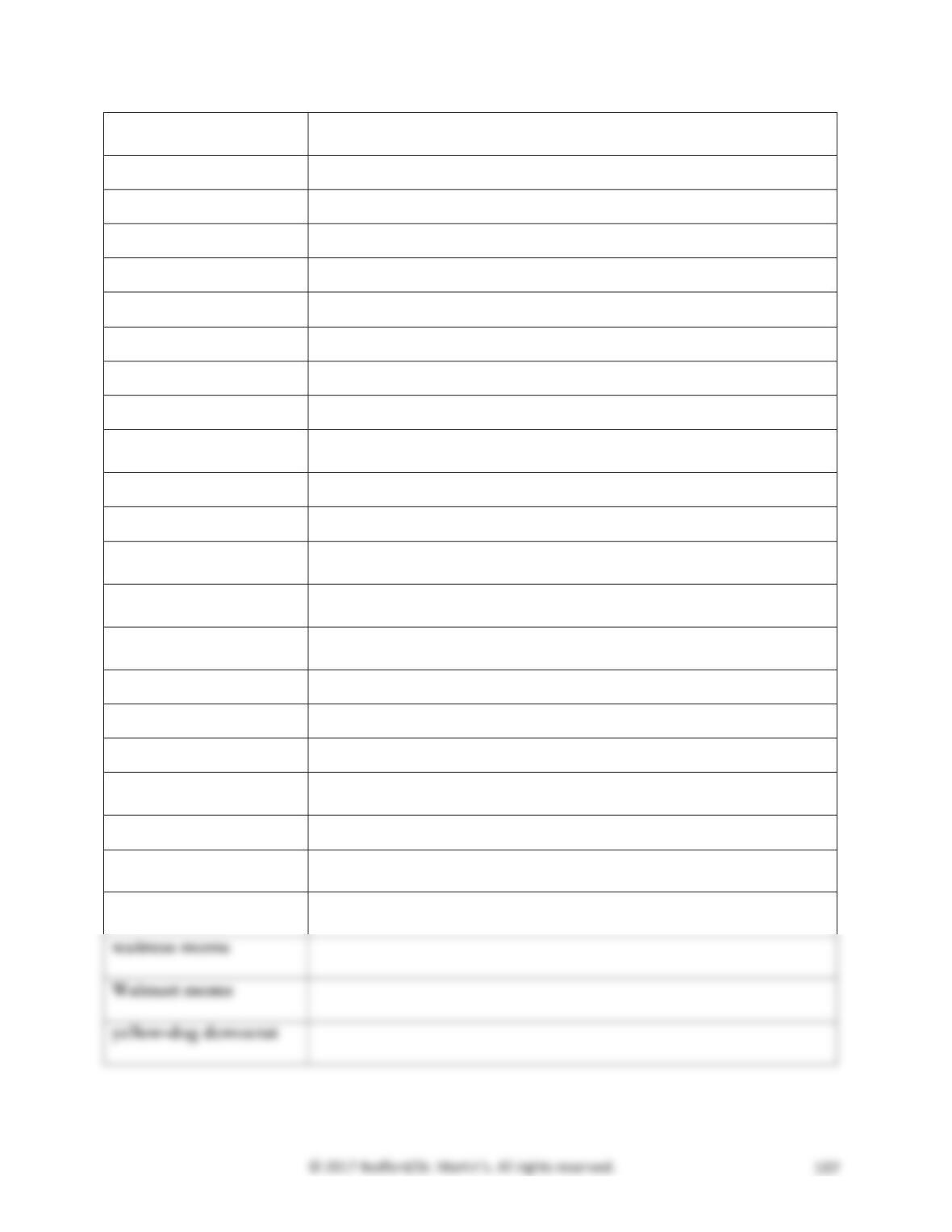
Making Sense of American Political Jargon
If you have watched American television news shows on networks like MSNBC,
CNN, and Fox News, you’ve heard political jargon. Although it may be common to
“tune out” jargon that when you aren’t familiar with, understanding what
commentators and politicians are referencing is essential to decoding their
messages—and to being an informed citizen. Below are political terms from
(2016) that require definitions. Take 10 minutes of class
time to write what you think the definitions are. Then take the worksheet home,
search for the definitions as interpreted by politicians, and record them as well. How
do your definitions compare?
anchor baby
angry white men
astroturfing
Beltway bandits
birther
hockey mom
horserace
inside baseball
Joe Sixpack
lane
the left
NASCAR dad
pundit
purple state
red state
straw votes, straw polls
swing state
talking head
tree hugger
TV hit
2016er
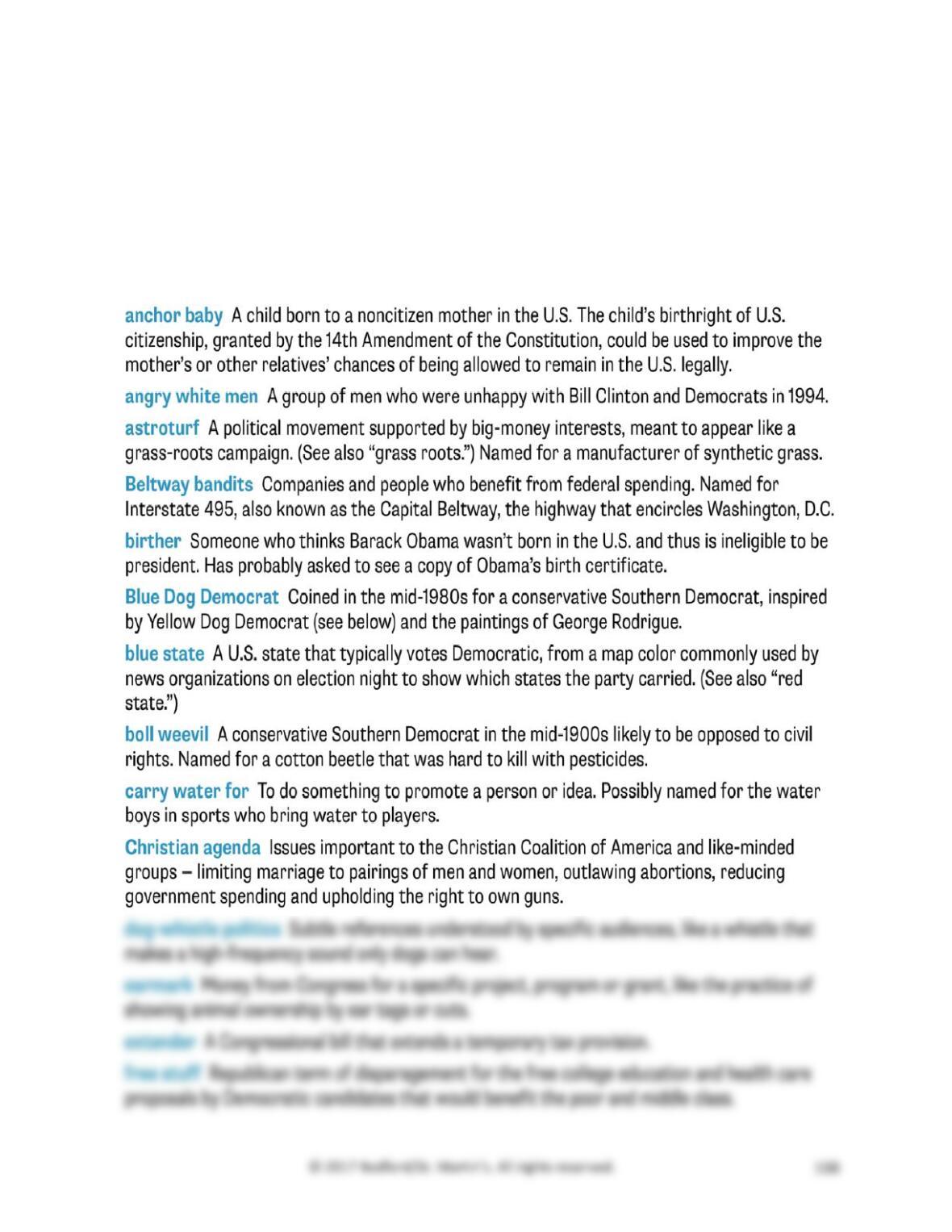
Answer Key:
Making Sense of American Political Jargon
The following definitions were taken from an article by Nicholas Johnson titled “American Political
Jargon” (2016). The article can be found at http://www.bloomberg.com/quicktake/american-
political-jargon.