CHAPTER 28
USES AND GRATIFICATIONS
Outline
I. Introduction.
A. Instead of asking, “What do media do to people?” Katz flipped the question around
to ask, “What do people do with media?”
B. People make daily choices to consume different types of media.
C. The theory attempts to make sense of the fact that people consume an array of
media messages for all sorts of reasons, and the effect of a given message is
unlikely to be the same for everyone.
II. Assumption 1: People use media for their own particular purposes.
A. The study of how media affect people must take account of the fact that people
deliberately use media for particular purposes; this is Katz’s fundamental
assumption.
B. Audiences are not passive.
C. Uses and gratifications theory emphasizes that media choices are personal and can
change over time.
III. Assumption 2: People seek to gratify needs.
A. The deliberate choices people make in using media are presumably based on the
gratifications they seek from those media.
IV. Assumption 3: Media complete for our attention and time.

Copyright © 2018 McGraw-Hill Education. All rights reserved. No reproduction or distribution without the
prior written consent of McGraw-Hill Education.
A. Different media compete with each other for your time as well as other activities that
don’t involve media exposure.
B. The need that motivates media consumption must be identified in an effort to
understand why people make the choices they do.
V. Assumption 4: Media affect different people differently.
A. Audiences are made up of people who are not identical.
B. These differences determine the outcome or gratification a consumer receives.
VI. Assumption 5: People can accurately report their media use and motivation.
A. If uses & gratifications theory was to have any future, researchers had to find a way
to uncover the media that people consumed and the reasons they consumed it.
B. To discover why people consume media, they must be asked.
C. The controversial aspect of this measurement strategy is whether or not people are
truly capable of discerning the reasons for their media consumption.
D. Scholars have attempted to show that people’s reports of the reasons for their media
consumption can be trusted, but this continues to be debated.
VII. A typology of uses and gratifications.
A. For the last 50 years, uses & grats researchers have compiled various lists of the
motives people report, constructing a typology of major reasons for exposure to
media.
B. A typology is simply a classification scheme that attempts to sort a large number of
specific instances into a more manageable set of categories.
C. Rubin claims that his typology of eight motivations can account for most
explanations people give for why they watch television.
2. Companionship.
4. Enjoyment.
6. Relaxation.
8. Excitement.
D. Each category is relatively simplistic but can be further subdivided.
E. Rubin claims that his typology captures most of the explanations people give for their
media consumption.
F. Researchers have argued for including habitual watching as a possible motive for
media use.
VIII. Parasocial relationships: Using media to have a fantasy friend.
A. Consumers develop a sense of friendship or emotional attachment with media
personalities.
B. Parasocial relationships can help predict how media will affect different viewers in
different ways.
C. In the same way uses & grats could be used to study TV-viewing, it also holds
potential for studying social media.
IX. Beyond TV: Uses & grats in the age of new media.
A. S. Shyam Sundar, founding director of the media effects laboratory at Penn State,
believes technologies such as social media challenge the notion that people use
media to satisfy needs that arise from within themselves.
B. Media technology itself can create gratification opportunities that people then seek.
C. Whether or not Sundar is right that gratifications may arise from technology rather
than ourselves, it seems that the gratification possibilities that emerge with new
media aren’t quite the same as the ones formulated when TV ruled the mass media
world.
X. Critique: Heavy on description and light on prediction?
A. For some, the emphasis on description rather than explanation and prediction is one
of the theory’s weak spots.
B. Jiyeon So notes that uses & gratifications theory was never intended to be merely
descriptive; it was originally designed to offer specific predictions about media
effects.
C. The propositions that people use media to gratify particular needs and that those
needs can be succinctly described using eight categories seem relatively simple.
D. Scholars question the testability based on whether or not people can accurately
report the reasons for their media use.
Key Names and Terms
Elihu Katz
Hebrew University Professor emeritus who proposed that studying the media choices
was important enough to save the field of communication.
Uniform Effects Model
The view that exposure to a media message affects everyone in the audience in the
Typology
A classification scheme that attempts to place a large number of specific instances into
a more manageable set of categories.
Parasocial relationship
A sense of friendship or emotional attachment that develops between TV viewers and
media personalities.
Principal Changes
This chapter has been edited for clarity. In addition, new research from twin studies
shows that media choices are partially driven by wired-in genetic predispositions. The concept
of parasocial relationships in the age of new media is also discussed.
Kick-off Questions & Interaction Starters
• How did you use media, if at all, last night? What other options did your media use
compete with?
• Do you know why—or could you explain—why you choose to use a specific medium?
• Do you think people can accurately explain their reasons or motives when it comes to
media use?
• Do men and women use media for similar reasons or are there gender-specific
rationales for our media use?
• Assuming the theory is true and people are motivated to use media to meet a certain
need, is there also a parallel rationale for non-media use?
Suggestions for Discussion
A need by any other name
Exploring Katz’s uses & gratifications theory can often result in a discussion of needs.
In modern psychology, Abraham Maslow’s Hierarchy of Human Needs is arguably the best-
Media Dependency?
In using the language of psychological needs and gratifications, a subtle but important
implication is made. Needs are necessary conditions for life, and often they are universal
(such as food, water, and sleep), and clearly differentiated from wants (a non-essential desire).
By classifying media messages by the needs they fulfill, it may tacitly imply that media can
therefore be life sustaining. For some people (including some of your students), this may be a
bridge too far. But you may consider dialoging with them about our society’s growing
dependency on media to fulfill important needs. While media might not be the only method to
reach satiation, is it the one upon which they are growing increasingly dependent? There are
It is worth noting, though, that in many cases, the above analogy between media use
and alcohol may be too strong. In some cases, media use may be more like food, in that it
Negative bias or too easy
As demonstrated in the theories featured in A First Look, it isn’t hard to find scholars
who take a somewhat dim view of media. Harkening back to Turkle (critique section of ch. 10),
McLuhan (ch. 25), Barthes (ch. 26), and Hall (ch. 27), and looking forward to Gerbner’s
cultivation theory (ch. 29) and McCombs and Shaw’s agenda setting (ch. 30), you might
consider prompting your students to think, if taken together, aren’t we rather hard on media?
Clearly, theorists like Neil Postman believe that media consumption is nothing short a
horseman of the Apocalypse. In his 1985 manifesto, Amusing Ourselves to Death, Postman
Non-use typology
Katz speculates that users’ media consumption is motivated by drives or desires. The
usage of that media then provides some gratification. We scratch our media itches and are
fulfilled. It makes me wonder if a typology ought to be constructed for non-media use too.
Making the same assumptions about active choice and volition, users may opt out
Sample Application Logs
Hannah
My parents and my brother were often in conflict growing up because my brother spent so
much time using electronics. For our parents, his gaming was merely enjoyment and an
escape from his other school work. They wanted him to focus and he just wanted to play. For
my brother, media usage was studying (similar to Rubin’s idea of watching TV as a means of
information). He wanted to be a video game designer, so he played a lot of video games and
Exercises and Activities
Charting the theory
Uses & grats represents a theory from the socio-psychological tradition. This might be a
good time to remind students of some of the tenets shared by this camp of theorists. As
presented in chapter four, this tradition focuses on the discovery of truth by careful, systematic
observation. The theorists will look for cause-and-effect explanations in order to predict future
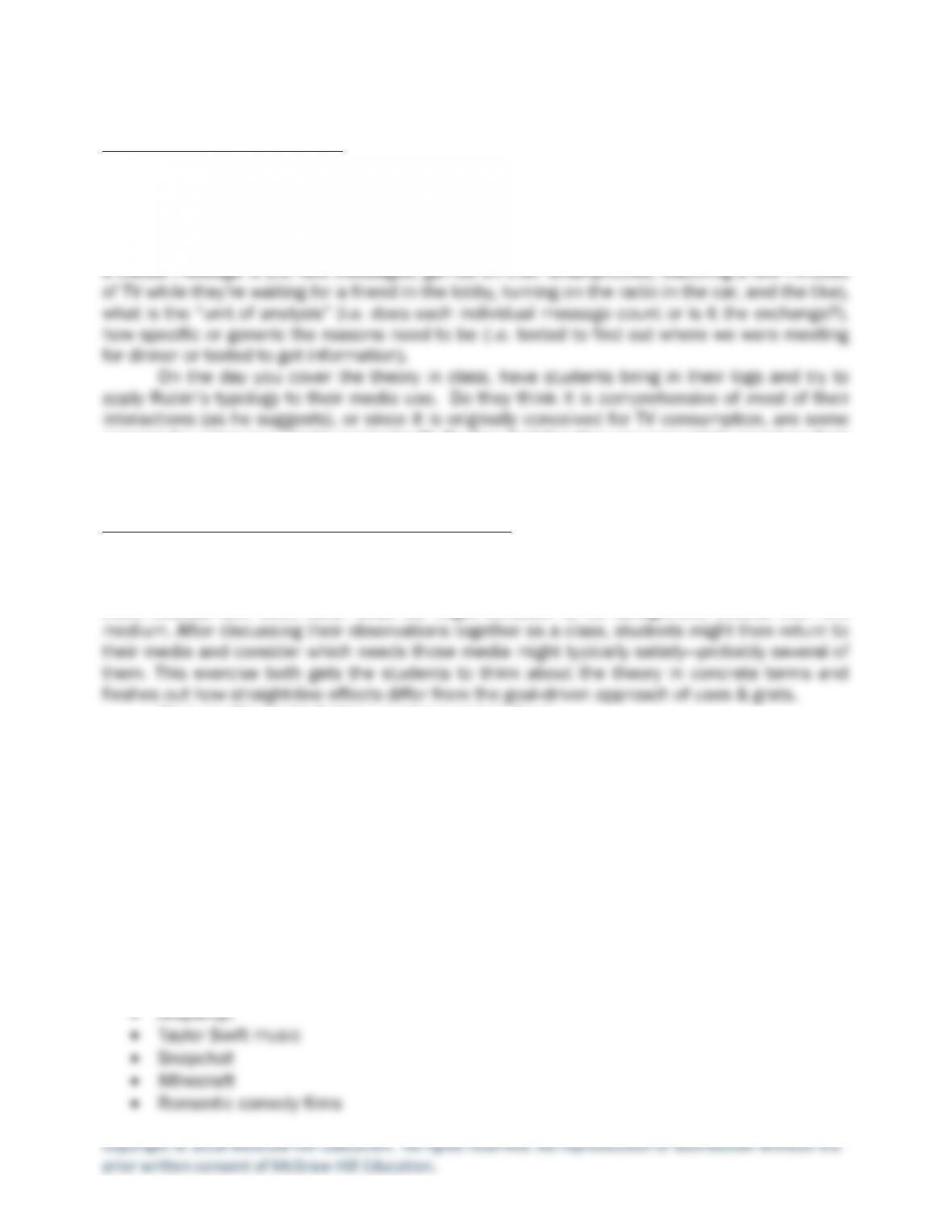
From a socio-psychological tradition, then, each of those elements (or variables) can be
operationalized, measured, and quantified in order to reach conclusions. Personal traits may
be explained as elements of one’s personality, identity, or personal make-up. For example, you
might be a particularly active person who likes to keep busy and who doesn’t tolerate
downtime very well. The second variable is the needs that arise for a person based on their
hand, watching an episode of Game of Thrones won’t likely disappoint with its high body count
and unexpected plot twists. The fourth and fifth elements, use of media and perceived
gratifications, are at the heart of uses & grats. Here, theorists rely on the self-reflections of
users to accurately report what media they choose and what they got out of it.
The theory assumes conscious and strategic choice when selecting media. As Katz
contends, it’s not what media does to us, it’s what we do with the media. Remember to
Based on your own experience
It may be useful to ask your students to conduct a 24-hour diary experiment before you
cover this chapter in class. Using a few concise descriptors, have them record their media
usage for a 24-hour period and give some reason or motive. I shy away from giving them
Rubin’s categories to start, choosing instead to let the students supply one- or two-word
descriptions. You will likely have to prompt them with some specific parameters, such as what
reasons for using new media overlooked? Do they feel like they can accurately report on their
own rationale? Self-report is both the strength and the kryptonite for uses & grats: the theory
claims people can tell you why, but critics doubt the veracity of those statements.
Considering straight-line effects versus uses & grats
Recently, when Andrew taught this theory, he listed several types of media on small
slips of paper and put them into a bag. Students split up into pairs and drew from the bag. You
could have students draw one medium or several if you want them to compare. Then, he had
them discuss with each other what we might consider to be straight-line effects from the
Here are the media Andrew used in a recent class:
• Full House re-runs
• Call of Duty
• CNN
• The Real Housewives of New York City
• Harry Potter novels
• Game of Thrones
• Instagram
• The Rush Limbaugh Show (on the radio)
• The Super Bowl
• Mario Kart 8
• Mozart’s symphonies
• Pokémon Go
• Twitter
• The Little Mermaid
• The latest issue of The Wall Street Journal
• Star Wars Episode VIII: The Last Jedi
Uses & grats in sports
If you or your students are interested in sports, you might bring in some of the research
on how uses & grats has been applied to sports. Earnheadt and Haridakis (2008) explored the
concept of motives when it comes to sports and team identification. What motivations drive
fans so strongly that they will expend large amounts of time, money, and effort to follow their
favored team or player? As you might guess, they discussed that fans vary in their reasons for
following a given sport or team and they believe fans are able to articulate the why question
just as Katz believes that media consumers can.
Further Resources
Theoretical considersations
Sarah M. Coyne, Laura M. Padilla-Walker, and Emily Howard, “Emerging in a Digital World: A
Decade Review of Media Use, Effects, and Gratifications in Emerging
Adulthood,” Emerging Adulthood, Vol. 1, 2013, pp. 125-137.
Hui-Fei Lin and Chi-Hua Chen, “Combining the Technology Acceptance Model and Uses and
Applied contexts (general)
Kristin M. Barton, “Why We Watch Them Sing and Dance: The Uses and Gratifications of
Talent-Based Reality Television,” Communication Quarterly, Vol. 61, 2013, pp. 217–
235.
Bela Florenthal, “Applying Uses and Gratifications Theory to Students’ LinkedIn Usage,” Young
Consumers, Vol. 16, 2015, pp. 17-35.
Amanda Jo Ratcliff, Josh McCarty, and Matt Ritter, “Religion and New Media: A Uses and
Gratifications Approach,” Journal of Media and Religion, Vol. 16, 2017, pp. 15–26.
Social media use
Amandeep Dhir, Gina M. Chen, and Sufen Chen, “Why Do We Tag Photographs on Facebook?
521.
Amber L. Ferris and Erin E. Hollenbaugh, “A Uses and Gratifications Approach to Exploring
130-138.
115-122.
97.
Erin Willis and Patrick Ferrucci, “Mourning and Grief on Facebook: An Examination of
Motivations for Interacting With the Deceased,” OMEGA: The Journal Of Death And
Dying, Vol. 76, 2017, pp. 122-140.
Uses & grats in sports
Adam C. Earnheardt and Paul M. Haridakis, “Exploring Fandom and Motives for Viewing
Television Sports,” in Sports Mania: Essays on Fandom and the Media in the 21st Century,
Lawrence W. Hugenberg, Paul M. Haridakis, and Adam C. Earnheardt (eds.), McFarland,
Jefferson, NC, 2008, pp. 158-171.
John S. W. Spinda, “From Good Ol’ Boys to National Spectacle: Motives and Identification
Among Young NASCAR Fans,” in Sports Fans, Identity, and Socialization: Exploring the
Fandemonium, Adam C. Earnheardt, Paul M. Haridakis, and Barbara S. Hugenberg (eds.),
Lexington Books, Lanham, MD, 2012, pp. 177-189.
Online gaming
Christopher J. Ferguson, Benjamin Trigani, Steven Pilato, Stephanie Miller, Kimberly Foley, and
Hayley Barr, “Violent Video Games Don’t Increase Hostility in Teens, but They Do Stress
Girls Out,” Psychiatric Quarterly, Vol. 87, 2016, pp. 49–56.
Other online media
Chunmei Gan and Hongxiu Li, “Understanding the Effects of Gratifications on the Continuance
Intention to Use WeChat in China: A Perspective on Uses and Gratifications,” Computers
in Human Behavior, Vol. 78, 2018, pp. 306-315.
Barbara K. Kaye, “Going to the Blogs: Toward the Development of a Uses and Gratifications
Measurement Scale for Blogs,” Atlantic Journal of Communication, Vol. 18, 2010, pp.
194-210.
Politics and civic life
Gary Hanson, Paul Michael Haridakis, Audrey Wagstaff Cunningham, Rekha Sharma, and J. D.
Ponder, “The 2008 Presidential Campaign: Political Cynicism in the Age of Facebook,
MySpace, and YouTube,” Mass Communication & Society, Vol. 13, 2010, pp. 584-607.