Part 2, p. 58
Part 2
Organizing and Structuring a Public Speaking Course
This section provides the following resources to help instructors structure and organize the
introduction to a public speaking course.
• Sample syllabus
• Student’s record of grades
• Information sheet for instructor
• Guide to teaching online
SAMPLE SYLLABUS
The following syllabus represents what an instructor might typically expect of a student taking an
introductory public speaking course. These requirements should be adapted to fit the expectations
Public Speaking Syllabus
Course Description: Students will learn the skills and strategies needed to prepare and deliver
special occasion, informative, and persuasive speeches. Special consideration is given to adapting
Course Objective/Rationale: During the course, you will be asked to stand before a group
and deliver information, argue a position, present an award, introduce a guest speaker, or honor a
special event. It is important that you command the audience’s attention and present yourself as a
Instructor:
Voice mail: ext. Email address:
Office room no.: Office hours:
Part 2, p. 60
Student Learning Outcomes
2. Students will deliver special occasion, informative, and persuasive speeches.
4. Students will manage their apprehension about communicating in public contexts.
Attendance: You are expected to attend all classes. Absences require a physician’s note that you
are to be excused. Do not be late for class. Coming to class late or leaving early will be counted as
an absence for the entire class period.
The following is the Department of Communication’s absenteeism policy:
Absences beyond the allotted amount will result in a 10-point reduction from your final grade for
each occurrence.
Inform your instructor if an emergency prevents you from giving a speech on an assigned date. If
Part 2, p. 61
are responsible for finding out what material was covered and whether any announcements were
made.
Text: Dan O’Hair, Hannah Rubenstein, and Rob Stewart’s A Pocket Guide to Public Speaking,
Exams: Three 75-point exams will be given during the semester. Each exam will consist of
twenty-five standard multiple-choice questions worth 50 points, and multiple-choice, short-
Preparation: Speeches and Written Assignments
You will be required to deliver four speeches. You will be evaluated on your skill in selecting
and researching a topic, organizing and delivering your speeches, and following instructor
requirements. You will be evaluated on the criteria on the grading sheet(s), your ability to adapt
while presenting the information orally, and on your adherence to time limits.
Part 2, p. 62
Note: On each day that you are scheduled to perform a speech, you must turn in two typed copies
of your outline and your grading sheet. One outline will be graded and returned to you; the other
copy will be kept in the course administration file. If you fail to turn in the required copies, you
You must prepare an outline for each speech. All written assignments are to be neatly typed,
double-spaced on 8.5 × 11-inch white paper with 1-inch margins. Follow APA (American
Psychological Association) guidelines regarding fonts, headings, and pagination. Incomplete
sentences and mistakes in grammar, punctuation, and spelling will adversely affect your grade.
Self-Evaluation: You are required to upload a speech video to LaunchPad for A Pocket Guide
to Public Speaking, Sixth Edition, for self-evaluation. Each instructor will select the speech to be
uploaded and evaluated, so check with your instructor for the date you upload the video.
Part 2, p. 63
Speech Critiques
You will critique two speeches either inside the classroom setting (e.g., guest speaker,
competition tapes) or outside it (e.g., speakers on campus, in the city council, in a place of worship,
at a special occasion). If the instructor does not provide this opportunity during class time, you are
Grades: You will be graded in this class based on (1) the number of points you earn for each
exam, speech, and written assignment; and (2) your class participation. The total number of points
available for the semester is 1,000. Keep track of your scores on the Student’s Record of Grades
Part 2, p. 64
SPECIAL NOTES
Academic Misconduct: The guidelines in the Student Code of Responsibility and Conduct will be
upheld in this course. According to the Academic Misconduct Code:
Academic misconduct includes (a) cheating (using unauthorized materials, information, or
study aids in any academic exercise; plagiarism; falsification of records; unauthorized
possession of examinations; intimidation; any and all other actions that may improperly affect
To prevent the use of recycled speeches or papers on campus and the downloading of speeches
from the internet, each student will be required to turn in two copies of written assignments. One
Reasonable Accommodation: Students who have a disability that may prevent them from fully
demonstrating their abilities should contact the instructor or the course director as soon as possible

Part 2, p. 65
STUDENT’S RECORD OF GRADES
Speeches
Special Occasion Speech ____ /50
Informative Speech ____ /140
Exams
First Exam ____ /75
Second Exam ____ /75
Third Exam ____ /75
Instructor Points ____ /100
Team Workshops Activity (optional)
Assurance Readiness Quizzes (optional)
Other Required Assignments
Informative Communication Research Paper ____ /100
Part 2, p. 66
Speech Critiques (2 @ 25 points) ____ /50
Subtotal ____ /1,000
Less ____ absences × 10 points each ____
TOTAL ____
NOTE: It is your responsibility to record your grades for this class. Do not expect your

Part 2, p. 67
INFORMATION SHEET FOR INSTRUCTOR
Name
Phone
Email
Class Level
Major and Concentration
What are some other communication classes you have taken? Where were they taken?
What are your career objectives? What do you hope to gain from this course to meet those
objectives?
Do you have any concerns about completing this course?
Do you understand the policies set forth in the syllabus? If you do and you agree to abide by them,
please sign below. If you have any questions or concerns, please see your instructor as soon as
possible.
Signature Date
Note: Complete this form and give it to your instructor during the first two weeks of classes.
Part 2, p. 68
GUIDE TO TEACHING ONLINE
CLASS WEB PAGE
An easy-to-use class web page is one that has a clear organization and a clean layout. You may
want to visually diagram the web page’s contents first so you can be consistent with where and
how you upload material. For example, assignments need to be uploaded in the same format (as an
item or a file) to the same tab (Content folder of home page). A benefit to creating an item is that
you can write the assignment directly in the text box and students do not have to download any
Posting and Receiving Assignments
It is also important to be consistent in the way in which you accept assignments: Do you want
Syllabus
It is best to create a Syllabus tab so students can easily navigate to it. If the syllabus is modified,
post the changes under Announcements to ensure that all students are aware of changes made.
Part 2, p. 69
Links
Limit the number of links that students have to follow. If the assignment is written in a Word
document, copy and paste the content directly into an item folder rather than making it an
Interactive Tools
Adding interactive tools such as discussion boards, journals, and wikis can be a great way to
facilitate classroom participation. Creating a new forum each week in the Discussion Board tab
Online Journal
Assigning an online journal is a good way to invite feedback and to increase communication
between students and instructor. Require students to keep a journal where they are free to write
about the class, the curriculum, the delivery, and any anxieties or concerns. This is an excellent
way to check in with students when face-to-face contact is minimal. It also helps students reflect
Part 2, p. 70
Wiki
Creating a wiki can be a creative way to produce a class glossary of important or misunderstood
terms. Students can post a term they do not understand and other students can define it, helping to
Grading
One aspect of online learning that appeals to students is the fast and easy grading. Students can
easily and conveniently keep track of their grades and monitor their progress; instructors save time
Exams
Administering exams online can be done with as much control as in a classroom environment.
Time limits and test accessibility can be determined by each instructor. If group efforts or cheating
are a concern, you can issue a test password to each student. Once a test is completed, detailed test
SAMPLE COURSE SCHEDULES
Three sample course schedules follow—for courses offered within a semester system, a quarter
system, and a summer session.
Part 2, p. 71
Semester Schedule (Tentative)
15 weeks
Week Speeches, Lectures, and Exams Readings
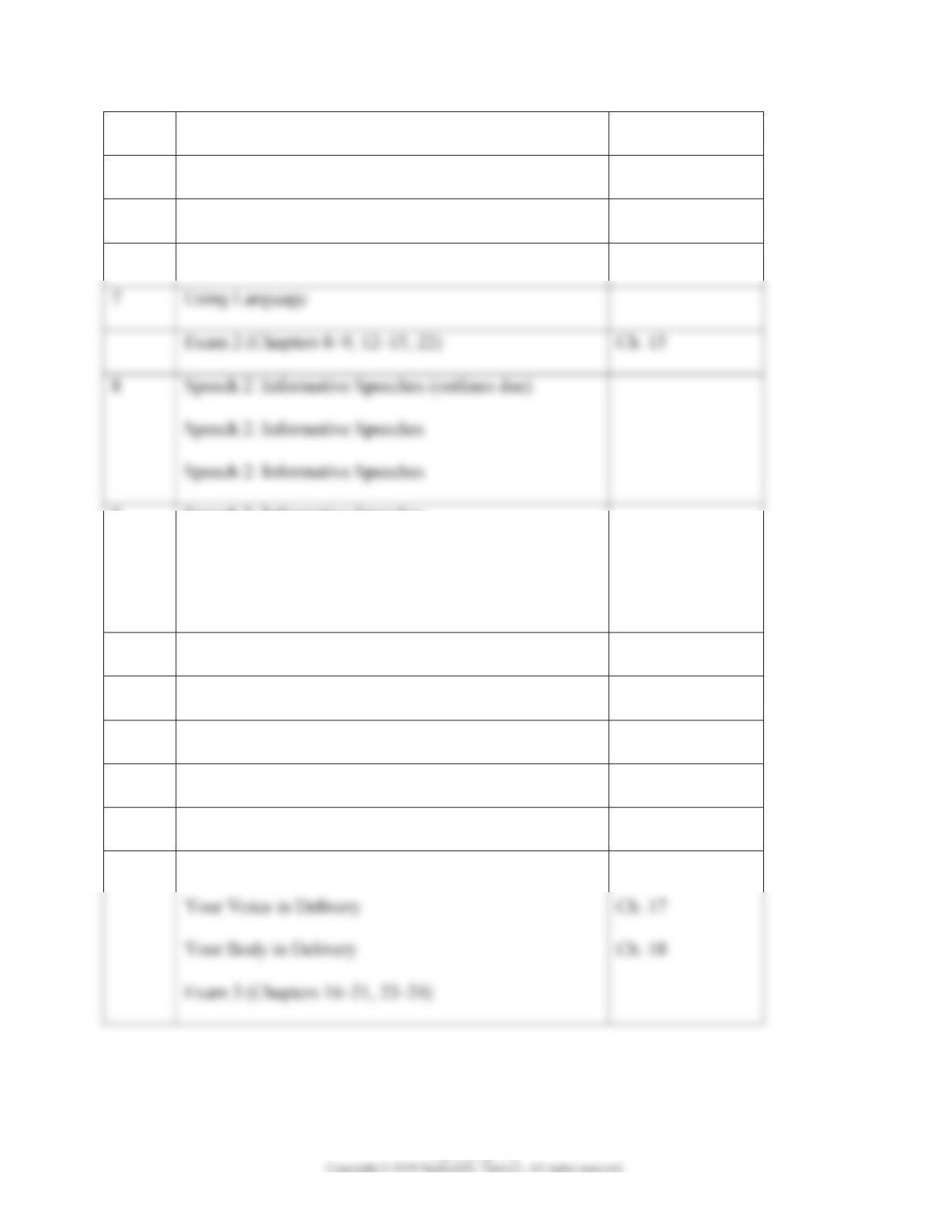
1 Syllabus
Becoming a Public Speaker Ch. 1
Listeners and Speakers Ch. 5
3 Analyzing the Audience
Selecting a Topic and Purpose Ch. 6
Organizing the Body of the Speech Ch. 7
Citing Sources in Your Speech Ch. 11
Exam 1 (Chapters 1–7, 10–11, 25) Ch. 10
4 Speech 1: Special Occasion Speeches (outlines due)
Speech 1: Special Occasion Speeches
Part 2, p. 72
6 Introduce Informative Speech/Paper Assignments
Principles of Informative Speaking Ch. 22
Developing Supporting Material Ch. 8
Finding Credible Sources in Print and Online Ch. 9
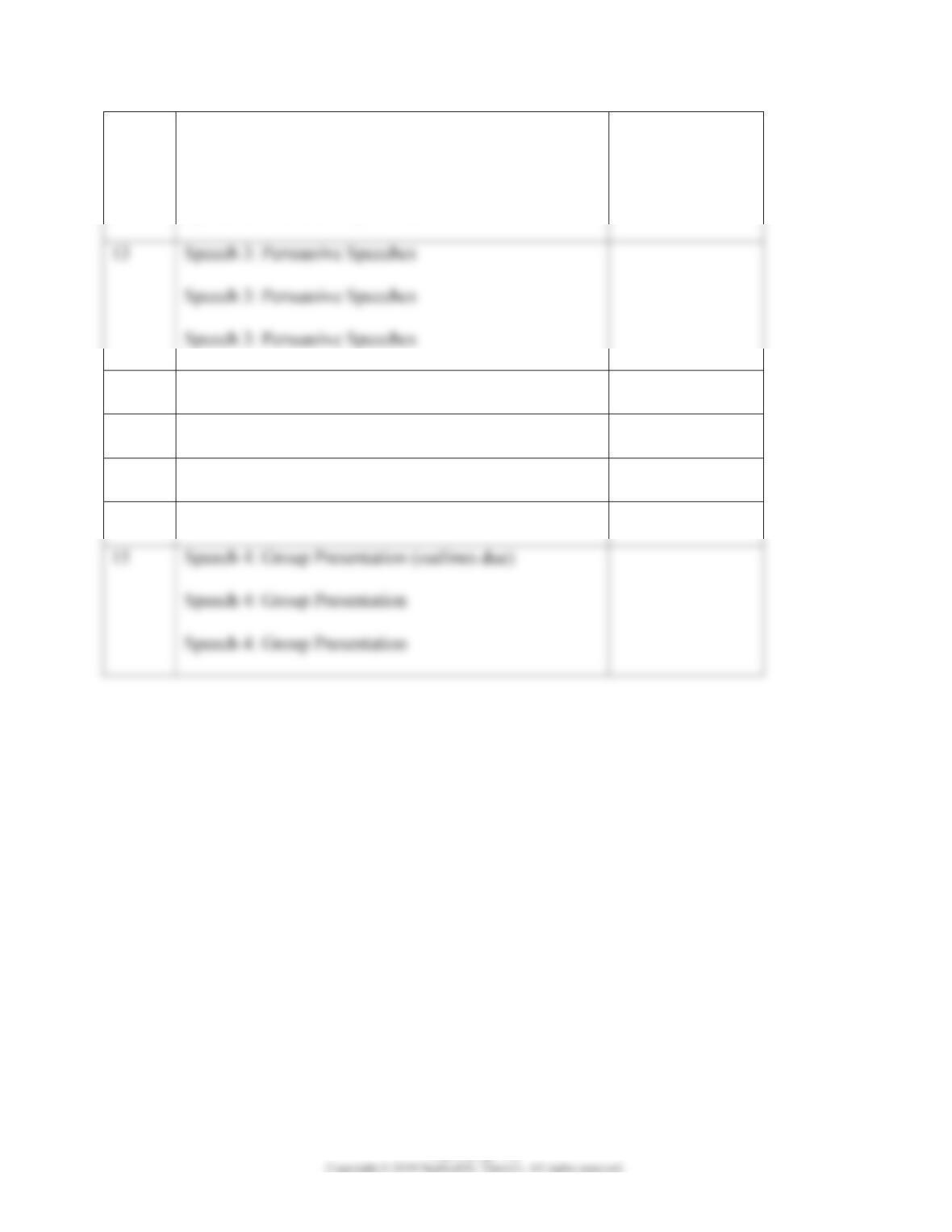
9 Speech 2: Informative Speeches
Speech 2: Informative Speeches
Speech 2: Informative Speeches (papers due)
10 Discuss Persuasive Speech Assignment
Persuasive Speaking Chs. 23–24
Speaking with Presentation Aids Ch. 19
Designing Presentation Aids Ch. 20
11 Using Presentation Software Ch. 21
Methods of Delivery
Ch. 16
Part 2, p. 73
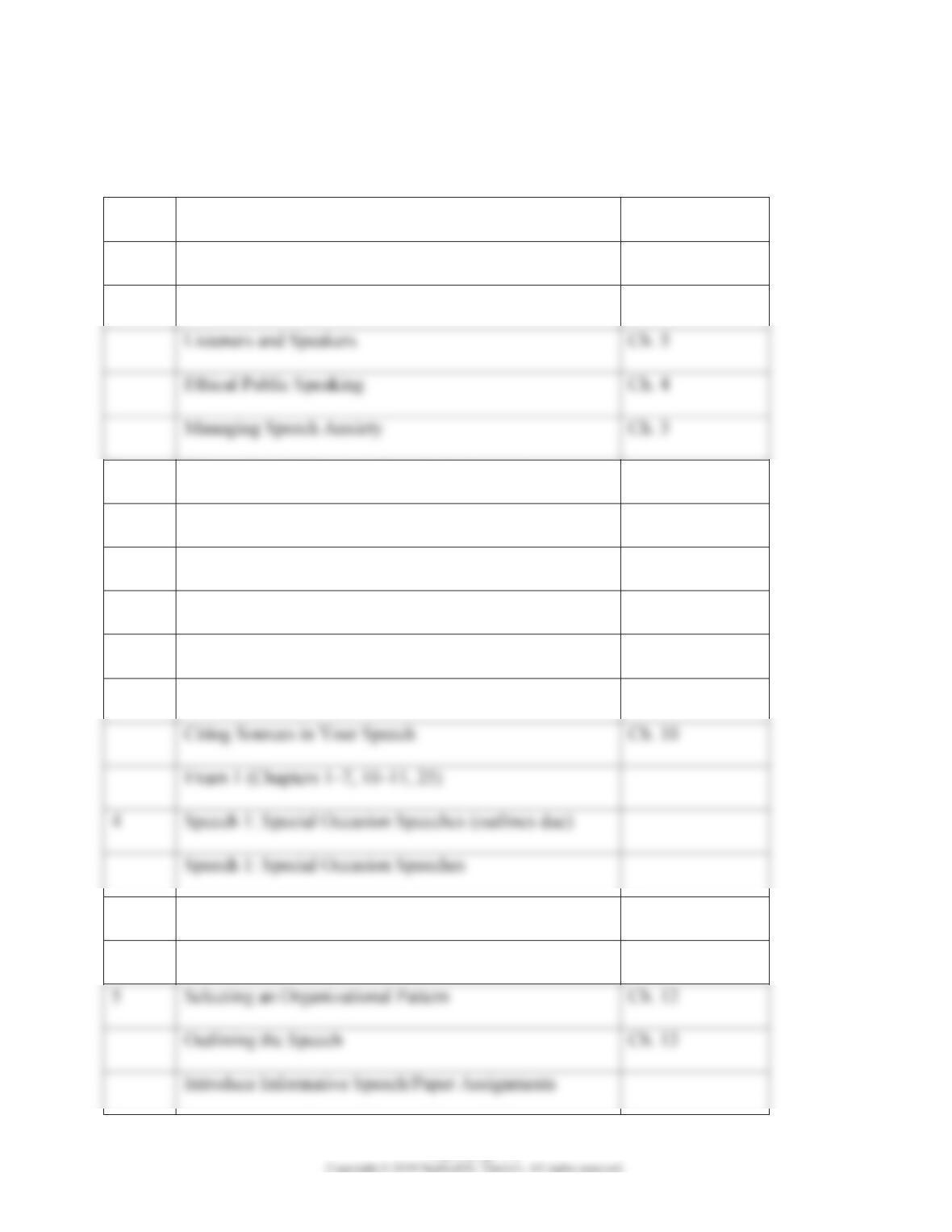
12 Speech 3: Persuasive Speeches (outlines due)
Speech 3: Persuasive Speeches
Speech 3: Persuasive Speeches
14 Discuss Group Presentation Assignment
Communicating in Groups Ch. 27
Delivering Group Presentations Ch. 28
Social Science Courses Ch. 33
Part 2, p. 74
QUARTER SCHEDULE (TENTATIVE)
12 weeks
Week Speeches, Lectures, and Exams Readings
1 Syllabus
Becoming a Public Speaker Ch. 1
2 Discuss Special Occasion Speech Assignment
Speaking on Special Occasions Ch. 25
From A to Z: Overview of a Speech Ch. 2
Analyzing the Audience Ch. 6
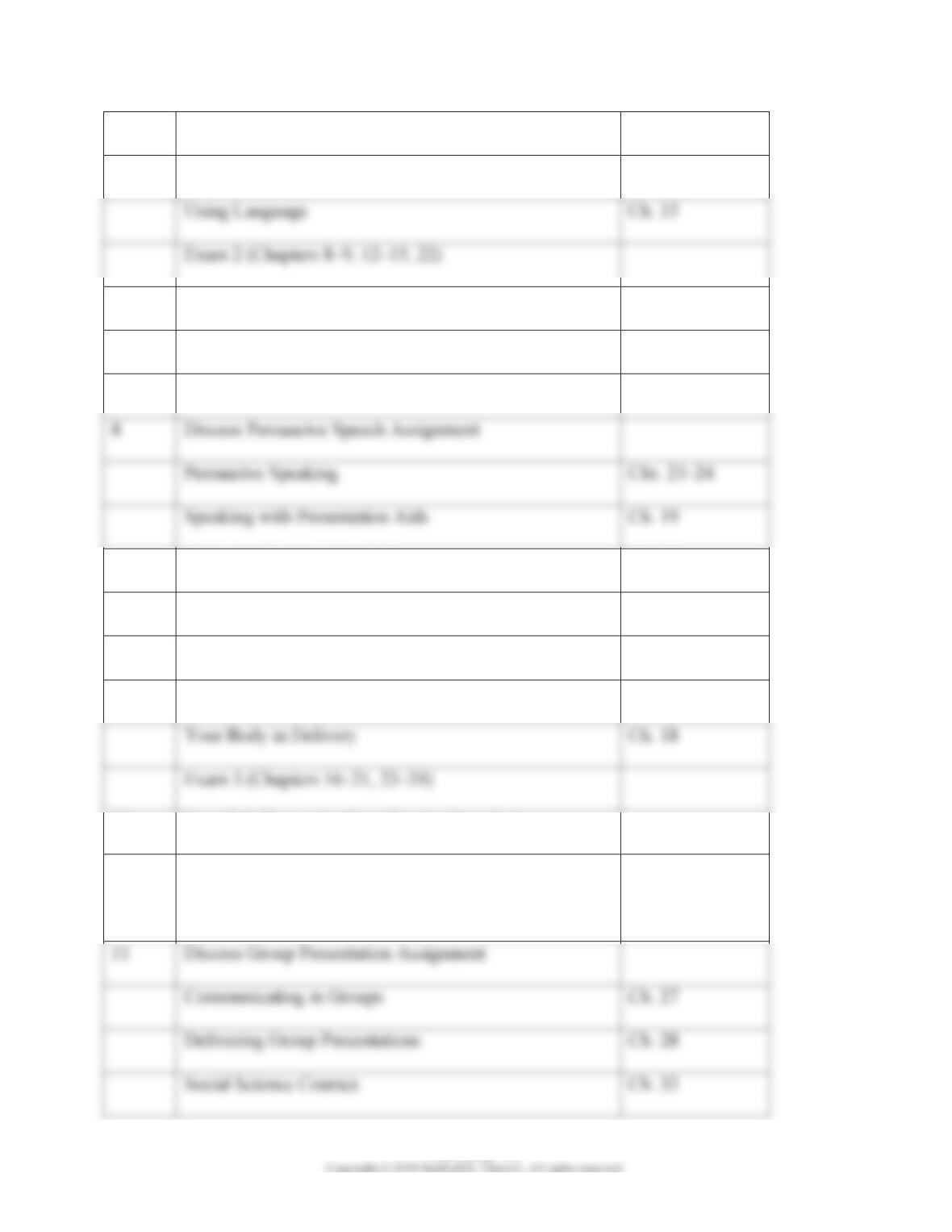
3 Selecting a Topic and Purpose Ch. 7
Organizing the Body of the Speech Ch. 11
Developing Supporting Material Ch. 8
Finding Credible Sources in Print and Online Ch. 9
Part 2, p. 75
Principles of Informative Speaking Ch. 22
6 Developing the Introduction and Conclusion Ch. 14
7 Speech 2: Informative Speeches (outlines due)
Speech 2: Informative Speeches
Speech 2: Informative Speeches
Designing Presentation Aids Ch. 20
Using Presentation Software Ch. 21
9 Methods of Delivery Ch. 16
Your Voice in Delivery Ch. 17
10 Speech 3: Persuasive Speeches (outlines due)
Speech 3: Persuasive Speeches
Speech 3: Persuasive Speeches

Part 2, p. 76
12 Speech 4: Group Presentation (outlines due)
Part 2, p. 77
SUMMER SESSION SCHEDULE (TENTATIVE)
4 weeks
Week
1
Speeches, Lectures, and Exams Readings
Day 1 Syllabus
Becoming a Public Speaker
Ch. 1
From A to Z: Overview of a Speech Ch. 2
Day 3 Selecting a Topic and Purpose Ch. 7
Analyzing the Audience Ch. 6
Day 5 Speech 1: Special Occasion Speeches
Speech 1: Special Occasion Speeches
Speech 1: Special Occasion Speeches
Week
2