
Chapter 2
Perceiving Others, Perceiving Ourselves
C
CHAPTER OBJECTIVES
• Understand that our communication with others is based on our perceptions, which are formed
either through conscious thinking or through instant mental associations and therefore may not
always be accurate.
• Analyze our perceptions of ourselves—our self-concepts—and the ways that they are influenced
CHAPTER OUTLINE
CHAPTER INTRODUCTION
• The opening scene of the chapter offers a scenario where a basketball prospect name Shoshana
is interested in team tryouts at her university. When she arrives at the basketball table at the
university club resource event, Shoshana is not greeted warmly by the coach of the club team.
Shoshana is disheartened by the coach’s demeanor and skips the tryouts.
PERCEIVING OTHERS
• The ability to perceive others correctly is important because this perception creates your view of
reality.
• People who are able to read others accurately are able to employ better social skills, form closer
relationships, and generally navigate life more smoothly.
• The Meaning of Perception
Perception is the process by which we come to understand the stimuli in our world.
Stimuli include any sensory information—the information we receive through our
senses of sight, hearing, smell, taste, and touch.

Making a good impression
• Your communication behaviors influence others’ perceptions of you.
Deepening and strengthening our interactions
• Perception is a two-way process.
• The Formation of Perceptions
Perceptions are formed both consciously and unconsciously.
Receiving stimuli
• To some extent, the stimuli that we respond to depend on our needs,
Using mental associations (schemas) to make sense of stimuli
• After the mind perceives stimuli pertaining to a person, we use mental
associations (schemas) to form an idea about a person’s attributes, his or her
possible behaviors, and the meaning of his or her communicative behaviors.
Sources of mental associations
• Life experiences
BARRIERS TO PERCEPTION AND HOW TO OVERCOME THEM
• Why Are Perceptions Often Inaccurate?
First impressions
• People may “freeze” on their first impressions and resist further cues that
contradict it.
Stereotypes are inferences that people draw about others simply because they’re part of
a given social category.
Fooled by appearances
• Some evidence suggests that people can judge personality traits such as
“extraversion, emotional stability, openness, self-esteem, and religiosity” based
on appearance alone “with some degree of accuracy.”

• Improving the Accuracy of Perceptions
Recognize that perceptions are fallible.
• During the process of correction, we consider the input we’ve taken in and apply
logic to make a reasoned judgment about others’ behavior.
Seek additional data.
• First impressions can be misleading, but you can strengthen them by looking for
additional information.
• When people have negative first impressions, they tend to limit further
communication.
• Ask questions that allow you to gain a better understanding of a person’s traits.
Differentiate facts and inferences.
• Facts are statements for which there is enough proof to convince almost any
reasonable and objective person that they are true.
PERCEIVING OURSELVES
• Each of us has a self, our own personal construction of who we are. Only you know the whole
picture of how you see yourself.
• The Nature of Your Self Concept
Your self-concept reflects “our attempt to explain ourselves to ourselves” and includes
abilities, accomplishments, personality, preferences, and characteristics.
The self-concept also includes an extended self that focuses on your perceptions of
yourself as a participant in a relationship (such as sister, son, or friend) or as a part of a
group (such as African Americans or Christians).
Attributes of self-concepts
• Unique
• Dynamic. It can change over time.
• Relatively stable
• Variable salience. The salience of self-concept attributes varies from person to

• Sources of Self-Concepts
Reflected appraisals: The feedback that we receive about ourselves from others
(“looking-glass self”).
• Sources of reflected appraisals include parents, peers, and siblings.
• We may focus on the feedback received from members of in-group(s)—social
groups we feel affiliated with and respect.
• Improving Your Self-Concept
Positive self-talk
• Self-talk is essentially talking to yourself. Positive self-talk builds you up. It can
increase your self-confidence and improve your ability to succeed.
• Self-fulfilling prophecy occurs when you expect a particular outcome to occur,
which causes you to behave in a way that makes the outcome more likely.
Personal growth refers to the process of strengthening your self-awareness and trying
IDENTITY MANAGEMENT
• Everyone has both a private and public self.
Your private self is known only to you. Nobody else truly knows the whole picture of
how you see yourself.
Your public self represents the self that you portray to other people.
Identity management or impression management is the process by which people
“present information about themselves in order to appear as they wish others to perceive
them.”
• How We Engage in Identity Management
We regularly apply identity management when interacting with others, although our

Self-disclosure is the intentional revelation of important information about ourselves
that others are not likely to know.
Emotional intelligence is the ability to understand one’s own and others’ emotions.
• Objectives of Identity Management
There are a number of goals that we may try to achieve through identity management,
and they typically are accomplished through different communication strategies:
• Ingratiation is used when a person hopes to be liked.
• Ethics and Identity Management
Unless those who interact with us are willing to listen to the whole story of our lives, we
cannot reveal our entire self-concept.
Picking and choosing which elements of ourselves we will reveal is inevitable.
Truth telling is an important societal norm.
• Online Identity Management
Social media provide us with new and unprecedented opportunities for identity
management.
LIST OF KEY TERMS
perception
stimuli
sensory information
person perception
inferences
mental associations (schemas)
stereotype
transference
self-serving bias
in-group
out-group
self-talk
self-fulfilling prophecy
personal growth
reappraisal
private self
public self
C
CLASS DISCUSSION QUESTIONS
1. What are some stereotypes of college students? Can we assume that all of the students in this class
fall into those categories? Why or why not? When have you stereotyped other people, and when
have you been stereotyped by others? What perception checking could you or the other person have
done to check for inaccuracies?
2. What things help shape our perceptions as we go through life? Can our perceptions change over
time?
3. What are some ways you can improve your self-concept? What are some specific ways you can
strengthen your self-awareness?
• Key ideas you are looking for here are engaging in positive self-talk, strengthening self-
awareness, engaging in reappraisal (changing interpretation of something that has happened
in your life), and having a good support network.
4. Have you ever had a conversation with someone and started replaying the conversation in your
head as soon as it was over? What was the context of the conversation, and with whom were you
speaking? Why do we sometimes replay conversations in our heads after they have occurred?
• Ultimately, this situation boils down to perception. We care what people think of us
(depending on the person’s status or our relationship with a certain individual, we tend to be
5. How do you alter your communication behaviors when you have a favorable opinion of
someone? Conversely, how do you alter your communication behaviors when you have an
unfavorable opinion of someone? What are some strategies you can use to become a better
communicator with both types of people?
• No matter how hard we try, we are going to go through life and discover that not everyone
likes us. Perhaps this happens because one person has a false perception of another person.
6. How can your network of friends influence others’ perceptions of you? Provide an example of
when you judged someone based on their friends. Explain the importance of surrounding yourself
with a supportive network of friends.
• Whether or not we like it, we are judged based on our “inner circles.” For example, if
students are part of a club or an organization that is admired for its community service
APPLY YOUR SKILLS
APPLY YOUR SKILLS FROM CHAPTER 2
1. Look at the “Apply Your Skills” activity on page 65 in the text. After students complete the
activity, have them answer the following questions, either in small groups, in a class discussion, or in
writing:
• Conversely, do you believe someone’s perception of you has changed over time? If so, in
what ways?

• What are three ways that people alter their online identity to change others’ perceptions of
them? Do you think most people are truthful in an online environment, or do most inflate
MORE “APPLY YOUR SKILLS” IDEAS
1. Go to the illustration “Perception” on page 33 in the text. Note that perceptions of each
individual in the illustration are based on appearance. For each individual shown, identify the
2. Go to the illustration “Pizza …” on page 37 in the text, and identify why the individual does not
notice the monster in the picture. Along the same lines, identify what channels and types of
television you view. Explain why you select them. Is it possible to view every single channel at one
time, and would you want to do that? Why or why not?
3. Go to the illustration “The Sound of Laughter” on page 38 in the text, and notice that our brains
do not retrieve information from a filing cabinet when introduced to stimuli in our environment.
Instead, stimuli trigger different associations that we already have experienced in our lives. What are
10 things that come to mind that are associated with the word laughter? Will this list be the same
forever, or will it change over time?
4. Go to the illustration “The Power of Ubuntu” on page 54 in the text. After apartheid ended in
South Africa, the principle of ubuntu—the bond that connects all living things—was incorporated
into the new national anthem. Ubuntu was culturally engrained in the speakers of the Bantu
languages in Africa. What is significant about the five different languages shown in the national
anthem as it relates to ubuntu?
5. Go to the illustration “Who Has Higher Emotional Intelligence?” on page 59 in the text. Read the
6. Go to the illustration “Identity Management: Ethics” on page 61 in the text. How many lies can
you identify in John Smith’s online dating profile? Why might an individual not tell the whole truth
in an online environment? What are the ramifications of not being truthful in an online
environment?
PERSONAL WRITING ASSIGNMENTS
1. Reflected appraisal: Have students think of a time when someone gave them positive feedback.
What was that scenario, who provided the feedback, and how did the feedback affect the student’s

2. Stereotyping: Have students think of a time when they have stereotyped other people. What was
the context of the situation? Have them describe how their perceptions may have been formed, and
3. Identity management: Have students reflect on their relationships with their friends, significant
others, family members, coworkers, and teachers. How do they manage their identity in each of
these relationships? Do they alter their communication behaviors? If so, how?
C
CLASSROOM ACTIVITIES
1. Self-concept: Have students take out of piece of paper and a writing utensil and list eight to 10
characteristics that describe who they believe they are as a person (include demographics,
2. Because first impressions aren’t always correct, it is important to engage in some perception
checking. Have students think of a time when they could have misunderstood the behavior of
3. Have students form pairs and ask take out their smartphones. Have them pull up one of their
social media accounts. If they feel comfortable (some may not or may not have a social media
account), have them swap phones with their partner and scroll through their photos and comments.
4. Self-concept: Bring in markers, glue, scissors, a variety of magazines, and construction paper.
(Bring enough supplies to meet the needs of the class.) Distribute the supplies, and give students 20
5. Perception checking: Use an image of a person whose background you are familiar with, and ask
students to make inferences about the person based on what they see. A good image to use is one of
Dr. David Ores, a physician whose arms are covered in tattoos (and ironically is in the business of
removing tattoos for other people). After you display an image, ask students the following questions:
How old is this person? What is this person’s profession? What is his or her income level? What is
his or her personality like? What physical characteristics lead to such inferences? Don’t disclose the

A
ADDITIONAL MEDIA RESOURCES AND ACTIVITIES
2. Search for and watch the video “Dove Real Beauty Sketches” (2013), and relate that to your
perception of self. When you wake up in the morning and look in the mirror, what goes through
your mind? Do you focus on the negative, or do you engage in positive self-talk? How does that
self-talk influence how you communicate with yourself and with others?
H
HANDOUTS AND READY–TO–PRINT ACTIVITIES
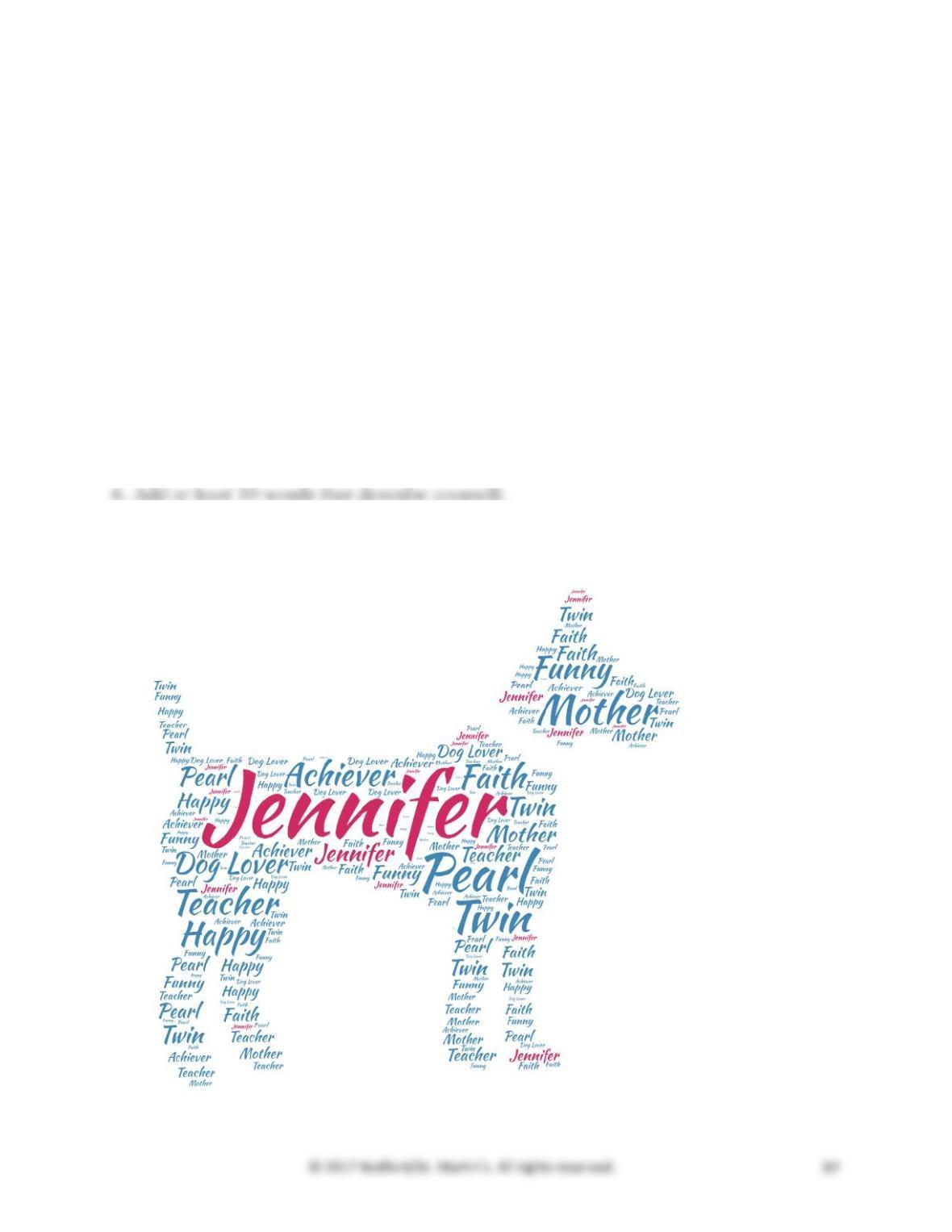
Create Your Own Word Cloud (Self-Concept)
Creating your own world cloud is a great exercise for helping you become more aware
of your self-concept. Several websites are available for creating a word cloud, but one
site that is particularly user-friendly is tagul. Some quick instructions are provided
1. Go to .
3. Log in.
5. Select Create New Word Cloud.
7. Select your favorite colors, fonts, and a shape of cloud that tells more about who
you are.