
Part 2, p. 153
Generally effective and extemporaneous ____
OUTLINE
Typed and in correct outline form ____
At least five sources ____
Written in correct APA style ____
Internal summaries included and labeled ____
Transitions included and labeled ____
CONCLUSION
TEAM GRADE
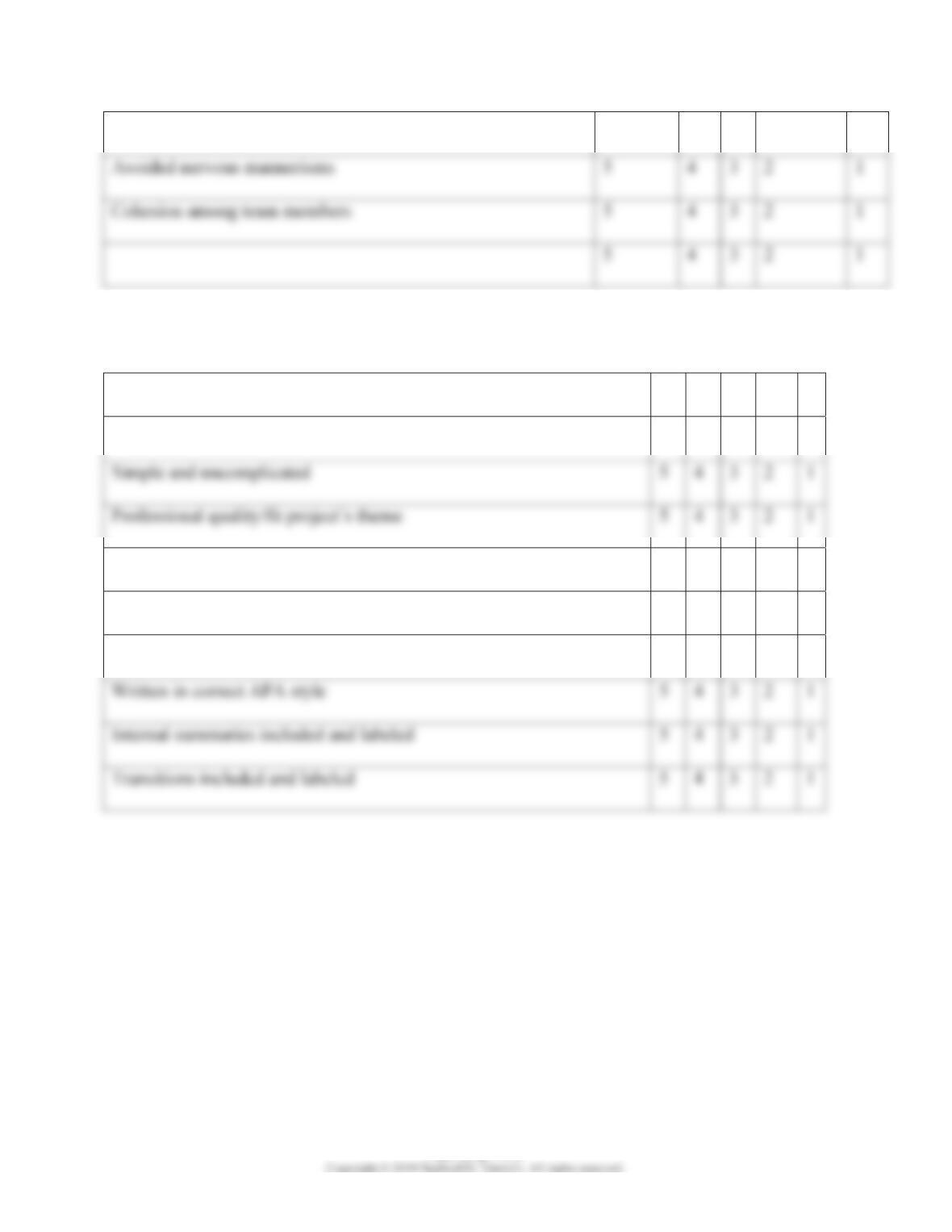
Cohesion among team members ____
Plans satisfied needs presented in case(s) ____
COMMENTS:
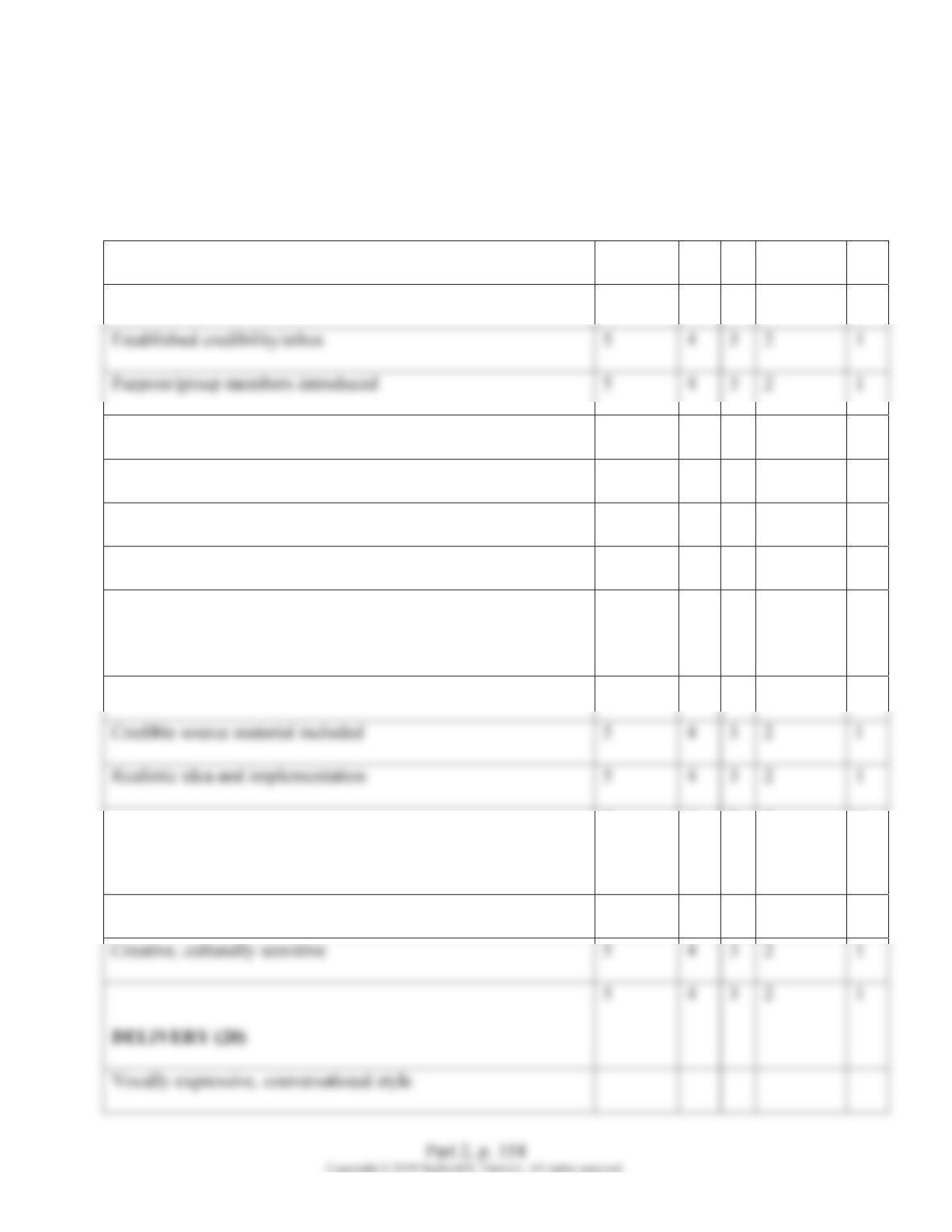
GRADING SHEET FOR PROFESSIONAL PRESENTATION
Name ____________________________ Topic ____________________________
INTRODUCTION (15) Agree Disagree
Captured audience’s attention 5 4 3 2 1
BODY (15)
Key ideas explained
Points supported (citations/arguments) 5 4 3 2 1
Feasible/realistic proposal presented 5 4 3 2 1
5 4 3 2 1
ORGANIZATION (15)
Clear organizational pattern
5 4 3 2 1
LANGUAGE (10)
Concise, colorful
Part 2, p. 155
Adequate eye contact 5 4 3 2 1
POWERPOINT VISUAL AIDS (20)
Speaker’s ability to use the technology 5 4 3 2 1
Creativity/full use of resources 5 4 3 2 1
OUTLINE (25)
Typed and in correct outline form 5 4 3 2 1
At least five sources 5 4 3 2 1
GROUP EVALUATION _____/ 10
TOTAL _____/130

Grading Sheet for Professional Presentation
Name _______________________
Topic _______________________
+ Excellent
܂ Satisfactory
– Needs improvement
0 Failed to complete
INTRODUCTION Speech Strengths and Areas for Improvement
Captured audience’s attention ____
BODY
Key ideas explained ____
ORGANIZATION
Clear organizational pattern ____
LANGUAGE
Concise, colorful ____
Creative, culturally sensitive

Part 2, p. 157
DELIVERY
Vocally expressive, conversational style ____
Adequate eye contact ____
POWERPOINT VISUAL AIDS
Speaker’s ability to use the technology ____
Creativity/full use of resources ____
OUTLINE
Typed and in correct outline form ____
At least five sources ____
Written in correct APA style ____
Internal summaries included and labeled ____
Transitions included and labeled ____
GROUP EVALUATION _______
COMMENTS:

DESCRIPTION AND GRADING SHEET FOR TEAM WORKSHOP (OPTIONAL)
1. Instructor divides students into three teams of ten (or fewer).
2. Students need to develop instruments and procedures for providing performance feedback to
3. Each team must design and manage a class workshop on specific concepts related to one of the
following three major topic areas.
4. Each workshop should include (a) a one-page synopsis of the major conceptual issues, (b) a
demonstration of key concepts, and (c) activities that involve members of the class.

Part 2, p. 159
GRADING SHEET FOR TEAM WORKSHOP NO. _______
Evaluation Category Points
2. Demonstration of key concepts _________
3. How well the workshop involved members of the class _________
Comments
Strong points
Weak points

Part 2, p. 160
SELF-EVALUATION VIDEO SHEET
Name __________________________________ Date _____________________________
Title/Topic
How well have you met each section of the grading sheet requirements?
How well did you explain and support your ideas (e.g., evidence, testimony, examples)?
How effectively did you use previews?
How effectively did you use internal summaries?
How effectively did you use transitions?
Did you provide adequate nonverbal support (e.g., gestures, eye contact)?
What was your greatest strength?
What was your greatest weakness? How will you overcome it?

Peer Evaluation Sheet
Name __________________________________ Date _____________________________
Title/Topic
How did the speaker meet each section of the grading sheet requirements?
How well did the speaker explain and support his or her ideas (e.g., evidence, testimony,
examples)?
How effectively did the speaker use previews?
How effectively did the speaker use internal summaries?
How effectively did the speaker use transitions?
Discuss the speaker’s nonverbal support (e.g., gestures, eye contact).
What was the speaker’s greatest strength?
What was the speaker’s greatest weakness? How might he or she overcome it?
Outside Speech Critique Evaluation 1
Your Name
Speaker’s Name __________________ Date & Time ___________________
1. How did the speaker gain the attention of the audience?
2. How did the speaker relate the topic to the audience?
3. What was the thesis statement of the speech (or the main purpose)?
6. Discuss the speaker’s conclusion. How well did he or she summarize the main theme? Did the
speaker review the major points? To what extent was the conclusion creative?
7. Discuss the speaker’s use of language. Was it clear, concise, creative?
9. In what parts of the speech could the speaker have improved this presentation?

Part 2, p. 163
Outside Speech Critique Evaluation 2
Your Name
Speaker’s Name _________________ Date & Time ______________
1. How did the speaker gain the attention of the audience?
2. How did the speaker relate the topic to the audience?
3. What was the thesis statement of the speech (or the main purpose)?
4. Was there a preview of the main points? List them.
7. Discuss the speaker’s use of language. Was it clear, concise, creative?
8. Discuss the speaker’s delivery (e.g., eye contact, gestures, vocal variety).
9. In what parts of the speech could the speaker have improved this presentation?

Part 2, p. 164
WHAT TO FOCUS ON WHEN TIME IS LIMITED
Preparing an oral presentation for other, general-education courses and major courses is not
uncommon. It is possible that A Pocket Guide to Public Speaking will be used as a supplement to a
course you are teaching. Several essential topics should be covered when using this text as a
Monday Chapter 2—“From A to Z: Overview of a Speech”
Wednesday Chapter 17—“Your Voice in Delivery”
Friday Chapter 18—“Your Body in Delivery” or
When the Pocket Guide is used to augment several speaking assignments in your course,
the following is recommended over a three-week period.
Part 2, p. 165
Week 1 Chapter 2—“From A to Z: Overview of a Speech”
Chapters 17 and 18—“Your Voice in Delivery” and “Your Body in
Delivery”
Week 2 Chapter 30—“Presentations Assigned across the Curriculum”
One chapter from Chapters 29 and 31–36 (Assign the relevant chapter
Week 3 Chapters 19 and 20—“Speaking with Presentation Aids” and “Designing
Presentation Aids”
GRADING AND EVALUATING SPEECHES
There are two main components to consider when evaluating speeches. The most obvious critique
of any public speaking presentation is the delivery of the speech. Aspects of delivery, discussed in
detail in Chapters 16–18, include vocal elements and using the body. The second component to
consider when evaluating speeches is the organization of the speech, including the speech outline.
The speech outline should be evaluated to determine whether (1) the primary parts of the speech

Part 2, p. 166
following: attention-getting introduction, clear preview of speech, adequacy of reference page
(including use of style guides), use of presentation aids, and use of transitions between speakers.
Sample Grade Sheet
Element Excellent Very Good Good Poor Comments
Eye contact
Vocal variety
Body in delivery
Introduction
Public Speaking Midterm Course Evaluation
Course Evaluation
What do you feel are the strengths of the class? (Consider the textbook, supplemental resources,
use of technology, teaching style, assignments, group work, arrangement of class time,
expectations, course policies, etc.)
Instructor Evaluation
What do you like about the instructor’s teaching style? (Consider clarity of instructor expectations,