Chapter 15, p. 401
CHAPTER 15
Using Language
CHAPTER CONTENT OUTLINE
I. Use an oral style.
A. Successful speakers use an oral style, writing speeches for the ear to make their message
clear to the audience.
B. Strive for simplicity.
1. Be concise. Strive to get your point across effectively, using as few words as possible.
2. Translate jargon, the specialized “insider” language of a profession, into commonly
1. Repetition of key words and phrases emphasizes important ideas, helps listeners
1. Pronouns such as we, us, I, and you draw your audience into your message.
II. Choose concrete language and vivid imagery.
A. Use concrete language—words that are specific, tangible, and definite. Abstract
language—general, nonspecific words—should be avoided.
1. You can evoke vivid imagery by using figures of speech—forms of expression that
create striking comparisons between the unfamiliar and the known to help listeners
grasp meaning.
a. A simile explicitly compares one thing to another, using like or as.
b. A metaphor also compares two things but does so by describing one thing as
actually being the other.
D. Avoid clichés, mixed metaphors, and faulty analogies.
III. Choose words that build credibility.
A. Speakers should use language that is appropriate, accurate, assertive, and respectful.
B. Use words appropriately.
2. The more formal the occasion, the closer you will want to stay within these
boundaries.
3. At times, it may be appropriate to mix casual language, regional dialects, or even
C. Use words accurately.
1. Avoid malapropisms, the inadvertent use of a word or phrase in place of one that
Chapter 15, p. 403
D. Use the active voice.
2. A verb is in the active voice when the subject performs the action.
E. Use inclusive, unbiased language.
2. Use colloquial expressions or idioms only if you are certain your listeners understand
those terms.
IV. Choose words that create a lasting impression.
A. The denotative meaning of a word is its literal, or dictionary, definition. The connotative
meaning of a word is the special association created by each individual.
B. Use repetition to create rhythm.
1. Repetition of key words or phrases creates a distinct rhythm that implants important
ideas in listeners’ minds.
a. Anaphora is a type of repetition in which the speaker repeats a word or a phrase at
C. Use alliteration for a poetic quality.
Chapter 15, p. 404
1. Alliteration is the repetition of consonant sounds in two or more neighboring words or
D. Experiment with parallelism.
1. Parallelism refers to the arrangement of words, phrases, and sentences in similar
form. It helps the speaker emphasize important ideas and can create a sense of steady
or building rhythm.
KEY TERMS
rhetorical device a technique of language to achieve a desired effect
oral style the use of spoken language that is simpler, more repetitious, more rhythmic, and more
interactive than written language
jargon specialized terminology developed within a given endeavor or field of study
concrete language nouns and verbs that convey specific (as opposed to abstract) meaning

Chapter 15, p. 405
simile figure of speech used to compare one thing to another by using the words like or as (e.g.,
“He works like a dog”)
metaphor figure of speech used to make implicit comparisons without the use of “like” or “as”
(e.g., “Love is a rose”)
analogy extended metaphor or simile that compares an unfamiliar concept or process with a more
familiar one in order to help the listener understand the one that is unfamiliar
cliché overused phrase such as “burning the midnight oil” or “works like a dog”
mixed metaphor comparison that juxtaposes two unlike, often clichéd, expressions, such as “He
went off the deep end like a bull in a china shop”
colloquial expressions informal expression characterized by regional variations of speech
denotative meaning literal or dictionary definition of a word
connotative meaning individual associations that different people bring to bear on a word
anaphora rhetorical device in which a speaker repeats a word or phrase at the beginning of
successive phrases, clauses, or sentences
epiphora rhetorical device in which a speaker repeats a word or phrase at the end of successive
phrases, clauses, or sentences
Chapter 15, p. 406
alliteration repetition of the same sounds, usually initial consonants, in two or more neighboring
CHAPTER STUDY GUIDE
I. SUMMARY QUESTIONS
Why is it important that speech language be simple and concise?
Successful speakers strive for simplicity and conciseness. To ensure that they get their
message across, they avoid complex words and jargon that may not be understood by everyone.
What is concrete language?
Concrete language is specific, tangible, and definite. In contrast, abstract language is general
and nonspecific. Abstract words such as power and peace do not have a specific reference and
Chapter 15, p. 407
How can you create vivid imagery in your speeches?
Vivid imagery can be created through concrete and colorful words and through figures of
speech such as similes, metaphors, and analogies. A simile explicitly compares one thing to
another, using like or as to do so. A metaphor also compares two things but does so by describing
How can you use language to build credibility?
Speakers can build credibility with their audiences by using words appropriately, accurately,
assertively, and respectfully. Being appropriate means upholding the rules of grammar and using
How can you ensure that your language is culturally sensitive and unbiased?
Speakers can be culturally sensitive—considerate of cultural beliefs, norms, or traditions that
are different from their own—by adapting their language for a diverse audience. Speakers who are
Chapter 15, p. 408
How can you use language to create a lasting impression?
Three effective strategies for using language to make speeches memorable are the rhetorical
devices of repetition, alliteration, and parallelism. Repetition involves repeating key words or
phrases at various intervals to create a distinct rhythm and thereby implant important ideas in
listeners’ minds. Repetition is often used to create a thematic focus. Alliteration is the repetition
II. DISCUSSION QUESTIONS
1. Why is it so important to consider the connotative meanings of words in appealing to an
audience? How can an analysis of audience attitudes, values, and beliefs be used to evaluate
the connotative implications of certain words?
Connotative meanings are created in the context in which words are used, not in the words
themselves. Because individuals communicate in a variety of contexts and situations, it may be
Chapter 15, p. 409
2. Think of three or four instances in which you could incorporate slang or regional or ethnic
terms into a speech in a way that would be appropriate to the audience, the occasion, and the
topic. Be ready to discuss these in class.
This activity could serve as a group exercise. When students are generating appropriate
3. How skillful are you at selecting words that have exactly the meaning you seek? Many people
use a printed thesaurus or one that is part of their word-processing package. Roget’s Thesaurus
is available in print as well as online at http://thesaurus.com/Roget-Alpha-Index.html.
CONTENT PRESENTATION IDEAS
I. STUDENT ACTIVITIES
1. Choose an ordinary object in the room around you. Without explicitly naming the object, write
a paragraph describing it in detail. Read your description to a classmate, and see if he or she
can guess what the object is.
This activity, especially helpful in demonstrating denotative and connotative meanings,
2. Review the paragraph you wrote for activity 1, looking for use of metaphors, similes, and
analogies. If you have not used them, try to describe the object using these figures of speech.
3. Write instructions for how to complete a task that you know well. It could be how to complete
a particular sport move, build something, make something, or formulate something. Use as
much specialized “insider” language, or jargon, as possible to convey your ideas. Share your
write-up with a classmate (or group of classmates) and see how much they understand. Then
4. Select a piece of writing you have done recently—a speech, a term paper, or other work—and
edit it for conciseness. Can certain words and sentences be deleted to make the message clearer
and more concise? Try using a thesaurus to substitute simple words for unwieldy ones.
Chapter 15, p. 411
II. GROUP ACTIVITIES
1. As part of a class activity, work in groups of five to generate five to ten sensitive words for
which more appropriate language can be substituted. Each group should report its results to the
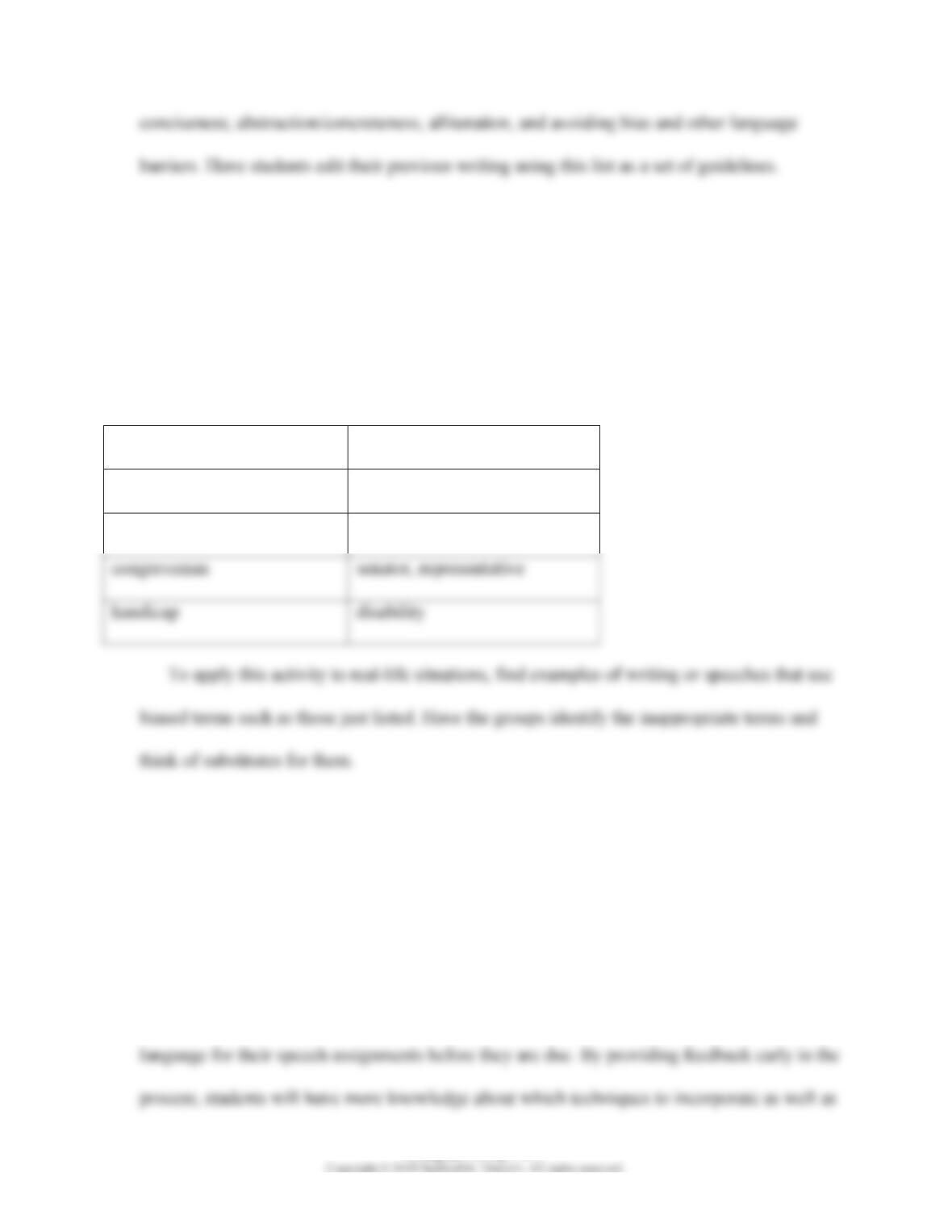
class. To spur your thinking, consider the following substitutions.
Instead of Saying . . . Consider . . .
janitor maintenance worker
repairman repair person
2. In groups of three to five classmates, read aloud from one classmate’s speech. Evaluate how he
or she has handled language in terms of the following: simplicity and conciseness; vividness of
imagery; accuracy of word usage, including connotative meanings; transitions; sentence
structure; length and completeness of sentences; and use of personal pronouns.
This activity provides an excellent opportunity for students to practice developing effective

Chapter 15, p. 412
3. In a team of four or five people, look through several newspaper or magazine articles and select
one that could be appropriately used as spoken language in a speech. Next, find a text that
would be ill-suited for use as spoken language. Report your results to the class.
Selections that are more appropriately read include writings that already use vivid
language (e.g., alliteration, metaphors) and that can help readers conjure their own
visualizations of what is written. Selections that are more appropriate for oral delivery include
III. ADDITIONAL QUESTIONS AND ACTIVITIES
QUESTIONS
The following questions may be used by instructors to help illustrate important points in the
chapter and to facilitate students’ learning of this material.
These questions can be used as:
• Homework questions
• Quizzes
Chapter 15, p. 413
1. Explain what the text means by oral style.
Oral style: is the specific word choices and rhetorical devices that speakers use to express
2. The text talks about using language that is simple and free of jargon, concise, and concrete.
Explain and give examples of each of these terms.
Purpose: Speakers say what they mean in short, clear sentences. They can translate
jargon—the specialized language of a given group or profession—into commonly understood
terms.
Conciseness: As a rule, speakers should strive to use as few words as possible to express
3. What is abstract language? Give two or three examples to demonstrate how you can make an
abstract word more concrete.
Abstract language: words that are general and nonspecific.
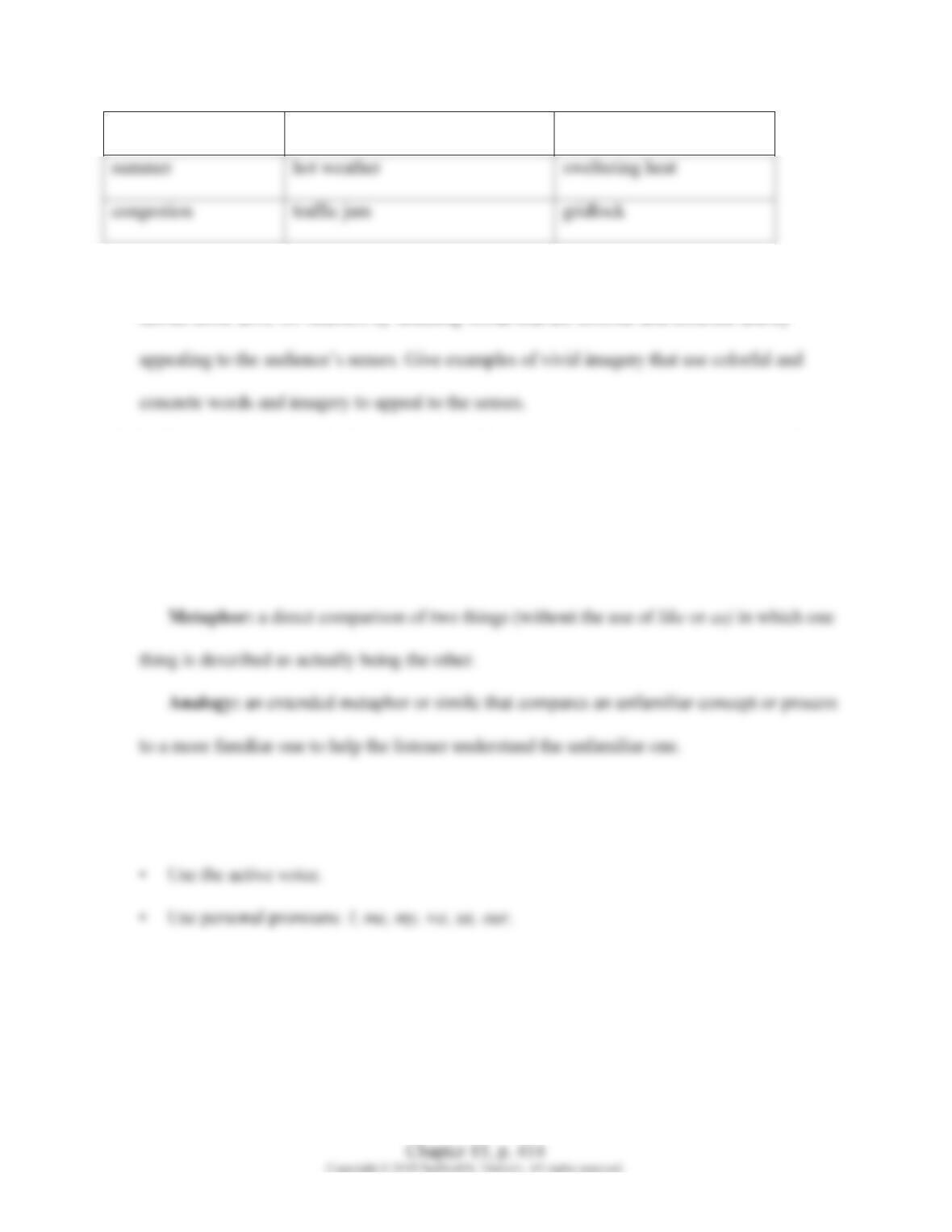
Abstract Less Abstract Concrete
4. Another way to use language to share meaning is through vivid imagery. Speakers can make
stories come alive for listeners by selecting words that are colorful and concrete and by
5. Define figure of speech. Define three types of figures of speech, and give an example of each.
Figure of speech: form of expression that creates a striking comparison to help the listener
visualize, identify with, and understand the speaker’s ideas.
Simile: an explicit comparison of one thing to another using like or as.
6. What two things can a speaker do to convey confidence and conviction? Give examples of
each.
7. To build trust and credibility, language must be accurate. In terms of accuracy, a speaker must
consider the meaning of words. Explain the denotative and connotative meanings of words,
and give an example of each.
Chapter 15, p. 415
8. The way in which words are arranged in a speech can make the speech more memorable. What
three things should speakers take into consideration when arranging their language?
• Repetition: repeating key words or phrases at various intervals to create a distinct rhythm
ACTIVITIES
Confidence, Conviction, and Lasting Impressions
Purpose: To help students identify the active voice, personal pronouns, repetition, and parallelism
in speeches.
Instructions: Ask students to review recent issues (perhaps three) of Vital Speeches of the Day.
Cultural Sensitivity
Purpose: To help students understand cultural differences and how to adapt to individuals who
Chapter 15, p. 416
Instructions: During class, show students clips from movies that depict various intercultural
encounters, including male-female ones. Examples of some films are Gunga Din, Mr. Baseball,
1. How did the two cultures differ?
2. What communication problems did this create?
3. Were the communication difficulties resolved? If not, how could the speaker have changed
6. Were the individuals from the two cultures changed by their encounter? If so, did
communication play a role in this change? How?
Additional instructions: This activity also works well with newspaper or magazine stories.
The Meanings of Words: Denotative and Connotative
Purpose: To familiarize students with denotative and connotative meanings.
Instructions: Have students identify the denotative and connotative meanings of each of the
following words. Then have them come up with five of their own words and give both meanings
for each.
1. Girl or boy
Chapter 15, p. 417
3. Thrifty
5. Drugs—high
7. Surfing
1. What is the most beautiful word you know?
2. What is the softest or gentlest word?
3. What is the ugliest word?
4. What is the most frightening word?
5. What is the harshest or sharpest word?
6. What word makes you feel lonely?
7. What word makes you feel angry?
8. What is the most overused or trite word?
9. What word makes you feel happiest?
Discussion: As a class, discuss students’ answers, illustrating how many students provided
different words for each meaning.
Keep It Simple
Purpose: To help students learn to use language concisely.

Chapter 15, p. 418
Additional instructions: If instructors have examples (written, visual, or audio) of individuals
giving a speech or a presentation, this activity can be done as a class during class time.
Figures of Speech: Metaphors, Similes, and Analogies
Purpose: To give students practice in constructing metaphors, similes, and analogies.
Instructions: Have students construct metaphors, similes, and analogies for the following.
Metaphors
1. Provide a metaphor for your life.
3. Provide a metaphor for what you think about education.
5. Provide a metaphor about justice.
Similes
7. “Coming home is like . . .”
Analogies
9. Use an analogy to describe some process that you engage in as a student or at your job.
11. Provide an analogy to help someone understand what it feels like to give a speech.
12. Provide an analogy to explain the bonds of friendship or brotherhood/sisterhood.
Discussion: As a class, students can share their answers with one another. Also, students can
generate other examples and create even more metaphors, similes, and analogies.
RECOMMENDED SUPPLEMENTARY RESOURCES
Ammer, C. (2006). The facts on file dictionary of clichés: Meanings and origins of more than
3,500 terms and expressions. New York, NY: Checkmark Books.
Andrews, J. R. (1973). A choice of worlds: The practice and criticism of public discourse. New
Cmiel, K. (1990). Democratic eloquence: The fight over popular speech in nineteenth-century
America. New York, NY: Morrow.
Corbett, E. P., & Connors, R. (1998). Classical rhetoric for the modern student (4th ed.). New
York, NY: Oxford University Press.
Earley, P., & Mosakowski, E. (2004). Cultural intelligence. Harvard Business Review, 139–146.
Lutz, W. (1996). The new doublespeak. New York, NY: HarperCollins. (On the abuse of
language.)
Miller, C., & Swift, K. (1991). Words and women: New language in new times. New York, NY:
HarperCollins.
Raspberry, W. (1984, May). Any candidate will drink to that. Austin American Statesman, 11,
A10. (“The Whiskey Speech” defuses an issue with humor.)
Safire, W. (1980). On language. New York, NY: Longman.
Spears, R. (2005). Dictionary of American slang and colloquial expressions (4th ed.). New York,
NY: McGraw-Hill.
SUGGESTED WEBSITES
Merriam-Webster Dictionary Online < http://www.merriam-webster.com/>