CHAPTER 13
MEDIA MULTIPLEXITY THEORY
Outline
I. Caroline Haythornthwaite is the chief theorist behind media multiplexity theory,
which originally took a cybernetic approach to understanding how and why we use
different communication channels
A. The theory claims that our social networks powerfully influence the media we
use, including why we might choose one medium over another to send a
greeting such as happy birthday.
II. Mapping our social networks
A. Scholars in the cybernetic tradition think we can map out what our relationships
look like in a social network.
B. Social network scholars call bonds weak ties if they don’t consume much time or
energy, like acquaintances, classmates, and distant relatives.
C. In contrast, strong ties such as romantic partners, immediate family, and BFFs
III. When are strong ties weak, and when are weak ties strong?
A. With strong ties, we experience acceptance, intimacy, and enjoyment.
B. Stanford sociologist Mark Granovetter claimed he wasn’t so sure that strong ties
are always better than weak ties.
C. He affirmed the importance of close relationships for understanding our identity,
F. Granovetter’s treatise on weak ties has inspired many scholars, including
Haythornthwaite, who found his explanation of strong and weak ties particularly
helpful for understanding the channels that sustain them.
IV. Media multiplexity: Tie strength involves the channels we use.
A. Haythornthwaite sought to create maps of relationships in education contexts,
with particular interest in courses that take place online—often with students
located far apart from one another.
B. At first, Haythornthwaite wanted to understand how online learners adapt to the
computer-mediated environment: “What happens to such relationships when
face-to-face contact is unavailable or severely limited?”
1. Claim #1: Communication content differs by tie strength, not by medium.
a. Earlier theories of communication technology suggested some channels
can’t effectively facilitate the ambiguous messages common in close
relationships.
b. Media multiplexity theory and social information processing (SIP) theory
agree that those earlier theories weren’t quite right—people can and do
maintain close ties online.
c. SIP researchers have been most interested in the getting-to-know-you
phase of relationship initiation, and they’ve pointed to the need for
extended time during it.
2. Claim #2: The hierarchy of media use depends on group norms.
a. According to multiplexity scholars, this allocation of different channels for
different kinds of ties creates a hierarchy of media use expectations.
3. Claim #3: Adding and subtracting media access influences weak ties.
a. Haythornthwaite would argue that the launch of Facebook created latent
ties, or “connection[s] available technically, even if not yet activated
socially.”
b. She thinks the impact of a loss of a communication medium would
depend on the strength of your tie.
c. Where a weak tie, with few other channels, might be heavily impacted, on
the flip side, Haythornthwaite thinks strong ties are relatively unaffected
by the loss of a medium.
V. Are media use and tie strength always associated with each other?
A. As you’d expect for an objective theory steeped in both the cybernetic and socio–
psychological traditions, scholars haven’t taken the link between tie strength
and media use for granted; they’ve gathered evidence to support that crucial
belief.
B. At the same time, their empirical detective work has found that the tie
strength/media use link may depend on some other ingredients. If those factors
aren’t present, tie strength and media use may not be so tightly linked—if they’re
linked at all.
C. One such factor is medium enjoyment, or one’s preference for a specific
medium, driven by the belief that it is fun and convenient.
D. As the study of medium enjoyment in family relationships concluded, “Effective
media choice does not match medium to message so much as medium to
person.”
VI. Critique: Strong on simplicity, weak on explanation and prediction.
A. Media multiplexity theory is the youngest theory in this book, yet it has gained a
sizable following among scholars within and outside the communication
discipline.
B. “To date, [the theory] represents the most comprehensive and systematic
attempt to explain how the multimodality of social life influences, and is
influenced by, the characteristics of interpersonal relationships.”
C. One of the theory’s greatest strengths is its relative simplicity.
D. These hypotheses are testable, and as scholars have conducted quantitative
research, the numbers have tended to support the theory’s claims.
E. Where the theory falters is its explanation of the data.
F. Haythornthwaite seems to emphasize that tie strength drives channel
expansion. Yet at other times, she acknowledges that increased communication
probably strengthens the tie.
G. Additional research on the theory’s causality claims could enhance the theory’s
ability to predict future events.
H. Despite the need for better prediction and explanation, the theory has
demonstrated its practical utility.
Key Names and Terms
Carolyn Haythornthwaite
Syracuse University professor who takes a cybernetic approach to understanding how
and why we use different communication channels.
Weak tie
A relationship involving a small investment of time and emotional energy, such as an
acquaintance.
Strong tie
Bridging ties
Weak tie relationships that enable information and resources to pass between groups
of people.
Media multiplexity
Strongly tied pairs use more media to sustain their relationships than do weakly tied
pairs.
Art Ramirez
Interpersonal communication scholar from University of South Florida who explored
how people reconnect with old friends via Facebook.
Hierarchy of media use expectations
Group norms that guide which media are used with all ties and which are reserved for
strong ties.
Latent tie
Copyright © 2018 McGraw-Hill Education. All rights reserved. No reproduction or distribution without the
prior written consent of McGraw-Hill Education.
A preference for a specific medium, driven by the belief that it is fun and convenient.
Principal Changes
This is a new chapter in the 10th edition of A First Look.
Kick-off Questions & Interaction Starters
• What is your favorite form of communication? Why do you prefer that channel?
• How would your relationship with your partner or best friend change if you didn’t see each
other face-to-face? Or didn’t text? Or didn’t have social media available?
• Do you talk about the same things regardless of channel or vary your conversation
depending on how you’re talking?
Suggestions for Discussion
Revisiting Shannon and Weaver
As you begin this chapter, it might be useful to start with a recap of Shannon-Weaver’s
(1963) model of communication. Claude Shannon, a MIT-trained mathematician, engineer,
and cryptographer is considered the founding father of information theory—the study of coding,
quantifying, and transmitting information through circuits and channels. Working for Bell Labs
(later, Bell Telephone Laboratories), Shannon adapted probability theory (developed by Norbert
Wiener) to examine uncertainty in message transmission. Using his background in math, data,
and signal processing, Shannon broke the process into component parts: source, transmitter,
signal, noise, receiver, and destination. Warren Weaver provides a commentary more
applicable for a general audience. Together, their Shannon-Weaver model broke new ground in
the emerging empirical field of communication.
As mentioned in this manual (see ch. 4), the model is not without its critics. To some,
the theorists’ over-simplification of the process ignores context and relationship. Likewise, it
presents a one-way delivery system where information is generated by one person and passed
One route, many routes
As alluded to in the chapter, a cybernetics approach to studying communication is like
mapping out a route or pathway. To help your students grasp the central idea of the theory— tie
strength drives use of multiple media—you might consider comparing the process of
communicating with others to driving to a particular destination. If you frequently drive from
one place to another, say from home to work or school, you likely know various ways to get
from Point A to Point B. For example, when I leave my house and head to school, I can take (1)
a scenic route through a wooded area, (2) a zig-zagging option through some neighborhoods
with little traffic, (3) a shortcut that isn’t all that interesting but bypasses train tracks and
Hierarchical rankings
While there are various possible media for communicating (say, for example, face-to–
face, via text message, and through Facebook), Haythornthwaite claims there is not a universal
hierarchy or ranking of the options. That is determined by the group norms. Your students
might resist this notion by claiming that face–to-face (or some other channel) is always
superior. Ask them to consider the relationship with the person sitting next to them. Often,
students can sit side by side every day, only exchange a few pleasantries but rarely going much
deeper. On the occasion when a classmate asks for their number to call or text them, it
changes the nature of their bond. Likewise, a friend request on Snapchat or Facebook might
suggest they are more than just typical classmates. The basic, standard, or lowest common
Violating the expectations
If you are covering theories in roughly the same order as the textbook, this may be a
good time to revisit Burgoon’s expectancy violation theory (ch. 7). She postulated that our
expectancies are shaped by what we see as required, expected, and desired in a given
circumstance. Though she was dealing primarily with in-person conversations, you can easily
translate her principles to the form or medium of communicating. For stronger ties, where we
have more options, there is still likely a norm or default form. That is part of our expectancy.
Combining ideas from the theories, if you knew you had a strong tie (what Burgoon labelled a
“rewarding communicator valence”), violating the expectation of medium could also trigger the
You could also discuss with students how their norms are set regarding channel or
medium. Some classic approaches, such as media richness theory, suggest that a medium of
communication is richer when it allows for more adaptability, interactivity, and can handle
messages that are more complex. Thus, a norm might be to use the richest medium available.
On the other hand, in some settings efficiency is key and, therefore, whichever channel gets
the job done with the least amount of effort is preferable. Violating the norms may suggest that
Medium or the Message
Depending on when (or if) you cover McLuhan’s media ecology approach (ch. 25),
Haythornthwaite’s theory presents an interesting counterpoint. Even if you haven’t gotten
there yet, your students might be familiar with McLuhan’s central point: the medium is the
message. In her theory, though, Haythornthwaite might contend that the relationship/tie
strength is the message. McLuhan states that the form with which we communicate shapes
the message we communicate in such a profound way that it (the content) is not understood
Talking with Nana: How media multiplexity might have an ageist bias
The gap between the haves and the have-nots concerning access to technology may be
shrinking, but it would shortsighted to assume it is non-existent. Media multiplexity theory
assumes that stronger ties will also have more channels at their disposal, but this may also be
impacted by one’s tech access and savvy. Many options for communicating depend on having
a computer or smart phone and wifi service. In the absence of those things, even strong ties
may have few choices. You might discuss with your students which populations might be more
impacted by fewer options including younger or older people and those of lower socio-
premise. As an empirical theory, MMT aims to be broadly generalizable and, therefore, these
questions might plant some doubts about the validity of her claims.
It might also be productive to ask students to contemplate if MMT has a Western-bias.
Sample Application Log
Kenzie
Communicating with my oldest sister, who lives overseas, is a challenge because of the time
difference; because of the strong tie we have through multiple media channels it’s doable. She
and I became close my freshman year and her senior year at college. Living on the same
campus, we spent significant time together. This face to face relationship permeated our
media use as we tagged each other in pictures on Instagram and Facebook, sent pins via
Exercises and Activities
Breaking down the model
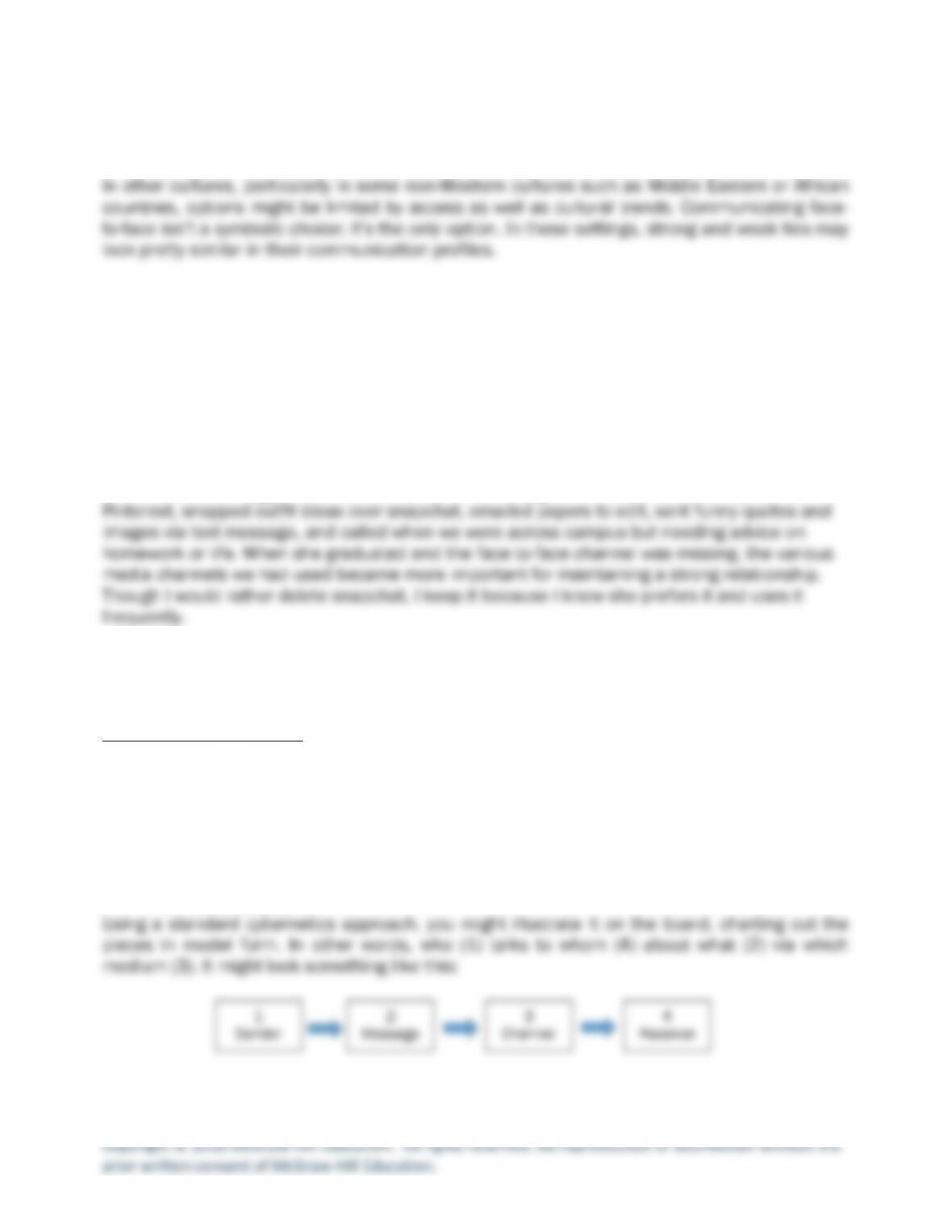
Haythornthwaite’s quote (on page 161) is worth some unpacking. “Asking ‘who talks to
whom about what and via which media’ revealed the unexpected result that more strongly tied
pairs make use of more of the available media, a phenomenon I have termed media
multiplexity.” A recap of her statement might look like this:
Who?
Talks to whom?
About what?
Via which medium?
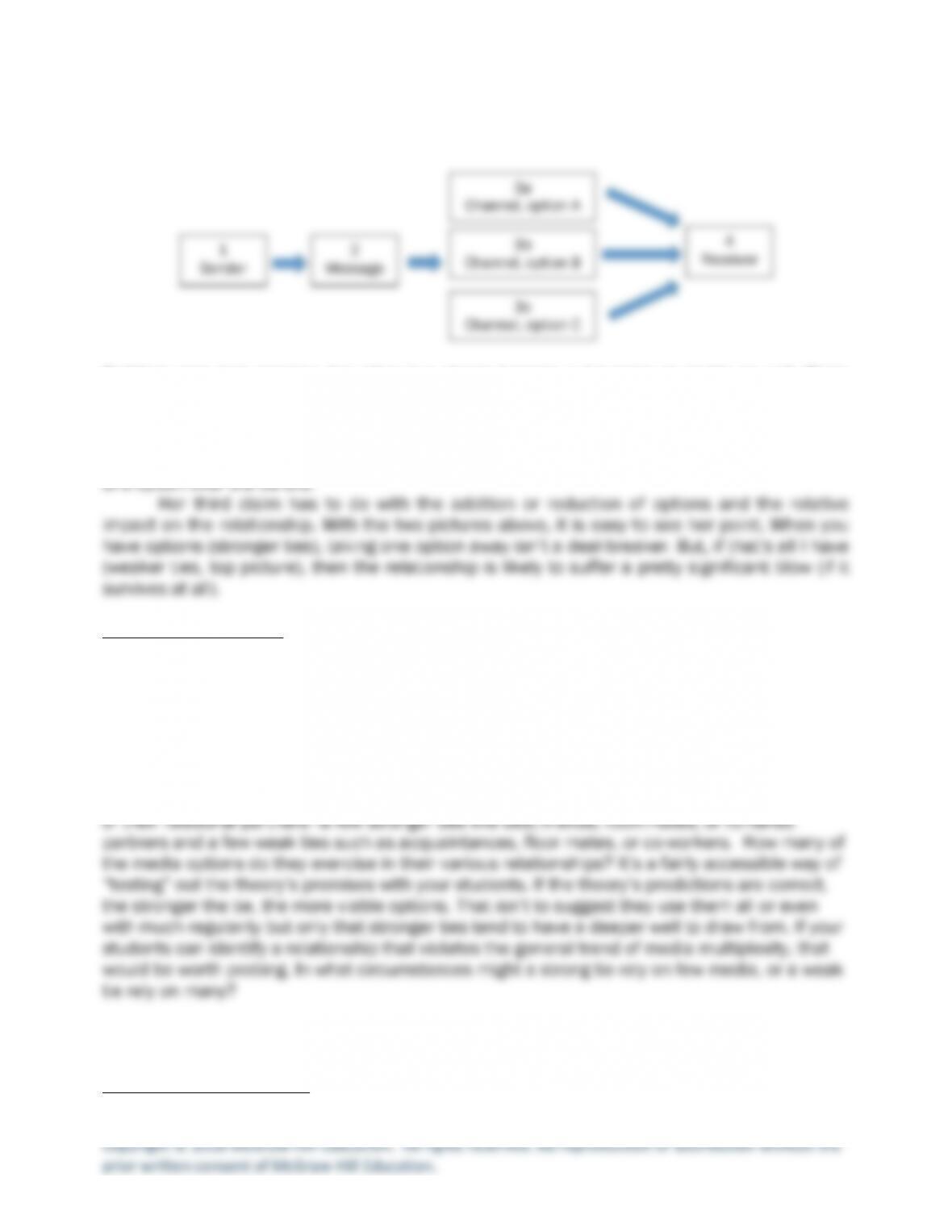
Haythornthwaite’s argument is that while the above may be true for weak ties, those with
greater tie strength have more opinions in box 3. Their picture look more like this:
Building upon that premise, her other two claims become a bit easier to tackle as well. Claim
#2 suggests that the three options regarding channel aren’t in a fixed location. Depending on
the norms, those options may be re-ordered. (See discussion above). Furthermore, as
indicated by Ledbetter’s own research and discussed in the chapter, the choice of which
option to use may be dependent on a variety of factors including enjoyment and preference for
Assessing their options
To help students think about Haythornthwaite’s claims, you might address the various
channels they use to communicate. I spend a few minutes allowing them to brainstorm some
options on their own. Then, create a list on the board to show the variety of options. You might
want to differentiate channels that have both group (such as a group chat on Whatsapp) and
individual forms (a private message) as well as those that have public (a tweet or Facebook
post) and private forums (Twitter’s direct message or Facebook messenger). If your students
are like mine, they will likely have a few dozen options (one of my classes came up with 34
choices in a matter of minutes). Then, given the totality of their options, ask them to list a few
Further Resources
Theoretical considerations
Jen Eden and Alice E. Veksler, “Relational Maintenance in the Digital Age: Implicit Rules and
Multiple Modalities,” Communication Quarterly, Vol. 64, 2016, pp. 119-144.
Eszter Hargittai and Y.-L. Patrick Hsieh, “From Dabblers to Omnivores: A Typology of Social
Family and Intergenerational issues
Michael Chan, “Multimodal Connectedness and Quality of Life: Examining the Influences of
Technology Adoption and Interpersonal Communication on Well-Being Across the Life
Span,” Journal Of Computer-Mediated Communication, Vol. 20, 2015, pp. 3-18.
Justin Peer, “Parent-Emerging Adult Relationships in the Digital Age: A Family Systems
Theoretical Perspective,” in Identity, Sexuality, and Relationships Among Emeging
Adults in the Digital Age (Michelle F. Wright, ed.), IGI Global, Hershey, PA, 2017, pp.
112-127.
Jennifer Schon, “‘Dad Doesn’t Text’: Examining How Parents’ Use of Information
1387.
Friendship
Nathan Miczo, Theresa Mariani, and Crystal Donahue, “The Strength of Strong Ties: Media
Multiplexity, Communication Motives, and the Maintenance of Geographically Close
Friendships,” Communication Reports, Vol. 24, 2011, pp. 12-24.
Facebook as relational maintenance
Michael G. Blight, Kristy Jagiello, and Erin K. Ruppel, “‘Same Stuff Different Day:’ A Mixed-
Method Study of Support Seeking on Facebook,” Computers In Human Behavior, Vol.
53, 2015, pp. 366–373.
Andrew M. Ledbetter and Joseph P. Mazer, “Do Online Communication Attitudes Mitigate the
Association Between Facebook Use and Relational Interdependence? An Extension of
Other applied contexts
Hui-Jung Chang and J. David Johnson, “Communication Networks as Predictors of
Organizational Members’ Media Choices,” Western Journal of Communication, Vol. 65,
2001, pp. 349-369.
Shu-Fen Tseng, Yuli Patrick Hsieh, “The Implications of Networked Individualism for Social
Participation: How Mobile Phone, E-mail, and IM Networks Afford Social Participation for
Rural Residents in Taiwan,” American Behavioral Scientist, Vol. 59, 2015, pp. 1157–
1172.