
CHAPTER 12
COMMUNICATION PRIVACY MANAGEMENT THEORY
Outline
I. Introduction.
A. Petronio sees communication privacy management theory as a map of the way
people navigate privacy.
B. Privacy boundaries are barriers that determine how much information one shares
with another.
C. Petronio sees communication privacy management theory (CPM) as a description of
a privacy management system that contains three main parts.
1. The first part of the system, privacy ownership, contains our privacy boundaries
that encompass information that we have but others don’t know.
3. Privacy turbulence, the third part of the privacy management system, comes into
play when managing private information doesn’t go the way we expect.
D. Having a mental image of these three parts of the privacy management system is
helpful in understanding the five core principles of Petronio’s CPM. The first four deal
with issues of privacy ownership and control; the fifth involves privacy turbulence—
the turmoil that erupts when rules are broken.
E. There are five core principles of CPM:
1. People believe they own and have a right to control their private information.
3. When others are told or given access to a person’s private information, they
become co-owners of that information.
5. When co-owners of private information don’t effectively negotiate and follow
mutually held privacy rules, boundary turbulence is the likely result.
1. A lot of private information we tell others is not about ourselves.
3. It has a neutral connotation, whereas self-disclosure has a positive feel.
1. Petronio defines privacy as “the feeling one has the right to own private
information.”

Copyright © 2018 McGraw-Hill Education. All rights reserved. No reproduction or distribution without the
prior written consent of McGraw-Hill Education.
2. Ownership conveys rights and obligations.
3. Privacy boosts our sense of autonomy and makes us feel less vulnerable.
4. Our sense of ownership motivates us to create boundaries that will control the
spread of what we know.
III. Rules for concealing and revealing: People control their private information through the
use of personal privacy rules.
A. An easy way to grasp what she means is to remember that people usually have rules
for managing their private information.
B. Five factors play into the development of a person’s unique privacy rules including
culture, gender, motivation, context, and risk/benefit ratio.
2. With regards to gender, popular wisdom suggests that women disclose more than
men, yet research on this issue is mixed at best.
4. Traumatic events can temporarily or permanently disrupt the influence of culture,
gender, and motivation when people craft their rules for privacy.
5. Risk/benefit ratios do the math for revealing as well as concealing private
information.
IV. Disclosure creates a confidant and co–owner: When others are told or discover a person’s
private information, they become co-owners of that information.
A. The act of disclosing private information creates a confidant and draws that person
into a collective privacy boundary.
B. Disclosing information to another person results in co-ownership.
2. As co-owners, people tend to feel responsibility for the information, though not
always equally.
3. Those who had the information foisted upon them may be more casual about
protecting it.
V. Coordinating mutual privacy boundaries: Co-owners of private information need to
negotiate mutually agreeable privacy rules about telling others.
A. This pivotal fourth principle of CPM is where Petronio moves from being descriptive
to prescriptive.
B. Assuming the privacy boundaries co-owners place around the information are
different, co-owners must negotiate mutual privacy boundaries—collective
boundaries that people shape together.
C. Boundary ownership is the rights and responsibilities that co-owners of private
information have to control its spread.
2. A deliberate confidant is someone who intentionally seeks private information,

3. A reluctant confidant doesn’t want the disclosure, doesn’t expect it, may find the
4. A shareholder is someone deemed to deserve access and control.
D. Boundary linkage is the process of the confidant being linked into the privacy
boundary of the person who revealed the information.
1. Boundary linkage is the process of determining who else gets to know.
2. When the revealer and recipient have a close relationship, the recipient is more
likely to deal with the new information the way the revealer wants.
E. Boundary permeability—How much information can flow?
1. Boundaries can be closed, thick, or stretched tight allowing little information to
3. Rules act as filters, letting some information pass easily through, while other
information is closely guarded.
4. Disclosers and receivers need to negotiate mutual rules for possible third-party
dissemination.
VI. Boundary turbulence – Relationships at risk: When co-owners of private information don’t
effectively negotiate and follow jointly held privacy rules, boundary turbulence is the likely
result.
A. Turbulence can radically alter our relationships by the way it affects our thoughts,
feelings, and actions.
B. Petronio predicts that people react to turbulence in attempts to regulate the
disturbed relationships that it creates.
C. Fuzzy boundaries occur when there are no recognized mutual boundaries, in which
case a confidant resorts to using their own privacy rules to guide what they say to
others.
D. Intentional breaches occur when a confidant purposefully reveals a secret they know
the original owner does not want shared.
2. A confidentiality dilemma occurs when a confidant must breach a collective
privacy boundary in order to promote the original owner’s welfare
E. Not all boundary and relational turbulence comes from privacy rules out of sync or
the intentional breach of boundaries.
1. Sometimes people create turmoil by making mistakes, such as letting secrets
2. Errors of judgment occur when someone discusses private cases in public
places.
3. A miscalculation in timing can cause turbulence when information is revealed at
a bad time.

VII. Critique: Keen diagnosis, good prescription, cure in process?
A. CPM nicely meets five of the six criteria for a good interpretive theory.
B. It scores well on providing a new understanding of people, backing that up by sound
qualitative research, the support of a community of agreement, clarifying privacy as a
value, and calling for reform (though that is a bit of a stretch).
C. CPM lacks aesthetic appeal, in both style and clarity.
D. A gap in the theory is that Petronio does not offer insight on how to conduct
negotiations or offer solutions for when boundary turbulence occurs.
E. Over the 35 years in working with the theory, she’s acknowledged the theory’s
ambiguities and repackaged things for improved clarity.
Key Names and Terms
Sandra Petronio
Communication scholar from Indiana University-Purdue University Indianapolis who
advocates for a rules-based approach to management of privacy and the disclosure of
private information.
Privacy boundaries
A metaphor to show how people think of the borders between private and public
information.
Private information
The content of potential disclosures; information that can be owned.
Privacy
The feeling that one has the right to own private information.
Rule-based theory
A theory that assumes we can best understand people’s freely chosen actions if we
study the system of rules they use to interpret and manage their lives.
Collective privacy boundary
An intersection of personal privacy boundaries of co-owners of private information, all of
whom are responsible for the information.
Mutual privacy boundary

A co-owner of private information who did not seek it nor want it.
Boundary linkage
An alliance formed by co-owners of private information as to who else should be able to
know.
Principal Changes
This chapter has been edited for clarity and readability. In particular, the material on
boundary ownership has been reorganized and the term stakeholder has been added
alongside shareholder.
Kick-off Questions & Interaction Starters
• As a child, why would you keep a “secret”? Have those reasons changed as an adult
or is the contexts of privacy just more complex?
• How did you learn about the concept of “privacy” or what it means to keep a secret?
Suggestions for Discussion
Assumption and interaction maxims
In the introductory materials, the principles of the theory are grouped into three main
parts: issues related to privacy ownership (principles #1-3), privacy control (principle #4), and
privacy turbulence (principle #5). You might ask students to consider if they must be taken in
order. In other words, must you accept her first principles before the later? You might also

In some of her writing, Petronio and her colleagues divide the core principles of the
theory into assumptive maxims (#1 and 2) and interaction maxims (#3, 4, & 5). It might be a
useful distinction to make in your discussions as the first tenets or core principles are
foundational and the last three ideas rely on an acceptance of those principles to be true. So,
for example, one must hold the assumption that I own, possess or control my information (#2)
before I can postulate that I also have a right to invite others to share in it (#3). Another point
Five core principles or six?
In the chapter’s treatment of CPM, the theory is organized into five core principles.
However, in some of her own writings, Petronio suggests a sixth principle, which precedes
those that are addressed here. She suggests that the first principle is that people experience
a dialectical tension between openness and privacy, or between being known and keeping
information concealed. I find the chapter’s take on the theory interesting as it jumps right in
Classifying theories
As the semester progresses, I encourage my students to find different ways to “group”
theories. There are a lot of theories and they can quickly all get mushed together. Obviously,
there are some fairly well defined differences based on paradigms (objective vs. interpretive),
by tradition, or by context area (i.e. interpersonal, media, intercultural). However, I also push
them to think of alternate ways of clustering theories—and CPM becomes an interesting
catalyst for a discussion about routine or habitual actions compared to strategic or intentional
acts. Some theories—such as CPM— take the stance that more explicit, planned out
approaches can produce better ends. This mindfulness may not be second-nature but can
Broadly-based research
With a theory about interpersonal privacy, you might imagine the wide-ranging possible
applications. From internet concerns to family secrets, privacy can be a sexy topic to study.
However, as you have likely noted, the textbook authors have been effortful to include diverse
scholarship from a range of different contexts within each chapter. As you discuss CPM, you
might note to your students how much research for this theory speaks to marginalized groups
or stigmatized conditions. Petronio and other CPM researchers have a long history of applying
the theory to issues related to health concerns (such as infertility or HIV status), stigmatized
When Andrew teaches the theory, he notes the methodological and even philosophical
pluralism among the CPM research community. Many theories tend to only employ research
that falls within their own (objective or interpretive) camp. In contrast, although CPM is
interpretive in its roots, examples of objective scholars who use CPM aren’t hard to find.
Sample Application Log
Andy
My girlfriend Rissa and I share many intimate details with each other. I remember this one
occasion when she was telling me something that was super secretive and super private.
Before she told me, she specified for about ten minutes that I could not tell anyone, not my
best friend Ryan, not my parents, no one. I had to swear on my life that I would not let this
piece of information get out. After all this hassle, she finally told me. Communication Privacy
Management theory explains Rissa and my behavior. She felt that she owned this piece of
Exercises and Activities
Turbulence as a metaphor
Though it is only one of the principles to the theory, it seems to me that relational
turbulence as the outcome of poorly negotiated privacy boundaries deserves considerable
attention. The choice of the term “turbulence” seems ideally suited to describe the situation.
Most people will likely be familiar with turbulence as experienced while travelling by plane, so I
exploit the example to illustrate the theory. Turbulence rarely cancels a flight; it might change
the course it takes, cause detours to unanticipated locations, or make the ride somewhat
I also think an interesting tie-in with uncertainty reduction is possible when discussing
the nature of turbulence. Does it change if you know the turbulence coming? At times, when I
have been on trips, a pilot announces ahead of time the presence of rough patches ahead,
essentially encouraging passengers to prepare themselves. Though you are not certain how
rough it will be, you can, to quote the classic film, All About Eve, “Fasten your seatbelts, it’s
gonna be a bumpy ride.” Is it possible to do this when it comes to privacy and boundary
negotiating? How can we figure out ahead of time if we have different privacy standards than
Diagramming CPM: Concentric circles
As a graduate student, I was fortunate enough to have Sandra Petronio as a professor
during some of the formative years of CPM. Taking a seminar from Dr. Petronio on privacy and
disclosure, we unpacked the principles of CPM, which she had been researching for years and
was in the process of writing what would become her book-length treatment Boundaries of
Privacy: Dialectics of Discourse (Albany: State University of New York, 2002). What stuck with
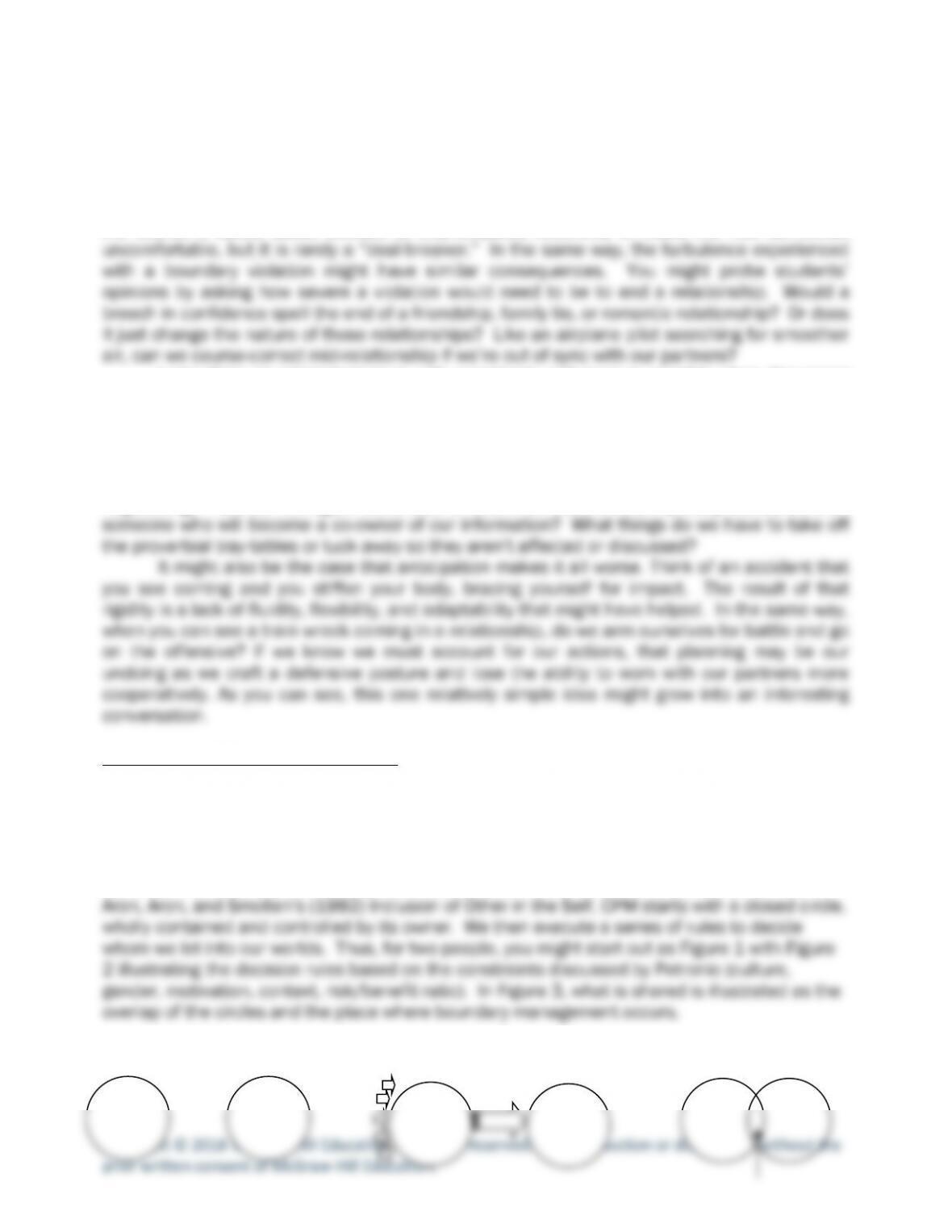
me since that time was the conceptualization of information as concentric circles. Similar to
Figure 1: Starting out Figure 2: Decision time Figure 3: Co-Owners

Feature film illustration
One film that beautifully explores the many negotiated boundaries is Good Will Hunting.
In it, Will Hunting (portrayed by Matt Damon) experiences a multitude of privacy boundaries
including his closest friend Chuckie (Ben Affleck), his therapist Sean (Robin Williams), his
professor Dr. Lambeau (Stellan Skarsgard), and his love interest, Skylar (Minnie Driver). In
each case, the film illustrates some of his struggles with co-ownership. In one particularly
memorable scene, Sean tells Will about his late wife and explains the benefits of privacy AND
disclosure:
Sean: Wonderful stuff, you know, little things like that. Ah, but, those are the things I
miss the most. The little idiosyncrasies that only I knew about. That’s what made her
my wife. Oh and she had the goods on me, too, she knew all my little peccadilloes.
People call these things imperfections, but they’re not, aw that’s the good stuff. And
If your students are fans of the Harry Potter books and films, you might consider using a
clip from the 2007 film Harry Potter and the Order of the Phoenix. Behind the back of
oppressive Professor Umbridge, Harry and several of his classmates form Dumbledore’s Army.
Harry’s budding relationship with classmate Cho Chang is brought to a halt when Cho is
coerced into divulging the secret society to Umbridge. The scene illustrates the choice of
disclosing private information (principles 2-3) to such a deliberate confidant. The fallout is a
nice illustration of what happens after these breaches in privacy are revealed.
Also poignant though perhaps far less familiar to students is the film, Call Me By Your
Name (2017). In the coming-of-age story, Elio (played by Timothee Chalamet) is an introverted,
sexually inexperienced 17-year old who lives with his parents in Northern Italy. When Oliver, a
24-year old graduate student, comes to stay with the family to work with Elio’s professor
father, Elio is torn between a budding romance with Marzia and his attraction to Oliver.

Copyright © 2018 McGraw-Hill Education. All rights reserved. No reproduction or distribution without the
prior written consent of McGraw-Hill Education.
frank about his feelings for Oliver and about his grief at the relationship’s end. In this scene,
Elio makes a different choice about what of his private information he chooses to share. The
contrast of the two scenes is interesting as both potential confidants (Marzia and his father)
are compassionate and, yet, he makes different choices.
Further Resources
In 2013, Journal of Family Communication (Vol. 13, Issue 1) released a special issue
exclusively focusing on CPM theory. Articles of note in that issue include:
• A status report on the theory (Petronio)
• Parent/child communication privacy (Toller & McBride)
CPM has been applied to a variety of contexts. In some articles/writings, the theory has gone
by the name “Communication Boundary Management” (CBM).
Relational & Family
Erin D. Basinger, Erin C. Wehrman, and Kelly G. McAninch, “Grief Communication and Privacy
Rules: Examining the Communication of Individuals Bereaved by the Death of a Family
Member,” Journal of Family Communication, Vol. 16, 2016, pp. 285-302.
Erin A. Brummett and Keli Ryan Steuber, “To Reveal or Conceal?: Privacy Management
136.
Carrie D. Kennedy-Lightsey and Brandi N. Frisby, “Parental Privacy Invasion, Family
Communication Patterns, and Perceived Ownership of Private
Information,” Communication Reports, Vol. 29, 2016, pp. 75-86.
Andrew M. Ledbetter, Sarah Heiss, Kenny Sibal, Eimi Lev, Michele Battle-Fisher, and Natalie
LGBTQ Applications

Copyright © 2018 McGraw-Hill Education. All rights reserved. No reproduction or distribution without the
prior written consent of McGraw-Hill Education.
Diana Breshears and Rebecca DiVerniero, “Communication Privacy Management Among Adult
Children With Lesbian and Gay Parents,” Western Journal of Communication, Vol. 79,
2015, pp. 573-590.
Rose Helens-Hart, “Females’ (Non)Disclosure of Minority Sexual Identities in the Workplace
From a Communication Privacy Management Perspective,” Communication
Studies, Vol. 68, 2017, pp. 607-623.
Tim McKenna-Buchanan, Stevie Munz, and Justin Rudnick, “To Be or Not To Be Out in the
Classroom: Exploring Communication Privacy Management Strategies of Lesbian, Gay,
Computers/ Technology
Jeffrey T. Child, Paul M. Haridakis, and Sandra Petronio, “Blogging Privacy Rule Orientations,
Privacy Management, and Content Deletion Practices: The Variability of Online Privacy
Management Activity at Different Stages of Social Media Use,” Computers in Human
Behavior, Vol. 28, 2012, pp. 1859-1872.
Ralf De Wolf, “Group Privacy Management Strategies and Challenges in Facebook: A Focus
Group Study Among Flemish Youth Organizations,” Cyberpsychology, Vol. 10, 2016, pp.
17–32.
Bethany D. Frampton and Jeffrey T. Child, “Friend or Not to Friend: Coworker Facebook Friend
1600.
Jessica Vitak, “A Digital Path to Happiness? Applying Communication Privacy Management
Theory to Mediated Interactions,” in The Routledge Handbook of Media Use and Well-
Being: International Perspectives on Theory and Research on Positive Media Effects,
Leonard Reinecke and Mary Beth Oliver (eds.), Routledge/Taylor & Francis Group, New
Workplace & Educational
Stephanie A. Smith and Steven R. Brunner, “To Reveal or Conceal: Using Communication
Privacy Management Theory to Understand Disclosures in the Workplace,”
Management Communication Quarterly, Vol. 31, 2017, pp. 429-446.
Jason L. Snyder, “E-Mail Privacy in the Workplace: A Boundary Regulation Perspective,” Journal
of Business Communication, Vol. 47, 2010, pp. 266-294.

Copyright © 2018 McGraw-Hill Education. All rights reserved. No reproduction or distribution without the
prior written consent of McGraw-Hill Education.
Jason L. Snyder and Karen M. Cornetto, “Employee Perceptions of E-mail Monitoring from a
Boundary Management Perspective,” Communication Studies, Vol. 60, 2009, pp. 476-
492.
Health Communication/ Cross- cultural applications
Jennifer J. Bute and Tennley A. Vik, “Privacy Management as Unfinished Business: Shifting
Boundaries in the Context of Infertility,” Communication Studies, Vol. 61, 2010, pp. 1-
20.
63.
Masaki Matsunaga, “Individual Dispositions and Interpersonal Concerns Underlying Bullied
Victims’ Self-Disclosure in Japan and the US,” Journal of Social and Personal
Relationships, Vol. 27, 2010, pp. 1124-1148.
Affirmative Vasectomy Decision. Communication Studies, Vol. 66, 186-203.
doi:10.1080/10510974.2014.930917
Lynsey K. Romo, “How Formerly Overweight and Obese Individuals Negotiate Disclosure of