
SAMPLE SYLLABUS
INSTRUCTOR NAME AND CONTACT INFORMATION
Instructor: Dr. Jane Doe
Office telephone: 555-555-5555
REQUIRED RESOURCES
• Textbook: Fraleigh, Tuman, and Adams, Let’s Communicate, ISBN: 978-1-4576-0601-4
• Additional materials:
Notebook
Writing utensil
Two-pocket folder
COURSE DESCRIPTION
This course is an introduction to the theory and practice of communication in multiple contexts,
including individual speeches, interpersonal interactions, and small group interactions. The course
includes a significant formal writing component and public speaking component. The course is
OBJECTIVES
Learning objectives for foundational studies
• Locate, critically read, and evaluate information to solve problems.
• Critically evaluate the ideas of others.
• Apply knowledge and skills within and across the fundamental ways of knowing (natural
sciences, social and behavioral sciences, arts and humanities, mathematics, and history).
• Demonstrate an appreciation of human expression through literature and fine and performing
arts.
• Demonstrate the skills for effective citizenship and stewardship.
• Demonstrate an understanding of diverse cultures within and across societies.
• Demonstrate the skills to place your current and local experiences in global, cultural, and
Course objectives
• Apply basic theoretical concepts to the study of human communication.
• Apply concepts of small group communication in the development and execution of a small
Skills or applied learning objectives
• Demonstrate how the curriculum will develop critical thinking skills.
• Demonstrate how the curriculum will develop information literacy skills.
• Include a graded writing component, which whenever possible is developmental.
COURSE POLICIES
Academic integrity: All members of the university are expected to uphold professional standards.
As students, you are responsible for “learning and upholding professional standards in research,
Please note: Plagiarism—passing off someone else’s idea as your own—is subject to university
procedures and carries serious penalties, ranging from a grade of zero on the assignment to failure
for the course or dismissal from the university. Plagiarized material will receive a grade of zero
in this course. Additional penalties may include a grade penalty for the course or referral to the
Office of Student Conduct and Integrity, which can result in suspension, expulsion, and a
(INSERT NAME). Please do not go to the director without first coming to me so that we can try to
find a solution together.
Classroom environment: The effectiveness of this course depends on the creation of an
encouraging and safe classroom environment. Exclusionary, offensive, or harmful speech will not be
tolerated and, in some cases, may be subject to university harassment procedures. We are all
E-mail policy: Feel free to e-mail me with questions, comments, or concerns. I will typically
respond within 24 hours (often less) on weekdays and within 48 hours or less on weekends. All e-
mails sent to me should include the following:
• Subject line: The subject line should include the name of the course number and a short one- to
two-word subject so I have a sense of what I’m receiving (for example, Comm 101—Question
about paper).
• Greeting: The greeting should address me (for example, Hello Instructor Doe, Good Morning
Instructor Doe, Dear Dr. Doe, etc.).
• Body: The clearly written body should include few or no spelling or grammar errors. Be sure
Attendance: What you will take away from this course depends on your willingness to engage with
the material. Because this is a skills course, your presence is essential for you to develop and
understand the principles of communication that we discuss. You are expected to attend class
regularly and participate in classroom discussions. If you miss class regularly, it will be difficult to do
well in this class, earn participation, or keep up with assignments.
• Each student is allowed two penalty-free absences in a TuTh class or three penalty-free absences
in a MWF class. Each unexcused absence after your “free” ones will reduce your final
letter grade by one-third. The only excused absences are those due to religious holidays,
military deployment or training, university-sponsored events, or medical or family emergencies.
In such cases, you must provide documentation to your instructor.
director of foundational studies in communication. Please contact the Office of Student Affairs
at (XXX) XXX-XXXX if your absence exceeds five consecutive days due to illness,
hospitalization, or family emergency. The OSA can help inform instructors of your extended
absence if you are not able to do so and may help you navigate the challenging situation.
Tardiness: Please come to class on time because late arrivals disrupt the flow of the class and create
an unnecessary distraction. Tardiness is defined as arriving after roll has been taken or after the
lecture has begun. Being tardy three times will count as one full absence. If you arrive late to class
during a classmate’s speech, please wait outside the door until the speech is over and then enter the
Technology: Because your mental presence is as important as your physical presence, cell phone
and laptop use will not be permitted in the class unless your instructor has deemed them necessary
for online quizzes or activities—in which case, you will be given ample notification. Laptops are not
Sleeping in class: If students are sleeping during class, they are subject to an absence.
Instructor absence: If your instructor does not come to class at the beginning of the class period,
wait 10 minutes and then call the Department of Communication at (XXX) XXX-XXXX for
GRADING INFORMATION
Format of assignments
• You will be turning in your writing assignments using the proper MLA (Modern Language
Association) format when conducting research.
• Please only use Arial or Times New Roman (point size 12) when submitting papers.
• Most of the papers you write will need to be double-spaced in a MicroSoft Word document.
Word automatically defaults to 2.25 lines between paragraphs, so you will need to change your
line spacing setting in Word prior to submitting your assignments.
• If you are submitting an assignment with multiple pages, make sure you staple your pages
together prior to submission.
Grading distribution
• Public speaking: 25%
• Writing: 40%. Students will be given assignments and exercises to bring to life the concepts and
theories that are discussed in class. All written assignments will be typed and must meet
formal standards for writing.
• Quizzes and exams: 25%. There will be chapter quizzes and one final examination. Quizzes and
the final exam will consist of multiple-choice and true-or-false questions. The goal of the exam is
to assess students’ ability to understand material from the text and lectures and to apply these
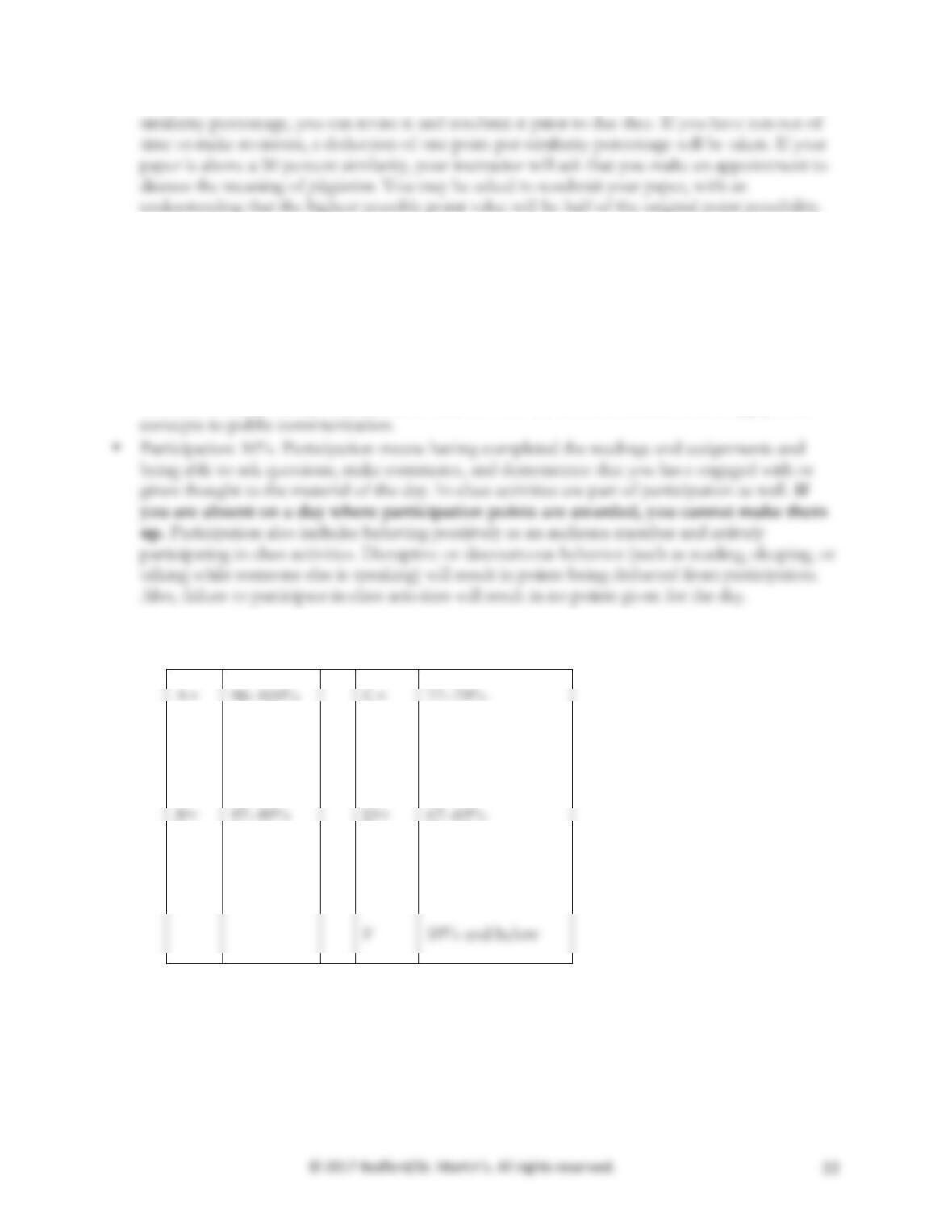
Grading scale:
A
A–
B
B–
93–97%
90–92%$
83–86%
80–82%
C+
C
C–
D
D–
73–76%
70–72%
63–66%
60–62%
Late work policy: All assignments are due at the start of your class time (not in the middle of
class and not at the end of class). Late assignments are not accepted (unless there is a documented
emergency). If you know you will not be in class on a given day, I will accept early submission of
assignments via e-mail. (Early is defined as any time before the beginning of your class time.)
FINAL EXAM POLICY
As is indicated in the University Handbook (sections 111.1.1.1–111.1.1.1), “no student shall be
excused [from the final exam] except for illness or conflict with a legitimate university
activity.” Students are required to provide documentation in advance of the final exam and will
EXPECTATIONS
Agreement with syllabus content: This syllabus is an agreement between the professor and the
student, between me and you, to provide and complete a worthy learning experience. By remaining a
What do I expect from my students?
• Students should read all of the chapters (or other reading assignments) and be ready to discuss
any part of the readings.
• Students should raise questions when they are uncertain about the material we are discussing,
including questions for which I might have no easy answers.
What can my students expect from me?
• Because I am aware that students learn in many different ways, I will not lecture at my students
daily from behind a raised podium. Instead, I will provide instruction to them in an interactive
• I will stay abreast of current technology and apply it in the classroom whenever it adds to the
learning experience.
• I will help guide students through the issues that they raise, and we will seek resolutions
together.
• I will make every effort to ensure that students understand the issues and concepts that are
presented in my courses.