Chapter 9: Effective Practices for Teaching Academic Skills to Students with Autism Spectrum
Disorders
Summary:
This chapter addresses instruction for students with ASD in three primary academic areas:
reading, writing, and mathematics. Beginning with a discussion of the Common Core Standards, adopted
by many US states in 2010, the chapter describes changing expectations in academics for all students in
grades K-12. For example, in reading, there is the expectation that all students will be able to read
independently with comprehension. In writing, there is an expectation that students will be able to write
for a variety of purposes including persuasive and informational essays. Further, students are expected to
Several aspects of reading are discussed in this chapter. First, common terminology are defined,
including the following:
• Phonemic awareness: the ability to hear, identify, and manipulate individual sounds into words
• Phonics: the ability to understand that different sounds correspond with letters of the alphabet,
and that these sounds can be blended to make words
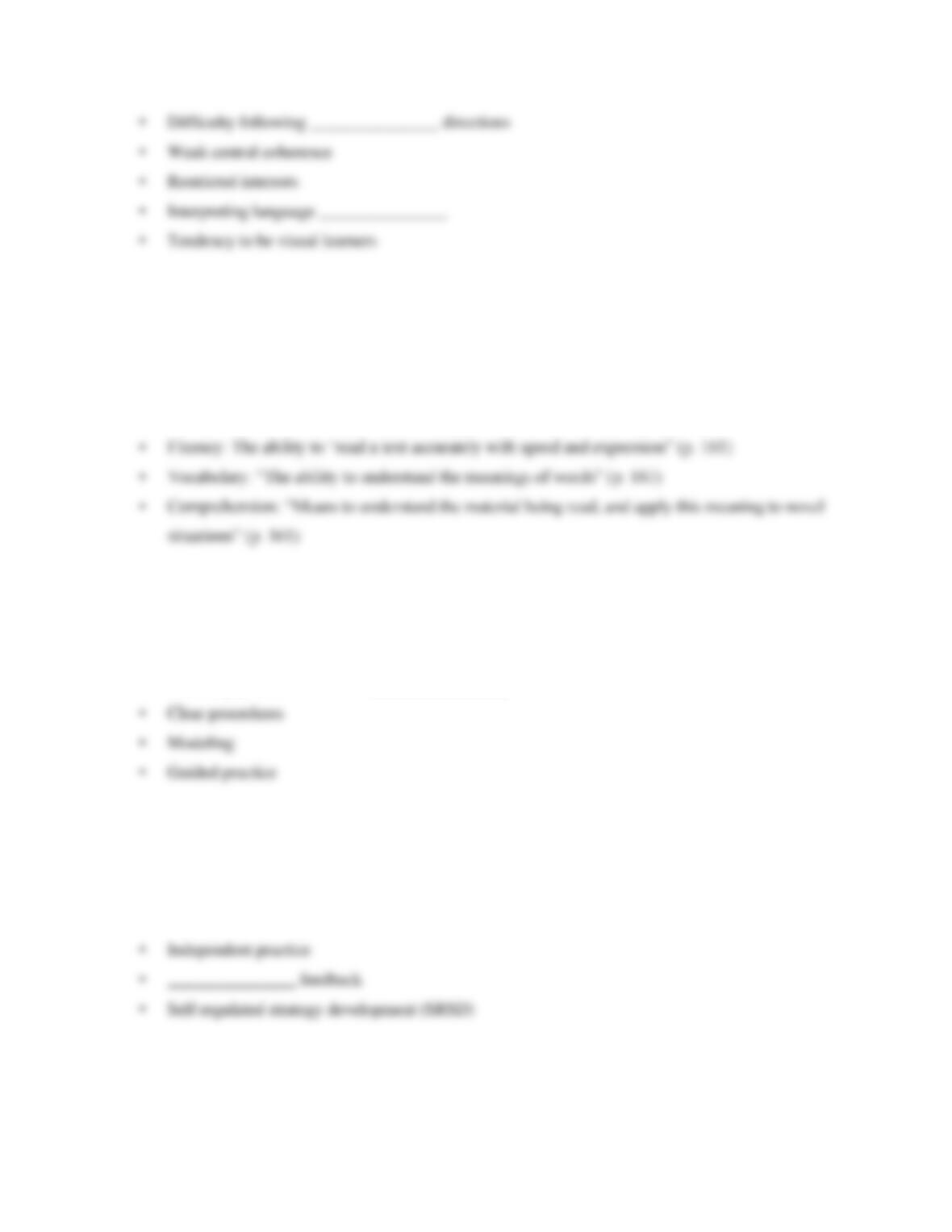
• Fluency: the ability to read text accurately with speed and expression
• Vocabulary: the ability to understand the meanings of words
• Comprehension: the ability to understanding the meanings of words; reading for understanding
Mathematics instruction is another area in which direct and explicit instruction has been found to
be most effective. It is suggested that teachers first focus on the foundational skills of adding, subtracting,
etc., and then move to application of these skills to meet the contemporary standards. Multiple
demonstrations and repeated examples for foundational skills are recommended, as is practice with
feedback. Feedback should be reinforcing for correct responses and provide guided practice and
correction when the student is incorrect. Concrete-representational abstract (CRA) is a strategy used for
Objectives:
2. Discuss the learning needs that are unique to students with ASD that must be considered by
educators to promote academic success.
4. Describe how educators can incorporate principles of Universal Design for Learning (UDL) to
modify or adapt instruction to meet the academic needs of students.
Focus Questions:
1. What are some of the current academic expectations that may be challenging for students with
ASD who experience learning difficulties in literacy or mathematics?
3. Describe two key research findings pertaining to academic outcomes for students with AD, and
4. Describe three techniques on how you can modify a fifth-grade reading less about Explorers of
the Southwest, for students with ASD that have below grade level reading and writing skills. How
would you ensure meaningful access to the content, while differentiating the assignment to meet
student’s learning needs?
Key Terms:
Common Core State Standards
Differentiation
Evidence-based practices
Fluency
Phonemic awareness
Phonics
Universal design for learning
Weak central coherence
Instructional Strategies:
Strategy
Rationale
Description/Steps
Modifications/
Alternative Options
Common Core State
Standards Discussion
Allow students to
expand their
understanding and
1. Facilitate a discussion with
the students about the
possible changes from
Encourage students to
conduct an Internet
search on CCSS and
application of
concepts to real
world examples
traditional academic
instruction (particularly for
students with disabilities)
compared to the new
expectations of the CCSS
2. Have students discuss the
benefits and possible
difficulties the CCSS may
present in the education of
students with disabilities,
particularly those with more
significant disabilities
students with
disabilities; the
Council for
Exceptional Children
website will be a
good resource
Academic Instruction
Research
Presentations
Provide the students
the opportunity to
engage with the
current literature in
the field
1. Have students read a
research study on reading,
writing, and/or mathematics
instruction for students with
ASD
2. Have students present
mini-lessons over their study,
including description of the
study design and results and
a demonstration of the
instructional method
3. Have students discuss the
merits of each strategy
presented for use with their
own students or future
students
Have students work in
teams and assign
specific academic
areas or instructional
procedures
Differentiated
Instruction Practice
Provide opportunity
for students to
synthesize and apply
concepts from the
reading
1. Obtain a copy of a
teachers’ edition of an
academic or core content area
textbook in grades K-12
2. Have students adapt one of
the lessons for a student with
ASD
3. Have students share with
classmates
Allow students to
work in teams or pairs
Assign specific
content areas to each
student/team
Provide a case
example of a student
with ASD for whom
the students must
specifically adapt the
material

students with autism.
Chapter 9: Effective Practices for Teaching Academic Skills to Students with Autism Spectrum
Disorder
Guided Notes
Outline
• The Common Core Standards
• Characteristics of ASD That May Negatively Impact Academic Learning
• Reading Terminology
The Common Core Standards
• Developed by National Governor’s Association in ________
• Adopted by majority of states to:
• Includes _______________ for mathematics and English Language Arts (ELA) in grades K-12
• Reading for comprehension in social studies and science as well as writing are subsumed within the
ELA standards
• The Common Core Standards of often difficult to address for teachers of students with
_______________ for a number of reasons:
− Students are expected to read _______________ with grade-level proficiency
− Integration of Knowledge and Ideas standard that suggests students _______________ be
able to read and evaluate central themes from a variety of texts, analyze arguments, and
compare and contrast themes
Characteristics of ASD That May Negatively Impact Academic Learning
• Delays in _______________ functioning
• Difficulty interpreting abstract concepts
Reading: Terminology
• Phonemic Awareness: “The ability to hear, identify, and manipulate individual sounds in words”
(p. 161)
• Phonics: “The ability to understand that different sounds correspond with letters of the alphabet,
and these can be manipulated and blended to read and write words” (p. 161)
Reading Instruction
• Elkonin boxes (_______________ awareness)
• Onset and Rime cards (_______________)
• Matching pictures and words (_______________)
Writing Instruction
• Pre-writing _______________ organizers
• Modeling
• _______________ practice
Mathematics Instruction
• _______________ and explicit instruction
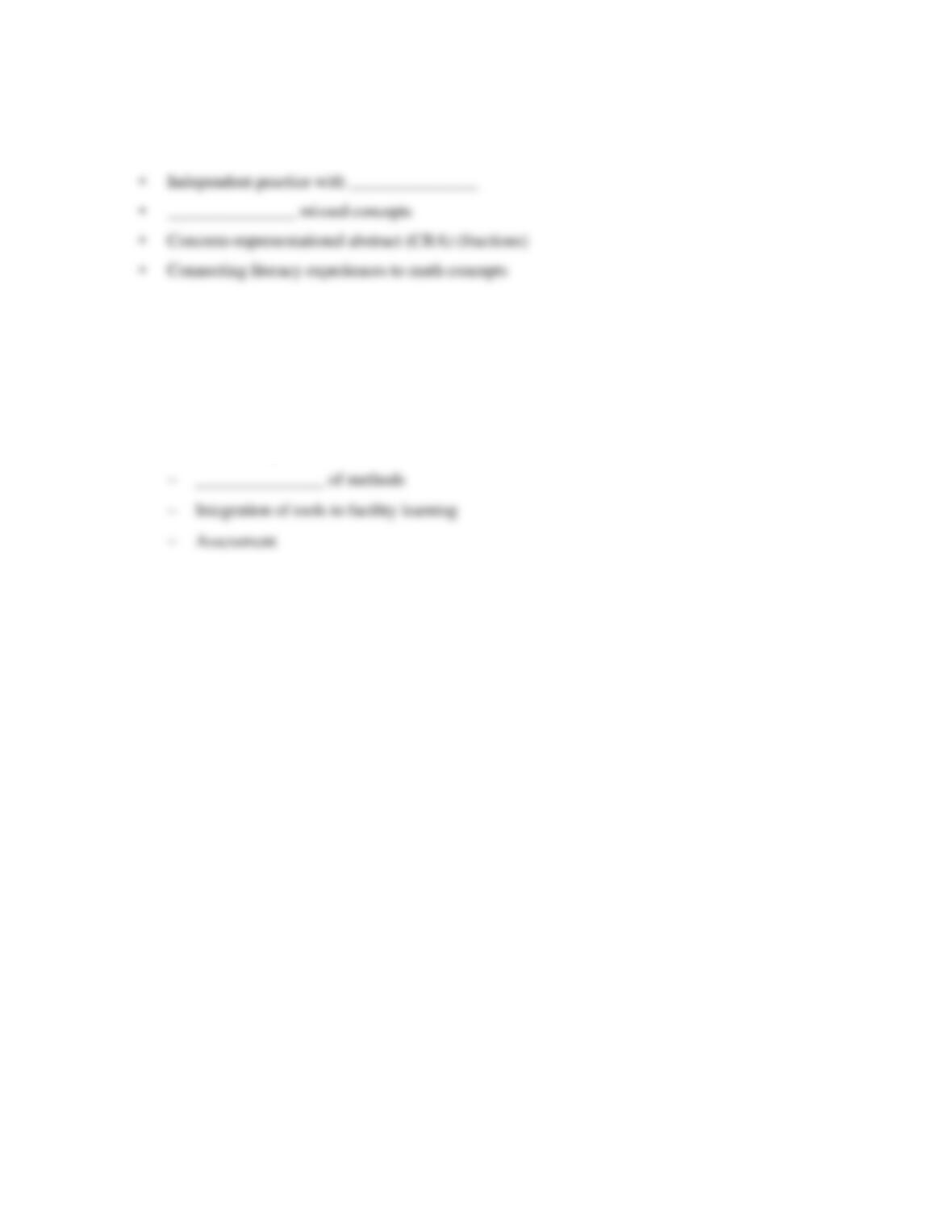
• Multiple demonstrations for performing an operation
• Guided practice
Universal Design for Learning (UDL)
• Theoretical framework intended to _______________ academic outcomes and student
engagement
• Includes several key principles to guide instruction and planning:
− Goal setting