Chapter 8: Daily Living Skills
Summary:
Skills of daily living are critical for individuals with ASD across the lifespan. The ultimate goal is
functional independence in the mainstream of society with as few supports as possible. Therefore,
teaching functional skills with a goal of ultimate independence is key. Some questions teachers can ask to
aid in determining what skills are functional, or socially significant, are: (a) what are the student’s life
goals?, (b) what prerequisite skills should be addressed in order to build daily living skills or functional
routines?, (c) how will this goal lead to the student’s lifelong goals? and (d) is the goal socially
significant?
Evidence-based practices for teaching daily living skills to students with ASD include
predominantly those based on the principles of applied behavior analysis. Among these, tasks analysis
and chaining are some of the most commonly researched because they involve instruction of skills that
have multiple steps, such as making a meal or brushing teeth. Task analysis involves breaking a multi–
step skill into smaller components, each of which can then be taught individually or in tandem, to produce
acquisition on the entire skill. How much skills are broken down depends on the individual student, as
some students require more simple steps than others. For example, Student A may have no difficulty
opening the refrigerator and selecting the appropriate items for making her sandwich, with one step
labeled, “get sandwich supplies” however Student B may need to have steps for opening the refrigerator
and getting each of the supplies.
Objectives:
1. Identify core characteristics of ASD that impact a student’s ability to learn daily living skills.
2. Describe the prerequisite skills necessary for daily living skills that should be addressed when
working with individuals with ASD.
4. Explain how to utilize effective teaching strategies when teaching daily living skills.
Focus Questions:
2. What prerequisite skills should be a primary focus of instruction prior to teaching daily living
skills and functional routines?
4. What are some specific instructional strategies that are evidence-based that can be used to teach
daily living skills?
5. Once skills are assessed, what should then occur with the findings in order to make an informed
decision with instruction and data collection?
Key Terms:
Prompt dependence
Functional skills
Functional independence
National Research Council
Scientifically based research
Skill acquisition
Task analysis
Instructional Strategies:
Strategy
Rationale
Description/Steps
Modifications/
Alternative Options
Daily Living Skills
Assessment Activity
Real world practice
may enhance
students’
understanding of
concepts
1. Obtain a portion of one
of the commonly used
commercial assessments
for daily living skills and
provide students with a
copy
2. Have students interview
a caregiver or teacher
and complete a portion of
the assessment based on
alternative, students
could observe the
Allow students to
work in teams
Assign teams to
specific daily living
skills areas (e.g.,
hygiene) and have
teams share their
experiences with the
assessment process
goals for that specific
area
individual to complete
the assessment
3. Have students develop 3-
5 instructional goals
based on the assessment
results
4. Allow students to share
results of their process
with classmates
Task Analysis
Supplemental,
expanded lesson may
assist students with
the concepts
1. Discuss with students
how to conduct a Task
Analysis for a complex,
multi-step skill, as is
discussed in the section
on Chaining
2. In small groups or pairs
have students task
analyze a skill they do
every day, breaking it
down into as many steps
as might be appropriate
for someone just learning
the skill
3. Have students share the
task analysis with the
class
Have students
actually go and
complete the task to
see first-hand the
steps involved
Have students create a
data sheet that might
be appropriate for a
multi-step skill
Suggested Resources/Readings:
Iovannone, R., Dunlap, G., Huber, H., & Kincaid, D. (2003). Effective educational practices for
students with Autism Spectrum Disorders. Focus on Autism and Other Developmental
Disabilities, 18, 150-165.
This article describes core elements that should be included in any instructional program for
students with ASD.
National Professional Development Center on Autism Spectrum Disorders: http://autismpdc.fpg.unc.edu/
TEACCH. From http://www.teacch.com, retrieved December 24, 2007.
This web site is an evidence-based service, training, and research program for individuals of all
Chapter 8: Daily Living Skills
Guided Notes
Outline
• Overview
• Why Do We Need to Teach Daily Living Skills to Students with ASD?
• Identifying Daily Living Skills to Teach
• Barriers to Learning
• Assessment for Daily Living Skills Instructional Planning
• Instructional Strategies for Teaching Daily Living Skills
• Hierarchy of Prompting
• IEP Development and Data Monitoring
Overview of Daily Living Skills
• Definition:
• Skills that a person needs to learn in order to have _______________ over their
environment
• Examples:
• _______________ skills such as bathing and brushing teeth
• _______________ such as making a meal or cleaning one’s home or clothes
Why Do We Need to Teach Daily Living Skills to Students with ASD?
• Many students with ASD do not “_______________” or learn daily living skills the way that
typically developing students do
• Students with ASD have social communication deficits, may have cognitive deficits, motor
deficits, sensory-related issues, or restricted or repetitive patterns of interest that
Identifying Daily Living Skills to Teach
• Focus on the _______________ goals for the student: _______________ independence
• Consider the social _______________ of the skills
• Ask these 4 questions:
• What are the student’s lifelong goals?
• What _______________ skills should be addressed in order to build daily living skills or
functional routines?
Barriers to Learning
Assessment for Daily Living Skills Instructional Planning
1. _______________ –referenced tests
2. _______________ –based assessments
2. Provide greater depth of content and may be more ASD specific
3. Task Analysis
1. Breaks down a task into _______________ steps, and assesses student performance at
each step to determine both what and how to teach
3. Necessary first step to chaining and is an _______________ -based practice
Instructional Strategies for Teaching Daily Living Skills
ABA
• Discrete Trial Training
• Chaining
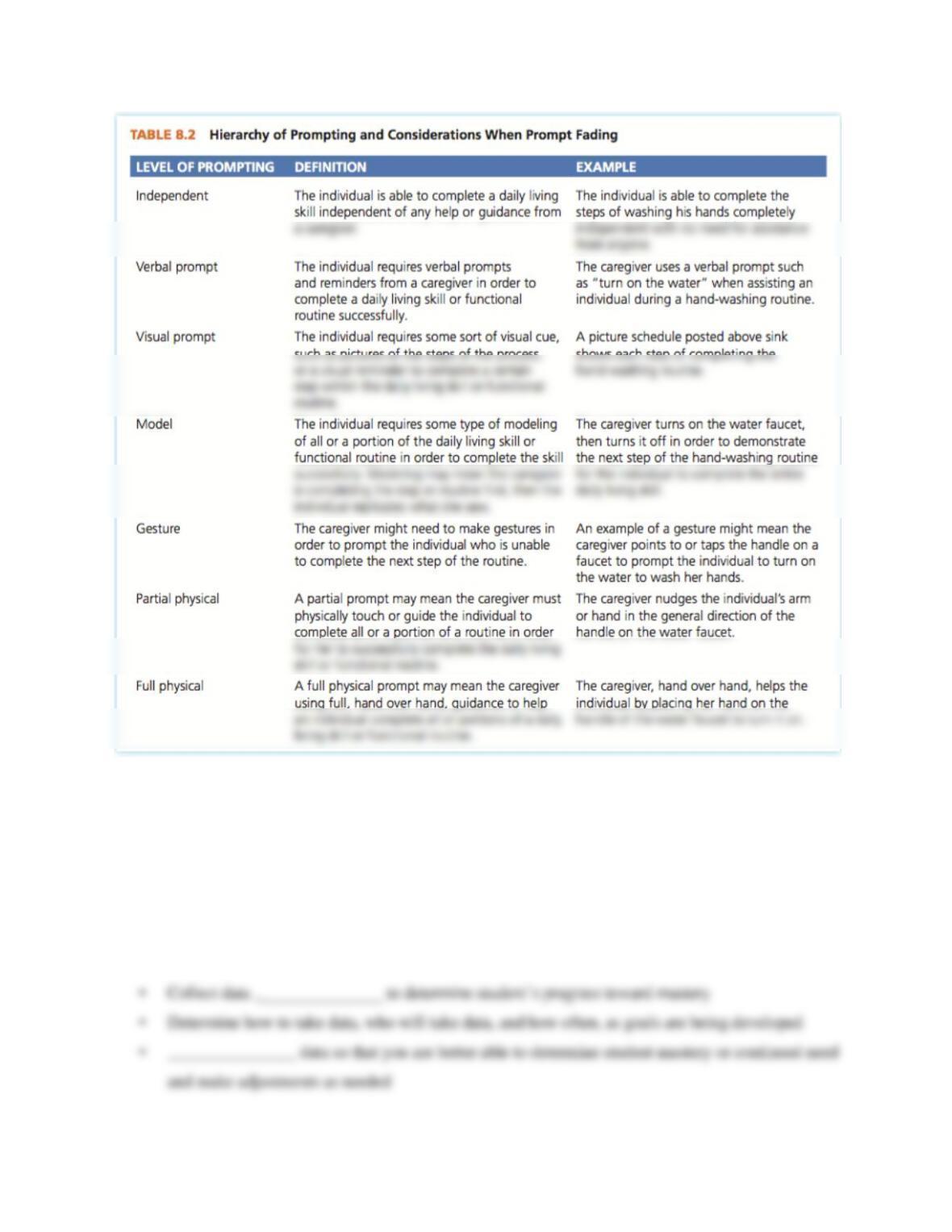
Hierarchy of Prompting and Considerations When Prompt Fading
IEP Development and Data Monitoring
• Ensure IEP goals address _______________ _______________ skills if assessments reveal this
to be an issue for any student
• Ensure that the criteria for mastery _______________ prompt levels if independence is not yet
achieved