Chapter 7
Students with Learning Disabilities
Learning Outcomes
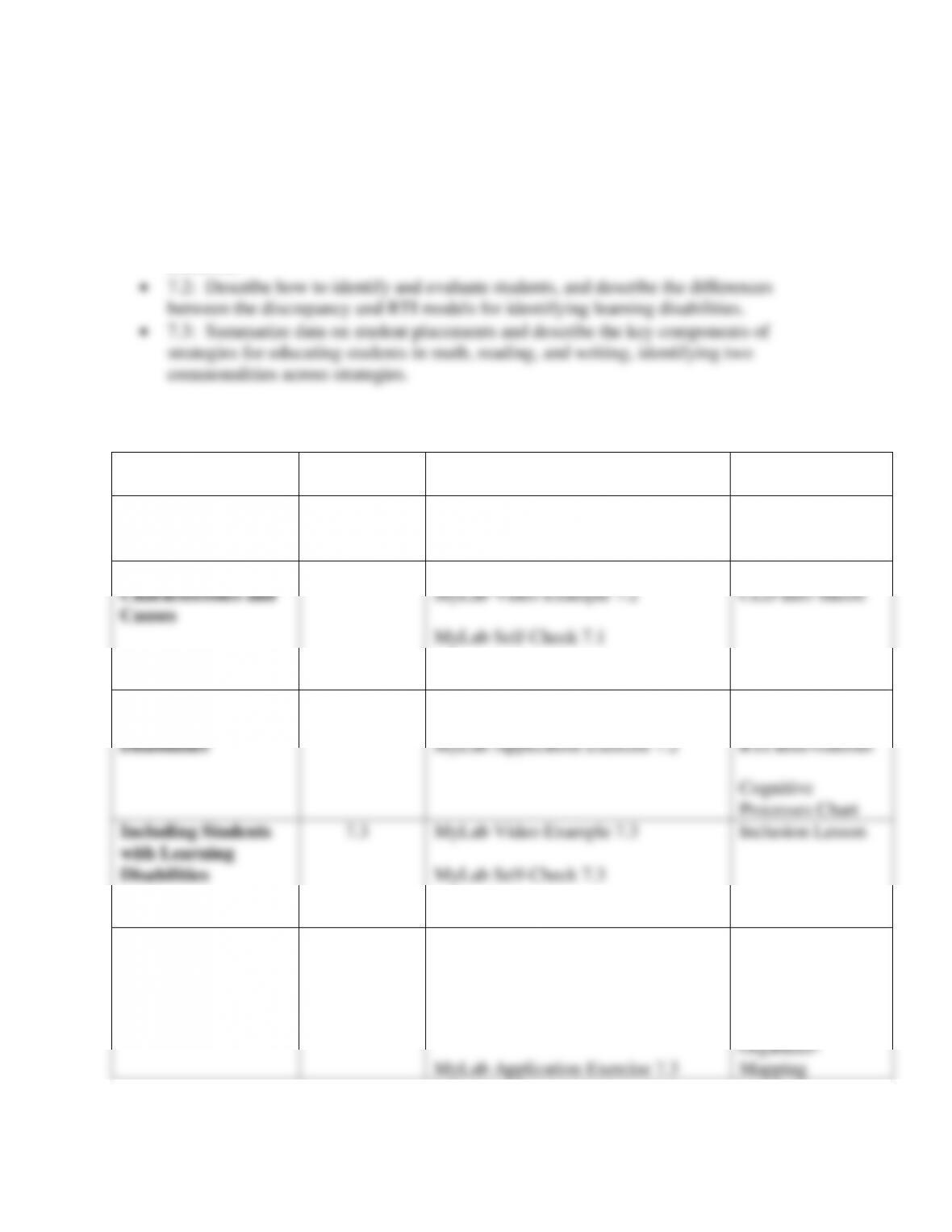
• 7.1: Define learning disabilities, their common characteristics, their causes and at least
one specific challenge related to students’ academic achievement, memory, and
emotions.
Chapter Heading
Learning
Objectives
Activities in the MyLab with E-text
Additional Class
Activities
Defining Learning
Disabilities
7.1
MyLab Self-Check 7.1
MyLab Application Exercise 7.1
Describing the
Characteristics and
Causes
7.1
MyLab Video Example 7.1
MyLab Video Example 7.2
MyLab Self-Check 7.1
MyLab Application Exercise 7.1
CLD Info Sheets
Evaluating Students
with Learning
Disabilities
7.2
MyLab Self-Check 7.2
MyLab Application Exercise 7.2
Discrepancy Chart
RTI Interventions
Cognitive
Processes Chart
Including Students
with Learning
Disabilities
7.3
MyLab Video Example 7.3
MyLab Self-Check 7.3
MyLab Application Exercise 7.3
Inclusion Lesson
Educating Students
with Learning
Disabilities
MyLab Video Example 7.4
MyLab Video Example 7.5
MyLab Video Example 7.6
MyLab Self-Check 7.3
MyLab Application Exercise 7.3
Differentiating
Instruction:
Scaffolding
Advance
Organizer-
Mapping
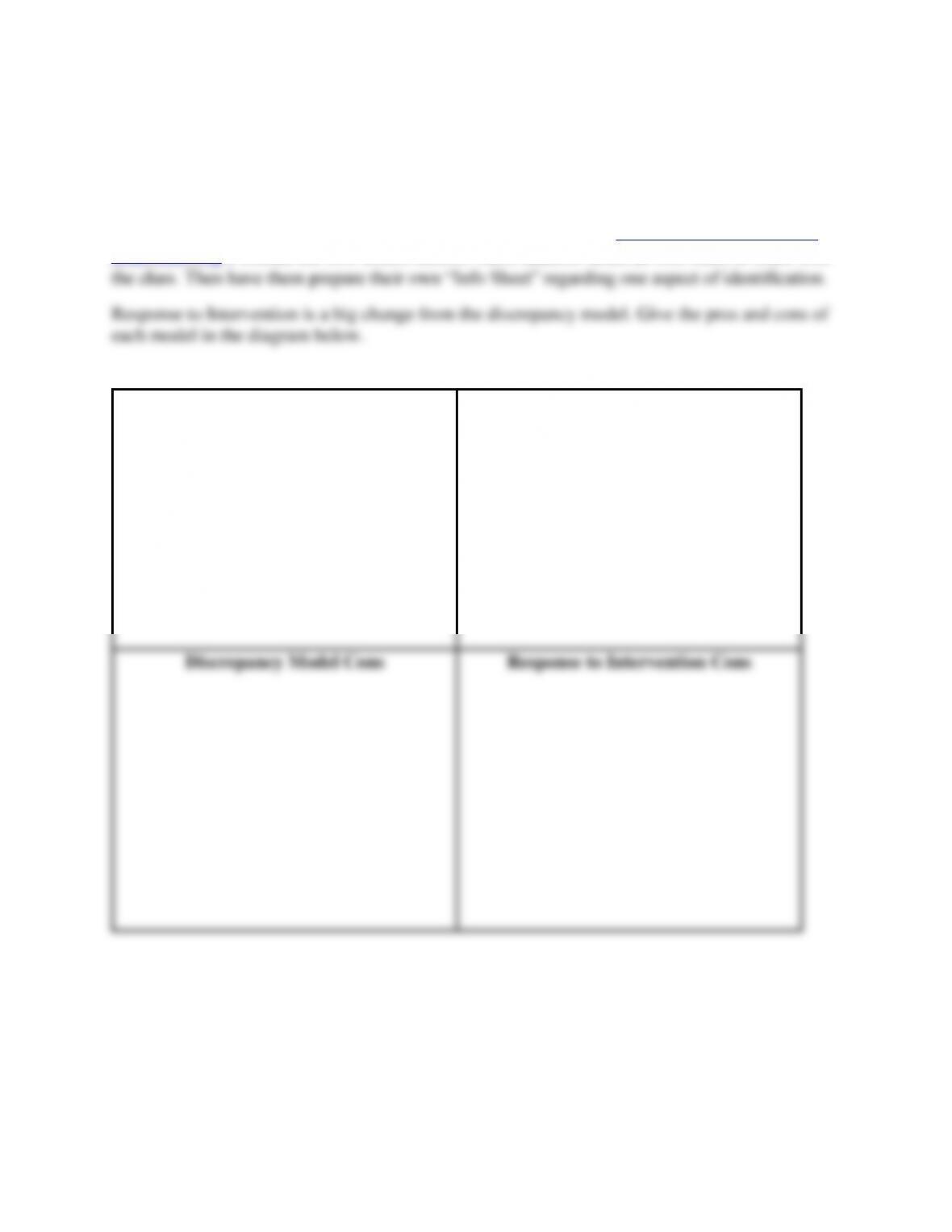
Class Activities in Addition to MyLab Activities
Search for the Council for Learning Disabilities webpage (at press: www.council-for-learning-
disabilities.org ). Locate the Info Sheets section. Have students select an info sheet to share with
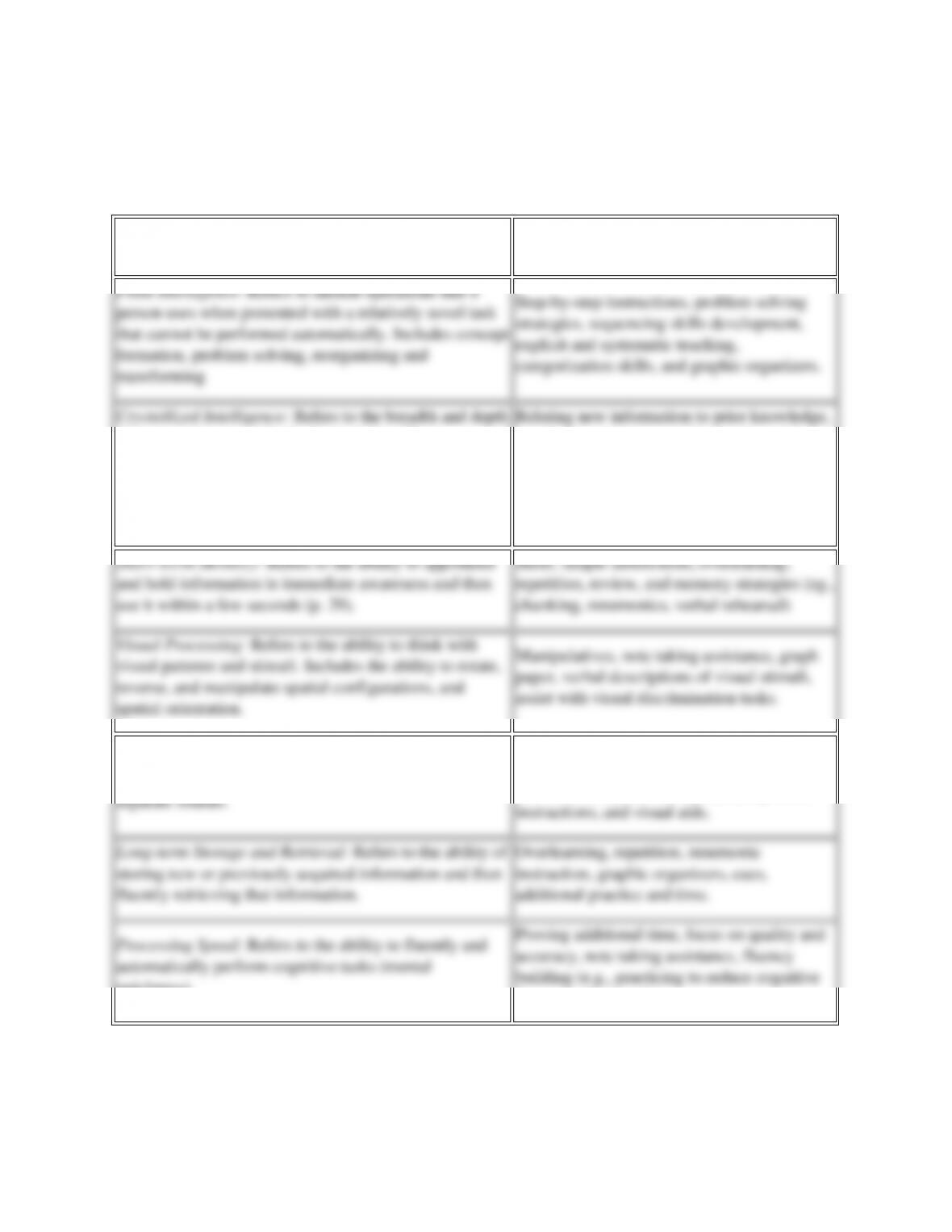
Discrepancy Model Pros
Response to Intervention Pros
Discrepancy Model Cons
Response to Intervention Cons
Have students create lessons for each component of the chart below.
Cognitive Processes and Interventions/Strategies
Cognitive Process
Children with processing deficits may
benefit from:
Fluid Intelligence: Refers to mental operations that a
person uses when presented with a relatively novel task
that cannot be performed automatically. Includes concept
formation, problem solving, reorganizing and
transforming
Step-by-step instructions, problem solving
strategies, sequencing skills development,
explicit and systematic teaching,
categorization skills, and graphic organizers.
Crystallized Intelligence: Refers to the breadth and depth
of a person’s general fund of knowledge. These
knowledge stores are acquired through formal school
experiences and general life experience. These stores are
primarily language based and include both declarative
and procedural knowledge.
Relating new information to prior knowledge,
vocabulary strategies and instruction, rich
learning experiences (e.g., museums, field
trips, and virtual field trips), scaffold
instruction, and incorporating student interests
in learning.
Short-Term Memory: Refers to the ability to apprehend
and hold information in immediate awareness and then
use it within a few seconds (p. 29).
Short, simple instructions, overlearning,
repetition, review, and memory strategies (eg.,
chunking, mnemonics, verbal rehearsal)
Visual Processing: Refers to the ability to think with
visual patterns and stimuli. Includes the ability to rotate,
reverse, and manipulate spatial configurations, and
spatial orientation.
Manipulatives, note taking assistance, graph
paper, verbal descriptions of visual stimuli,
assist with visual discrimination tasks.
Auditory Processing: Refers to the ability to notice,
compare, discriminate, and distinguish distinct and
separate sounds.
Provide phonological awareness activities
(e.g., rhyming, alliteration, songs, and
imitations), explicit and systematic phonics
instructions, and visual aids.
Long-term Storage and Retrieval: Refers to the ability of
storing new or previously acquired information and then
fluently retrieving that information.
Overlearning, repetition, mnemonic
instruction, graphic organizers, cues,
additional practice and time.
Processing Speed: Refers to the ability to fluently and
automatically perform cognitive tasks (mental
quickness).
Proving additional time, focus on quality and
accuracy, note taking assistance, fluency
building (e.g., practicing to reduce cognitive
demands, flashcards)
(Cognitive Processes adapted from Flanagan, Ortiz, Alfonzo, & Mascolo, 2006, p. 25-30;
Interventions/Strategies adapted from Mather and Jaffe, 2002)
Have students each take a respective grade level and subject area and develop an overarching
curriculum map for their “school”.
Have students locate the state standards for a particular grade level and topic. Then have them
look at one grade level below and one above and create a plan for scaffolding the material.