Chapter 6: Teaching Students with Autism to Communicate
Chapter Summary
This chapter highlights key differences in the language development of children with ASD and
provides an introduction to assessment and instructional strategies.
Key features of Autism Spectrum Disorders (ASD) are neurological disorders characterized by
differences in verbal and nonverbal social communication. From a very early age, students with autism
display differences in their interactions with others. These differences influence the development of
important communicative behaviors needed at home, school, and in the community.
Whereas children with typical language development learn the syntax, semantics, and pragmatics
of a language by overhearing and engaging in communication exchanges, the development of differing
aspects of language is often impaired in individuals with ASD. Students with ASD often demonstrate a
greater capacity for learning nouns over verbs and tend to have difficulty using bound morphemes to
mark past tense. Although children with ASD demonstrate relatively intact understanding of the
grammatical rules of language, children with global language delays experience differences in all three
areas of language. As a result, it is important to consider the addition of targets in all three areas of
language for children with ASD rather than a focus on only the one aspect of language development.
Designing and implementing interventions for individuals with ASD is essential to future success.
The most important skills are those that promote an individual’s ability to independently engage in
meaningful social-communication interaction in a variety of settings (NRC, 2001; Ogletree et al., 2007;
Prizant & Wetherby, 2005). Some interventions available for supporting the social-communication
development of individuals with ASD include: the behavioral interventions of discrete trial instruction
and verbal behavior; naturalistic intervention strategies, Picture Exchange Communication System
(PECS) and pivotal response training (PRT). Social Communication Emotional Regulation Transactional
Supports (SCERTS) is a social pragmatic interventions program.
Chapter Objectives
2. Discuss the communication differences of children with autism.
4. Discuss the major research contributions of communication intervention for students with autism.
5. List and describe the research-based interventions for communication interventtion for students
with autism.
Chapter Focus Questions
1. What are the typical stages of joint attention and communicative intent development?
3. What are the verbal operants? List and describe.
4. What are some methods of instruction of the verbal operants?
5. What are some other evidence-based intervention strategies or models for use in teaching
communication intervention to students with ASD?
Chapter Key Terms
Augmentative and alternative communication (AAC)
Communication
Perlocutionary stage
Communication assessments
Picture exchange communication systems
(PECS)
Communicative intent
Pivotal response training (PRT)
Discrete trial instruction
Echoics
Pragmatics
Expressive verbal language
Receptive language
Reciprocal interactions
Illucionary stage
Response to joint attention (RJA)
Initiating joint attention (ISA)
Intraverbals
Semantics
Syntax
Joint attention
Language
Locutionary stage
Mands
Nonverbal communication
Tact
Video modeling
Wernicke’s are
Verbal behavior
Locutionary stage
Instructional Strategies/Activities
Strategy
Rationale
Description/Steps
Modifications/
Alternative Options
Language Sample/
Assessment Activity
Real world practice
may enhance students’
understanding of
concepts
1. Using Handout 6.1, have
students observe someone
in their natural
environment, recording
the frequency and types
of communication on the
form, including the verbal
operants
Allow students to
work individually
Have students also
observe a student
with ASD and
compare their
communicative
2. Have students discuss the
variety of ways
individuals communicate
with each other, based on
the results of the activity
behaviors with
someone of the same
age and gender;
discuss
Assessment Practice
Real world practice
may enhance students’
understanding of
concepts
1. Have students interview a
parent or teacher of an
individual with ASD
about the language and
communication needs of
their child.
2. Using a pseudonym to
protect confidentiality,
have students share
sample responses to the
questions with the class or
small groups
3. Have students discuss
communication
priorities/goals based on
the interviews
Allow students to
work alone or in
small groups
Class Debate: Which
Communication
System is Best?
Discussion may aid
student understanding
of concepts
1. Assign small groups of
students one of the
following communication
system options to
research:
a. Speech only
b. Sign Language
c. Voice Output
Communication
Device
d. Symbol System (such
as the Picture
Exchange
Communication
System)
2. Have teams debate with
each other the benefits/
pros and cons of their
system
for varying individuals
with ASD given
particular characteristics
Show video of each
of the different types
to the class
Adams, C. (2002). Practitioner review: The assessment of language pragmatics. Journal of Child
Psychology and Psychiatry, 43, 973-987.
American Speech and Hearing Association (ASHA):
http://www.asha.org/public/speech/development/chart.htm
A comprehensive discussion of communication development in typically developing children. It
also contains several resources, position papers, and so on related to students with ASD.
Augmentative and Alternative Communication Connecting Young Kids:
Autism Internet Modules: http://www.autisminternetmodules.org/mod_list.php
Online modules detailing a variety of interventions for students with autism.
Bates, E., Bretherton L., Shore, C. & McNew, S. (1983). Names, gestures, and objects: The role of
context in the emergence of symbols. In K. Nelson (Ed.), Children’s Language (Vol. 4). Pp.
59-123. Hillsdale, N.J.:Erlbaum.
Center for Autism Related Disabilities (CARD):
http://www.coe.fau.edu/card/free%20Resource%20Materials.htm
Educational resources for students with ASD from Florida Atlantic University
National Research Council (2001). Educating Children with Autism. Lord, C. & McGee, J.P. (Eds.),
Washington, DC: National Academy Press.
Ogletree, B., Oren, T., & Fischer, M. (2007). Examining effective intervention practices for
communication impairment in autism spectrum disorder. Exceptionality, 15(4), 233-247.
Paul, R. (2005). Assessing communication in Autism Spectrum Disorders. In F. Volkmar, R. Paul,
A. Klin, & D. Cohen (Eds.), Handbook of autism and pervasive developmental disorders (3rd
edition, pp. 799-816). New York: Wiley.
Prizant, B. & Wetherby, A. (2005). Critical issues in enhancing communication abilities in persons
with autism spectrum disorders. In F. Volkmar, R. Paul, A. Klin, & D. Cohen (Eds.),
Handbook of autism and pervasive developmental disorders (3rd edition, pp. 925-945). New
York: Wiley.

The SCERTS Model: http://www.scerts.com/
This web site focuses on building social communication, emotional regulation and transactional
support. Specializing in ASD this is a research-based educational approach
Treatment and Education of Autistic and Related Communication Handicapped Children:
http://www.teacch.com/communication.html
This web site is an evidence-based service, training, and research program for individuals of all
ages and skill levels with Autism Spectrum Disorders. The web site provides information about
structured teaching and physical organization as ways of teaching students with Autism Spectrum
Disorders effectively
Chapter 6: Teaching Students with Autism to Communicate
Guided Notes
Outline
• What is Social Communication & Why is it Important
• Communication in Individuals with ASD
What is Communication & Why is it Important
• _______________ = the ability to use symbols and to convey or receive a feeling or idea
to/from another person
• Includes social communication: the ability to communicate verbally and nonverbally with a
3 Components of _______________ Communication
• Joint Attention
• Symbol Use and Intention
• Language
Joint Attention
• The ability to realize that others have _______________ and experiences that are not
necessarily one’s own
• The shared experiences between oneself and another person
Symbol Use & Intention
• Symbols are the means by which we convey _______________ messages (e.g., spoken
words, nonverbal gestures, pictures, etc.)
3 Stages of Intention
• Prelocutionary:
− During _______________, moving from reflective cries to an understanding of object
function
• Illocutionary:
− Child’s use of gestures to gain another’s _______________ and to communicate wants
Language
• _______________ is a “rule governed system of abstract symbols” (p. 185)
• Three components of Language:
− _______________: language structure
Communication in Individuals with ASD
• Better understanding of nouns vs. other parts of speech (e.g., runner vs. running)
• _______________ understanding ‘bound morphemes’, or tense (e.g., work vs. worked)
Communication Assessment
• Critical Skills for Development of Social Communication:
− Social Skills
− _______________ Language
− Receptive Language
− Nonverbal Communication
3 Considerations for Communication Assessment
• Frequency
• Form
• Function
Communication Intervention
• Recommendations:
− Intervention should target _______________ and _______________ communication
Instructional Activity Handouts
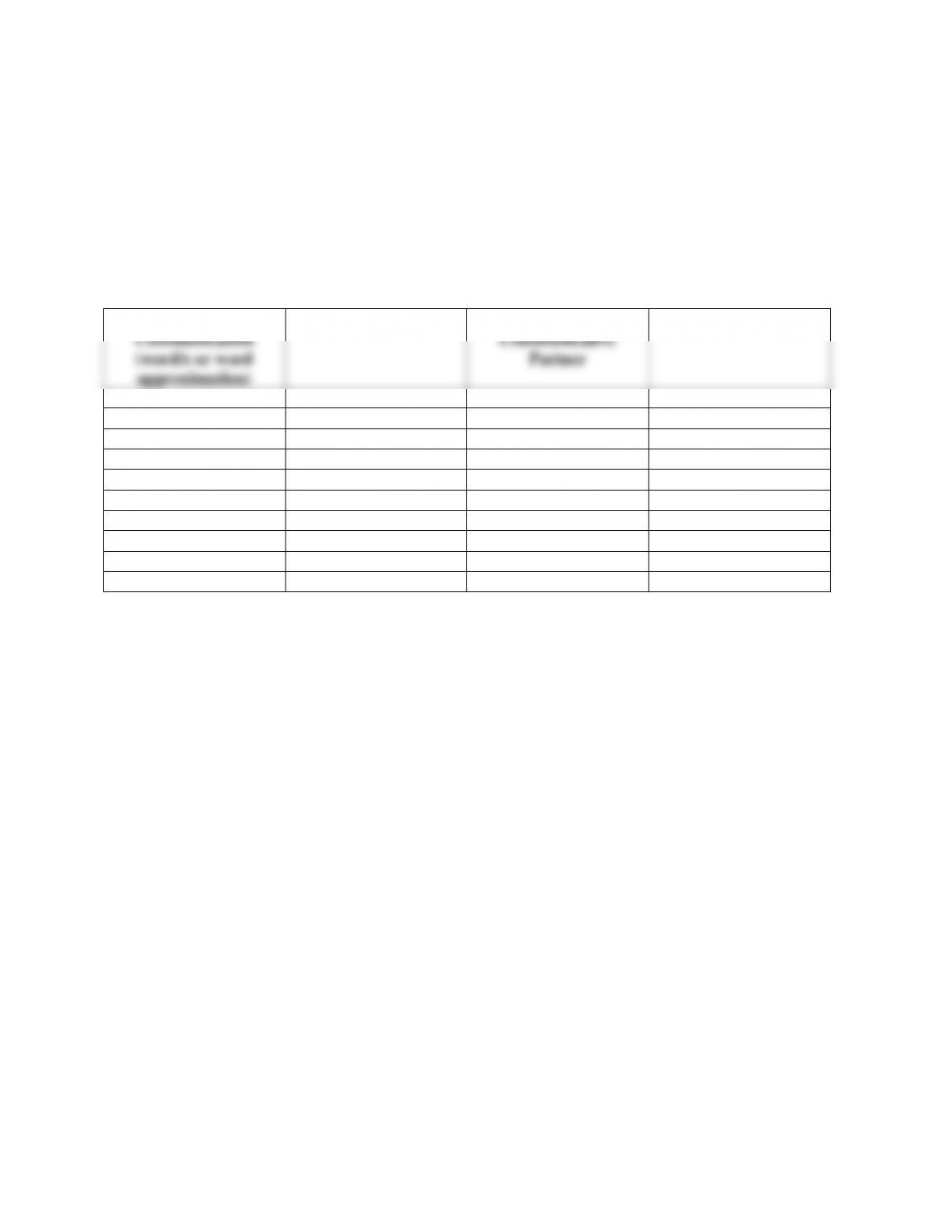
Handout 6,1: Language Sample
Student: ____________________ Date/Time: __________
Location: _______________________ Activity:
___________________
Student
Communication
(word/s or word
approximation)
Directed to Whom?
Response of Intended
Communicative
Partner
Verbal Operant?