Chapter 5: Teaching Students with Autism using the Principles of Applied Behavior Analysis
Chapter Summary
Applied Behavior Analysis (ABA) is the utilization of the basic principles of learning and
motivation to address socially important problems. The principles of ABA, conclude that all behavior is
learned, behavior serves a purpose, and behavior is contextual. Research exists to support the use of ABA
for children with autism and shows that early, intensive ABA offers substantial gains for these children.
Discrimination training is a component within an ABA program addresses complex behaviors
taught through strategies including shaping, chaining, and modeling. Shaping is the process of reinforcing
successive approximations of the desired behavior (Skinner, 1953). Chaining is another instructional
strategy that is used to teach a series of behaviors in the presence of a specific stimulus. Modeling as an
instructional strategy is the process of demonstrating a behavior for a student to imitate.
Students acquire simple behaviors from. Teachers can then their procedures to reflect a more
flexible instructional sequence through the presentation of varied discriminative stimuli and the use of
naturalistic behavioral teaching procedures including; natural environment training (NET), incidental
teaching, and pivotal response teaching (PRT). Verbal behavior is the term B. F. Skinner (1957) coined
Incidental and milieu teaching strategies are further components of ABA programming and used
within the context of the natural environment during daily routines. Some environmental arrangement
strategies including sabotage, blocking, missing pieces, and small portions may be used to elicit language
or to increase the likelihood of manding (Hemmeter & Kaiser, 1994).
Students with ASD experience an increased prevalence of challenging behaviors. Before any
intervention plan is developed for challenging behaviors, a functional behavioral assessment should be
completed to determine the antecedents and consequences evoking and/or reinforcing the challenging
behavior. Intervention plans are then developed based on the function of the behavior. All parties
involved with the child’s instruction must be a part of this process.
Chapter Objectives
1. Describe and use the discrete trial training techniques.
2. Describe and use errorless teaching strategies.
4. Describe generalization and maintenance strategies.
6. Describe and use basic data collection.
Chapter Focus Questions
1. Describe and give an example of discrete trial training for a student with autism.
2. Describe and give an example of errorless teaching for a student with autism.
4. Describe and give an example of both generalization and maintenance for a student with autism.
5. Describe and provide an example of incidental teaching for a student with autism.
Chapter Key Terms
Applied behavior analysis (ABA)
Maintenance
Chaining
Mand
Discrete trial training (DTT)
Milieu teaching
Discriminative stimulus
Modeling
Error correction
Principles of Behavior
Generalization
Shaping
Incidental teaching
Tact
Instructional control
Verbal Behavior
Intraverbal
Instructional Strategies/Activities
Strategy
Rationale
Description/Steps
Modifications/
Alternative Options
“Why do people play
golf?” Activity
Students may better
process information
through relating to a
real life activity
familiar to most
people`
1. Discuss with students the
functions of behavior (see
Figure 5.1) and Handout
5.1
2. Ask students to reflect on
each function presented
in Handout 5.1 in terms
of this question, “Why do
people play golf?”
3. Share ideas and discuss
what real life classroom
examples might be for
each
Allow students to
work individually
Divide the class into
groups, each taking
only one function
and then sharing
their discussion with
the class
Practice with DTT,
Errorless Teaching,
and Error Correction
understanding of the
Hands-on practice
may improve student
1. Have students work in
pairs to practice each of
Have students
evaluate their own
concepts
monitor and provide
corrective feedback
where appropriate
a. Discrete Trial
Training
b. Most-to-Least
Prompting
c. Least-to-Most
Prompting
d. Time Delay
e. Error Correction
Procedure
evaluation, using the
checklist in Handout
6.2 (adapted from the
information found in
Box 6.1 and Figure
6.3)
Class Discussion:
Chaining
Discussion may allow
students to further
process and
understand new
material
1. Following the lecture on
chaining, encourage
students to brainstorm
types of skills, student
characteristics, or other
variables that would lend
themselves more to each
a. Forward Chaining
b. Backward Chaining
c. Total Task
Presentation
2. Have students brainstorm
how other skills might
look when taught with
each of the three chaining
procedures
Divide the class into
small groups
assigning each group
to a particular
chaining procedure
and then have them
share their
discussions with the
whole class
Homework: Verbal
Behavior Sampling
Identifying the use of
the Verbal Behavior
Operants in real life
may enhance student
understanding
1. Have students observe
some speaking in their
normal, day-to-day
activities and record they
frequency and/or types of
each verbal operant they
hear the individual use
2. Have students either
graph the frequencies for
each or create a list of
each type and share
Allow students to
work alone or in
small groups
Assign small groups
specific verbal
operants and then
have them share with
the class
Suggested Chapter Readings/Resources
Hemmeter, M, L., & Kaiser, A. P. (1994). Enhanced Mileu teaching: Effects of parent-implemented
language intervention. Journal of Early Intervention, 18, 269-289.
House Bill 2847: www.azautisminsurance.org/files/hb2847-HouseEngrossed.pdf
HB 2847, otherwise known as Stevens Law in Arizona is the first allocation of state funds for the
treatment of autism through ABA. Stevens Law mandates insurance coverage for ABA treatment.
Pavlov, I. P. (1927). Conditional reflexes: An investigation of the physiological activity of the cerebral
cortex. (G. V. Anrep, Trans). London: Oxford University Press.
Pérez-Gonzalez, L. A., García-Asenjo, L., Williams, G., & Carnerero, J. J. (2007). Emergence of
intraverbal antonyms in children with pervasive development disorder. Journal of Applied
Behavior Analysis, 40, 697-701.
Petursdottir, A, I., Carr, J, E., Lechago, S. A, & Almason, S. M. (2008). An evaluation of
Chapter 5: Teaching Students with Autism Using the Principles of Applied Behavior Analysis
Guided Notes
Outline
• Definition of ABA
• Principles of Behavior
• Using ABA to Teach New Skills
• Using ABA to Address Challenging Behaviors
Definition of ABA
• Applied Behavior Analysis (ABA) is “the utilization of the basic __________ of learning and
motivation to address __________ important problems” (p. 80)
Principles of Behavior
All Behavior is Learned
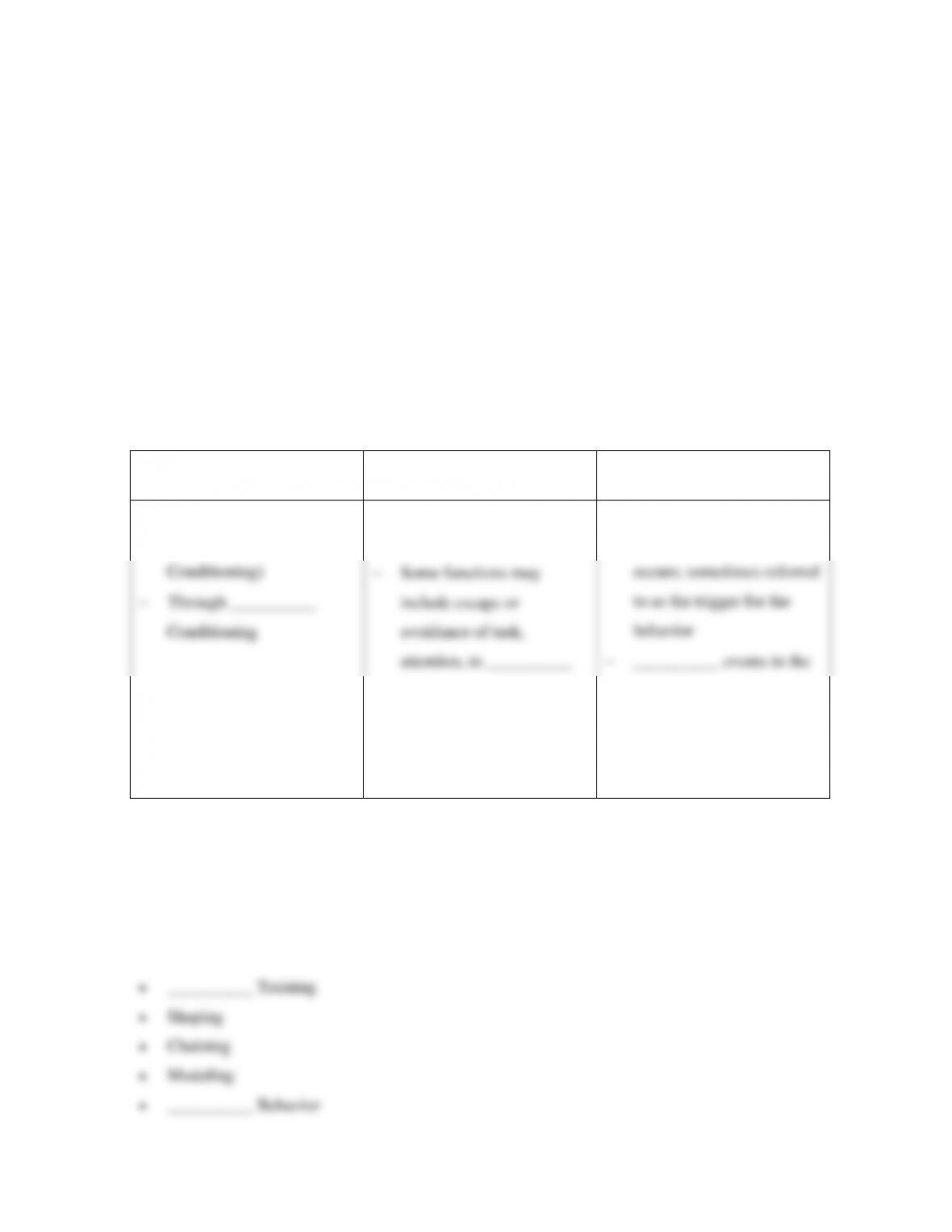
All Behavior Serves a
Purpose
All Behavior is Contextual
− Through Association
Learning (__________
Conditioning)
− Through __________
Conditioning
− Functions __________
from person to person
− Some functions may
include escape or
avoidance of task,
attention, to __________
something tangible, or a
preferred activity, or for
self-soothing/self-
stimulation
− Behavior is influenced by
the __________ in which it
occurs; sometimes referred
to as the trigger for the
behavior
− __________ events in the
immediate environment or
setting events that have
happened previously
Using ABA to Teach New Skills
• Discrete Trial Training
• Errorless Learning
• Error Correction
Discrete Trial Training
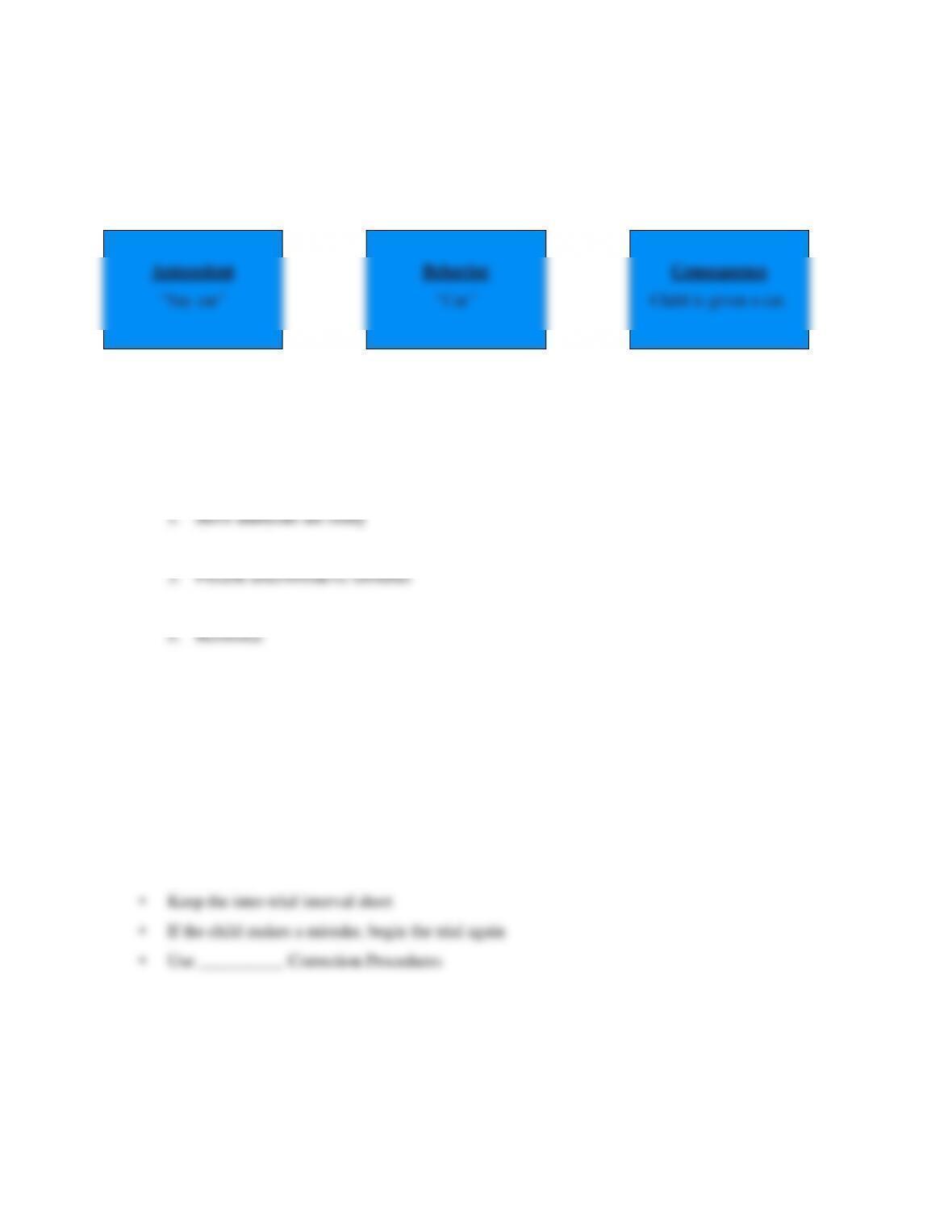
• Used to teach new skills through the __________ contingency:
Antecedent
“Say car”
Behavior
“Car”
Consequence
Child is given a car.
If the car serves as a reinforcer, the next time someone says, “Say car,” there is a high probability
the learner will do so.
Steps of DTT
• __________ Steps of DTT:
2. Gain child’s attention
4. Prompt
6. Use correction procedure as necessary
7. Collect __________
Some Things to Keep in Mind During DTT
• Always get __________ control prior to beginning the trial
• Keep the A – B – C separate from each other; no overlapping
• Reinforce immediately
• __________ the field when possible between trials
Errorless Learning
• Used during DTT to ensure that the learner achieves __________ the first time
• Uses series of prompts and prompt fading techniques to support learning
• Beware of prompt __________
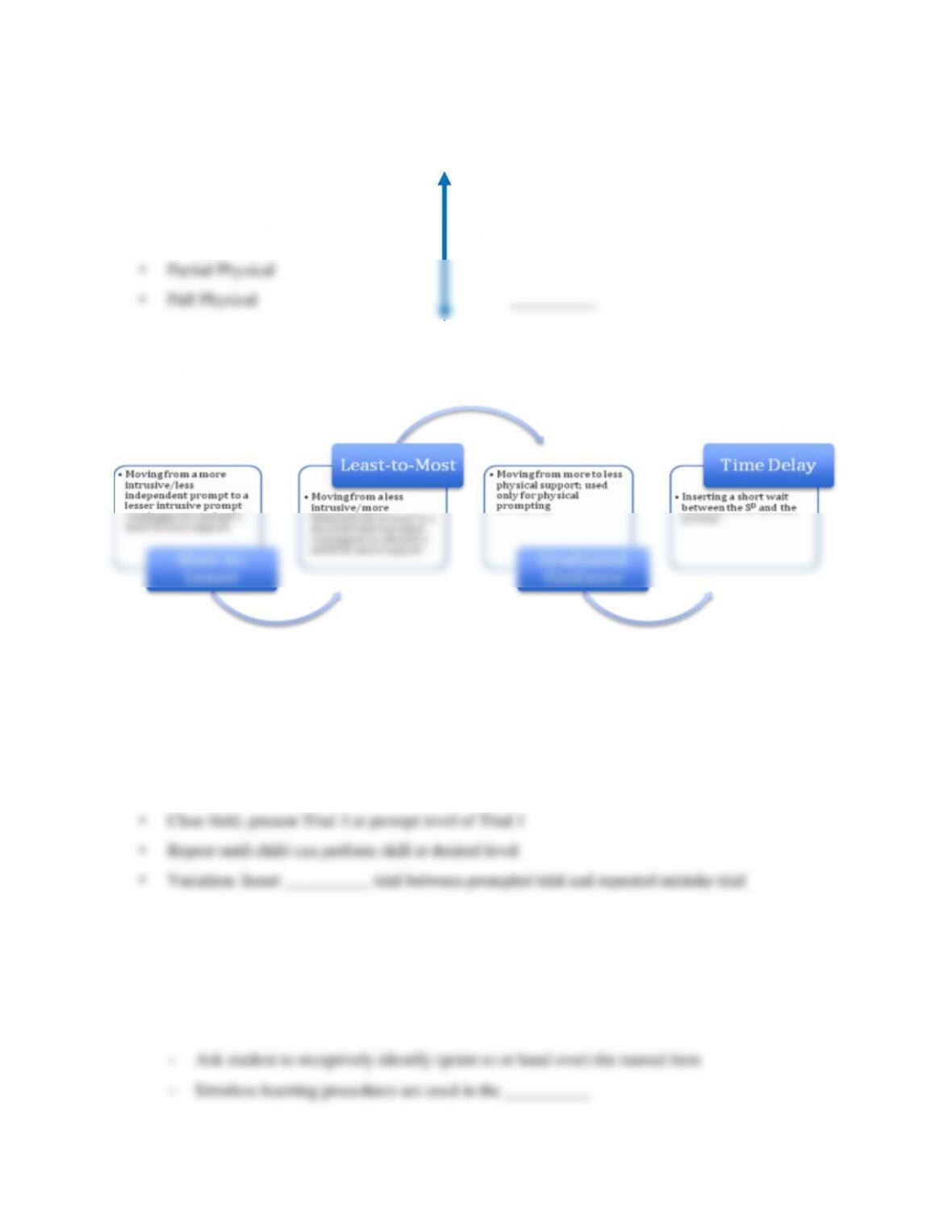
Hierarchy of Prompts
• Stimulus
__________
• Gestural
• Model
• Partial Physical
• Full Physical
__________
Prompting Procedures Used in Errorless Learning to Prevent Prompt Dependency
Error Correction
• Trial 1: Mistake
• Clear field, present Trial 2 with prompt (at last required level prior to mistake)
• __________ prompted trial
Discrimination Training
• Used in receptive language training (as a foundation for future learning)
• Steps:
− Present __________ or more items to the student
Shaping
• Defined as “reinforcing successive approximations of the desired behavior” (p. 87)
• As the response becomes more proficient and/or more independent, increased levels of
reinforcement may be used.
Chaining
• Used to teach multi-step skills following a Task Analysis
o Forward Chaining: Begin instruction with the first step in the chain
Modeling
• Also known as __________ training
• May include a live, written, visual, or audio model
• Prerequisite skills include an ability to:
− Attend to the model
Verbal Behavior
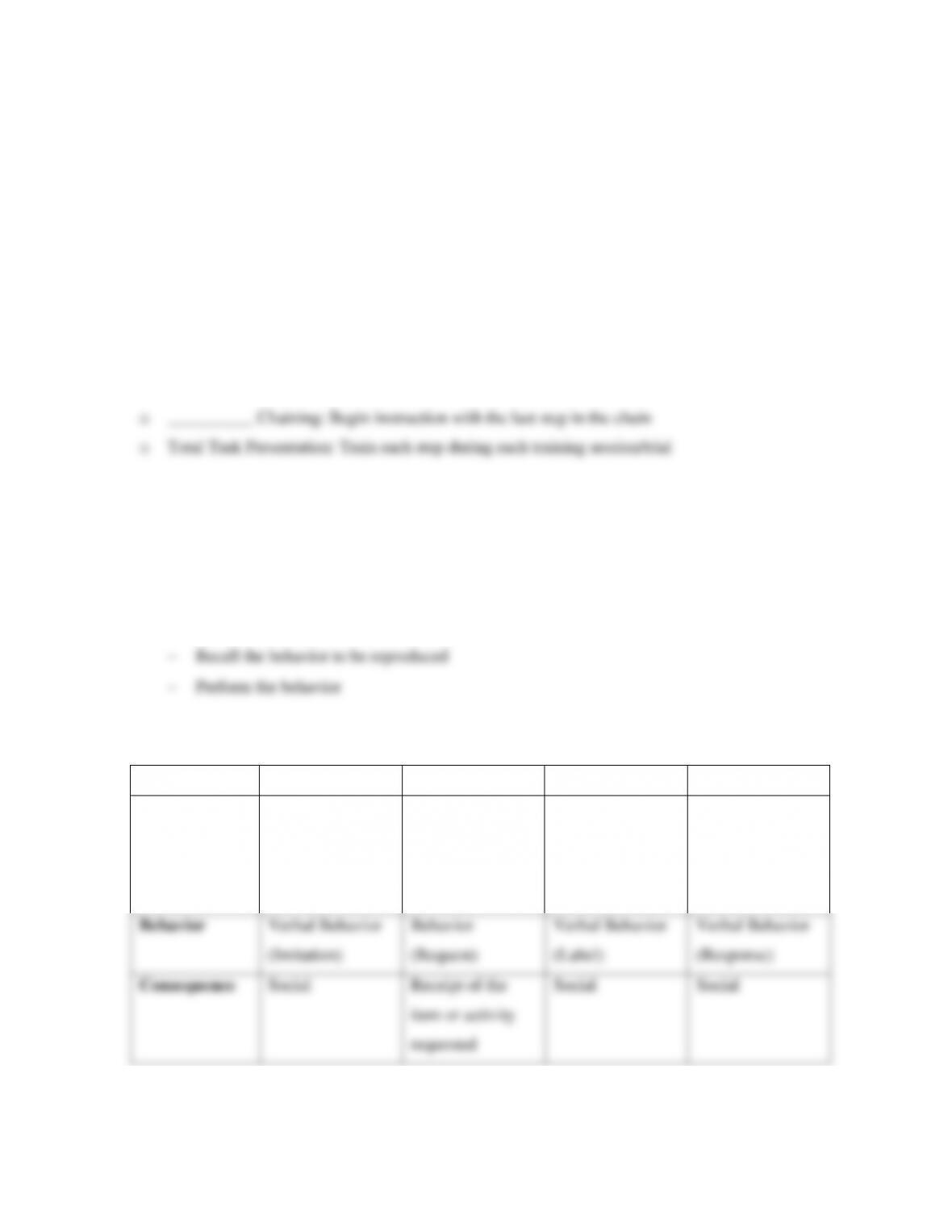
Echoic
Mand
Tact
Intraverbal
Antecedent
Someone’s
Verbal Behavior
Desire or
Motivation
Non-verbal
stimulus present
in the
environment
Someone’s
Verbal Behavior
Behavior
Verbal Behavior
(Imitation)
Behavior
(Request)
Verbal Behavior
(Label)
Verbal Behavior
(Response)
Consequence
Social
Receipt of the
item or activity
requested
Social
Social
Using ABA to Address Challenging Behavior
• Identification of the __________ of the challenging behavior
• Using the __________ of behavior to systematically teach or shape replacement behaviors
Instructional Activity Handouts
Handout 5.1: Why Do People Play Golf?
Functions of Behavior
• Socially Mediated Positive: Payoff is obtaining something via another person or
because of their presence (example, attention or reinforcement provided by
another)
• Socially Mediated Negative: Payoff is the removal of an aversive by another
person (example: escape or avoidance)
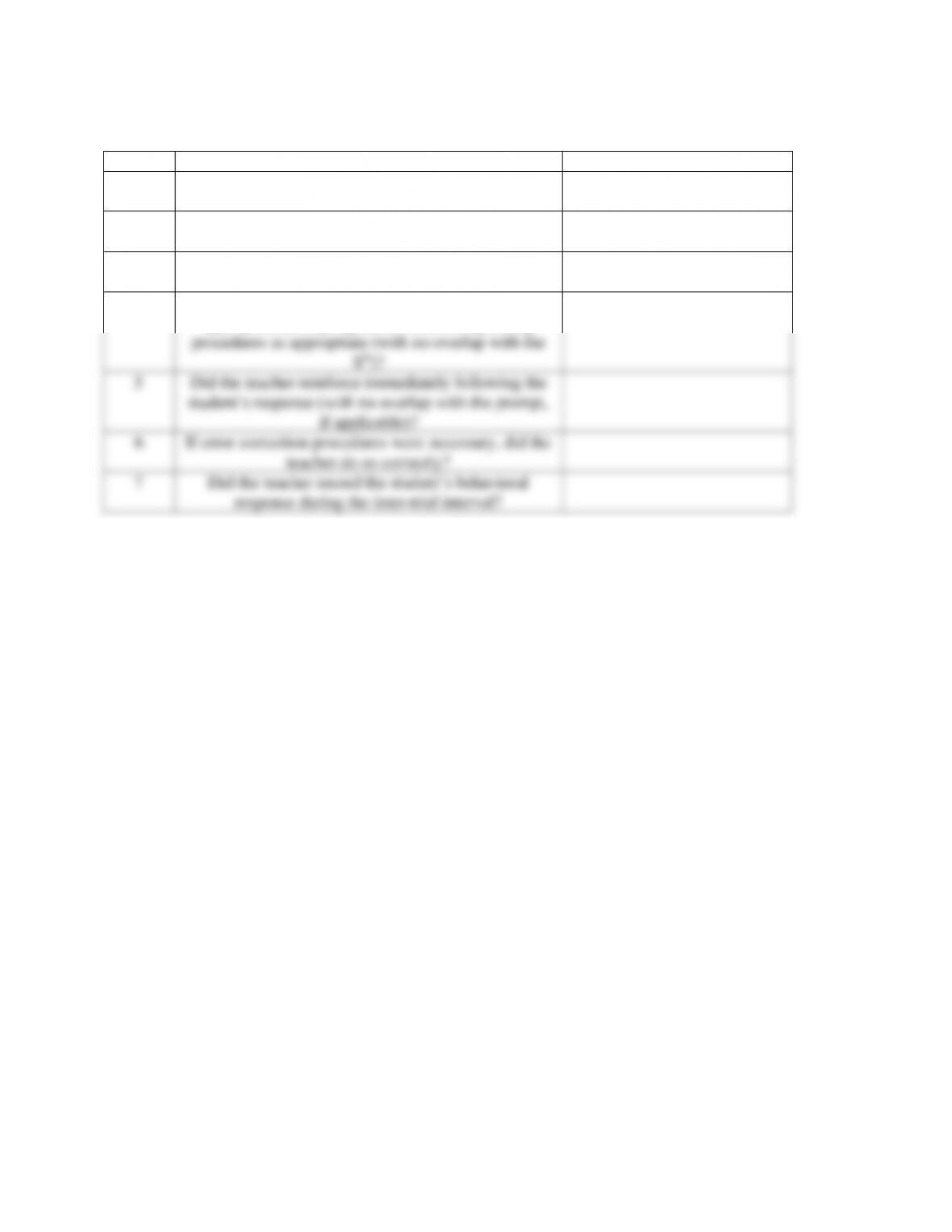
Handout 5.2: Checklist for Discrete Trial Training
Step #
Behavioral Query
Yes or No/Comments
1
Did the teacher have all the materials ready prior to
beginning each session or trial?
2
Did the teacher secure instructional control prior to
presenting the SD?
3
Did the teacher present the SD clearly and
appropriately?
4
If prompting was necessary, did the teacher use the
appropriate prompting method, including fading
procedures as appropriate (with no overlap with the
SD)?
5
Did the teacher reinforce immediately following the
student’s response (with no overlap with the prompt,
if applicable)?
6
If error correction procedures were necessary, did the
teacher do so correctly?
7
Did the teacher record the student’s behavioral
response during the inter-trial interval?