Chapter 4
Today’s Families and Their Partnerships with Professionals
Chapter Objectives
After studying this chapter, you should be able to:
• Explain the various definitions of family and describe characteristics of today’s families.
Chapter Overview/Presentation Outline
I: Introduction
Slide 2: Chapter 4 Objectives
-Present slide 2 and review the chapter objectives
II: Understanding Today’s Families
Slide 3: Defining Family
-Present slide 3 and discuss the definitions of family
III: Understanding Family Quality of Life and Your Role as an Educator
Slide 5: Domains of Family Quality of Life
-Present slide 5 and review the domains of family quality of life (Each domain is discussed in
detail in upcoming slides)
Slide 9: Family Interaction
-Present slide 9 and discuss the elements of family interaction
IV: Understanding Partnerships and Why They Are Important
Slide 13: What Are Partnerships and Why Are They Important?
-Present slide 13 and discuss family-professional partnerships
V: Forming Partnerships with Families
Slide 15: How Can You Form Partnerships with Families?
-Present slide 15 and discuss ways to form partnerships with families and review the seven
principles of partnerships (Each of the seven principles will be discuss in detail in upcoming
slides)
Slide 19: Commitment
-Present slide 19 and discuss the practices for commitment
Slide 20: Equity
-Present slide 20 and discuss the practices for equity
Class Activities
1. At the beginning of class, have students read the case study at the beginning of the chapter.
2. Using the terms provided below, have the students complete a concept map of the domains of
family quality of life. In groups, give the students chart paper, markers, and sticky notes. Have
3. Partnerships with families. Partnerships with families are imperative to the success of children
with disabilities. Ask the students to give one specific example of how they can accomplish each
4. At the end of class, have students revisit the case study at the beginning of the chapter. Use the
questions at the end of the chapter, “What do you think?” to facilitate discussion.
Concept Map Terms (activity 4.2)
• Disability-related support
• Friends or others to provide support
• Access transportation
• Pay expenses
• Family interaction
• Feel safe at home, work, school, and in the neighborhood
• Obtain medical and dental help when needed
• Learn to be independent
• Talk openly with each other
• Solve problems together
• Show they love and care for each other
• Achieve goals at school or work
• Parenting
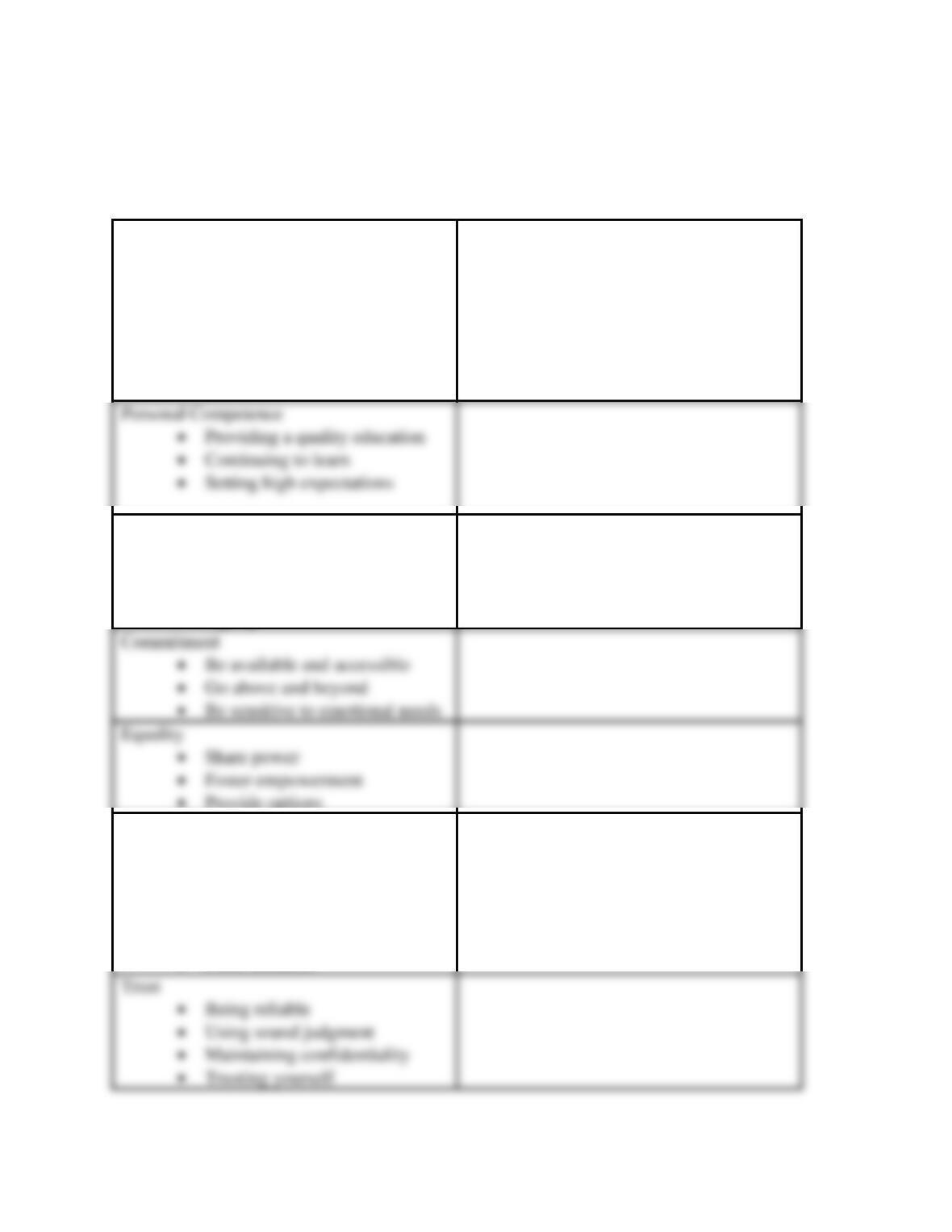
Partnerships with families (activity 4.3). Partnerships with families are imperative to the
success of children with disabilities. Give one specific example of how you can accomplish each
of the major principles of building successful partnerships with families of the students in your
classroom. Make sure your examples address most of the bulleted points.
Communication
• Be friendly
• Listen
• Be clear
• Be honest
• Provide and coordinate
information
Respect
• Honor cultural diversity
• Affirm strengths
• Treat students and families with
dignity
• Be sensitive to emotional needs
• Provide options
Advocacy
• Seek win-win solutions
• Prevent problems
• Keep your conscience primed
• Pinpoint and document
problems
• Form alliances
• Trusting yourself
Personal Competence
• Providing a quality education
• Continuing to learn
• Setting high expectations
Class activity ideas for Chapters 5–16
1. Have students create a brochure about the disability addressed in the chapter. The brochure
can be trifold and include: a definition of the disability, causes of the disability, characteristics of
2. Assign each student or pair of students a disability. Have the students prepare a class
presentation of the disability to include definition of the disability, causes and prevalence,