Chapter 4: Environmental Arrangement to Prevent Contextually Inappropriate Behavior
Chapter Summary
This chapter focuses on the prevention of challenging behaviors, described as “contextually
inappropriate” behaviors. Contextually inappropriate is the term used to describe what we commonly
think of as challenging behaviors, because of the fact that context plays a key role in one’s definition of
challenging behavior. For example, a student who screams for their team at the football game would not
be engaging in a challenging behavior because in that context the behavior is acceptable. Thus, this
chapter challenges teachers to consider the context in which a behavior occurs in determining its nature.
The role that prevention plays in addressing contextually inappropriate behaviors is critical. One must
begin by identifying the underlying cause of the behavior, the motivation behind it. To do this, teachers
and other professionals conduct a functional behavior assessment (FBA) and then develop a behavior
support plan from the results of the assessment.
Once the function of the behavior has been hypothesized, a behavior support plan, or behavior
intervention plan (BIP) is developed to address the challenging behaviors. The plan should include
antecedent interventions designed to a) teach functionally equivalent replacement behaviors to address the
motivation behind the behavior and b) prevent the occurrence of the challenging behavior. Functionally
equivalence is important because the newly taught behavior must meet the same purpose as the
challenging one and be as efficient and effective as it was. Additional consequence strategies, such as
extinction, may be incorporated to further reduce the challenging behavior.
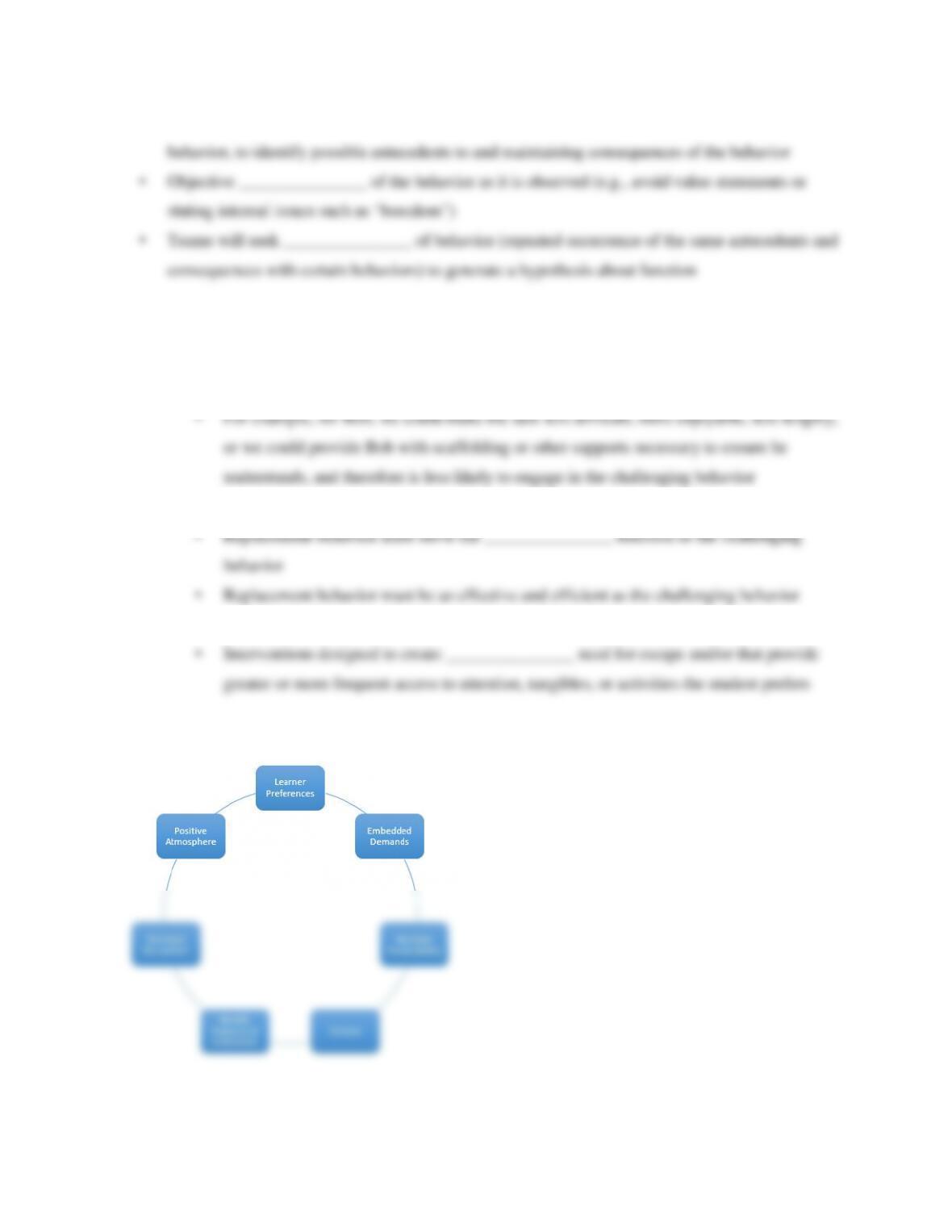
Seven specific antecedent strategies are recommended. These include:
• Using learner preferences: used to decrease need for escape by making materials or
content more interesting
• Embedding demands into reinforcing activities: using naturally occurring activities or
those that the student finds enjoyable and taking advantage of teachable moments, or
setting up embedded learning opportunities, is used to decrease escape motivated
behavior
• Eliminating or decreasing pain or discomfort: for behaviors that occur as a result of
something internal to the student, teachers should seek to identify the issue and make a
change
Chapter Objectives:
1. Understand how concepts of motivation, including states of deprivation, satiation, and aversive
stimuli, impact contextually inappropriate behaviors.
3. Describe the various ways that antecedent conditions contribute to contextually inappropriate
behavior.
5. Analyze the benefits and limitations of embedded instruction on the learning of various academic,
1. Explain three limitations and/or problems related to exclusive use of consequence strategies to
modify the behavior of students with autism.
2. What are the steps for completing functional behavior assessment: why should it be conducted
and who should be involved in the process?
4. In pairs or groups, create an activity matrix for teaching a behavior to Bob, Mitch, or Peyton. Be
sure to choose activities and behaviors that are derived from the case examples.
Key Terms:
ABC data
Antecedent
Aversive
Behavior support plan
Consequences
Contextual fit
Contextually inappropriate behavior
Direct assessment
Extinction
Instructional Strategies and Activities:
Strategy
Rationale
Description/Steps
Modifications/
Alternative Options
Practice FBA data
collection
To help students apply
concepts such as
anecdotal recording
and ABC data
collection and to see
the importance of
detail in identifying
function
1. Using a video or other
source of information, have
students complete an
anecdotal recording and and
ABC data sheet (Handout
4.1).
2. Once both sets of data have
been collected, have students,
in teams, attempt to identify
possible function based on
data from each.
3. Have students discuss
which data collection system
provided greatest detail and
thusly may be more useful at
determining function.
Instead of watching a
video, students may
select to conduct real-
time
observations/data
collection in their
place of work, with a
member of their
family, or other
individual.
Research review:
Antecedent-Based
Strategies
Provide students with
opportunities to
become familiar with
the literature on
evidence-based
practices designed to
reduce or eliminate the
need for challenging
behaviors in the
classroom
1. In teams, assign students to
conduct a literature review on
one of the seven antecedent-
based interventions discussed
in the book.
2. Have teams share their
findings with members of the
class and discuss practical
uses and examples of each
strategy found in the
literature.
Instead of teams,
students can work
independently and
read one assigned
research study to
share with members
of the class or smaller
groups.
Behavior intervention
plan development
Allow students the
opportunity to
consider strategies for
prevention of
challenging behavior,
using an antecedent-
1. Independently, ask students
to think about a contextually
inappropriate behavior of
their own, that they would
like to decrease (e.g., using
smart phone while drive,
behavior.
3. Ask students to develop a
behavior intervention plan for
their own behavior that
appropriate, functionally
equivalent replacement
Students may work in
teams to create
behavior plans for
hypothetical issues
unrelated to
themselves.
behaviors.
Suggest Chapter Readings/Resources:
http://nichcy.org/schoolage/behavior/behavassess#ass
http://www.pbis.org
http://autismpdcfpg.unc.edu/content/antecedent-based-interventions-ahi
Alberto, P. A., & Troutman, A. C. (2008). Applied behavior analysis for teachers. Upper Saddle
River: Pearson Education.
Savner, J., & Myles, S. B. (2000). Making visual supports work in the home and community:
Strategies for individuals with autism and Asperger Syndrome. Shawnee Mission, KS: Autism
Asperger Publishing Company.
Scheuermann, B., & Webber, J. (2002). Autism: Teaching does make a difference. Belmont, CA:
Wadsworth/Thomson.
Chapter 4: Environmental Arrangement to Prevent Contextually Inappropriate Behavior
Guided Notes
Outline
• Introduction
• Motivation
• Positive vs. Negative Reinforcement
• Motivation
Introduction
• What do we mean by “_______________ Inappropriate Behavior”?
− Behavior can be classified as appropriate or inappropriate
− This distinction is based on _______________
• Why is this important?
Motivation
• All behavior serves a _______________
• In applied behavior analysis (ABA) motivation goes _______________ someone’s “will” to do
something
− If we say a child had a tantrum because he wanted to does not tell us the reason he wanted to
• We should not rely on _______________ phenomenon (e.g., feelings) as explanations of motivation
• People behave in order to get something (reinforcement) that has historically been received following
a particular behavior
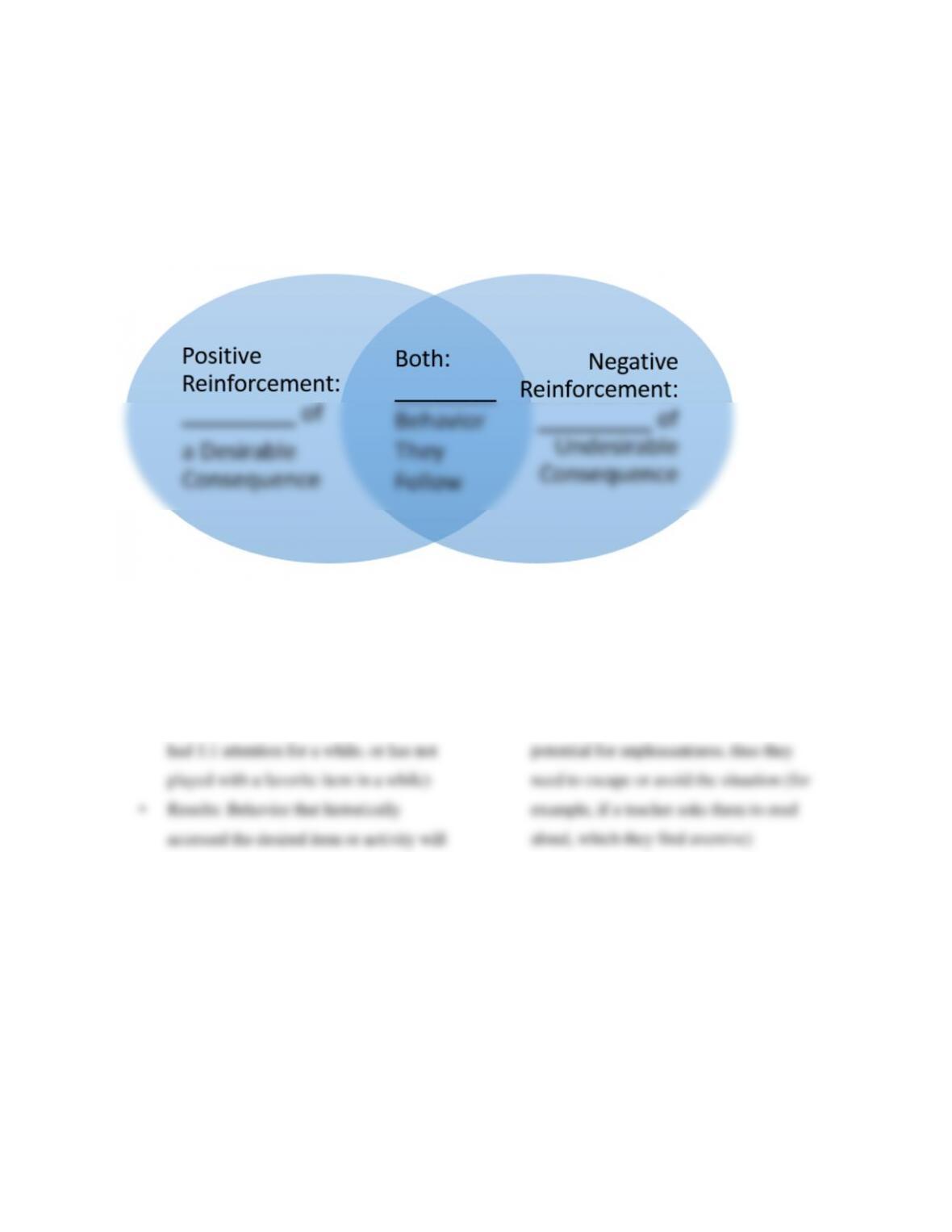
• Two types of reinforcement:
− Positive
− Negative
Positive vs. Negative Reinforcement
How Does Reinforcement Influence Motivation?
_______________ Reinforcement
_______________ Reinforcement
• Situation: Student has a need (for
example, has not eaten in a while, has not
had 1:1 attention for a while, or has not
played with a favorite item in a while)
• Results: Behavior that historically
accessed the desired item or activity will
occur, with the expectation of getting
what they want
• Situation: Student is placed in or finds
him/herself in an unpleasant situation or
potential for unpleasantness, thus they
need to escape or avoid the situation (for
example, if a teacher asks them to read
aloud, which they find aversive)
• Results: Behavior that historically
avoided or accessed escape from the
aversive situation will occur, with the
expectation of getting what they want
underlying motivation for a particular behavior
• Once we have identified the underlying _______________, we can _______________ the
environment and antecedents so that the student has less need for the behavior
• Once we have identified the underlying motivation, we can _______________ the student more
acceptable means of getting their needs met/getting what they want
• Underlying motivation can also be thought of as the function of behavior
How Can We Identify Underlying Motivation/Function?
Functional Behavior Assessment
• Steps:
2. Identify the behavior for assessment
4. Develop and test hypotheses
Data Collection Methods
• _______________ methods:
− Interviews
− Review previous records
− Behavior rating scales
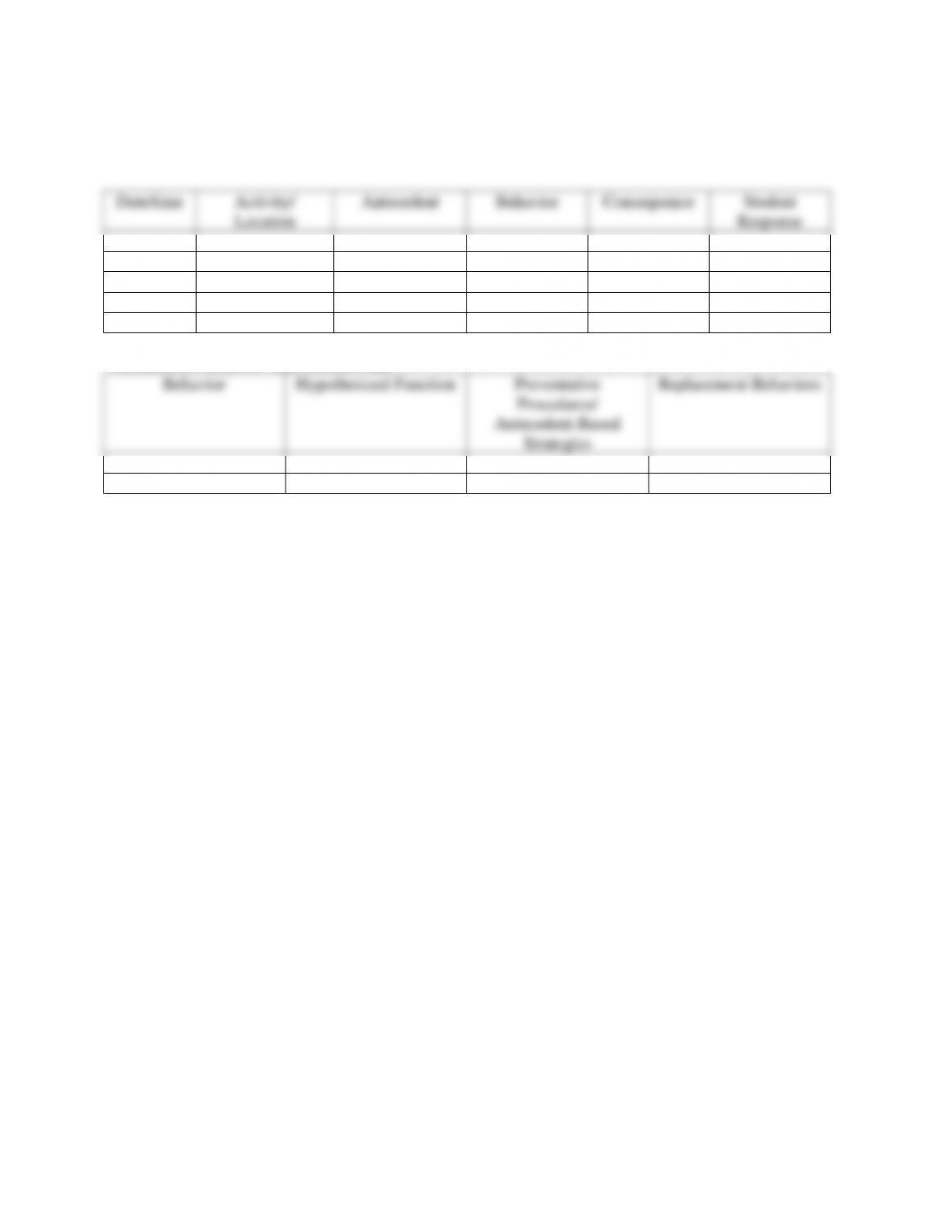
ABC Data
• Antecedent-Behavior-Consequence charting
• Emphasis is on _______________ environmental details that can aid in hypothesis development
• Recording environmental variable information _______________ and _______________ the
Developing Behavior Support Plans
1. Manipulate environmental variables to prevent the _______________ for the challenging
behavior in the first place
2. Teach the student a _______________ _______________ replacement behavior
3. Consider additional Antecedent-Based Interventions
Antecedent-Based Interventions
Instructional Activity Handouts
Handout 4.1: ABC Chart