Chapter 3
Today’s Families and Their Partnerships with Professionals
Learning Outcomes
• 3.1: Define family, parent (according to IDEA), family quality of life, and the five
domains of family quality of life, and then identify two indicators for each domain.
• 3.2: Identify the six partnership principles and two indicators for each and then describe
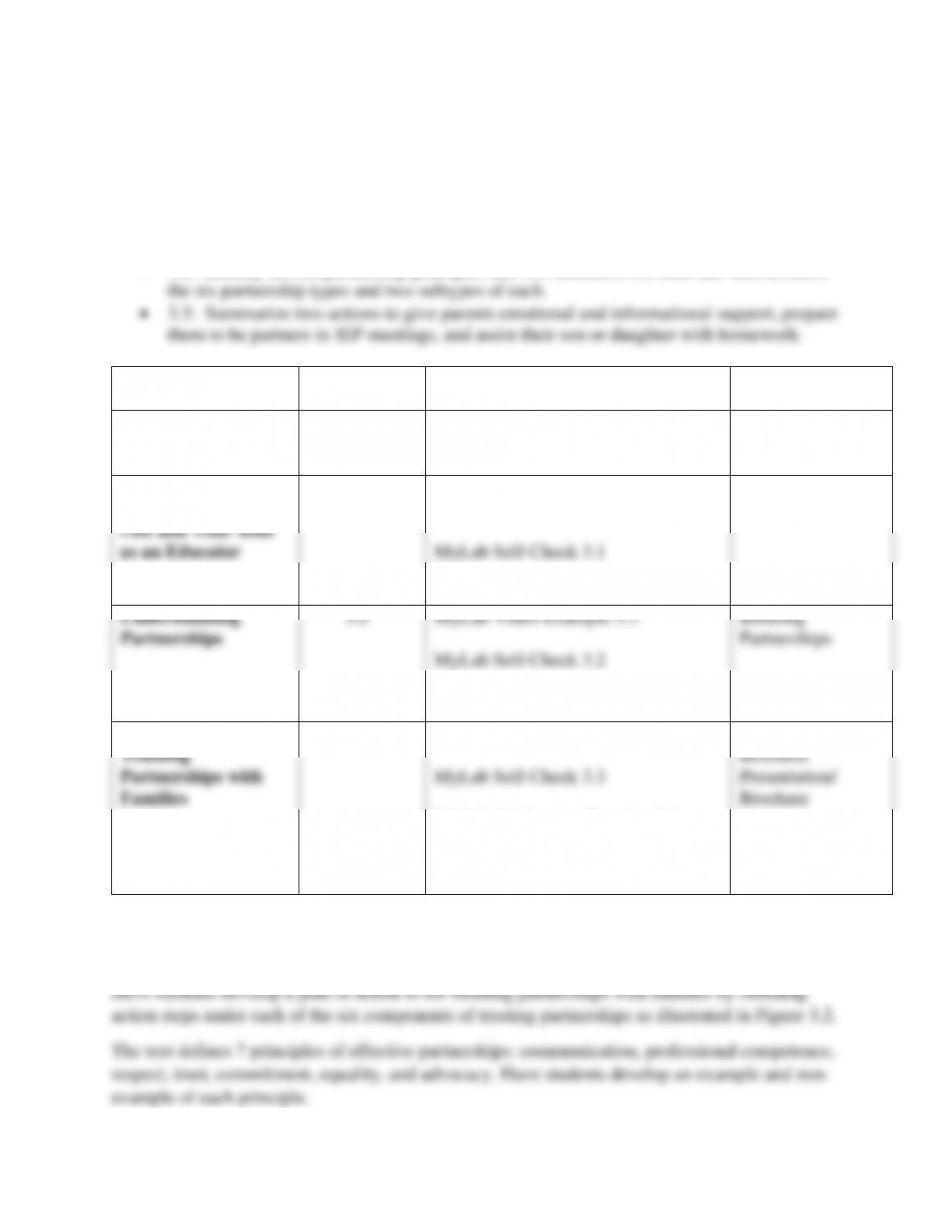
Chapter Heading
Learning
Objectives
Activities in the MyLab with E-text
Additional Class
Activities
Understanding
Today’s Families
3.1
MyLab Self-Check 3.1
MyLab Application Exercise 3.1
Family Collage
Understanding
Family Quality of
Life and Your Role
as an Educator
3.1
MyLab Video Example 3.1
MyLab Video Example 3.2
MyLab Self-Check 3.1
MyLab Application Exercise 3.1
How Can the
School Help?
Understanding
Partnerships
3.2
MyLab Video Example 3.3
MyLab Self-Check 3.2
MyLab Application Exercise 3.2
Building
Partnerships
Strategies to Form
Trusting
Partnerships with
Families
3.3
MyLab Video Example 3.4
MyLab Self-Check 3.3
MyLab Application Exercise 3.3
Community
Resource
Presentation/
Brochure
Mock IEP
Conference
Class Activities
Have students create a family collage reflecting their interpretation of family.
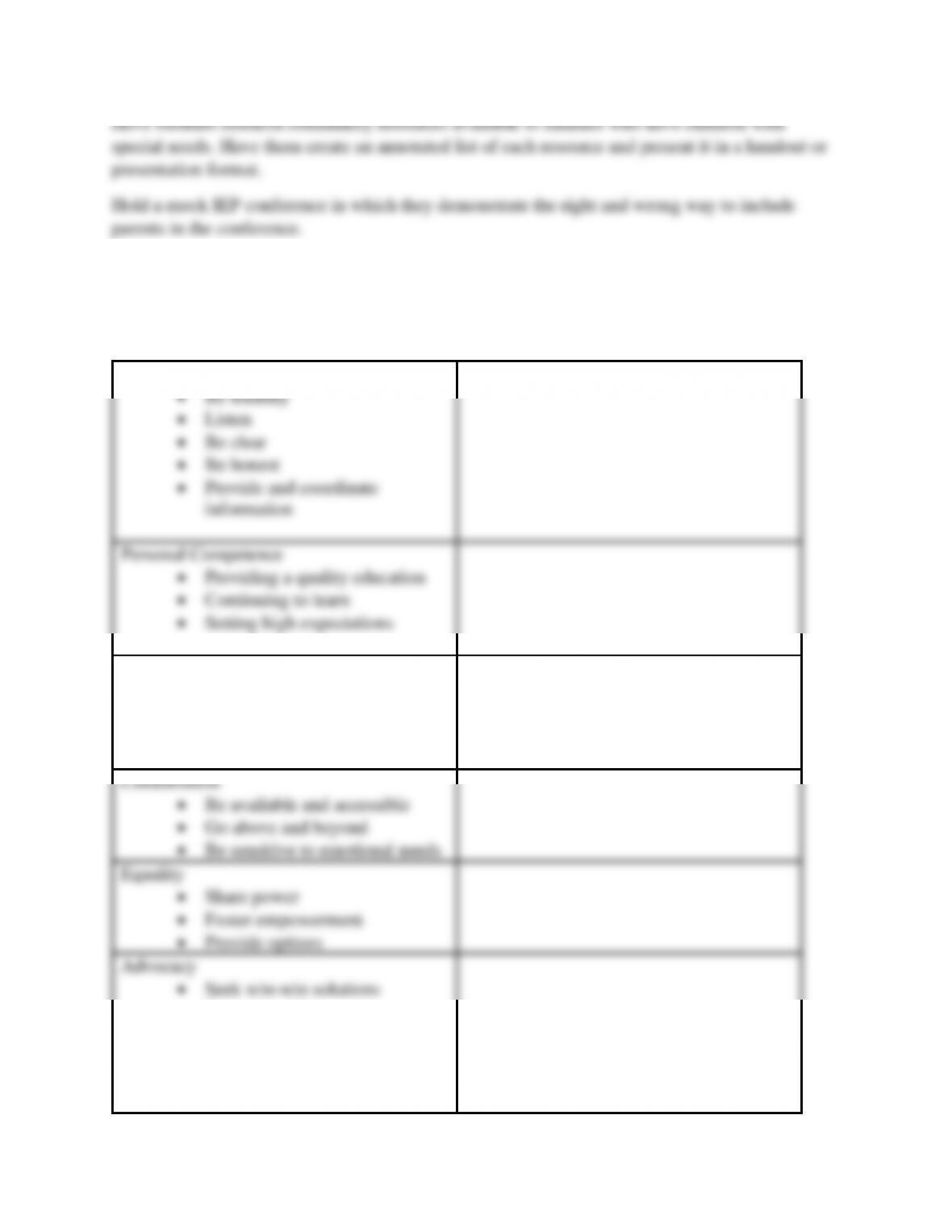
Partnerships with families are imperative to the success of children with disabilities. Give one
specific example of how you can accomplish each of the major principles of building successful
partnerships with families of the students in your classroom. Make sure your examples address
most of the bulleted points.
Communication
• Be friendly
• Listen
• Be clear
• Be honest
• Provide and coordinate
information
Personal Competence
• Providing a quality education
• Continuing to learn
• Setting high expectations
Respect
• Honor cultural diversity
• Affirm strengths
• Treat students and families with
dignity
Commitment
• Be available and accessible
• Go above and beyond
• Be sensitive to emotional needs
Equality
• Share power
• Foster empowerment
• Provide options
Advocacy
• Seek win-win solutions
• Prevent problems
• Keep your conscience primed
• Pinpoint and document
problems
• Form alliances

Trust
• Being reliable
• Using sound judgment
• Maintaining confidentiality
• Trusting yourself