Chapter 2: Evidence-Based Practices for Educating Students with Autism Spectrum Disorders
Chapter Summary
This chapter serves as an introduction to specific instructional and treatment methodologies by
describing the theoretical underpinnings and the research backing each for the purpose of educating
students with ASD.
Upon receiving the diagnosis of autism for their child, the question of which treatment will be the
demonstrate that there is a causal relationship between an educational intervention and immediate or long–
term changes that occur in development, behavior, social relationships, and/or normative life
circumstances.” Testing a hypothesis is done using a particular research design that may be one of two
broad categories: single-subject designs or group designs. The majority of the research conducted in the
area of autism utilizes the single-subject research design.
The National Autism Center’s National Standards Report (2009) provides a detailed review of the
literature to that time, and described interventions as Established, Emerging, Unestablished, or
Ineffective/harmful. This process led to the identification of 11 Established, Practices, 20 Emerging
Practices, and 5 Unestablished Practices. The NSP did not identify any treatment as “ineffective/harmful”
in their 2009 report.
There are four principles with regard to educating students with autism: self-determination,
independence, normalization, and functionality. An individual is said to be self-determined if they make
choices, makes decisions about their actions, set goals for themselves, recognize their own abilities
(strengths and needs), and advocate for themselves. The primary goal of education for students with
autism is to maximize their independence in all activities and across all settings. An individual has
Chapter Objectives
1. Increase awareness of evidence-based practices for students with Autism Spectrum Disorders
2. Increase awareness of unestablished practices and fad treatments
4. Identified the components of effective instruction for students with Autism Spectrum Disorders
5. Identify ways of determining effective treatment for students with Autism Spectrum Disorders
Focus Questions
1. List evidence-based practices for educating students with Autism Spectrum Disorders (ASD).
3. Describe the differences between a focused intervention and comprehensive treatement models.
4. What are components of effective instruction for students with ASD?
Chapter Key Terms
Applied behavior analysis
Naturalistic behavioral interventions
Comprehensive treatment model
Normalization
Pivotal response training
Discrete trial training
Self-determination
Evidence-based practices
Fad treatment
Focused intervention
Strategies for Teaching based on Autism
Research (STAR)
Systematic generalization
Unestablished treatments
Functionality
Instructional Strategies/Activities
Strategy
Rationale
Description/Steps
Modifications/
Alternative Options
Comparison of EBP
strategies (Handout
2.1)
Students may benefit
from reading and
comparing the NSP
and NPDC reports on
EBP for students with
ASD
1. Obtain a copy of the
National Autism Center’s
National Standards Report
(www.nationalautismcente
r.org/affiliates/) and the
National Professional
Development Center’s
Report
(http://autismpdc.fpg.unc.e
du/evidence-based-
practices)
2. Ask students to compare
and contrast the findings
of these reports
3. Ask students to share their
thoughts on the differences
between the two
Have students
complete the AIM
Modules related to
the EBPs identified
by NPDC
(http://www.autismin
ternetmodules.org/)
and contrast the top ten
sites with what the text
students with ASD as
well as the most
popular.
references as evidence-
based practice
3. Discuss the differences in
terms of practice in the
real world
rely on most, and
why, and then share
with the class.
Suggested Chapter Readings/Resources
The web site contains information on the causes of autism and discusses the Applied Behavioral
analysis approach to treatment.
This organization produces user-friendly evidence-based resources and guides that help families
put effective early childhood interventions to practice.
This website is an evidence-based service, training, and research program for individuals of all
ages and skill levels with Autism Spectrum Disorders. The Web site provides information about
structured teaching and physical organization as ways of teaching students with Autism Spectrum
Disorders effectively.
Green, G. (2001). Behavior analytic instruction for learners with autism: Advances in stimulus
control technology. Focus on Autism and Other Developmental Disabilities, 16, 72–85
Lounds, J., Seltzer, M., Greenberg, J. S., & Shattuck, P. T. (2007). Transition and change in
adolescents and young adults with autism: Longitudinal effects on maternal well-being.
American Journal on Mental Retardation, 112(6), 401-417.
National Association for the Education of Young Children: http://www.naeyc.org/
This Association is dedicated to improving the well-being of all young children, with
publications, resources and research.
Nirje, B. (1969). The normalization principle and it’s human management implications. In R. Kugel
& W. Wolfensberger (Eds.), Changing patterns in residential services for the mentally
retarded (pp. 181-195). Washington, DC: President’s Committee on Mental Retardation.
Perske, R. (2004). Nirje’s eight planks. Mental Retardation, 42, 147-150.
Scheuermann, B., Webber, J., Boutot, E. A., & Goodwin, M. (2003). Problems with personnel
preparation in autism spectrum disorders. Focus on Autism and Other Developmental
Disabilities, 1, 197–206.
Simpson, R. L. (2005). Autism Spectrum Disorders: Interventions and treatments for children and
youth. Thousand Oaks, CA: Corwin Press.
Chapter 2: Evidence-Based Practices for Educating Students with Autism Spectrum Disorders
Guided Notes
Outline
• Definition and Need for Evidence-Based Practices
• National Autism Center’s National Standards Report
• National Professional Development Center on Autism Spectrum Disorder (NPDC)
• Why Evidence-Based Practices?
Definition and Need for Evidence-Based Practices
• Required by _______________ (2004) and _______________ (2015)
• Evidence-based practices (EBP) are interventions and strategies that have been shown through
National Autism Center’s National Standards Report
Established Practices
Emerging Practices
Unestablished Practices
• Antecedent Package
• Behavioral Package
• Comprehensive Behavioral
Treatment for Young
Children
• _______________ Attention
Intervention
• Modeling
• Naturalistic Teaching
Strategies
• _______________ Training
• _______________ and
Alternative Communication
Device
• Cognitive
_______________
Intervention Package
• Developmental
Relationship-based
Treatment
• Exercise
• Exposure Package
• Academic Interventions
• Auditory Integration
Training
• Facilitated Communication
• Gluten- and Casein-Free
Diet
• Sensory Integrative Package
Response Treatment
• Schedules
• Self-management
• Story-based Intervention
Package
• Language Training
(Production)
• Massage/Touch Therapy
• Multi-component Package
• Music Therapy
• Peer-mediated Instructional
Arrangement
• Picture _______________
Communication System
• Reductive Package
• Scripting
• Sign Instruction
• Social Communication
Intervention
• Social Skills Package
• Structured Teaching
• _______________ -based
Treatment
• _______________ of Mind
Training
National Professional Development Center on Autism Spectrum Disorder (NPDC)
Table 2.2 National Professional Development Center on Autism Spectrum Disorder Identified
Evidence-Based Practices
BEHAVIORAL-BASED STRATEGIES
Antecedent-based Intervention
Collection of strategies in which the _______________ is
modified and/or _______________ in order to prevent a learner
Differential Reinforcement
Behaviorally based strategies that involve _______________
alternative, incompatible, other, or lower rates for interfering
behavior in order to replace it with more appropriate behavior.
Extinction
Behaviorally based strategy that withdraws or _______________
the reinforcer associated with an interfering behavior in order to
reduce or eliminate it.
Functional Communication
Training
Systematic practice of _______________ inappropriate
communicative behavior with more socially appropriate behavior.
Functional Behavior
Assessment
Systematic set of strategies used to _______________ the
underlying function, or purpose, of a behavior so that than
effective intervention can be developed.
Response
Interruption/Redirection
The physical _______________ or _______________ of
interfering behavior, predominantly those that are repetitive,
stereotypical, and/or self-injurious.
Self-management
Method in which learners are taught to _______________, record,
and report data, and _______________ their own behavior.
POSITIVE BEHAVIOR SUPPORT STRATEGIES
Prompting
_______________ strategy based on the principles of behavior.
Reinforcement
_______________ strategy based on the principles of behavior.
Task Analysis
Teaching strategy that _______________ a skill down into
smaller, more manageable steps and links them together during
teaching.
Time Delay
Strategy focused on _______________ the use of prompts during
instructional activities.
Computer Aided Instruction
Use of _______________ to teach academic, communication, and
language skills with computer modeling and computer tutors.
Discrete Trial Teaching
Instructional approach that teaches skills in a planned, controlled,
and _______________ manner using applied behavior analysis
principles.
Naturalistic Intervention
_______________ of practices including environmental
arrangement, interaction techniques, and strategies based on
applied behavior analysis principles.
Parent-implemented
Intervention (PII)
Strategies that recognize and utilize parents as effective
_______________ for their children.
Peer-mediated Instruction and
Intervention
Strategies designed to _______________ social
_______________ by teaching typically developing peers to
initiate and maintain interactions.
Picture Exchange
Communication System
Practice in which learners are taught to give a _______________
to a communication partner in exchange for a desired item and
then progress though ________ phases progressing in complexity.
Pivotal Response Training
Approach that teaches the learner to seek out and respond to
_______________ occurring learning opportunities using applied
behavior analysis principles.
EVIDENCE-BASED PRACTICES
Social Narratives
Written narratives that _______________ social situations in some
detail and _______________ relevant cues and offer examples of
appropriate responding to help the learner adjust to the situation
and adapt his/her behavior.
Social Skills Training
_______________ _______________ instruction with a shared
goal of learning social skills through activities such as role-play or
practice. Learners receive feedback from a teacher or adult
facilitator.
Speech Generating Devices
Portable, electronic devices that produce synthetic or digital
speech and are used as a means of _______________ for the user.
Structured Work Systems
An element of structured teaching developed by TEACCH aimed
at _______________ independence and _______________ the
need for teacher correction.
Video Modeling
Teaching strategy that uses videos as the core component of
instruction and allows for _______________ of the target skill via
observation.
Visual Supports
Tools presented visually that enable ta learner to
_______________ track events and activities as he/she moves
throughout the day.
Why Evidence-Based Practices?
• Strategies and practices that have been shown through _______________ sound research to be
_______________ have a greater likelihood of being effective with other students
• Evidence-based practices rely on the _______________, rather than on anecdotal or case study
recommendations
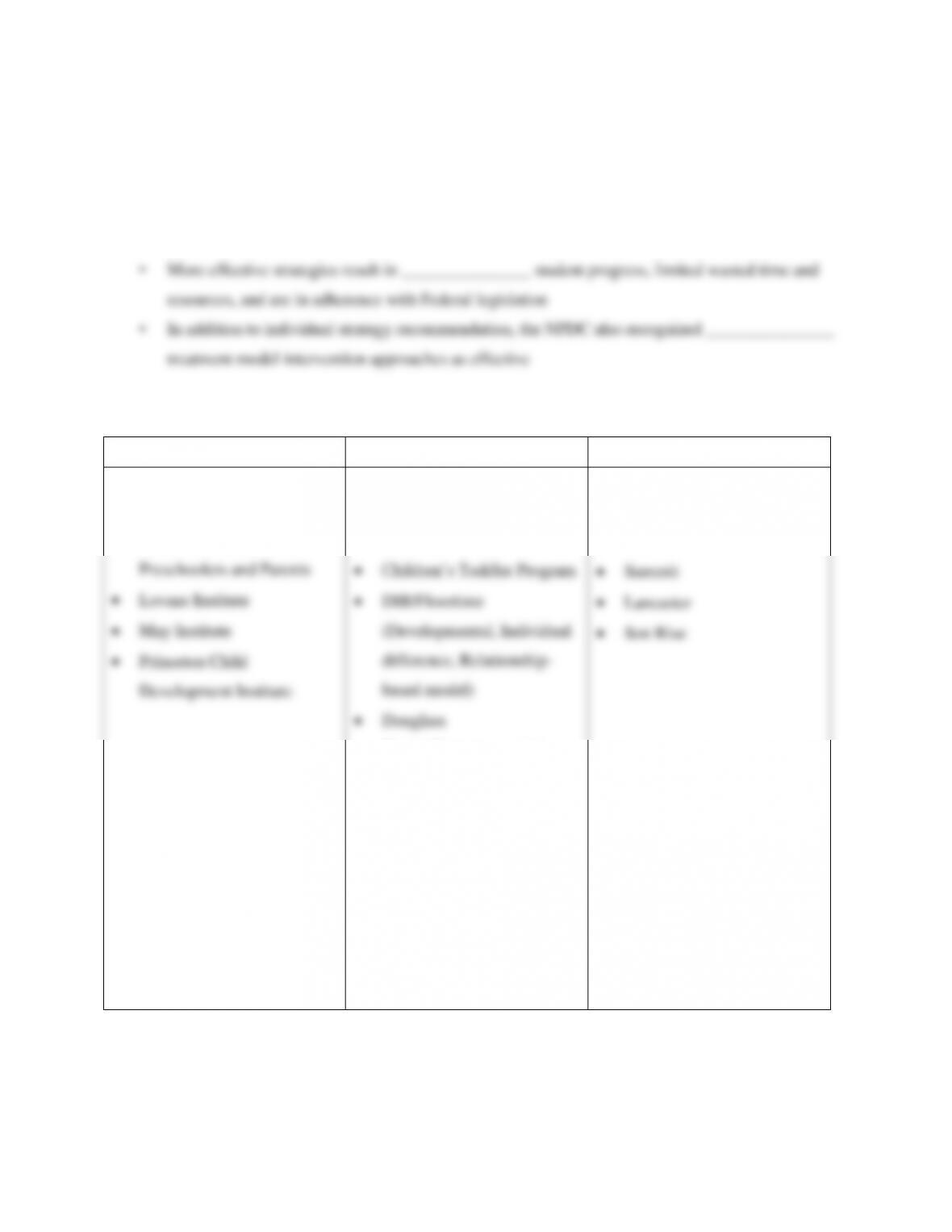
Degree of Development of Comprehensive Treatment Models
Strong Model Development
Partial Model Development
Limited Model Development
• Denver Model
• Learning Experiences: An
Alternative Program for
Preschoolers and Parents
• Lovaas Institute
• May Institute
• Princeton Child
Development Institute
• Autism Partnerships
• Center for Autism and
Related Disorders
• Children’s Toddler Program
• DIR/Floortime
(Developmental, Individual
difference, Relationship-
based model)
• Douglass
• Pivotal Response training
• Responsive teaching
related Communication-
handicapped Children)
• Hanen
• Higashi
• Eden
• Summit
• Lancaster
• Son Rise
Unestablished and Fad Treatments
• NAC classified _________ practices as unestablished (including auditory integration training,
facilitated communication, gluten-casein free diets and sensory integrative package)
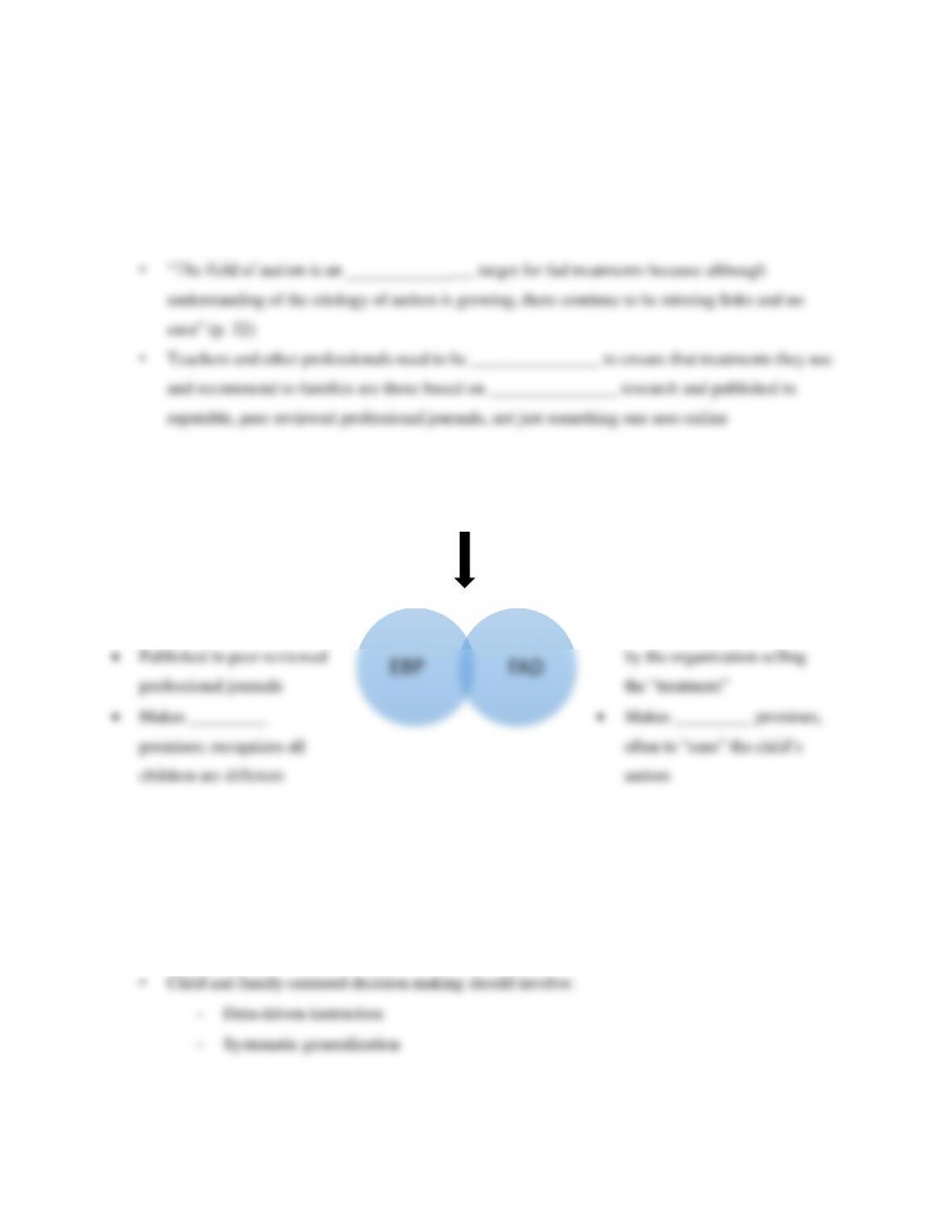
• Unestablished treatments have _______________ to _________ evidence to support their use
• A “__________ treatment” is “one that is adopted rapidly by consumers without validating
research to support its use” (p. 32)
• Fad treatments usually fade away when research emerges to suggest it is ___________ a viable
treatment
EBP vs. Fad
Goal: Improve Student Functioning
• Based on _______________
research and multiple
studies
• Published in peer-reviewed
professional journals
• Makes _________
promises; recognizes all
children are different
• Based on _______________
or case study
• “Published” only online or
by the organization selling
the “treatment”
• Makes _________ promises,
often to “cure” the child’s
autism
Child and Family-Centered Decision Making
• __________ require family/parent/caregiver input into the programming for their child
• Children’s individual strengths and needs should also drive decision making
• Remember that no two students with ASD are the same; each should be treated
_______________
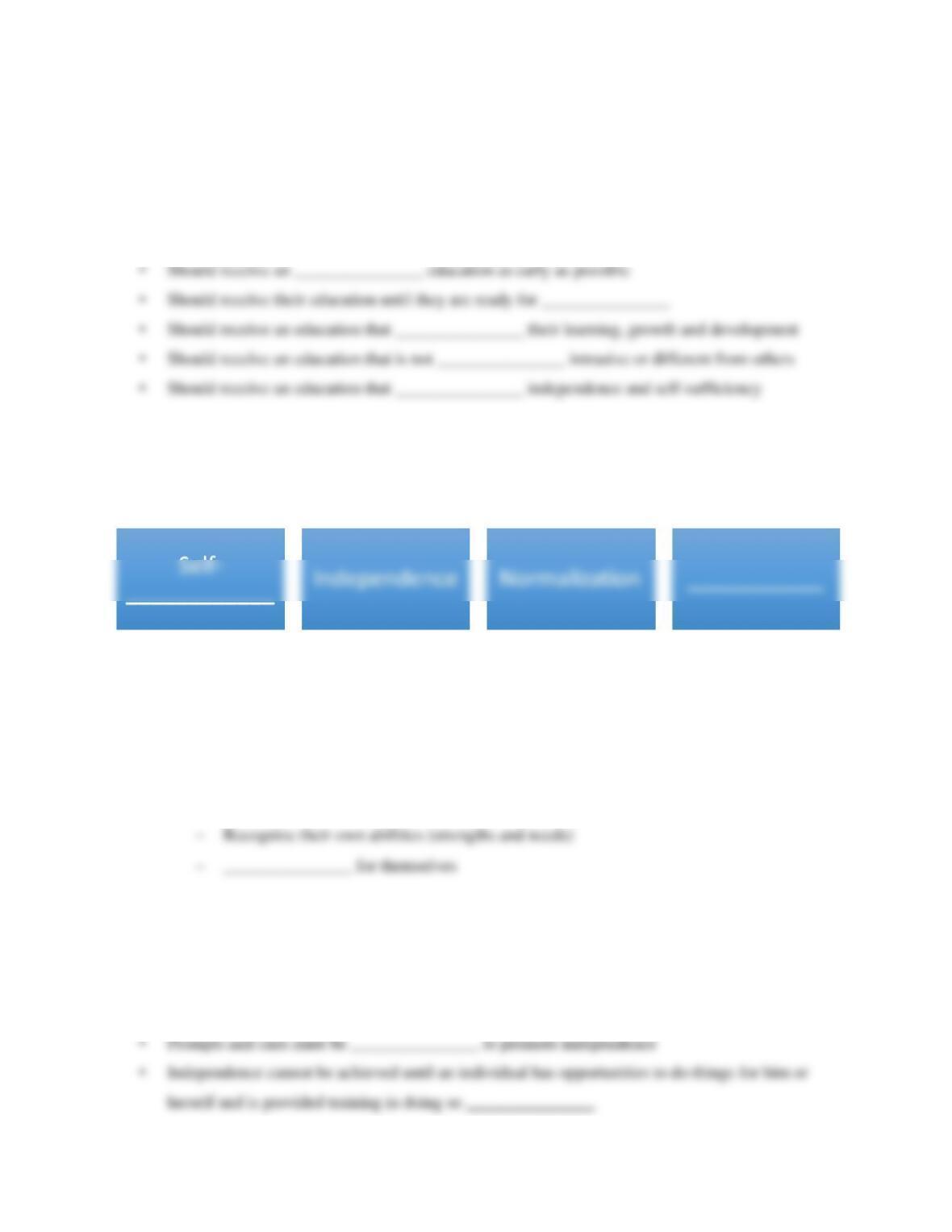
Students with ASD …
• Deserve a _______________ education that is no less than what is offered to others without
disabilities or with other disabilities
• Should receive an _______________ education designed to meet their individual needs
• Should __________ be isolated from others
Goal in Educating Students with ASD
• To provide them with opportunities to participate _______________ and successfully in the
mainstream of society, by promoting 4 key principles:
The Principle of Self-Determination
• One is said to be self-determined if they can:
− Make _______________
− Make decisions about their actions
− Set _______________ for themselves
The Principle of Independence
• A goal of education is to promote _______________ independence in all activities and settings
• Independence is achieved when an individual uses only those supports that are _______________
necessary for functioning
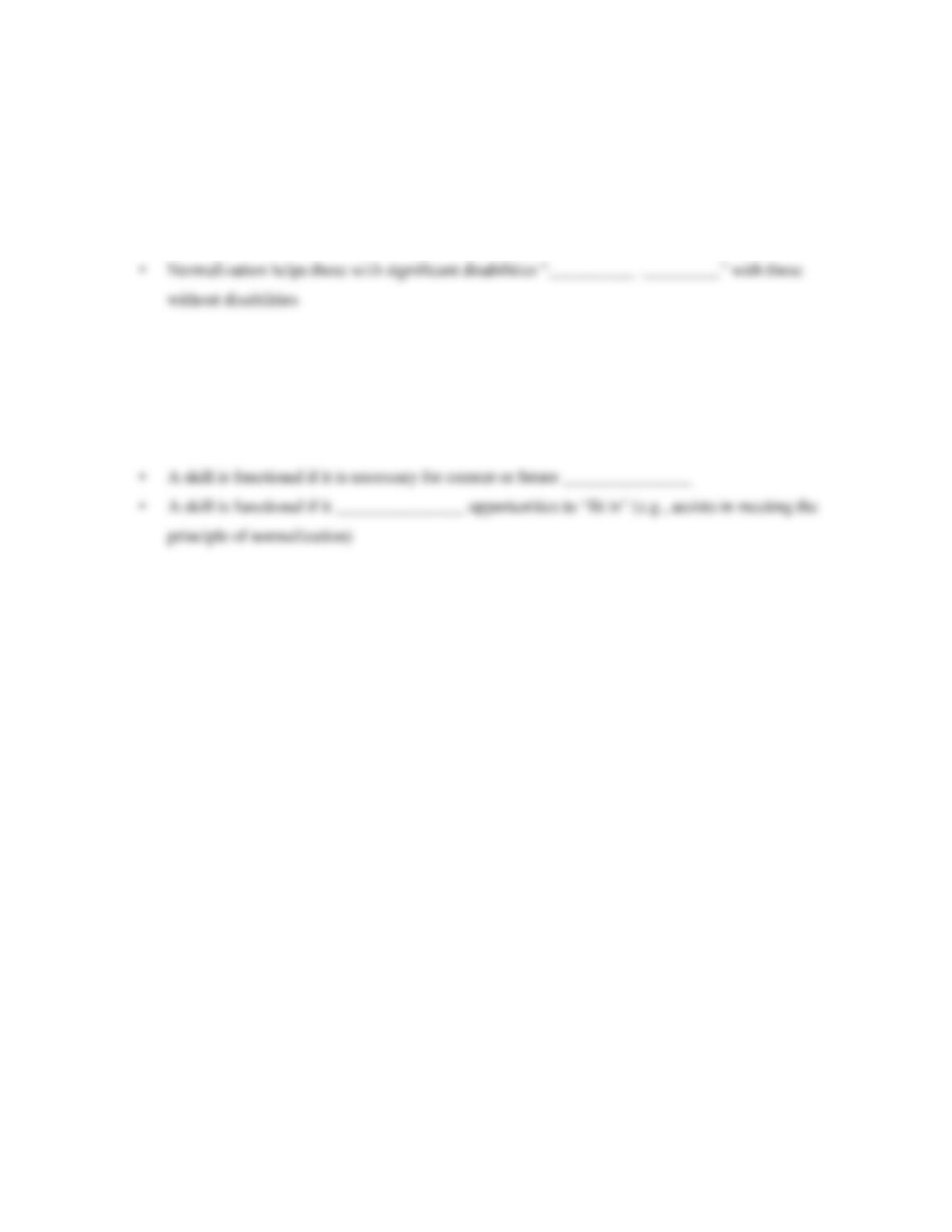
The Principle of Normalization
• Normalization occurs when the activities, materials, and settings in which a person engages are
the _______________ as those in which persons without disabilities of the same age, gender, and
culture are engaged.
The Principle of Functionality
• A skill is functional if it is _______________ to a child
• A skill is functional when: if the child _______________ do it himself, someone else will have to
do it for him
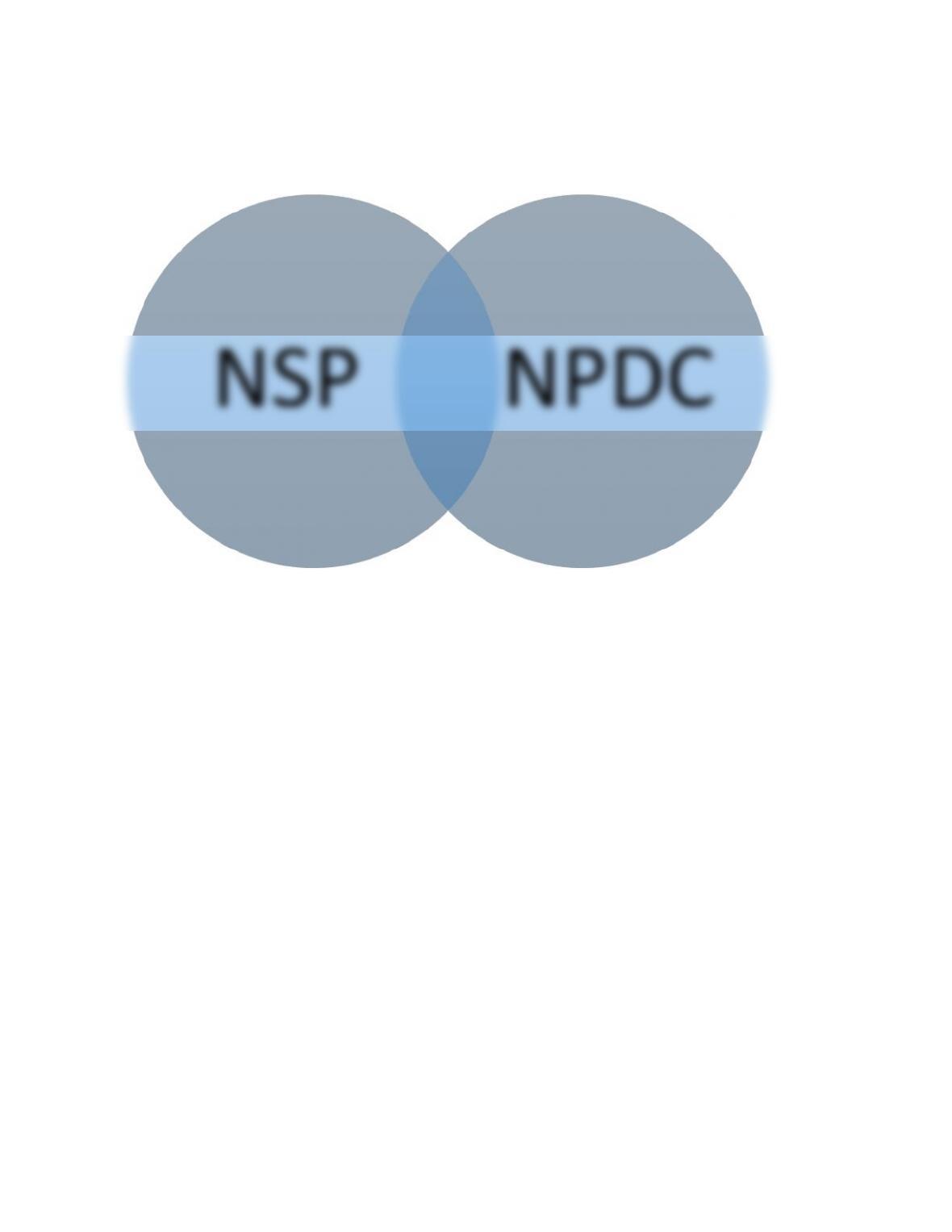
Instructional Activity Handouts
Handout 2.1 Compare/Contrast EBP Reports