Chapter 15
Understanding Students with Visual Impairments
Chapter Objectives
After studying this chapter, you should be able to:
• Identify and define types of visual impairments and the degrees and limitations of these
impairments.
Chapter Overview/Presentation Outline
I: Introduction
Slide 2: Chapter 15 Objectives
-Present slide 2 and review the chapter objectives
II. Identifying Students with Visual Impairments
Slide 3: Defining Visual Impairments
-Present slide 3 and discuss the definitions of visual impairments
Slide 7: Anatomy of the Eye
-Present slide 7 and discuss the anatomy of the eye
III. Evaluating Students with Visual Impairments
Slide 8: Determining the Presence
-Present slide 8 and discuss how to determine the presence of visual impairment
IV. Designing an Appropriate IEP
Slide 10: Partnering for Special Education and Related Services
-Present slide 10 and discuss the location of special education and related services
V. Using Effective Instructional Strategies
Slide 14: Early Childhood Students
-Present slide 14 and discuss programming that focuses on real experiences
Slide 15: Elementary and Middle Schools Students
-Present slide 15 and discuss the development of basic skills
VI. Assessing Students’ Progress
Slide 18: Measuring Students’ Progress
-Present slide 18 and discuss modifications for students with visual impairments
Class Activities
1. At the beginning of class, have students read the case study at the beginning of the chapter.
2. Have students create a brochure about the disability addressed in the chapter. The brochure
can be trifold and include: a definition of the disability, causes of the disability, characteristics of
3. Assign each student or pair of students a disability. Have the students prepare a class
presentation of the disability to include definition of the disability, causes and prevalence,
4. Expanded Core Curriculum. Much of our learning is incidental and learned naturally through
viewing others (Social learning). Since students who are blind do not have incidental learning,
they need an expanded curriculum to make sure they are able to function. Ask your students the
5. At First Sight ©1999, 128 minutes—Show a portion or all of At First Sight and allow students
6. At the end of class, have students revisit the case study at the beginning of the chapter. Use the
questions at the end of the chapter, “What do you think?” to facilitate discussion.
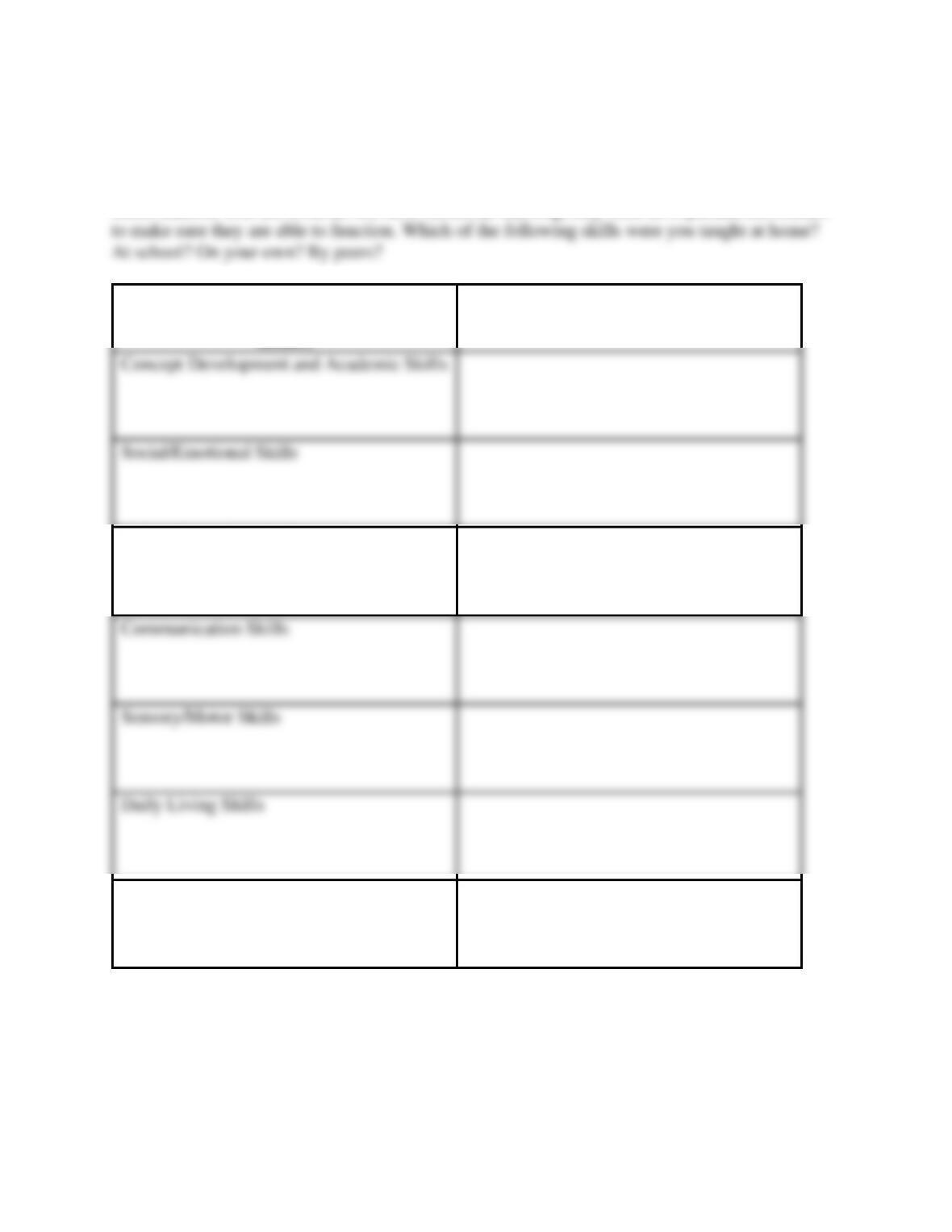
Expanded Core Curriculum (activity 15.4)
Much of our learning is incidental and learned naturally through viewing others (social learning).
Since students who are blind do not have incidental learning, they need an expanded curriculum
Expanded Core Curriculum
(See Figure 15–5 in your textbook for
details)
Where did you learn these skills?
Concept Development and Academic Skills
Social/Emotional Skills
Orientation and Mobility Skills
Sensory/Motor Skills
Daily Living Skills
Career and Vocational Skills
Though not in the basic curriculum, how beneficial would it be if more of these skills were in the
core curriculum for individuals without disabilities?