Chapter 14: Transition to Postsecondary Environments for Students with Autism Spectrum
Disorders
Chapter Summary
This chapter discusses the general dimensions of transition to adulthood for individuals with
ASD. The Individuals with Disabilities Education Improvement Act (IDEIA, 2004) requires that
transition be a part of the Individualized Education Plan (IEP)/ Individualized Transition Plan (ITP)
process beginning at age 16. Transition is defined as life changes or adjustments that occur as students
• 75%: adults with developmental disabilities unemployed (Van Laarhoven & Winiarski,
2012)
• 6%: people with ASD who have gained competitive employment (Shattuck, Wagner,
Narendorf, Sterzing, & Hensley, 2011)
• 56%: adults with ASD who were in sheltered workshops (Taylor & Seltzer, 2010)
These statistics suggest that the educational system is in some way failing to prepare young
people with ASD and other developmental disabilities for adulthood. Issues to be considered when
programming transition for youth with ASD include: building on strengths and interests in employment
intervention; presenting opportunities to learn in varied ways to combat challenges associated with ASD
• Sensory issues and environmental factors
• Social interactions
Despite the challenges, thre are some intervention models that can promote a successful transition
to adulthood for students with ASD:
• Applied behavior analysis
• TEACCH model
• Developmental, Individual Difference, Relationship-based model (DIR)
There are strengths and limitations to each of these models of instruction. Applied behavior analysis has
been shown through research as effective at teaching specific skills related to work and independent
living as well as at reducing challenging behaviors. The use of task analysis and chaining, systematic
prompting and prompt fading, positive reinforcement, systematic generalization, and data collection and
The chapter specifically recommends 4 primary components of effective transition programming:
community-based transition preparation, postsecondary education, universal design for transition, and
promoting self-determination and student involvement. Community-based instruction can aid in
generalization of skills learned in the classroom. Practicing skills in the real world promotes better
maintenance of the skills as well as builds fluency. Although historically not the case, a growing body of
research indicates that students with ASD can be successful in postsecondary environments. In order to
assist students in being able to find success in postsecondary environments such as colleges, universities,
and trade and technical training programs, teachers must ensure students are learning to their maximum
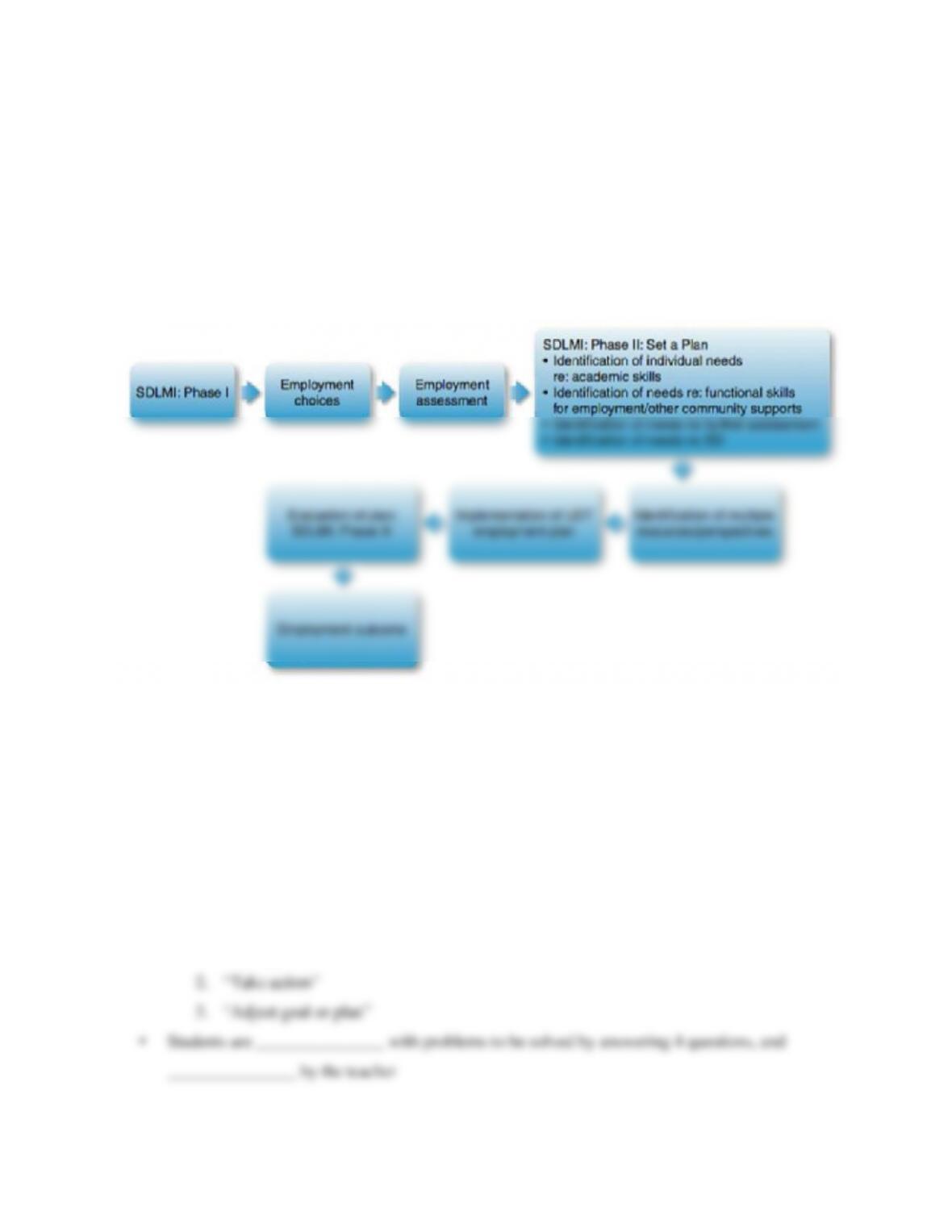
The Universal Design for Transition (UDT) is a model for promotion of employment and
integration of people with ASD into their communities, including employment settings. UDT works well
in conjunction with an assessment and curriculum model that focuses on building self-determination, the
Self-Determination Learning Model of Instruction (SDLMI). According to the chapter, UDT applies the
principles of UDL (discussed in chapter 9) to support transition planning for employment and
postsecondary adult life. Some key aspects of UDT include: multiple presentation means and alternatives
for acquisition of and demonstration of knowledge as well as multiple means of engagement and using
Chapter Objectives
1. Understand current issues in transition education related to the (a) history of the field, (b)
legislation that has impacted transition services, and (c) gap between research and practice.
3. Be familiar with the roles of key personnel in the transition process and be able to discuss the
4. Be cognizant of characteristics inherent in autism, challenges that there traits can cause in the
transition process, and strategies to mitigate these challenges.
Focus Questions
1. Describe the history, relevant legislation, and current state of the art in transition education and
services for persons with autism and significant disabilities with regard to employment statistics.
2. List and explain the guiding principles of person-centered transition planning.
4. How can educators integrate academic objectives and transition goals to enhance learning
outcomes?
Chapter Key Terms
Secondary education
Self-determination
Transition planning
Transition services
Universal Design for Transition
Instructional Strategies/Activities
Strategy
Rationale
Description/Steps
Modifications/
Alternative Options
Person-Centered
Planning Activity
Hands-on exploration
of concepts may
improve student
understanding of
content
1. Divide students into
small groups, assigning
each a case example of
an individual with ASD
from the text
2. Assign each group
member a role: parent,
teacher, individual with
ASD, or other family
member
3. Have students role play
4. Have groups share their
decisions as well as
to the concept of self-
Allow students to
select their roles
Community
Resources Guide
Researching resources
available within their
own states and
1. Assign small groups of
students one of the areas
associated with
Allow students to
work alone or in
small groups
communities may
increase student
understanding of
concepts
transition, as discussed
in the chapter
(employment, housing,
post secondary
education, social
relationships)
2. Have students research
the available resources
in their state or
community
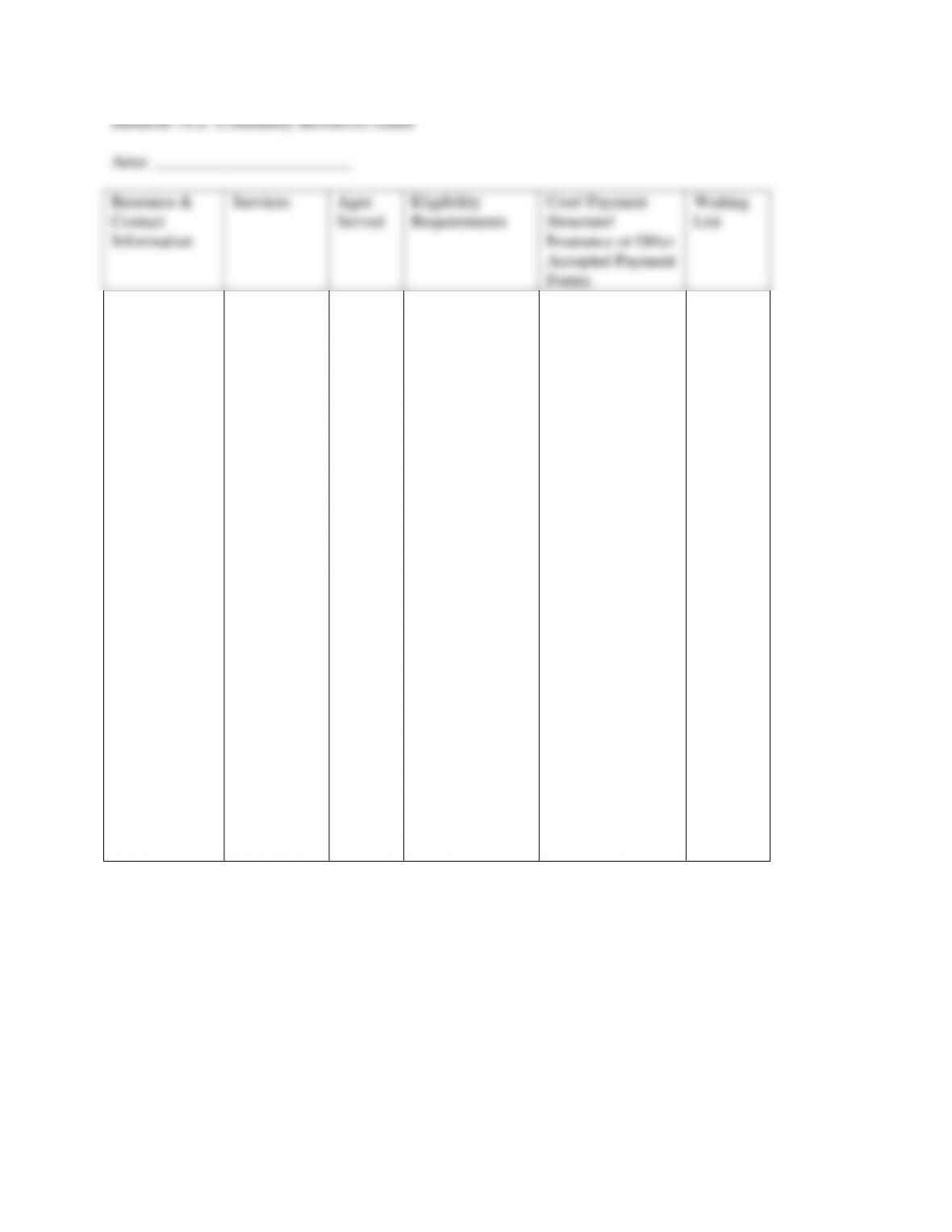
3. Have students complete
Handout 14.2
4. Put this information
together as a
Community Resources
Guide including all the
areas researched
Adult Service
Observation
Experience with adults
with ASD in the real
world may enhance
student understanding
of concepts
1. Locate several adult
services agencies,
groups homes,
employment settings,
etc. in your community
and arrange for students
to go for observations in
those settings
2. Have students write a
brief summary of their
observations and share
with the rest of the class
Allow students to do
the observations
alone or in small
groups
Suggested Chapter Readings/Resources
Chadsey-Rusch, J., & Gonzalez, P. (1988). Adults with developmental disabilities. In J. L. Matson
& A. Marchetti, (Eds.), Developmental disabilities: A life-span perspective (pp.228-255).
Philadelphia: Grune & Stratton.
Council for Exceptional Children, Division on Career Development and Transition:
http://www.cms4schools.com/dcdt/
National Center on Secondary Education and Transition: http://www.ncset.org/
This organization coordinates national resources, offers technical assistance, and disseminates
National Secondary Transition Technical Assistance Center: http://www.nsttac.org/
This organization assists in collection of data on IDEA 2004, helps state and local educational
agencies build their capacity to implement effective transition education and services, and
National Transition Network: http://ici2.umn.edu/ntn/
This organization was a program funded by the US Department of Education until 2001 that
provided technical assistance and evaluation services to states with grants for Transition Systems
Ozonoff, S., Dawson, G., & McPartland, J. (2002). A parent’s guide to Aspergers Syndrome and high–
functioning autism: How to meet the challenge and help your child thrive. New York: The
Guilford Press.
Smith, T. L., Polloway, E. A., Smith, D. J., & Patton, J. R. (2007). Self-determination for persons
with developmental disabilities: Ethical considerations for teachers. Education and Training
in Developmental Disabilities, 42(2), 144-151.
Chapter 14: Transition to Postsecondary Environments for Students with Autism Spectrum
Disorders
Guided Notes
Outline
• Overview of Transition
• Rationale for Transition Services: Risks and Negative Outcomes for Students with ASD
• Characteristics of ASD Impacting Positive Outcomes/Adequate Preparation for Adulthood
Overview of Transition
• Definition: “life changes or adjustments that occur as students move from school to independent
_______________ and _______________” (p. 218).
• Individuals with Disabilities Education Improvement Act (IDEIA, 2004) requires that
Rationale for Transition Services: Risks and Negative Outcomes for Students with ASD
• 75%: adults with developmental disabilities _______________ (Van Laarhoven & Winiarski,
2012)
• 6%: people with ASD who have _______________ competitive employment (Shattuck, Wagner,
Narendorf, Sterzing, & Hensley, 2011)
• 56%: adults with ASD who were in sheltered workshops (Taylor & Seltzer, 2010)
Characteristics of ASD Impacting Positive Outcomes/Adequate Preparation for Adulthood
• Sensory issues and environmental factors
• Social interactions
Three Models of Transition Instruction for Students with ASD
• Applied Behavior Analysis
• _______________ Model
• Developmental, Individual Difference, Relationship-based Model (_______________)
Applied Behavior Analysis
• Used to successfully teach a variety of skills needed in adulthood through
_____________________ strategies:
− of task analysis and chaining
− systematic prompting and prompt fading
TEACCH Model
• Evidence-based model for improving _______________ skill performance using:
− Environmental _______________
− Visual schedules
− Work systems
Developmental, Individual Difference, Relationship-based Model (DIR)
• Focused on building _______________
5 Components of Effective Transition Planning
• Community-_______________ Instruction
• Post-Secondary Education
• Universal Design for Learning
Community-Based Instruction
• Promotes _______________ by engaging learner _______________ the environment in which a
skill will later need to be performed
Post-Secondary Education
• Research supports _______________ young adults with ASD are attending postsecondary
schools such as trade/technical schools, 2, and 4 year colleges and universities
• Transition plans can _______________ success in these environments by:
− Provide consistent routine and structure with clear rules
− Provide _______________ expectations
− Use concrete language
Universal Design for Learning
• Model for _______________ employment and community integration of individuals with ASD
• Works well in conjunction with the Self-Determination Learning Model of Instruction
(_______________)
• Key Aspects:
− Multiple means of demonstrating knowledge
− Considering _______________ interests
− Considering students’ strengths
− Building self-determination
UDT Employment Model
SDLMI Model
• Based on the component elements of ______________________ behavior:
− Problem solving
− Goal setting
− Self-regulation
• 3 phases of instruction:
1. “Set a goal”
Instructional Strategies Handouts
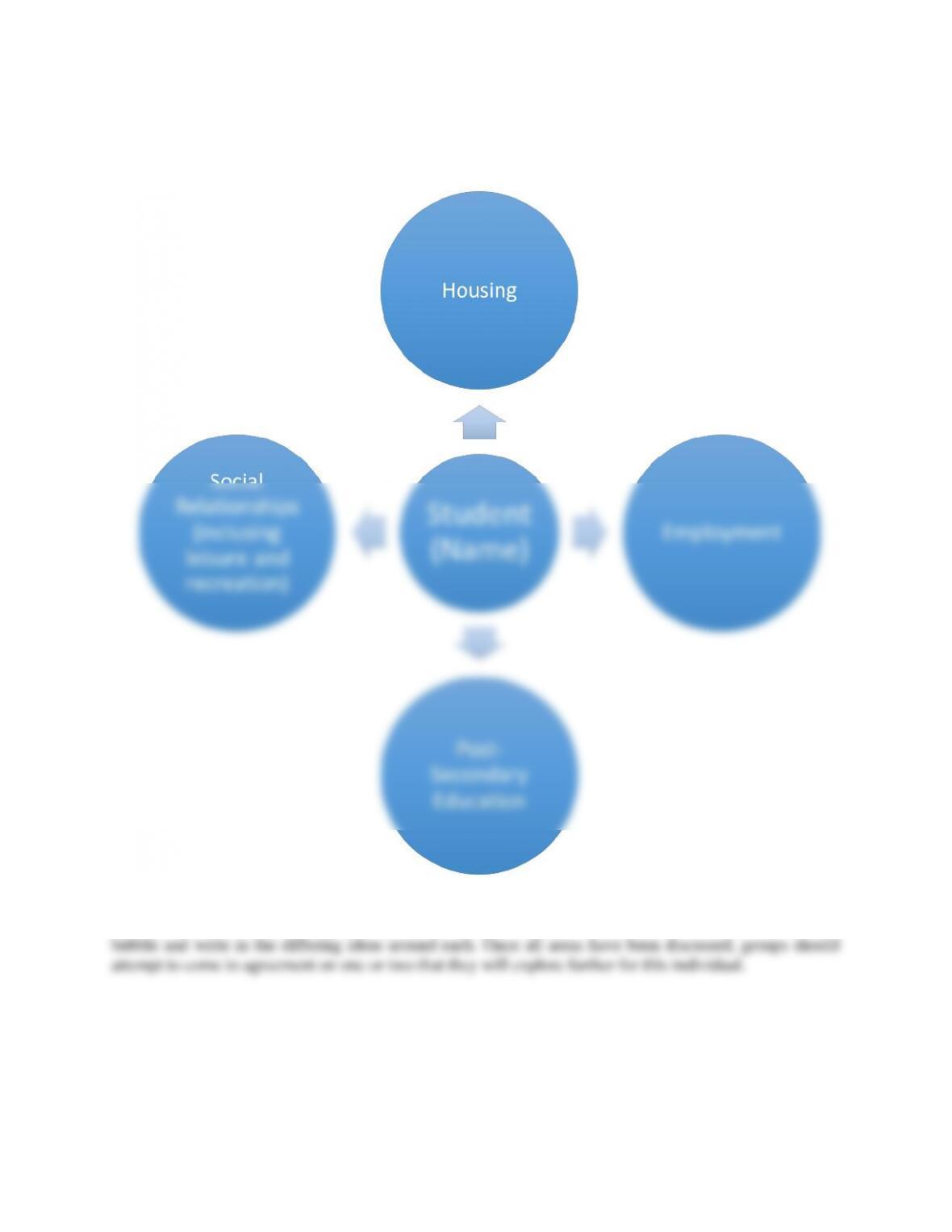
Handout 14.1: Person-Centered Planning Worksheet
Instructions: Students should brainstorm the types of each area they would like for the student whose
name is in the center, remaining in “character” as assigned. Students should draw lines from each outside
Resource &
Contact
Information
Services
Ages
Served
Eligibility
Requirements
Cost/ Payment
Structure/
Insurance or Other
Accepted Payment
Forms
Waiting
List