Chapter 13: Sexuality Education for Students with ASD
Summary:
This chapter addresses an oftentimes sensitive subject for parents and teachers. To understand the
importance of sexuality education for students with ASD, one must examine the myths associated with
sexuality of persons with developmental disabilities such as ASD. Myth 1 is that people with ASD have
• People with ASD are at risk for abuse and exploitation
• People with ASD are at risk for sexual-related health issues
Each of these risks is discussed in some detail, further providing rationale for sexuality education for this
population. Among the issues that deem this education so important are the fact that some individuals
with ASD do not understand the social norms or expectations and may advance sexually because they are
The Sexuality Information and Education Council of the United States (SIECUS) provides a
comprehensive list of sexuality-related content for ages five through adulthood, that teachers and others
can access in determining what is developmentally appropriate and should be taught at various ages. A
lifespan approach is important because it emphasizes not waiting until a child becomes sexuality active to
teach basic knowledge about sexuality. This chapter specifies that being proactive is key and that an
educational team should determine how skills we be taught across contexts, including home, school and
community.
While few curricula exist for teaching sexuality, two are presented on page 209. First is the
Intimate Relationships Sexual Health, which is aligned with the national standards. It is specifically for
adolescents and adults with high-functioning ASD. A key feature of this curricula is its focus on teaching
correct terminology as well as slang. Strategies promoted include visuals, peer modeling, and video
modeling. The other is Teaching Children with Down Syndrome about Their Bodies, Boundaries, and
Sexuality, which provides comprehensive lessons that are easy to teach. It is not specifically aligned with
SIECUS but does recommend teaching skills across the life span and also focuses on varied contexts for
instruction.
Objectives:
2. Understand the need for sexuality education across the life span.
4. Identify appropriate curricula for teaching sexuality.
Focus Questions:
1. Identify and discuss three reasons why it is critical to provide individualized, yet comprehensive,
sexuality education for people with ASD.
2. What is SIECUS? How can you use the SIECUS resources to teach sexuality education to the
people you serve?
4. Name three necessary components of a sexuality education program that you should look for
when assessing sexuality-education curriculum for students with ASD. Why are these areas
important?
Key Terms:
Collaboration
Curricula
Contexts
National Autism Center
Sexuality education
Sexuality Information and Education Council of the United States
Instructional Strategies/Activities:
Strategy
Rationale
Description/Steps
Modifications/
Alternative Options
Media/Social media
portrayal of people
with developmental
disabilities/ASD
Real world exploration
of concepts may
improve student
understanding of
content
1. Divide students into
small groups
2. Assign or have groups
select from popular
media, movies, and/or
social media for their
Allow students to
work individually
Instead of having
students research on
their own, assign
research
3. Have students review
their chosen media
source(s) and discuss
the way that adults with
developmental
disabilities, including
ASD, are portrayed
compared to reality
using Handout 13.1
4. Have groups share their
discussion points as
well as excerpts from
their media source that
supports their discussion
5. Discuss how the media
may contribute to the
myths regarding adults
with developmental
disabilities, including
ASD
specific movies,
books, social media
sites, magazine
articles, etc. to
individuals or groups
SIECUS Review
Hands-on familiarity
with the Standards
will aid in
conceptualizing the
comprehensiveness of
the document and the
varied areas in which
sexuality can be taught
through the lifespan
1. Have students review the
SIECUS Standards available
online.
2. Assign teams to review a
particular area across the
lifespan
3. Using a jigsaw format,
have members of each team
get together and share their
smaller team’s content
4. Encourage students to
consider the
comprehensiveness of the
Standards
5. Ask students to share
comments about the
standards
5. Discuss ways in which
Allow students to
select their area of
focus
Have students divide
up by age level rather
than content area and
then jigsaw out for
sharing
based strategy to
support students with
Standards that may be taught
by a teacher or a parent to a
Assign specific
that can be used as a visual
to support student
understanding of the
concept.
3. Have students share their
ideas with classmates and
discuss modifications that
may be necessary for
students of varying ability
levels
the graphic organizer
using one of the
Chapter Case Studies
as the student
Suggested Readings/Resources:
Ailey S.H., Marks B.A., Crisp C., et al. (2003) Promoting sexuality across the life span for individuals
with intellectual and developmental disabilities. Nursing Clinics of North America, 38, 229–
252.APA, 2000.
Davies, C. & Dubie, M. (2012). Intimate relationships and sexual health: A curriculum for teaching
adolescents/adults with high-functioning autism spectrum disorders and other social challenges.
Shawnee Mission, Kansas: AAPC Publishing.
Edelson, M. G. (2010) Sexual abuse of children with autism: Factors that increase risk and interfere with
recognition of abuse, Disability Studies Quarterly, 30 (1),
Hellemans, H., Colson, K., Verbracken, C., Vermeiren, R., Deboutte, D. (2007). Sexual behaviour in
high-functioning male adolescents and young people with Autism Spectrum Disorder. Journal of
Autism and Developmental Disorders, (37), 260-269.
Kalyva, E. (2010). Teachers’ perspectives of the sexuality of children with Autism Spectrum
Disorders. Research in Autism Spectrum Disorders, 4,433-437.
Koller, R. A. (2000). Sexuality and adolescents with autism. Sexuality and Disability, 18, 125-135.
National Autism Center. (2009). National standards report (S. M. Wilczynski, Ed.). Randolph, MA.
National Guidelines Task Force, 1996). Guidelines for comprehensive sexuality education:
Newport, J. & Newport, M. (2002). Autism-Asperger’s and sexuality: Puberty and beyond. Arlington, TX:
Future Horizons.
Stokes, M. & Kaur, A. (2005). High functioning autism and sexuality: A parental perspective. Autism, 9,
263-287.
Stokes, M. A., Newton, N., & Kaur, A. (2007). Stalking, and social and romantic functioning among
adolescents and adults with autism spectrum disorder. Journal of Autism & Developmental Disorders,
37, 1969-1986.
Travers, J., & Tincani, M. (2010). Sexuality education for individuals with autism spectrum disorders:
Chapter 13: Sexuality Education for Students with ASD
Guided Notes
Outline
• Sexuality and Persons with ASD: Myths
• Rationale for Sexuality Education for Students with ASD
• Risks of Lack of Sexuality Information for People with ASD
• Teaching Sexuality Across the Life Span
• Choosing and Individualizing Curricula
• Steps for Choosing Intervention
• Intervention Strategies
• Social Stories
Sexuality and Persons with ASD: Myths
• People with ASD have no sexual interest
• People with ASD have no sexual desires
Rationale for Sexuality Education for Students with ASD
• Having feelings and desires _______________ knowledge of social norms and appropriate
behaviors can lead to inappropriate behaviors.
the person with ASD to exhibit seemingly inappropriate behaviors” (p. 206).
• “People with ASD are at risk for making inappropriate sexual attempts” (p. 206).
• People with ASD are at _______________ for sexual abuse and exploitation with proper
education.
Risks of Lack of Sexuality Information for People with ASD
• Sexual abuse: predators view them as vulnerable because of _______________ of
communication skills
• Continued or unreported sexual abuse: they may _______________ know how to report abuse,
realize something is abuse, or have communication skills to report the abuse
• Inappropriate or risky sexual behaviors: because caregivers, in an attempt to protect, may punish
sexual behaviors without providing instruction on how to appropriately get one’s needs met
Teaching Sexuality Across the Life Span
• Sexuality Information and Education Council of the United States (_______________):
− _______________ across the life span
Choosing and Individualizing Curricula
• Ensure curriculum _______________ with National Sexuality Education Standards
• Ensure curriculum teaches basic hygiene and social and relationship development
• Ensure curriculum teaches how to _______________ oneself
Steps for Choosing Intervention
STPES
CONSIDERATIONS
1. Identify what skill needs to be
taught.
• Proactive: Is the child approaching a developmental age
where changes are inevitable? Both social and
biological?
2. Identify the age of the child.
• This is your starting point. However, do
_______________ teach skills in _______________.
Teach across the life span. For example, relationship
development begins with teaching family relationships
and friendships.
3. Using SIEICUS standards,
identify what skill should be
addresses according to the age of
the child.
• Does the child have the skills identified by the SIEICUS
standards for the younger years?
• If not, teach these skills in conjunction with the age-
appropriate skill. Focus on _______________
appropriate skills. Meet the child where she is in terms
of sexuality education.
4. Using the NAC (2009) guide,
identify the intervention options
that are appropriate for the
child’s age.
• Because there are no identified evidence-based
interventions to teach sexuality to people with ASD,
teachers must choose interventions validated for similar
behaviors and skill acquisition.
5. Match the intervention to the
skill.
Choose:
• The least intrusive intervention that has the most
likelihood of success.
• An intervention that has been validates for similar
acquisition or behavior reduction.
• An intervention that can be taught with
_______________ in all contexts.
• An intervention that fits with the _______________ of
the family.
Intervention Strategies
• Visuals
• Social Stories
Instructional Strategies Handouts
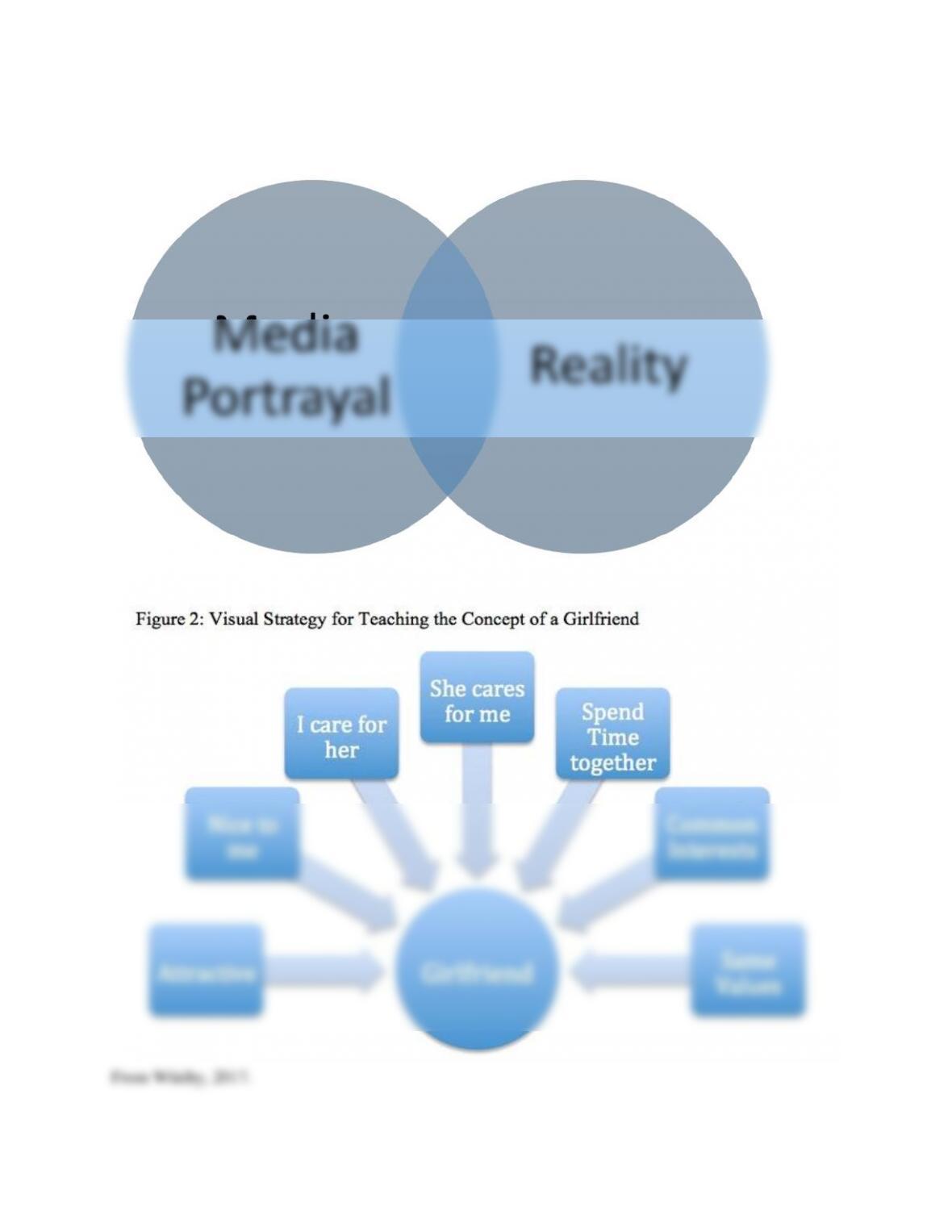
Handout 13.1: Media Review Venn Diagram (Similarities and Differences)
Handout 13.2: Example Graphic Organizer 1